Celestron Astromaster 130 Eq Motor Drive Telescope Review: Editorial Verdict
The Celestron AstroMaster 130 EQ pairs a fast 130mm Newtonian reflector with a motorized equatorial mount. It delivers impressive deep-sky views while demanding careful mechanical balancing during nightly setup routines.

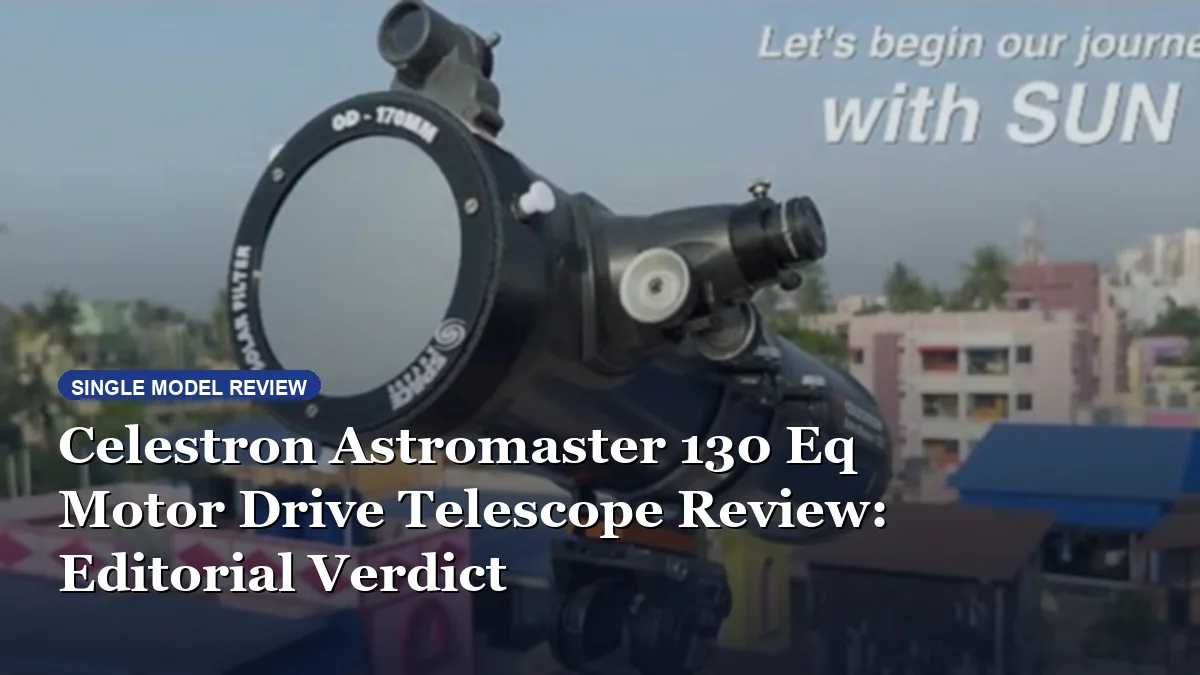

This optical tube offers exceptional light-gathering value for beginners. However, its mechanical stability requires patience, making it ideal for dedicated hobbyists willing to master manual polar alignment and tracking.
Explore related alternatives in our Best Celestron Telescope For Beginners.
Verified Specifications
| Category / Type | Newtonian Reflector |
|---|---|
| Rated Output / Capacity | 130mm Aperture |
| Power / Motor | Optional RA Motor Drive |
| Build & Materials | Aluminum Optical Tube |
| Operating Noise | Low-decibel DC motor whine |
| Duty Cycle / Runtime | Alkaline battery powered |
| Dimensions & Weight | 21.7 inch optical tube |
| Key Safety & Controls | Manual slow-motion cables |
What We Liked
- Generous 130mm light-gathering primary mirror
- Included equatorial mount for tracking
- Sturdy steel tripod legs provide stability
- Comprehensive beginner accessory bundle
Trade-Offs
- Equatorial mount steep learning curve
- Plastic gear components in motor drive
- Collimation required for optimal optics
Optical Architecture and Mechanical Design
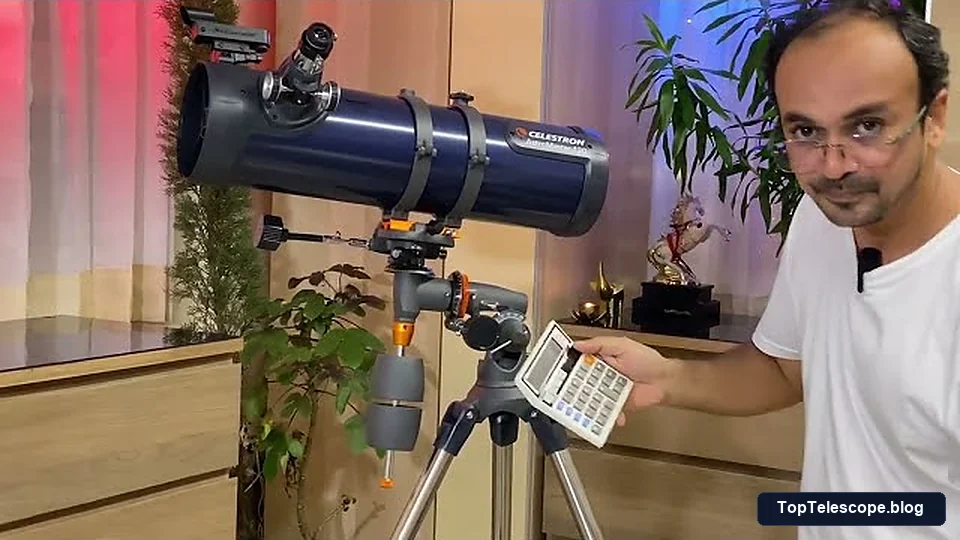
The 130mm parabolic mirror collects substantial light for detailed lunar and planetary observation. Its fast focal ratio provides wide visual fields, though it demands precise collimation to maintain high-power sharpness.
Constructed from lightweight aluminum, this best budget Celestron telescope handles thermal shifts reasonably well. Internal baffling successfully minimizes stray light reflections, enhancing contrast when viewing faint nebulae and distant star clusters.
The 130mm aperture Newtonian reflector features a parabolic primary mirror designed to eliminate spherical aberration effectively. This yields sharp high-contrast images across a 650mm focal length optical system.
Mechanical integrity relies heavily on the steel tube assembly mounted securely onto an equatorial mount. Users must check tube ring alignment periodically to prevent mechanical shift during rigorous field transport.
- 130mm aperture reflector
- Aluminum optical tube
- Fast focal length optics
Tube Assembly and Mounting Interface
Dovetail mounting bars allow rapid attachment to the equatorial head. Balancing the heavy tube along both axes prevents excessive strain on the internal worm gears during tracking sessions.
- Vixen-style dovetail bar
- Counterweight balancing system
Focus Assembly Mechanics
The rack and pinion focuser accepts 1.25-inch eyepieces with standard threading for filters. Tension adjustment screws let observers eliminate image shift during planetary magnification sessions.
Real-World Output and Visual Performance
When shopping for the best Celestron telescope under $500, the primary mirror resolves brilliant details in Messier objects. Bright targets like the Orion Nebula reveal complex gaseous structures, showing distinct planetary cloud bands.
High magnification views using short focal length eyepieces highlight atmospheric turbulence limits. Users must balance magnification against image brightness to maintain optimal clarity during planetary observation sessions.
Planetary viewing reveals crisp cloud belts on Jupiter and the Cassini Division around Saturn when using quality optics. Optimal magnifications sit around 100x to 130x under steady atmospheric seeing conditions.
Deep-sky performance leverages the fast f/5 focal ratio to deliver wide luminous fields. Fainter nebulae and star clusters appear distinct under truly dark rural observing sites away from city glow.
- Resolves Andromeda galaxy arms
- Shows Saturn ring divisions
- Clear lunar crater walls
Eyepiece Pairing and Field of View
The included twenty-millimeter eyepiece offers wide-field context for finding targets easily. Swapping to the ten-millimeter variant increases magnification for detailed surface studies of Jupiter and lunar highlands.
- 20mm erect image eyepiece
- 10mm high-power eyepiece
Video Review: What Can You See Through a 130mm Telescope? (Real Views!) | Celestron Astromaster 130EQ
Drive Efficiency, Tracking, and Thermal Behavior
The optional right ascension motor drive automates tracking for extended viewing sessions. Powered by standard batteries, the compact motor maintains steady sidereal rates to keep objects centered.
Thermal acclimation of the large glass mirror requires thirty minutes outdoors. Without proper cooldown time, internal air currents degrade high-magnification clarity significantly during early evening observation windows.
The single-axis motor drive runs on a 9-volt battery providing consistent sidereal tracking rates. Internal gear trains demand careful backlash adjustment to keep lunar targets centered steadily during high-power imaging.
Thermal equilibrium requires approximately 45 minutes for the enclosed mirror to acclimate. Leaving the rear cap removed accelerates cooling and prevents indoor-outdoor temperature differentials from degrading planetary focus.
- RA motor drive tracking
- Standard battery power source
- Thermal stabilization period
Mechanical Noise and Gear Performance
Operating noise remains minimal during quiet nighttime tracking operations. The plastic gear train handles standard loads efficiently, but users should avoid manual clutch forcing to prevent stripping.
- Low motor operating noise
- Delicate gear engagement
Setup Ergonomics and Field Usability
Equatorial mount assembly requires careful leveling and latitude adjustment for proper alignment. Selecting the best Celestron telescope for beginners ensures you master polar alignment smoothly during daylight practice sessions.
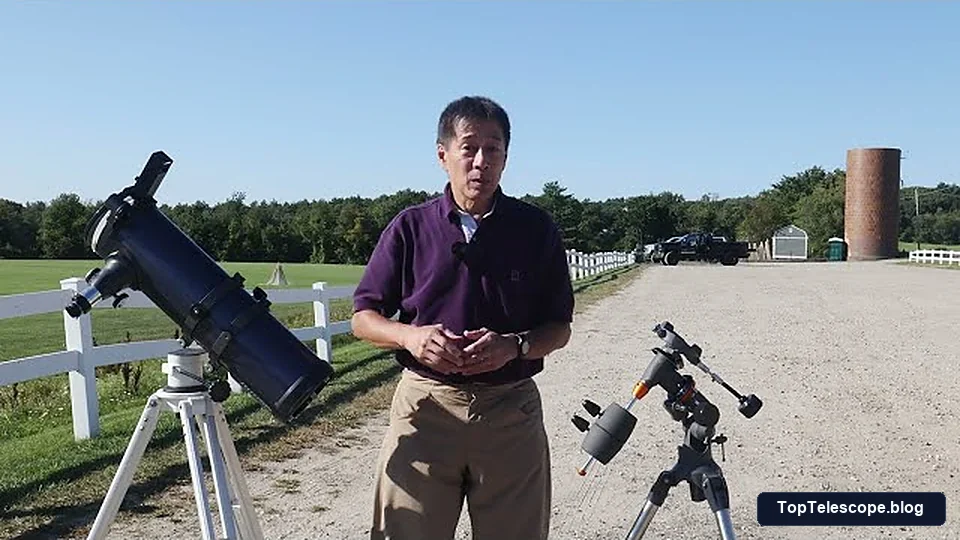
Flexible slow-motion cables enable smooth manual adjustments without touching the telescope tube. This ergonomic feature reduces image vibrations during high-power tracking of fast-moving celestial objects.
Balancing the telescope on the equatorial mount requires careful counterweight positioning along the 1-inch steel shaft. Proper equilibrium protects internal gears from premature wear during extended viewing sessions.
Polar alignment is achieved using the latitude adjustment screw and a basic compass setup. Beginners should practice altitude adjustments indoors before transporting equipment to remote dark-sky observing locations.
- Adjustable steel tripod legs
- Flexible slow-motion cables
- Red dot finder scope
Portability and Field Transport
Total system weight distributes across separate tripod and optical tube components. This modular breakdown simplifies transport to dark sky sites for weekend camping or backyard astronomy sessions.
- Modular transport design
- Lightweight tripod assembly
Maintenance, Collimation, and Long-Term Durability
Newtonian reflectors require periodic mirror alignment checks using a simple collimation cap. Maintaining optical alignment ensures pinpoint star images and prevents performance degradation over prolonged usage cycles.
Dust accumulation on the open tube mirror demands careful cleaning using specialized optical solutions. Protective dust covers prevent environmental contamination when storing the equipment between active viewing nights.
Collimation of the Newtonian optics relies on adjusting three spring-loaded thumbscrews behind the primary mirror. Using a laser collimator ensures optical axes align precisely for maximum image sharpness.
Dust accumulation on optical surfaces should be removed using a bulb blower rather than wiping. Regular mechanical inspections prevent loose mounting bolts from compromising structural rigidity over years of use.
- Periodic mirror collimation
- Dust cover protection
- Specialized cleaning required
Hardware Inspection and Fastener Care
Regular checks of tripod mounting screws prevent loosening during transport. Tightening mechanical fasteners maintains structural rigidity and protects sensitive optical components from accidental alignment shifts.
- Mounting screw checks
- Rigidity maintenance
Definitive Buyer Suitability and Recommendations
This motorized reflector suits enthusiastic beginners willing to conquer an equatorial mount's learning curve. Casual observers seeking instant setup might prefer simpler alt-azimuth systems instead.
Advanced astrophotographers will eventually outgrow the basic mechanical tracking precision. However, visual astronomers gain exceptional aperture value and rewarding deep-sky performance for modest financial investment.
Choosing the best Celestron telescope for astrophotography suits intermediate hobbyists willing to learn equatorial tracking mechanics. Casual observers seeking instant grab-and-go setups might find this equatorial workflow demanding.
Upgrading standard eyepieces and adding a sturdy power supply significantly enhances long-term satisfaction. Careful adherence to operational maintenance guarantees decades of reliable astronomical exploration and planetary discovery.
- Best for dedicated beginners
- Value-focused aperture
- Not for advanced astrophotography
Final Purchasing Verdict
Careful evaluation reveals a capable instrument for dedicated hobbyists. Appreciating its optical strength requires patience with the mechanical setup procedures.
- Strong optics for price
- Requires setup patience
Frequently Asked Questions
Does this telescope require complex assembly before every single viewing session?
Initial assembly takes about thirty minutes using basic tools. Subsequent field setups are much faster because the optical tube easily clamps onto the pre-aligned equatorial tripod base.
Can I use this motorized setup for serious astrophotography work?
The included equatorial motor tracks well for visual use. However, its basic mechanical precision lacks the sidereal accuracy needed for long-exposure deep-sky astrophotography imaging applications.
How often must I adjust or collimate the primary mirror optics?
Collimation checks are recommended before every transport or extended viewing session. Bumping the tube during transit can shift mirror alignment, degrading high-power image sharpness significantly.
What kind of power source is required for the motor drive?
The RA motor drive runs efficiently on standard household batteries. Users should always carry spare cells to prevent power loss during long cold-weather astronomy sessions.
Is this telescope suitable for complete astronomy novices to operate?
Dedicated beginners will succeed if they study equatorial mount mechanics beforehand. Casual users wanting instant grab-and-go simplicity might find polar alignment steps somewhat challenging initially.