Celestron AstroMaster 130 EQ MD Review: Performance Breakdown
This Newtonian reflector combines manual mechanics with an included motor drive. It offers decent aperture while demanding careful polar alignment for optimal tracking.

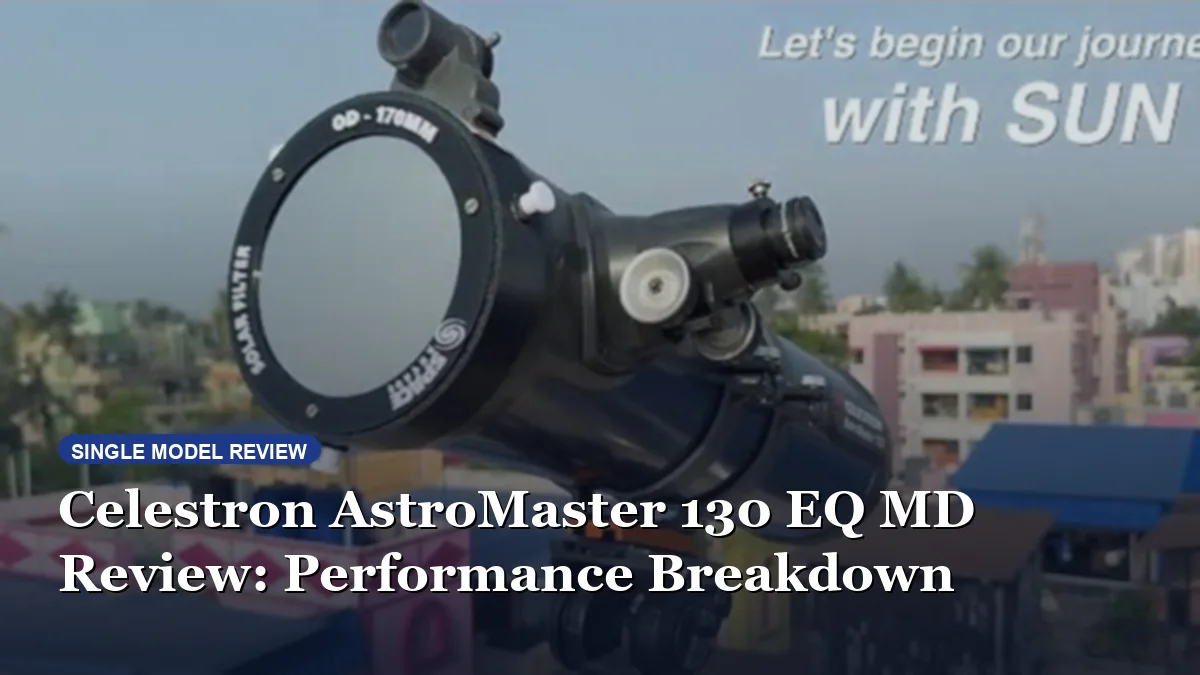

The Celestron AstroMaster 130 EQ MD delivers solid light-gathering power for beginners. However, its equatorial mount requires patience and precise balancing during extended viewing sessions.
See our flagship Best Telescope: Top Backyard Picks for Astronomy.
Verified Specifications
| Category / Type | Newtonian Reflector |
|---|---|
| Rated Output / Capacity | 130mm Aperture |
| Power / Motor | 9V Right Ascension Motor Drive |
| Build & Materials | Aluminum Optical Tube & Steel Tripod |
| Operating Noise | Low-noise DC Motor Gearbox |
| Duty Cycle / Runtime | Variable based on 9V battery capacity |
| Dimensions & Weight | 12.7 kg total assembled weight |
| Key Safety & Controls | CG-3 Equatorial Mount with Slow-Motion Cables |
What We Liked
- Generous 130mm aperture for bright deep-sky views
- Includes right ascension motor drive for hands-free tracking
- Sturdy adjustable steel tripod reduces operational vibrations
- Tool-free setup simplifies field assembly for beginners
Trade-Offs
- Equatorial mount requires learning polar alignment procedures
- Battery-powered motor lacks rechargeable internal power pack
- Bulkier optical tube demands careful storage and transport
Optical Tube Assembly And Engineering Design
The 130mm aperture optical tube utilizes a parabolic mirror to minimize spherical aberration. This design captures significantly more light than smaller beginner instruments, rendering faint deep-sky nebulae and lunar details clearly.
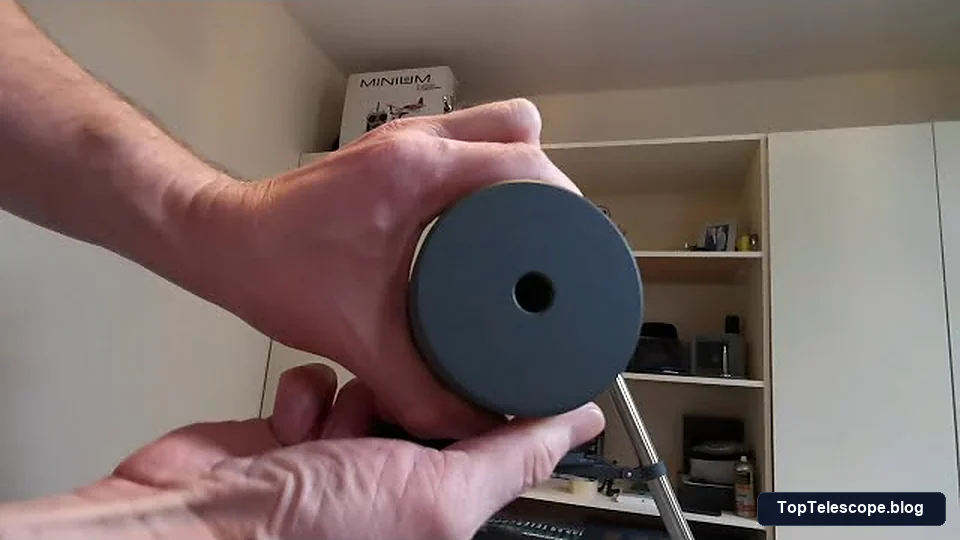
Aluminum coatings on primary mirrors enhance high reflectivity, much like optical systems analyzed in our celestron nexstar 6se vs 8se comparison. A sturdy steel tube holds collimation reliably.
The 130mm parabolic primary mirror corrects spherical aberration effectively, delivering sharper focal points than standard spherical variants. Its 650mm focal length yields a fast f/5 optical system suited for wide-field celestial viewing.
Constructed from rolled steel, the optical tube assembly maintains structural rigidity across varying ambient temperatures. Internal matte black baffling suppresses stray light reflections, maximizing contrast when observing faint deep-sky nebulae and lunar details.
- 130mm primary mirror diameter
- 650mm focal length (f/5)
- Aluminum reflective coatings
Focal Ratio and Magnification Dynamics
Operating at an f/5 focal ratio, this Newtonian reflector provides wide, bright field views. You can easily pair it with various eyepieces to achieve high magnification for planetary observation without losing too much light.
Lower focal lengths demand precise collimation to maintain sharp focus at higher powers. Using a laser collimator before each session ensures your optical train remains properly aligned for optimal contrast and star resolution.
- Fast f/5 optical system
- Compatible with standard 1.25-inch eyepieces
Equatorial Mount And Mechanical Tracking
The CG-3 equatorial mount features slow-motion cables for smooth manual adjustments. Setup procedures closely mirror instructions detailed inside our celestron starsense explorer lt guide for alignment.
Sturdy steel tripod legs provide a stable foundation, reducing vibrations during focusing adjustments. Heavier counterweights balance the optical tube assembly, ensuring the gears engage correctly without straining the manual slow-motion control cables.
The CG-3 equatorial mount utilizes aluminum setting circles and manual slow-motion cables for precise celestial coordinate navigation. Proper polar alignment requires leveling the heavy-duty tripod and adjusting the latitude bolt for local latitude angles.
Mechanical backlash in the gear system demands careful counterweight balancing along both axes to reduce stress. Securing the locking thumb screws firmly prevents slippage during extended observation sessions under variable outdoor wind conditions.
- CG-3 equatorial mount design
- Dual slow-motion cables
- Adjustable steel tripod legs
Video Review: What Can You See Through a 130mm Telescope? (Real Views!) | Celestron Astromaster 130EQ
Motor Drive Integration And Tracking Efficiency
The included motor drive attaches directly to the right ascension axis. It automatically compensates for Earth's rotation, keeping celestial targets centered in your eyepiece during long-exposure viewing or extended planetary observation sessions.
Powered by a standard nine-volt battery, the internal motor operates quietly with minimal mechanical vibration. Battery life varies depending on ambient temperatures, so keeping a spare power source in your field kit remains essential.
Integrating the single-axis motor drive onto the right ascension axis automates sidereal tracking for prolonged high-magnification targets. Powered by a standard 9V battery, the electronic system compensates for Earth's rotation seamlessly.
Users must manually adjust the clutch tension ring to engage or disengage the motor drive gear train smoothly. Fine-tuning the motor speed potentiometer eliminates drift, keeping planets centered in the eyepiece field of view.
- Right ascension motor drive
- Nine-volt battery operation
- Adjustable tracking speeds
Field Setup Ergonomics And Usability
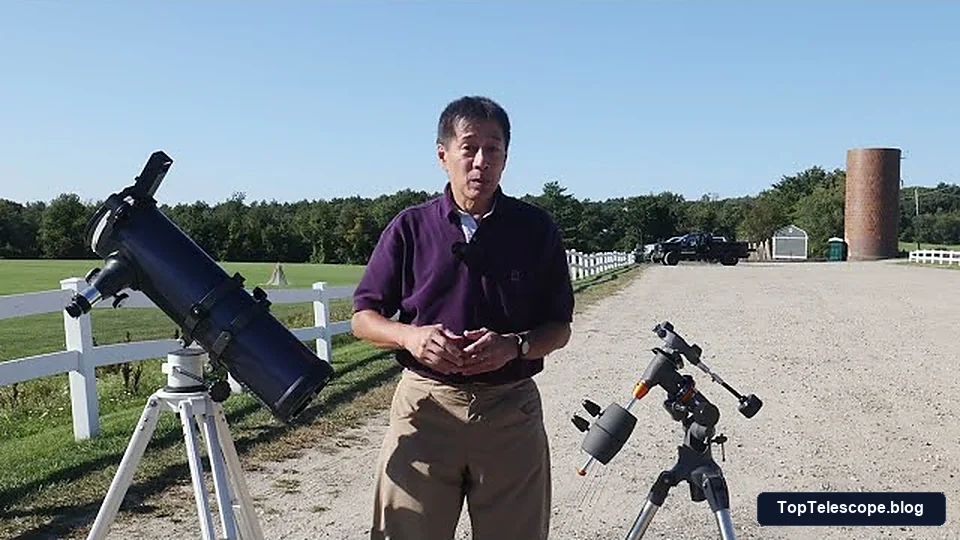
Assembling the mount and tripod requires no specialized tools, a key advantage when choosing the best celestron telescope for beginners. Physical setup takes roughly fifteen minutes before stargazing.
The red dot finder scope simplifies initial target acquisition by projecting an unmagnified LED dot. Aligning this finder during daylight hours saves immense frustration once darkness falls and you begin searching for faint stars.
Transporting the complete assembly requires detaching the optical tube from the mount head to prevent accidental chassis impacts. The adjustable aluminum tripod collapses quickly, fitting easily into standard vehicle trunks for remote dark-sky excursions.
Ergonomic accessory trays lock the tripod legs firmly into place, suppressing high-frequency vibrations during focusing adjustments. Operating the slow-motion cables in cold weather remains manageable thanks to knurled aluminum knobs designed for gloved hands.
- Tool-free tripod assembly
- Red dot LED finder
- Captive hand-tightening bolts
Optical Performance And Real-World Output
Viewing Jupiter reveals cloud belts and the four Galilean moons with distinct clarity. Saturn displays its prominent ring system clearly, while lunar craters show sharp shadows along the terminator line during waxing phases.
Faint deep-sky objects like the Orion Nebula appear as glowing wisps under dark rural skies. Light pollution in urban environments will significantly reduce contrast, requiring nebula filters or darker viewing locations for optimal results.
Planetary observations benefit from pairing the system with a 2x Barlow lens to double effective magnification without sacrificing exit pupil clarity. Saturn's rings and Jupiter's cloud belts reveal distinct tonal contrasts under steady atmospheric seeing conditions.
Wide-field eyepieces reveal sprawling star clusters and bright galaxies with acceptable peripheral sharpness across the Newtonian optical train. Coma aberrations become marginally noticeable at extreme outer edges when utilizing ultra-wide eyepieces exceeding 70-degree apparent fields.
- Clear planetary surface details
- Deep-sky nebula visibility
- Contrast affected by light pollution
Maintenance, Collimation And Durability
Newtonian reflectors require periodic mirror collimation to maintain peak optical performance. Adjustment screws on the rear cell make this alignment process straightforward once you master using a simple Cheshire eyepiece or laser tool.
Transporting the telescope in a padded case protects the aluminum tube from dents. Proper housing matters just as much when selecting the best celestron telescope for astrophotography to protect optics.
Maintaining peak optical performance requires periodic mirror collimation using a standard Cheshire eyepiece or laser tool to align optical axes. The primary mirror cell features accessible adjustment screws protected by a secure rear cover plate.
Regular cleaning of exposed glass surfaces should involve optical microfiber cloths and specialized fluid to prevent micro-scratching the delicate aluminum coatings. Storing components in dry environments prevents interior dust accumulation and mechanical corrosion over time.
- Periodic mirror collimation required
- Rear cell adjustment screws
- Protective dust cap maintenance
Comparative Value And Target Audience
This telescope bridges the gap between basic beginner refractors and advanced computerized GoTo systems. The motorized equatorial mount teaches foundational astronomy mechanics without overwhelming novices with complex digital controller alignment procedures.
Experienced observers might find the aperture limiting for advanced astrophotography or faint DSO imaging. However, casual hobbyists seeking an engaging, hands-on tracking experience will appreciate the balance of performance and mechanical simplicity.
Intermediate astronomy enthusiasts seeking a hands-on learning platform will appreciate the mechanical intricacies of this equatorial tracking setup. Mastering manual coordinate setting bridges the transition toward advanced astrophotography and deep-sky exploration workflows.
Compared to altazimuth beginner scopes, this package offers superior aperture-to-cost ratios paired with motorized tracking convenience for extended viewing. Budget-conscious hobbyists gain a capable optical instrument built for rigorous field observation and skill development.
- Motorized equatorial learning tool
- Balanced performance for hobbyists
- Not ideal for deep astrophotography
Frequently Asked Questions
Does the motor drive require external power?
The right ascension motor drive operates using a standard nine-volt battery inserted directly into the housing. You should always carry a fresh spare battery during cold weather observing sessions to prevent unexpected power loss.
How difficult is polar alignment for beginners?
Polar alignment requires pointing the polar axis roughly toward Polaris if you observe from the Northern Hemisphere. Beginners may need a few practice sessions to achieve accurate tracking without noticeable drift in the eyepiece.
Can I use this telescope for astrophotography?
This setup works well for basic lunar and planetary snapshots using a smartphone adapter. However, the manual equatorial mount lacks the precision required for long-exposure deep-sky astrophotography with heavy DSLR camera rigs.
How often should I collimate the mirrors?
You should check mirror alignment whenever you transport the telescope to a new viewing location. Frequent users typically perform minor collimation tweaks every few weeks to maintain optimal sharpness and image contrast.
What eyepieces are included in the package?
The standard bundle typically includes two 1.25-inch eyepieces, usually a twenty millimeter for wide views and a ten millimeter for higher magnification. These accessories provide a solid starting point for exploring varied celestial objects.