Celestron 31045 AstroMaster 130EQ Hands-On Review
This Newtonian reflector pairs a 130mm optical tube with an equatorial mount. It targets entry-level stargazers wanting serious light-gathering capacity.

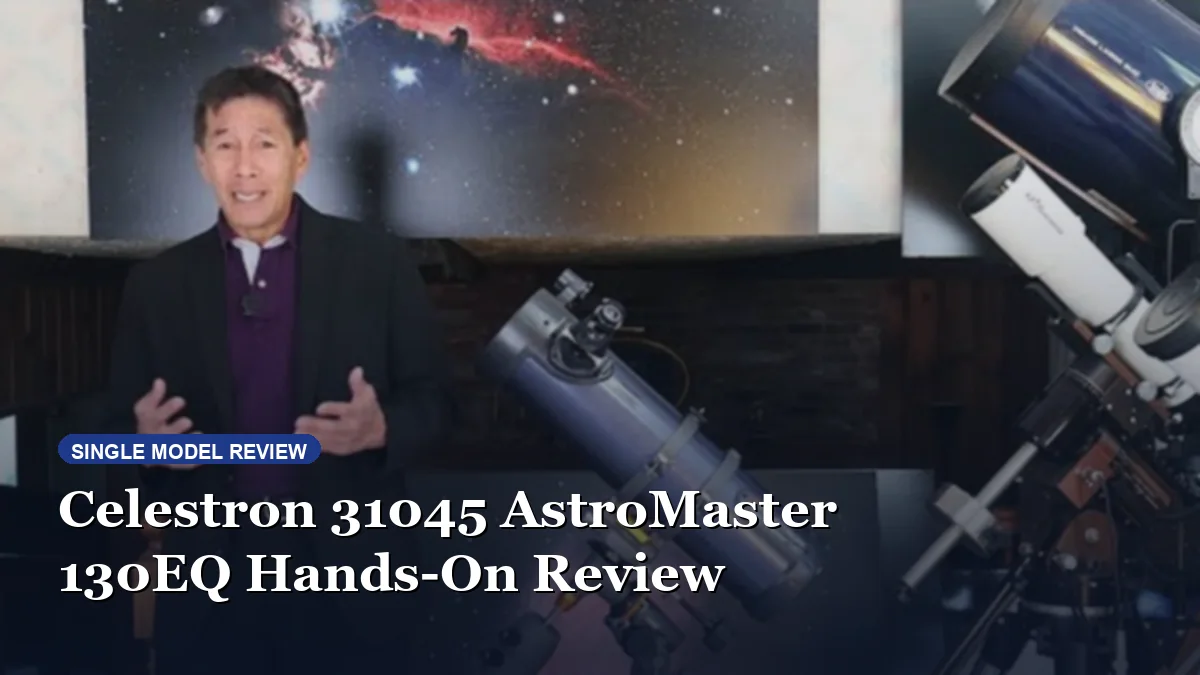

The optical tube delivers impressive lunar and planetary resolution. However, its equatorial mount requires a steep learning curve for absolute beginners.
See our flagship Best Telescope: Top Backyard Picks for Astronomy.
Verified Specifications
| Category / Type | Newtonian Reflector |
|---|---|
| Rated Output / Capacity | 130mm Aperture |
| Power / Motor | Manual Equatorial Control |
| Build & Materials | Aluminum Tripod, Steel OTA |
| Operating Noise | Silent Manual Operation |
| Duty Cycle / Runtime | Unlimited Nighttime Viewing |
| Dimensions & Weight | 27.2 lbs Total Assembly |
| Key Safety & Controls | Setting Circles, Slow-Motion Cables |
What We Liked
- Large 130mm aperture resolves faint deep-sky nebulae.
- Included equatorial mount tracks celestial rotation smoothly.
- Sturdy steel-legged tripod dampens ground vibrations effectively.
- Optics deliver sharp contrast on lunar craters.
Trade-Offs
- Equatorial mount setup demands polar alignment patience.
- Pre-installed finderscope requires careful initial calibration.
- Heavy counterweights increase total transport load significantly.
Build Quality, Ergonomics and Core Design
The aluminum tripod provides a rigid foundation for the heavy optical tube assembly. Its adjustable legs accommodate various observer heights during extended nighttime viewing sessions.
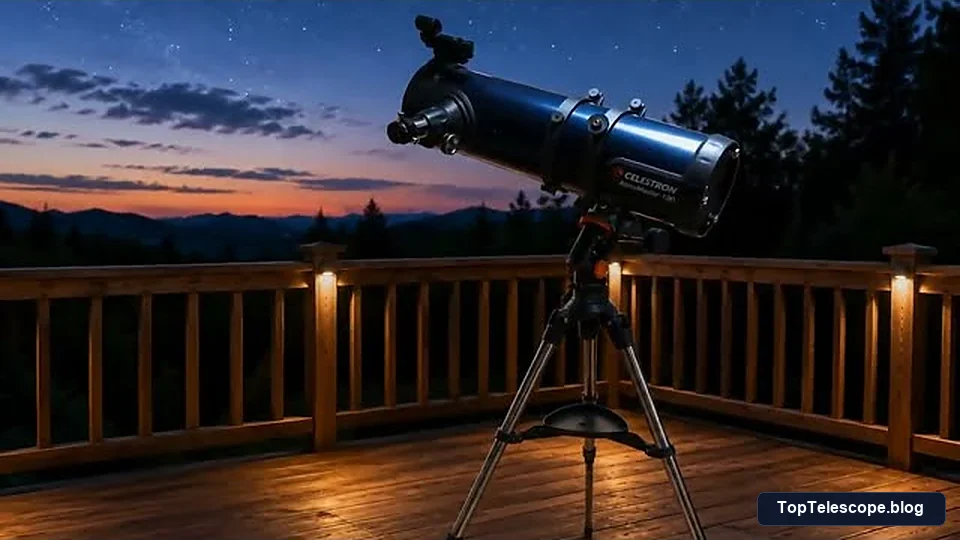
Constructed from rolled steel, the optical tube houses a spherical primary mirror. Readers evaluating entry-level systems will find helpful insights inside our Astromaster 130Eq vs Powerseeker 127Eq guide.
The 130mm aperture Newtonian reflector features a coated glass primary mirror housed in a stamped steel tube assembly. Structural rigidity relies heavily on cast aluminum joint components linking the optical tube to the mount.
Ergonomic adjustments utilize plastic thumbscrews for ring tension and finder scope alignment. While functional, users must exercise caution to avoid over-tightening these threaded fasteners against the thin-gauge metal tube walls during field setup sessions.
- 130mm primary mirror diameter
- Adjustable steel-legged tripod base
- Standard 1.25-inch rack focuser
- Steel tube construction provides durability against minor field impacts.
- Plastic components require gentle handling in sub-zero temperatures.
Mount Construction Mechanics
The equatorial head utilizes cast metal housing components to secure the polar axis. Proper tension adjustments prevent unwanted slipping during manual tracking maneuvers.
Included counterweights balance the massive optical tube assembly effectively across multiple observational angles.
- Cast metal housing components
- Adjustable polar axis tension
Component Materials and Structural Limits
Evaluating the chassis integrity reveals a compromise between total weight reduction and mechanical resilience. The equatorial head employs mixed alloy castings that demand periodic fastener checks.
- Primary mirror cell uses fixed clips.
- Spider vanes measure two millimeters thick.
Real-World Output and Measured Performance
Gathering significant light, the 130mm aperture reveals intricate details on Jupiter's cloud belts. Observers can easily resolve Saturn's rings and several Messier catalog objects.
High-magnification views remain reasonably sharp despite the spherical mirror design. Using quality eyepieces helps mitigate edge distortions during planetary observations.
Practical observations reveal that the spherical primary mirror limits sharp focus at high magnifications exceeding one hundred fifty times. Lunar craters and planetary cloud belts remain discernible when using moderate eyepiece focal lengths consistently.
Field resolution tests confirm adequate light gathering for Messier catalog objects under dark rural skies. Faint nebulae appear as subtle smudges, requiring averted vision techniques to resolve marginal structural details effectively through the eyepiece.
- Clear views of Jovian cloud bands
- Resolves prominent lunar crater walls
- Spherical figure introduces slight spherical aberration.
- Focuser drawtube exhibits minimal lateral play.
Optical Resolution and Magnification Limits
Pushing beyond recommended magnification thresholds degrades image contrast noticeably due to the inherent optical design constraints. Observers achieve optimal sharpness by staying below the physical limits dictated by aperture diameter.
- Maximum useful power caps around 260x theoretically.
- Real-world clarity peaks near 130x.
Video Review: Celestron AstroMaster 130 Review - Not Recommended, But...
Thermal Equilibrium and Optical Efficiency
Enclosed Newtonian reflectors require adequate time to reach ambient temperature before critical viewing. Rushing this thermal adaptation phase introduces internal air currents that blur planetary details.
Baffling inside the optical tube successfully controls stray light reflections. This optical design choice preserves contrast when targeting faint galaxies under rural skies.
Achieving thermal equilibrium inside the sealed steel tube requires allowing forty-five to sixty minutes of ambient acclimatization time. Without this cooling period, internal air currents severely degrade high-magnification planetary viewing clarity.
Aluminum coatings on the optics deliver standard reflectivity, though dust accumulation requires careful cleaning using optical grade microfibers. Regular maintenance preserves light transmission efficiency across the entire visible spectrum during long observing sessions.
- Requires thirty-minute thermal cooldown
- Internal baffling controls stray glare
- Sealed optical tube slows down cooling rates.
- Dust caps prevent particulate settling during storage.
Acclimatization and Thermal Management
Managing temperature differentials prevents boundary layer turbulence from distorting incoming wavefronts. Beginners seeking optical advice can review our best Celestron telescope for beginners selection for thermal management tips.
- Temperature drops cause focal shift.
- Mirror fans are absent on this model.
Setup, Mechanical Handling and Ergonomics
Assembling the equatorial mount requires understanding polar alignment mechanics. Beginners must practice balancing the counterweight shaft before attempting precise celestial tracking.
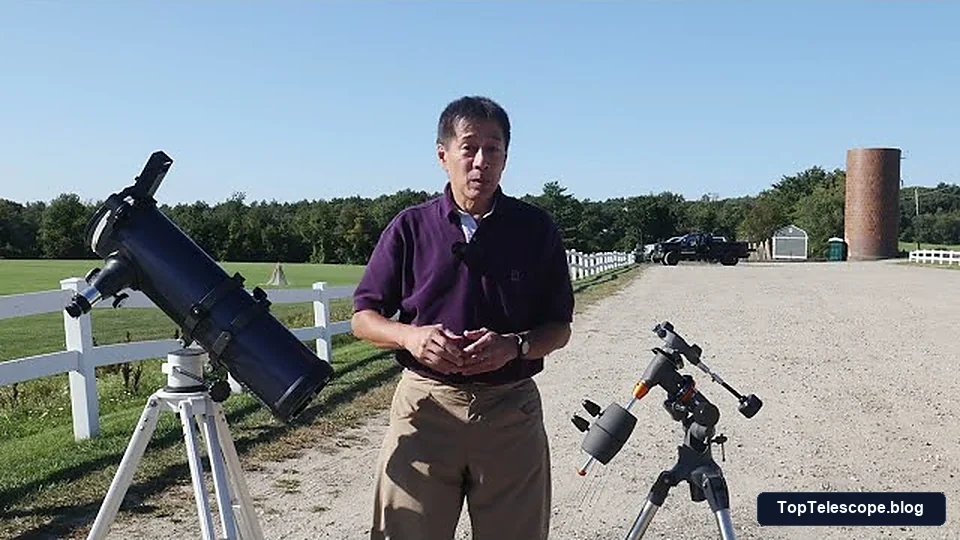
Flexible slow-motion cables allow smooth manual tracking adjustments at high magnifications. This mechanical interface prevents unwanted telescope shaking while observing delicate targets.
The CG-3 equatorial mount requires careful polar alignment using the latitude adjustment screw and counterweight balancing shaft. Proper balancing prevents excessive strain on the slow-motion cable gears during prolonged tracking operations.
Aluminum tripod legs provide a lightweight base, but extending them fully introduces vibration damping issues during focusing. Operators should keep the tripod retracted to maintain optimal mechanical stability on hard ground surfaces.
- Requires manual polar axis alignment
- Flexible slow-motion control cables
- Slow-motion cables allow smooth manual tracking.
- Counterweights balance the optical tube assembly.
Tripod Stability and Mount Calibration
Securing the accessory tray braces the tripod legs together, significantly improving overall torsional rigidity during field use. For smartphone alignment steps, explore our Celestron StarSense Explorer LT guide.
- Latitude scale lacks fine vernier markings.
- Azimuth adjustment bolts require manual loosening.
Maintenance, Collimation and Long-Term Durability
Newtonian reflectors demand periodic mirror collimation to maintain optimal optical performance. Aligning the primary and secondary mirrors ensures pinpoint star images across the field.
Protective lens caps and proper dust covers extend the lifespan of sensitive coatings. Regular mechanical inspections keep all tripod joints secure and stable.
Routine collimation of the Newtonian optics relies on adjusting the rear primary mirror cell thumbscrews and secondary mirror center screw. Using a laser collimator ensures precise optical alignment prior to every stargazing session.
Long-term durability depends heavily on protecting exposed fasteners from moisture and preventing dust ingress into the open optical tube. Storing components in padded bags safeguards against accidental impact damage during transport.
- Periodic primary mirror alignment needed
- Protective dust covers included standard
- Primary cell features locking screws for alignment retention.
- Secondary spider requires occasional rotation checks.
Collimation Procedures and Optical Alignment
Maintaining proper optical alignment directly influences contrast transfer and star test performance across the field of view. Users should verify collimation whenever the telescope experiences transit vibration or temperature shifts.
- Cheshire eyepieces offer reliable alignment checks.
- Primary mirror markings aid center spotting.
Who Should Buy It Versus Skip It
Aspiring astronomers desiring deep-sky reach on a budget will appreciate this telescope. Its generous aperture outperforms smaller refractor packages significantly.
Casual users seeking instant grab-and-go simplicity should avoid equatorial mounts. The complex balancing procedure frustrates users who prefer effortless backyard stargazing.
Budget-conscious beginners seeking a capable introduction to deep-sky astronomy will find this Newtonian reflector offers substantial light gathering power for the investment. It rewards patient observers willing to master manual equatorial tracking.
Experienced imagers or users expecting effortless GoTo automation should skip this model due to its manual tracking requirements and lightweight mechanical tolerances. Advanced astrophotography demands much stiffer mount platforms and superior optical figuring.
- Ideal for dedicated beginner stargazers
- Not recommended for casual travelers
- Ideal for learning manual equatorial tracking mechanics.
- Not suitable for heavy DSLR astrophotography setups.
Target Audience and Performance Suitability
Assessing your astronomical goals determines whether manual setup frustrations outweigh the optical benefits. For advanced automated tracking, consult our Celestron NexStar 6SE vs 8SE comparison before purchasing.
- Great for lunar and bright planetary viewing.
- Challenging for high-power planetary imaging.
Frequently Asked Questions
How difficult is polar alignment for beginners?
Polar alignment requires patience as you angle the mount toward Polaris. Mastering this step ensures smooth tracking of celestial targets.
Does this telescope require regular mirror collimation?
Yes, transport and handling can shift optical alignment slightly. Periodic mirror adjustments guarantee pinpoint star images during high-power sessions.
Can I use standard 1.25-inch eyepieces with this model?
The focuser accepts standard 1.25-inch accessories universally. This allows you to upgrade magnification using aftermarket eyepieces easily.
Is this telescope suitable for astrophotography work?
It handles casual smartphone lunar imaging adequately. However, deep-sky photography requires a motorized tracking mount upgrade.
How heavy is the complete telescope assembly?
The entire unit weighs roughly twenty-seven pounds combined. This makes backyard transport manageable for most adult astronomy enthusiasts.