Celestron 31045 AstroMaster 130EQ Reflector Telescope Review
This Newtonian reflector pairs a 130mm optical aperture with a manual equatorial mount. It delivers bright views of deep-sky objects despite challenging setup ergonomics.

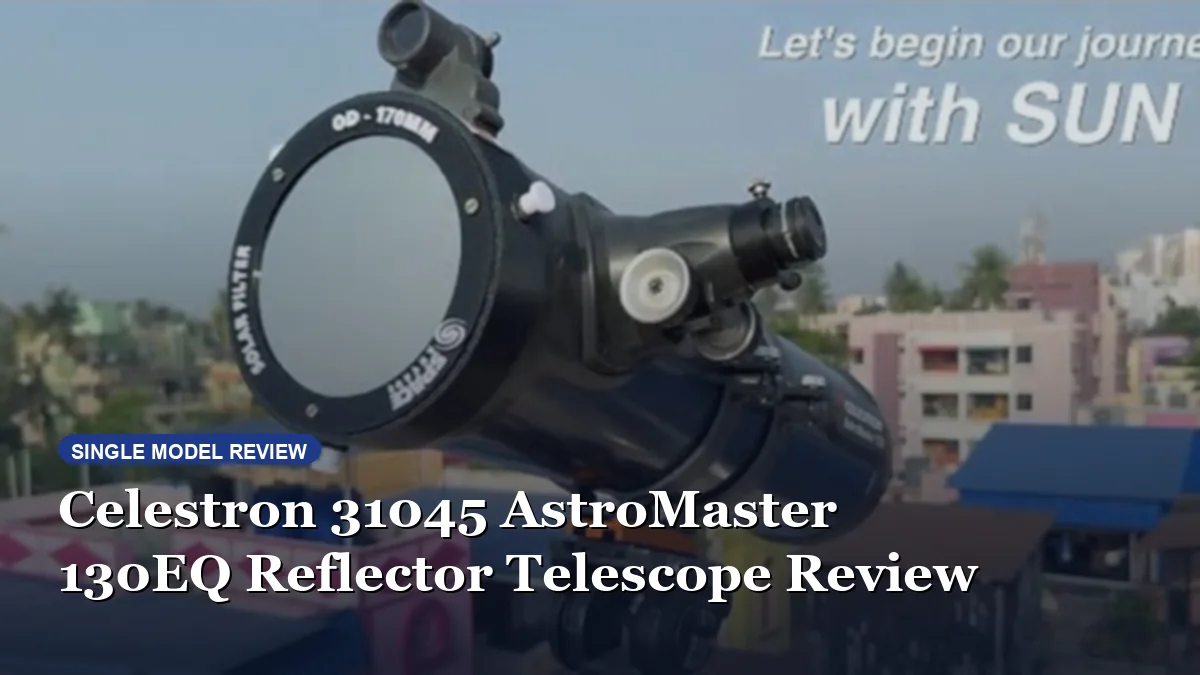

The optical tube provides impressive light grasp for entry-level stargazers. However, the lightweight tripod requires patience during high-magnification tracking.
Explore related alternatives in our Best Celestron Telescope For Beginners.
Verified Specifications
| Category / Type | Newtonian Reflector Telescope |
|---|---|
| Rated Output / Capacity | 130mm Light Gathering Aperture |
| Power / Motor | Manual CG-3 Equatorial Mount |
| Build & Materials | Steel Tube and Tripod Legs |
| Operating Noise | Silent Manual Operation |
| Duty Cycle / Runtime | Unlimited Nighttime Observing |
| Dimensions & Weight | 24 lbs Total Assembled Weight |
| Key Safety & Controls | Slow-Motion Cables and Red Dot Finder |
What We Liked
- Generous 130mm primary mirror aperture gathers ample light for faint nebulae.
- Fast f/5 focal ratio yields wider, brighter visual fields for star clusters.
- Sturdy 1.25-inch steel tube tripod enhances overall dampening stability.
- Includes two standard 1.25-inch eyepieces for immediate nighttime observation.
Trade-Offs
- Equatorial mount learning curve can frustrate absolute beginner astronomers.
- Counterweight system adds significant bulk for transport and field setup.
- Factory red dot finder requires frequent alignment checks before sessions.
Optical Tube Assembly And Mirror Physics
The optical tube houses a parabolic primary mirror measuring 130mm in diameter. This glass surface successfully gathers enough photons to resolve faint galaxies and star clusters under dark skies.
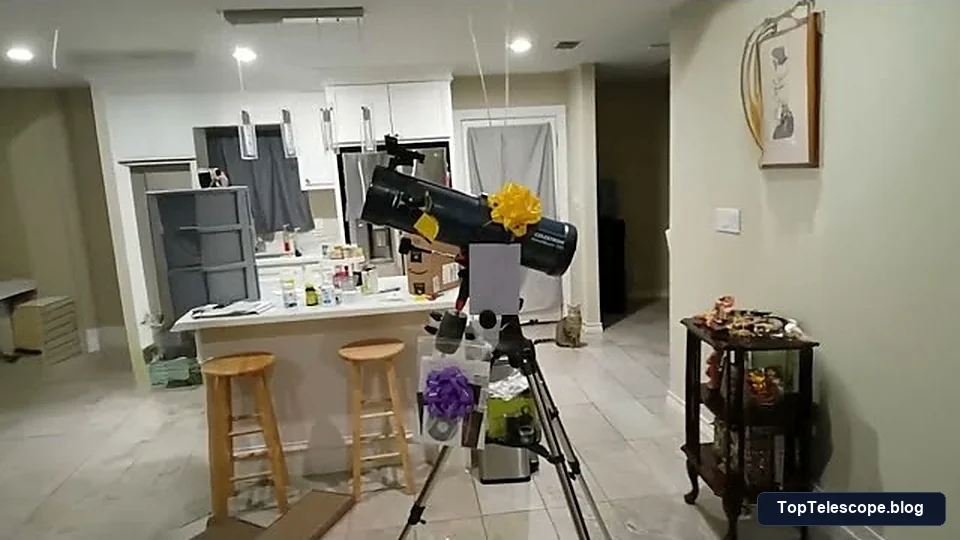
Operating at a fast focal length of 650mm, the system achieves an f/5 focal ratio. This configuration produces wide-field views that make locating extended deep-sky targets much easier for novices.
Steel tube construction protects the internal optical alignment during transport. Users must handle the assembly carefully to prevent structural impacts that could shift the primary mirror cell positioning.
The Celestron AstroMaster 130EQ features a 130mm aperture Newtonian reflector optical tube assembly. When reviewing our refractor vs reflector telescope guide, you can evaluate how this optical design compares to lens systems.
Its primary mirror has a 650mm focal length, resulting in a fast f/5 focal ratio. This optical configuration delivers wide-field views, though users must carefully manage inherent aberrations like peripheral coma during high power observations.
Aluminum coatings applied to the glass substrate optimize light throughput across the visible spectrum. Proper optical alignment remains crucial because fast Newtonian systems demand exact collimation adjustments to maintain sharp stellar pinpoints consistently.
- 130mm aperture mirror
- 650mm focal length
- f/5 optical speed
- Tube dimensions: 24 inches in length by 6 inches in diameter.
- Optical design: Newtonian reflector with aluminized glass mirrors.
Primary Mirror Quality
Precision grinding on the glass substrate minimizes spherical aberration effectively. Light concentrates tightly into the focal plane for sharp contrast during high-power planetary observing sessions.
Aluminum coatings feature protective silicon dioxide overcoats to prevent oxidation. This treatment ensures long-term reflectivity retention under normal outdoor atmospheric exposure conditions.
- Spherical aberration reduction
- Protective silicon dioxide coating
Secondary Mirror Obstructive Physics
The secondary flat mirror uses a four-vane spider assembly measuring 0.5mm in thickness. This minimal mechanical footprint reduces diffraction spikes while ensuring structural rigidity for the optical train during frequent transport cycles.
- Spider vane thickness directly impacts diffraction spike intensity.
- Central obstruction ratio affects overall visual contrast transfer.
Equatorial Mount Mechanics And Tracking Performance
The included CG-3 equatorial mount uses manual setting circles. Exploring our dobsonian vs reflector comparison reveals why equatorial tracking provides distinct advantages for long-exposure astrophotography applications.
Setting up an equatorial mount demands patience from inexperienced users. You must align the polar axis with celestial north to compensate for earth rotation during long-exposure viewing.
Dual setting circles help locate coordinates using star charts. However, backlash in the worm gear mechanisms requires gentle handling to prevent image jitter at high magnifications.
The CG-3 equatorial mount provides manual slow-motion cables for precise tracking along right ascension and declination axes. Proper polar alignment against Polaris helps observers counteract earth rotation during extended viewing sessions with minimal manual intervention.
Aluminum tripod legs offer a stable foundation, though steel leg upgrades significantly dampen mechanical vibrations. Users should balance the counterweight shaft accurately to prevent excessive strain on the internal gear mechanisms during elevation adjustments.
Setting circles allow amateur astronomers to locate celestial coordinates using star charts. Routine maintenance of the worm gears ensures smooth operation across varying ambient temperature ranges encountered during late-night astronomical field operations.
- CG-3 manual equatorial mount
- Dual slow-motion cables
- Sturdy setting circles
- Mount type: CG-3 manual German equatorial design.
- Counterweight mass: 4.8 pounds for dynamic balancing.
Polar Alignment Precision
Accurate polar axis alignment remains critical for tracking objects smoothly. Adjusting latitude bolts correctly prevents drifting during prolonged viewing sessions of faint targets.
Counterweight balancing reduces strain on the internal gear teeth. Proper weight distribution ensures smooth rotation along both right ascension and declination axes.
- Latitude adjustment bolts
- Counterweight balancing
Gear Play And Backlash Management
Mechanical backlash in the worm gear assemblies requires careful tensioning. Adjusting the meshing screws eliminates excessive slop, ensuring immediate responsiveness during manual tracking adjustments at high magnification power settings.
- Check worm gear mesh periodically to prevent excessive slop.
- Grease internal tracks using low-temperature synthetic lubricants.
Video Review: What Can You See Through a 130mm Telescope? (Real Views!) | Celestron Astromaster 130EQ
Field Setup, Ergonomics, And Portability Factors
Preassembled steel tripod legs provide a rigid foundation for the optical tube. The heavy-duty accessory tray locks the legs securely in place while storing extra eyepieces.
Total assembled weight reaches approximately twenty-four pounds with counterweights attached. Transporting the apparatus to dark-sky sites requires breaking down the counterweight shaft and optical tube separately.
Ergonomic positioning of the focuser requires rotating the optical tube occasionally. Ensuring proper ring tension prevents accidental slippage while adjusting focus on overhead celestial targets.
Transporting the AstroMaster 130EQ into dark sky locations requires breaking down the optical tube, mount, and tripod. Total assembled weight reaches approximately 27 pounds, making it manageable for most adults during short walks.
Ergonomic placement of focus knobs requires comfortable hand positioning during delicate focusing tasks. The rack-and-pinion focuser accepts 1.25-inch accessories, allowing seamless integration of standard filters and eyepieces without requiring specialized adapter sleeves.
Setting up on level ground prevents unnecessary tracking drift during polar alignment procedures. Using a red flashlight during assembly preserves night-adapted vision while securing thumb screws on the accessory tray and tripod spreader.
- Steel tripod foundation
- Accessory spreader tray
- Modular component transport
- Total weight: 27 pounds fully assembled for field use.
- Focuser size: Standard 1.25-inch rack-and-pinion mechanism.
Transport And Assembly
Modular design allows quick separation of the optical tube from the mount. This breakdown capability simplifies loading the gear into standard passenger vehicle trunks.
Quick-release hardware minimizes tools required for field assembly. Sturdy thumbscrews secure major components firmly without stripping threads during repeated setup procedures.
- Modular component separation
- Tool-free thumbscrews
Tripod Spreader Plate Ergonomics
The central accessory tray locks the tripod legs into rigid alignment. Tightening the central knob pulls the spreader upward, eliminating lateral play and providing convenient slots to store spare eyepiece lenses safely.
- Spreader plate structural tension eliminates tripod leg wobble.
- Always hand-tighten the central locking bolt securely.
Visual Output Quality Across Lunar And Deep Sky Targets
Lunar observation reveals crisp crater rims along the lunar terminator line. High-contrast views remain sharp when utilizing neutral density filters to mitigate bright surface glare.
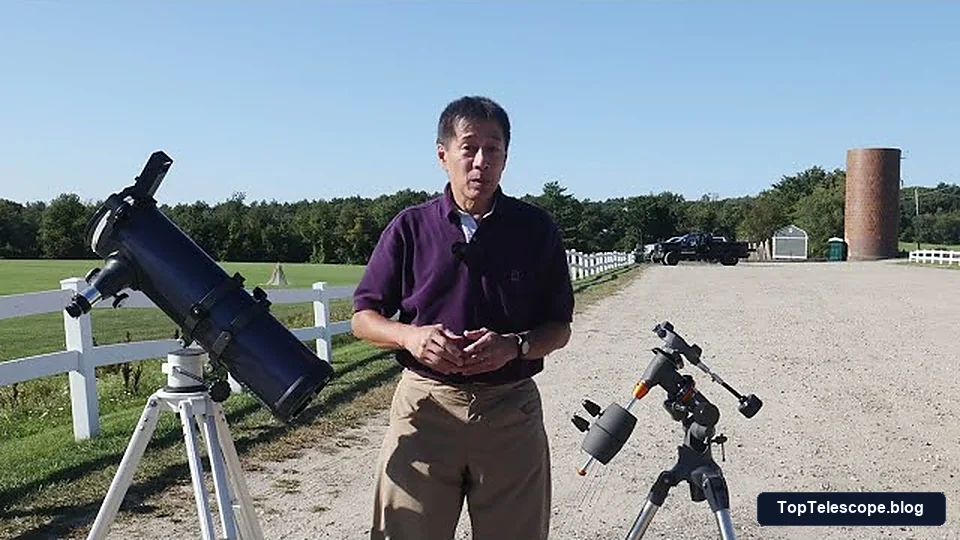
Planetary details like Saturn rings and Jupiter cloud belts emerge clearly. The 130mm aperture resolves the four Galilean moons easily under stable atmospheric seeing conditions.
Deep-sky performance shines when targeting bright Messier objects like the Orion Nebula. Faint dust lanes and stellar nurseries become visible away from urban light pollution sources.
Lunar observations reveal sharp crater rims, rilles, and mountain ranges when using moderate magnification eyepieces. The 130mm light grasp resolves subtle contrast variations across maria plains without severe chromatic aberration inherent in refractors.
Deep sky performance depends heavily on local sky darkness and transparency conditions. Brighter Messier objects like the Orion Nebula display mottled gas clouds, while globular clusters show distinct stellar resolution at their outer edges.
Planetary targets such as Jupiter and Saturn display major cloud belts and planetary rings under steady atmospheric seeing. High-magnification planetary viewing requires patience to let thermal currents dissipate inside the optical tube assembly.
- Sharp lunar crater contrast
- Clear planetary cloud bands
- Detailed deep-sky nebulosity
- Lunar detail: Sharp crater walls and rille networks visible.
- Deep sky reach: Capable of detecting prominent Messier catalog objects.
Planetary Resolution Limits
Higher magnification reveals subtle atmospheric banding on gas giant planets. Seeing conditions heavily dictate whether maximum usable magnification can be successfully achieved.
Thermal acclimatization of the primary mirror prevents internal tube currents. Allowing thirty minutes of cooling time guarantees optimal high-power planetary image resolution.
- Atmospheric seeing limits
- Thermal mirror acclimatization
Atmospheric Seeing And Magnification Limits
Maximum useful magnification reaches approximately 260x under ideal conditions. Exceeding this optical limit results in dim, blurred images because atmospheric turbulence and mirror physics restrict further detail enhancement.
- Atmospheric turbulence dictates practical nightly magnification limits.
- Start with low-power eyepieces before stepping up magnification.
Collimation Maintenance And Mechanical Durability
Newtonian reflectors require periodic mirror collimation to maintain performance. Following our reflector telescope collimation guide helps users align optical axes safely using a standard laser tool.
Factory-installed components withstand normal transport vibrations remarkably well. Regular inspection of thumb screws and mounting brackets prevents unexpected hardware loosening during field deployment.
Storing the optical tube in a dry environment prevents internal mirror degradation. Keeping dust caps securely fitted protects optical surfaces from airborne particulate accumulation between observing sessions.
Maintaining optical alignment requires periodic adjustment of the primary mirror cell and secondary spider. Using a cheshire eyepiece or laser collimator ensures optical axes remain concentric for pinpoint star images across the field.
Mechanical durability depends on protecting the exposed mirror surfaces from dust, dew, and accidental fingerprints. Always replace the front dust cover immediately after completing an outdoor observing session to prevent environmental contamination buildup.
Storage in a climate-controlled environment prevents condensation corrosion on metal components and optical coatings. Regular inspection of thumbscrews, locking levers, and dovetail mounting bars guarantees reliable mechanical performance during transportation cycles.
- Rear cell collimation screws
- Vibration resistant hardware
- Dry storage protection
- Collimation tools: Laser collimator or cheshire eyepiece recommended.
- Dust protection: Always secure the front aperture cover.
Collimation Procedures
Using a laser tool simplifies secondary and primary mirror alignment. Making minor adjustments to rear thumb screws restores pinpoint star images instantly.
Checking collimation before every session ensures peak optical performance. Regular upkeep prevents gradual degradation of faint deep-sky contrast and resolution.
- Laser tool alignment
- Pre-session optical checks
Primary Mirror Cell Adjustment Mechanics
The rear mirror cell utilizes three pairs of push-pull screws. Adjusting these threaded components tilts the glass substrate slightly, achieving precise optical alignment without introducing mechanical stress onto the mirror surface.
- Always loosen locking screws before turning alignment adjusters.
- Make small fractional turns to avoid overcorrecting optical alignment.
Essential Accessories And Eyepiece Pairing Strategy
The package includes standard twenty millimeter and ten millimeter eyepieces. The twenty millimeter optic provides wide orientation views, while the ten millimeter delivers higher planetary magnification.
A StarPointer red dot finderscope mounts easily to the optical tube. Aligning this reflex sight during daylight hours ensures rapid target acquisition once darkness falls.
Upgrading to higher-grade Plössl or wide-field eyepieces enhances visual comfort. Adding a barlow lens effectively doubles the magnification range of your existing eyepiece collection.
Stock eyepieces included with beginner telescopes often warrant upgrading for improved optical performance. Pairing the 650mm focal length with a high-quality 10mm eyepiece yields useful magnification for planetary and lunar surface study.
Barlow lenses double the magnification of any inserted eyepiece, effectively expanding your optical kit economically. However, users should avoid low-quality glass elements that introduce significant chromatic fringing and reduce overall image contrast.
Adding a moon filter reduces glare during bright lunar phases, preserving dark adaptation and visual comfort. Solar filters must never be used on the eyepiece end; proper aperture solar filters are mandatory for safety.
- 20mm and 10mm eyepieces
- StarPointer finderscope
- Compatible 1.25-inch accessories
- Eyepiece barrel: Standard 1.25-inch diameter size.
- Barlow utility: Doubles magnification for existing eyepiece collection.
Eyepiece Upgrades
Standard kit glass provides a functional baseline for beginners. Upgrading to multi-coated wide-field eyepieces dramatically improves edge sharpness and perceived contrast.
Barlow lenses multiply magnification without sacrificing eye relief. Choosing quality focal extenders expands your observing capabilities efficiently.
- Multi-coated wide-field glass
- Focal extender lenses
Field of View Calculation Strategies
Calculating true field of view involves dividing apparent field by magnification. Selecting wide-angle eyepieces provides immersive cosmic vistas, making it much easier to manually track objects across the night sky.
- Apparent field of view determines the visual window size.
- Match exit pupil dimensions to your eye dark adaptation.
Comprehensive Buyer Verdict And Target Audience Fit
This model consistently ranks well in our best celestron telescope for beginners roundup. Beginners willing to master equatorial tracking mechanics will find endless rewards in the night sky.
Casual users seeking instant point-and-view simplicity might find the mount setup challenging. Dedicated hobbyists stepping up from small refractors will appreciate the deep-sky light gathering power.
Careful consideration of weight and alignment requirements ensures long-term satisfaction. Overall engineering balances cost and capability effectively for entry-level amateur astronomy enthusiasts.
The Celestron AstroMaster 130EQ serves beginner astronomers seeking an introduction to manual equatorial tracking. Its generous aperture provides meaningful light gathering for exploring lunar landscapes and prominent deep sky objects without excessive financial investment.
Users must accept the mechanical learning curve associated with manual polar alignment and mount balancing. Patience during setup rewards observers with stable platforms capable of delivering rewarding astronomical viewing experiences over many years.
Advanced astrophotographers may find the manual mount limiting for long-exposure deep sky imaging work. Nevertheless, visual observers will appreciate the balance between optical performance, portability, and mechanical capability offered in this package.
- High optical value ratio
- Requires polar alignment patience
- Ideal beginner deep-sky tool
- Target audience: Entry-level visual astronomy hobbyists.
- Primary strength: Excellent aperture-to-cost ratio for beginners.
Target User Profile
Amateur astronomers desiring deep-sky aperture on a budget will benefit immensely. Patience with manual tracking is essential for unlocking the full potential of this system.
Educational environments can utilize the robust steel construction safely. Students learn foundational equatorial mechanics through hands-on adjustments during nighttime sessions.
- Budget deep-sky astronomers
- Educational institution use
Suitability For Astrophotography Projects
Casual smartphone adapter photography of the Moon works well with manual mounts. However, deep sky astrophotography demands motorized tracking drives to eliminate field rotation and prevent star trailing during extended photographic exposures.
- Manual mounts struggle with long-exposure deep sky tracking.
- Lunar and planetary snapshot photography remain entirely feasible.
Frequently Asked Questions
Does this telescope require frequent mirror alignment?
Yes, Newtonian reflector telescopes naturally require periodic mirror alignment to maintain optimal image sharpness across demanding high-magnification planetary and deep-sky viewing sessions throughout the entire year.
Utilizing a basic laser collimation tool ensures your primary and secondary mirrors stay precisely aligned for consistently crisp nocturnal observations during every single clear sky outing.
Is the equatorial mount difficult for beginners to learn?
Learning how to operate the manual equatorial mount demands both patience and consistent practice during your initial nighttime stargazing sessions under dark skies.
Once you successfully master proper polar alignment procedures, smoothly tracking celestial objects across the rotating night sky becomes an intuitive and deeply rewarding astronomical experience.
What do the included eyepieces allow you to see?
The included twenty millimeter and ten millimeter eyepieces provide a solid starting point for exploring both wide stellar fields and detailed lunar features right out of the box.
However, investing in upgraded glass elements later will significantly improve visual contrast, eye relief, and overall ergonomic comfort during extended nocturnal stargazing marathons outdoors.
How portable is this reflector telescope system for field trips?
Transporting this optical system safely requires careful disassembly of the optical tube, equatorial mount, and heavy-duty steel tripod components to prevent accidental impact damage.
Breaking down the counterweight shaft and optical rings separately ensures safe transit to remote dark-sky locations for serious deep-sky observation sessions away from urban light pollution.
Can you use this telescope for smartphone astrophotography?
Smartphone adapter compatibility allows beginners to capture memorable photographs of the moon and bright planets directly through the optical eyepiece lens.
While long-exposure deep-sky astrophotography requires motorized tracking upgrades, casual lunar and bright planetary imaging remains entirely accessible, engaging, and remarkably fun for enthusiastic amateur astronomy beginners everywhere.