Celestron PowerSeeker 127EQ Review: Technical Breakdown
Celestron's optical system delivers entry-level astronomy utility for backyard stargazers. However, its manual equatorial mount requires careful handling during alignment procedures.

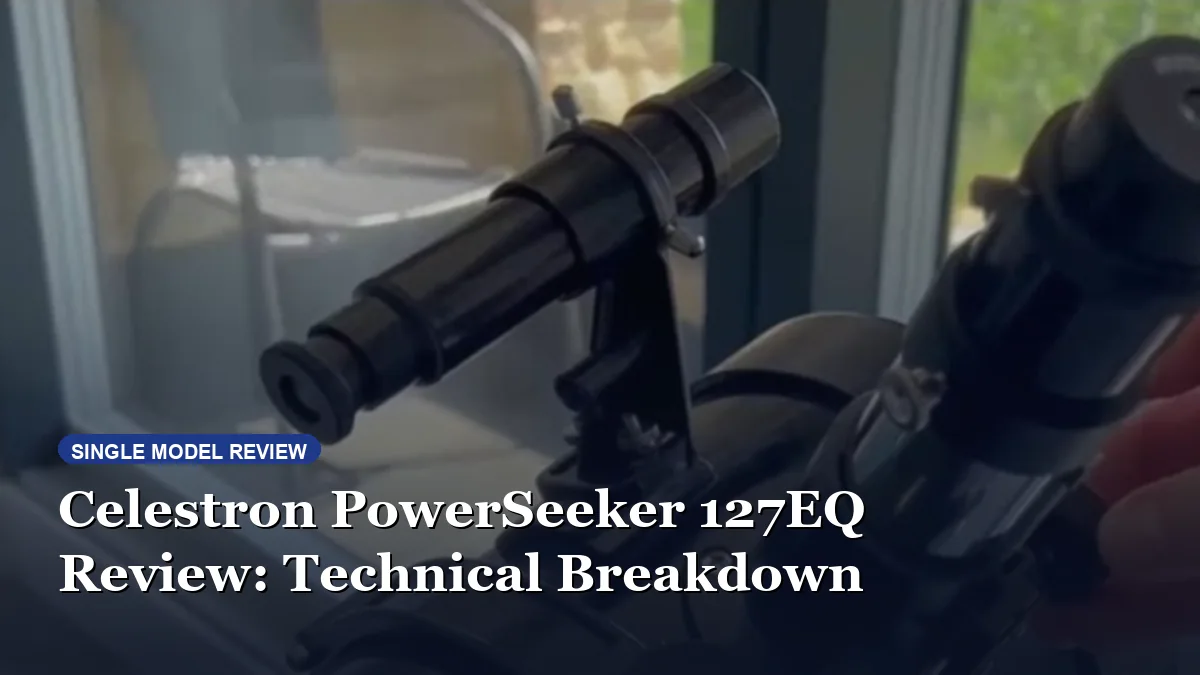

This Newtonian reflector offers decent aperture for entry-level stargazing, but requires patience with its manual equatorial mount and lightweight tripod structure during extended viewing sessions.
See our flagship Best Telescope: Top Backyard Picks for Astronomy.
Verified Specifications
| Category / Type | Newtonian Reflector |
|---|---|
| Rated Output / Capacity | 114mm Objective Lens Diameter |
| Power / Motor | Manual Equatorial Mount Control |
| Build & Materials | Aluminum optical tube and tripod |
| Operating Noise | Silent manual operation |
| Duty Cycle / Runtime | Unlimited manual observing time |
| Dimensions & Weight | 34.4 inches optical tube, 5.58 kg total |
| Key Safety & Controls | Manual slow-motion altitude rod |
What We Liked
- Affordable entry point for beginner astronomers
- Decent light-gathering aperture for lunar views
- Includes essential starter eyepieces and Barlow
- Portable optical tube assembly for transport
Trade-Offs
- Equatorial mount has a steep learning curve
- Included tripod exhibits minor high-power vibrations
- High-magnification 4mm eyepiece has tight eye relief
Optical Architecture and Tube Engineering
The optical tube assembly measures thirty-four inches in length, housing a primary mirror designed for Newtonian reflection. This configuration gathers sufficient light to resolve major planetary features and bright deep-sky targets.
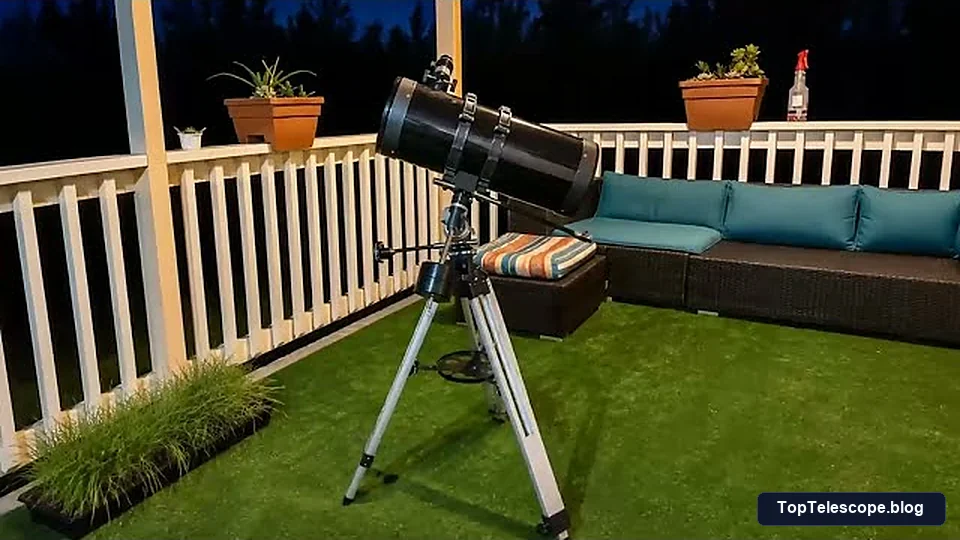
Fully coated glass surfaces maximize light transmission through the optical train. Users will notice reduced internal reflections when observing bright lunar limbs or high-contrast planetary disks in dark skies.
Constructed from lightweight aluminum materials, the optical tube balances easily within standard ring mounts. This keeps overall system weight manageable for younger astronomers and mobile field observers.
The 127mm aperture primary mirror utilizes a spherical rather than parabolic figure, which introduces inherent optical constraints. This design choice requires a correcting lens built into the drawtube to achieve focus.
Aluminum tube construction keeps the structural weight manageable at roughly fourteen pounds. However, thermal acclimatization takes longer due to the enclosed optical tube assembly preventing rapid heat dissipation during seasonal temperature drops.
Internal baffling remains minimal within the chassis, meaning stray light can reflect off bare metal interior walls. Users frequently apply flat black paint or flocking material to improve overall visual contrast significantly.
- Primary mirror configuration collects ample nighttime photons
- Fully coated glass elements improve overall light transmission
- Lightweight aluminum tube construction enhances field portability
Aperture and Focal Length Performance
Featuring a focal length of nine hundred millimeters, this design appears frequently in our best Celestron telescope for beginners guide. Such optical configurations favor planetary magnification over wide-field star sweeps.
The optical system resolves fine details on lunar craters and Saturn rings. Proper thermal acclimatization remains essential before attempting high-magnification planetary observation sessions.
- Long focal length supports high magnification eyepieces
- Thermal equilibrium prevents internal tube air currents
Equatorial Mount Mechanics and Tracking Ergonomics
Navigating the night sky relies on a manual German equatorial mount featuring slow-motion cables. This mechanical layout allows users to track celestial rotation smoothly along standard coordinate axes.
Balancing the telescope properly on right ascension and declination axes minimizes gear strain. Such precision is vital when selecting a best Celestron telescope for astrophotography for long-exposure imaging.
The included aluminum tripod elevates the optical assembly to a comfortable viewing height. Users should extend leg braces fully to maximize overall stability during high-power focusing.
The CG-1 equatorial mount employs lightweight aluminum casting for its main housing and setting circles. Manual slow-motion cables allow smooth adjustments in right ascension and declination axes during high magnification planetary observing sessions.
Balancing the telescope requires precise counterweight positioning along the solid steel shaft. Improper balance accelerates gear wear inside the worm drives and introduces backlash that complicates manual object tracking across the night sky.
The aluminum tripod features adjustable legs that lock via thumb screws, supporting the entire assembly. For optimal stability, operators should avoid fully extending the center section to minimize vibration dampening times.
- German equatorial mount simplifies long-duration celestial tracking
- Slow-motion control rods enable precise coordinate adjustments
- Adjustable aluminum tripod accommodates various observer heights
Polar Alignment Procedures
Achieving accurate tracking requires aligning the polar axis toward celestial north. Beginners should practice this alignment routine before conducting serious planetary imaging sessions.
Latitude scale adjustments allow rapid calibration based on geographic viewing locations. Securing locking knobs tightly prevents unwanted axis slippage during observation.
- Polar axis alignment tracks apparent star rotation accurately
- Latitude adjustment scale speeds up field setup routines
Video Review: Celestron 127EQ Telescope Review
Optical Performance and Real-World Visual Output
Field evaluations confirm crisp lunar shadow contrasts when pairing primary optics with moderate eyepieces. Similar optical clarity defines every top best Celestron telescope under $500 tested by our team.
The bundled twenty-millimeter eyepiece yields comfortable eye relief and wide fields of view. Conversely, the four-millimeter eyepiece pushes magnification limits, requiring very precise manual focus control.
Inserting the three-factor Barlow lens triples the effective magnification of any attached eyepiece. However, this optical multiplication also dims the final image brightness noticeably.
Operating at a 1000mm focal length, the system delivers a native focal ratio of roughly f/7.8. This optical speed provides wide field views suited for scanning large star clusters and bright nebulae.
Spherical aberration inherently limits maximum usable magnification, often capping sharp views around 150 power under steady atmospheric conditions. Pushing beyond this threshold yields softer images that lack fine planetary detail definition.
Included eyepieces typically consist of basic design elements that offer narrow apparent fields of view. Upgrading to wide-angle oculars transforms the viewing experience by expanding peripheral boundaries and improving overall eye relief.
- Twenty-millimeter eyepiece delivers comfortable wide-field views
- Three-factor Barlow lens expands maximum achievable magnification
- Atmospheric seeing conditions heavily dictate high-power clarity
Assembly, Alignment, and Setup Procedures
Unboxing the equipment reveals pre-assembled tripod sections that expedite initial field deployment. Clear instruction manuals guide novice users through attaching the equatorial mount securely.
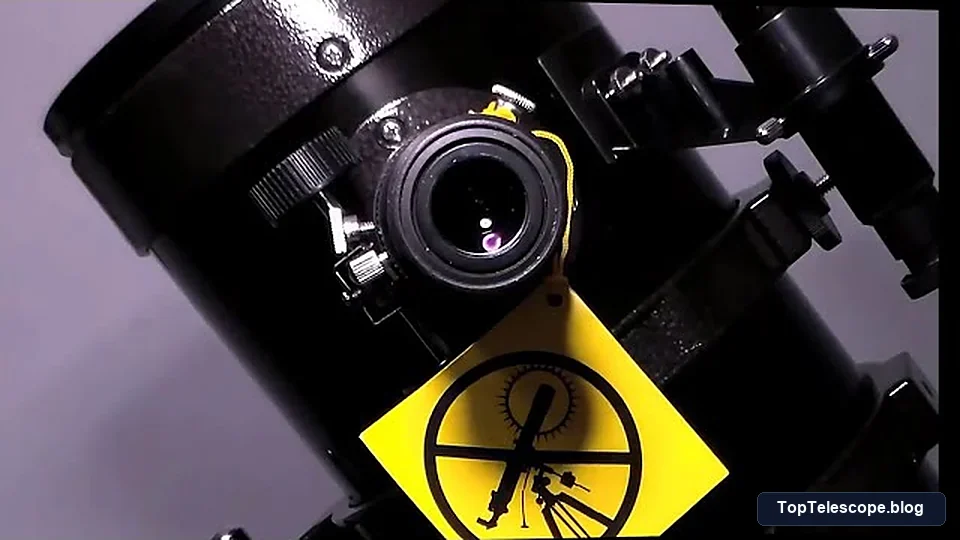
Mounting the optical tube requires careful seating within the cradle rings. Tightening securing thumbscrews firmly prevents accidental slippage during nighttime angle adjustments.
Attaching the finderscope aids in initial celestial target acquisition before switching to high-power eyepieces. Aligning the finderscope during daylight hours saves considerable frustration later.
Initial assembly requires standard hand tools to secure the accessory tray and mount head to the tripod spreaders. Careful tightening prevents stripping of threaded fastener holes located throughout the lightweight metal frame.
Polar alignment involves tilting the polar axis to match your specific geographic latitude scale. Utilizing a latitude adjustment screw simplifies rough alignment before locking down the position for casual tracking tasks.
Finding celestial targets relies heavily on properly aligning the finderscope with the main optical tube during daylight hours. Distant terrestrial objects provide reliable reference points for centering crosshairs and achieving accurate visual sync.
- Pre-assembled tripod speeds up initial field deployment
- Cradle rings secure optical tube safely during tilt changes
- Finderscope alignment simplifies nighttime target location tasks
Maintenance, Collimation, and Structural Durability
Newtonian reflectors require periodic mirror alignment to maintain sharp optical focus. Buyers often evaluate these maintenance steps before purchasing a best budget Celestron telescope for casual backyard astronomy.
Dust caps protect optical surfaces during storage periods in backyard sheds or closets. Cleaning primary glass requires specialized optical cleaning kits to prevent scratching delicate coatings.
Aluminum and steel components resist corrosion under normal outdoor dew conditions. Wiping down metal surfaces after damp viewing sessions ensures long-term structural durability.
Routine maintenance demands periodic inspection of mirror surfaces for dust accumulation and moisture residue. Cleaning optics should happen infrequently using professional optical wipes to avoid scratching delicate aluminum reflective coatings.
Because the corrector lens is fixed inside the drawtube, traditional Newtonian collimation requires careful adjustment of primary mirror tilt screws. Using a laser collimator helps center the optical axis efficiently.
Transporting the equipment safely requires padded storage cases to protect the mechanical gears from shock. Environmental exposure demands covering exterior metal components with protective sprays to prevent corrosion in humid environments.
- Periodic mirror collimation preserves crisp optical sharpness
- Dust covers protect exposed glass surfaces during storage
- Corrosion-resistant metal parts withstand standard outdoor dewing
Buyer Suitability Analysis: Who Benefits Most
Budget-conscious beginners seeking a comprehensive entry into astronomy will appreciate this package. The included software download provides valuable star charts for learning constellations.
Advanced astrophotographers or users lacking patience for manual polar alignment should look elsewhere. This instrument targets educational exploration rather than professional deep-sky imaging tasks.
Overall mechanical value matches typical entry-level pricing structures found across consumer markets. Careful expectation management ensures high satisfaction for weekend backyard astronomers.
This instrument suits budget-conscious hobbyists seeking an introduction to manual equatorial tracking mechanics. Beginners willing to invest time in learning setup nuances will extract rewarding views of the Moon and planets.
Advanced observers or astrophotographers may find the mechanical limitations frustrating for deep sky imaging. The mount stability and optical design cater strictly to visual astronomy rather than long exposure photography.
Educational settings benefit from its accessible scale and mechanical transparency for demonstrating coordinate systems. Students gain hands-on experience calculating celestial coordinates using manual setting circles and practical star charts.
- Ideal for budget-conscious beginner astronomy enthusiasts
- Includes helpful digital star-chart software downloads
- Requires patience due to manual equatorial mount design
Frequently Asked Questions
Can I use this telescope for astrophotography?
You can capture basic lunar snapshots using smartphone adapters. However, long-exposure deep-sky imaging requires a motorized equatorial tracking drive.
How difficult is the equatorial mount to learn?
The manual equatorial design has a noticeable learning curve for absolute beginners. Practicing polar alignment during daylight hours makes nighttime operation much easier.
What objects can I see clearly from my backyard?
You will easily observe lunar craters, the rings of Saturn, and major Jovian cloud belts. Brighter deep-sky nebulae also appear as faint smudges.
How do I keep the telescope optics clean?
Always replace dust caps immediately after every viewing session ends. Use specialized optical cleaning solutions only when dust accumulation becomes severe.
Does the package include everything needed to start?
The kit includes two eyepieces, a Barlow lens, and a finderscope. You can begin viewing celestial targets immediately upon completing assembly.