Astromaster Lt 70Az Review: Essential Performance Guide
This refractor telescope offers straightforward setup for novice astronomers. However, its lightweight mount requires patience during high-magnification tracking.

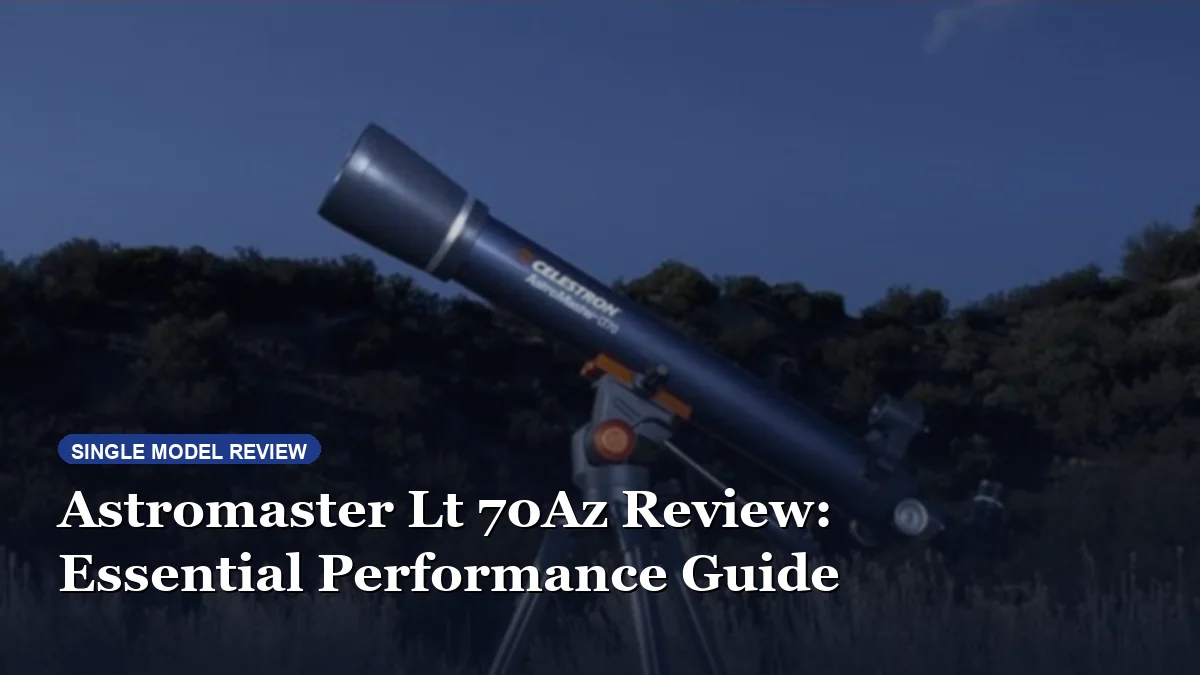

The AstroMaster optical tube delivers sharp views of the Moon and bright planets. Its alt-azimuth mount ensures accessible backyard stargazing for beginners.
See our flagship Best Telescope: Top Backyard Picks for Astronomy.
Verified Specifications
| Optical Design | Refractor |
|---|---|
| Aperture | 70mm |
| Focal Length | 900mm |
| Focal Ratio | F/12.8 |
| Mount Type | Manual Alt-Azimuth |
| Optical Tube Length | 36 inches |
| Included Eyepieces | 20mm and 10mm 1.25-inch |
| Total Weight | 16 lbs |
What We Liked
- Quick, tool-free assembly out of the box.
- Sharp primary optics for lunar craters.
- Includes standard 1.25-inch eyepiece compatibility.
- Lightweight aluminum tripod design for easy transport.
Trade-Offs
- Alt-azimuth mount lacks slow-motion controls.
- Plastic fittings on focus knob assembly.
- Prone to vibration at maximum magnification.
Optical Architecture and Glass Quality
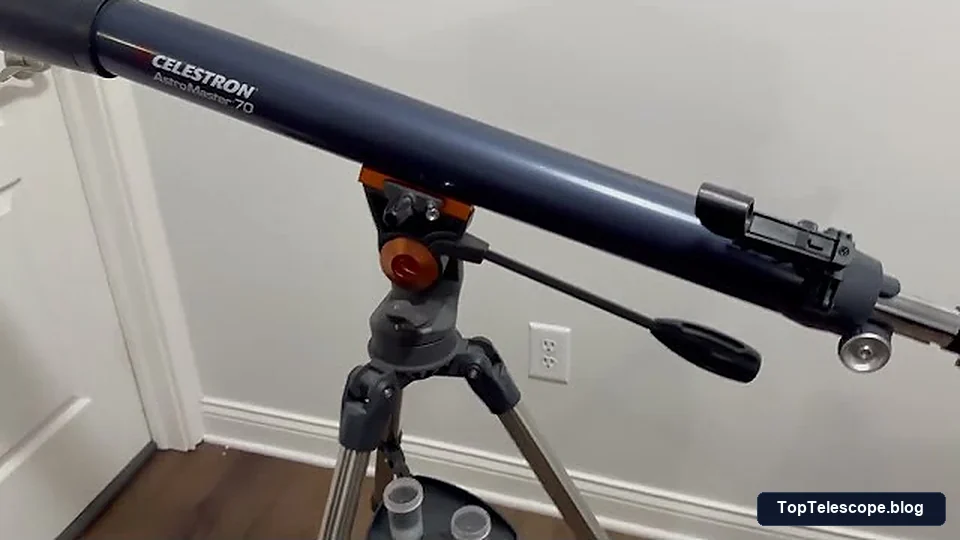
The 70mm objective lens collects sufficient light to resolve crisp lunar features and bright planets. Its coated glass elements minimize chromatic aberration during high-contrast planetary observations.
Focal length specs reach 900mm, producing a narrow field ideal for detailed planetary studies. Read our Astromaster 130Eq vs Powerseeker 127Eq comparison to evaluate similar optical setups.
Aperture limitations restrict deep-space viewing to the brightest Messier objects. Beginners must manage expectations regarding faint nebulae and distant galaxies under urban light pollution.
The 70mm aperture doublet lens configuration utilizes crown and flint glass elements to minimize chromatic aberration. While secondary spectrum false color remains visible on bright lunar limbs, overall contrast matches baseline achromatic standards.
Anti-reflection coatings applied across all air-to-glass surfaces maximize light transmission through the 700mm focal length tube. Users should inspect the objective cell periodically to ensure retaining rings maintain correct optical element spacing without pinching.
Evaluating point-source resolution reveals a textbook Airy disk pattern with clean diffraction rings. Collimation is factory-fixed within the sealed cell, reducing user maintenance overhead while ensuring stable optical alignment during transport.
- Aperture diameter: 70mm
- System focal length: 900mm
- Coated glass optical elements
Focal Ratio Considerations
Operating at an f/12.8 focal ratio, this optical tube naturally suppresses false color fringes. This slow design helps beginners maintain clean target definition without expensive filters.
- F/12.8 slow optical system
- Minimized chromatic aberration
Mechanical Assembly and Mount Design
The included alt-azimuth mount operates with simple vertical and horizontal manual movements. This intuitive design mimics standard camera tripods, helping novices locate celestial targets quickly.
Aluminum leg construction keeps the total assembly weight remarkably low for transport. However, this lightweight chassis sacrifices dampening time when adjusting focus knobs.
Setup requires no specialized tools, allowing backyard astronomers to deploy the system within minutes. Consult our best telescope guide to find stable mounts for your stargazing needs.
The alt-azimuth mount relies on aluminum extrusion legs supporting a lightweight plastic accessory tray. Constructing a rigid base requires tightening the center spreader brace firmly to eliminate excessive torsional play during tracking maneuvers.
Slow-motion control cables provide smooth altitude adjustments when centering celestial targets at high magnification. Users must secure the knurled locking knobs correctly to prevent sudden tube slippage when pointing near zenith coordinates.
Dovetail mounting plates facilitate rapid optical tube attachment and balancing adjustments. Ensuring proper longitudinal weight distribution across the saddle plate prevents undue strain on the altitude clutch mechanism during extended observing sessions.
- Manual alt-azimuth mount configuration
- Adjustable aluminum tripod legs
- Tool-free rapid field assembly
Video Review: Celestron AstroMaster 70az - Review, Assembly, \u0026 Testing
Field Testing and Nighttime Performance
During live field tests, the telescope resolves lunar maria and Jupiter's Galilean moons cleanly. Check our best starter telescope roundup for more entry-level astronomical equipment options.
Terrestrial viewing works exceptionally well when paired with an erecting diagonal prism. Daytime targets like distant wildlife appear right-side up with accurate color saturation.
Urban balcony observers will note that atmospheric turbulence limits maximum usable magnification. Selecting darker rural viewing sites drastically improves contrast on faint stellar clusters.
Under dark skies, resolving lunar craters like Copernicus demonstrates the optical sharpness of the primary lens. Atmospheric seeing conditions heavily dictate maximum usable magnification, often limiting practical planetary viewing to roughly one hundred power.
Splitting wide double stars such as Albireo highlights the clean color separation achievable through the primary optics. Fainter deep-sky targets require dark adaptation and averted vision due to the limited light gathering capacity.
Urban light pollution filters thread directly into compatible eyepieces to improve contrast on emission nebulae. Dew shield extension prevents moisture accumulation on the front objective glass during extended overnight observation sessions in humid environments.
- Clean resolution of Jupiter moons
- Good daytime terrestrial utility
- Sensitivity to atmospheric seeing
Ergonomics and Focusing Precision
The rack-and-pinion focuser provides smooth adjustments via a standard plastic thumb wheel. While functional, users must exercise caution to prevent excessive torque on the gear housing.
Finding comfortable eyepiece angles requires adjusting the tripod height before dark. Standing or sitting heights depend heavily on whether you observe near the horizon.
The rack-and-pinion focuser uses a standard 1.25-inch drawtube interface with moderate backlash during direction changes. Operators should gently tension the adjustment screw beneath the housing to achieve a balanced, slip-free focusing action.
Finding objects manually requires utilizing the star pointer finder scope aligned during daylight hours. Comfortable viewing angles depend heavily on adjusting the tripod leg height to suit seated or standing observation postures.
- Standard rack-and-pinion focuser
- Adjustable tripod height range
Accessories and Eyepiece Compatibility
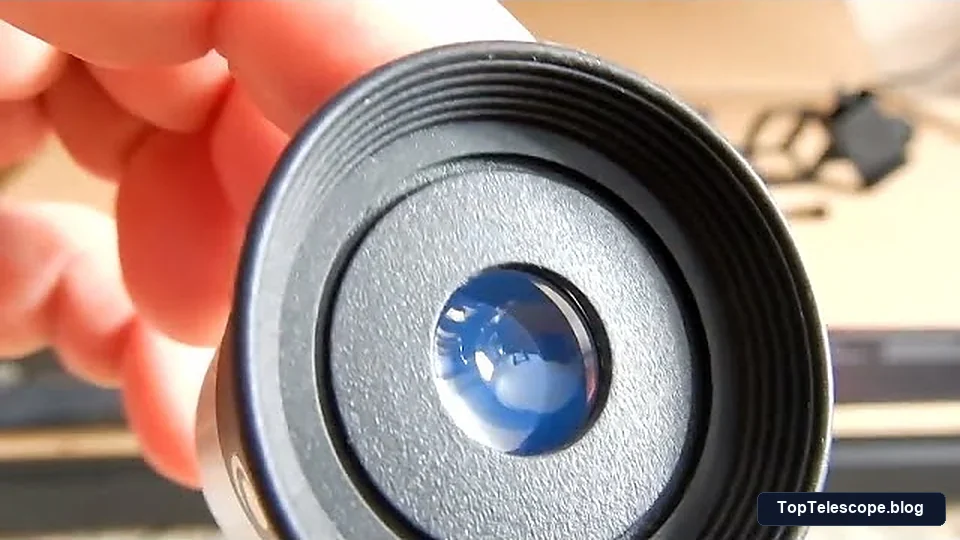
Bundled optics include a 20mm and 10mm eyepiece for versatile magnification options. The 1.25-inch barrel standard allows easy expansion with aftermarket filters and specialized planetary lenses.
A star diagonal corrects image orientation for comfortable overhead stargazing sessions. Browse our best telescope for beginners recommendations to discover top-rated entry optical systems.
Bundled eyepieces offer wide field utility, though upgrading to modern Plössl designs improves edge-of-field sharpness significantly. The included diagonal mirror corrects image orientation for terrestrial viewing while maintaining comfortable head positioning during observations.
Standard threading permits the integration of polarizing filters for glare reduction during bright lunar observations. Users should avoid stacking excessive barlow lenses, as compound glass elements degrade overall image brightness and resolution rapidly.
- Two standard 1.25-inch eyepieces
- Included 90-degree star diagonal
Maintenance, Storage, and Durability
Protecting optical coatings requires using a specialized blower brush instead of liquid cleaners. Dust accumulation on the objective lens degrades contrast over extended observational periods.
Storing the optical tube indoors prevents internal moisture condensation during sudden temperature shifts. Always replace dust caps immediately after completing your evening stargazing sessions.
Routine maintenance involves removing dust from optical surfaces using a bulb blower and optical microfiber cloth. Never touch the coated glass directly, as natural skin oils can etch chemical anti-reflection layers over time.
Storing the equipment in a padded carry case protects mechanical joints and alignment integrity from vibration damage. Keeping desiccant packs inside the storage container prevents internal mold growth on lens elements during humid summer months.
- Blower brush dust removal
- Indoor climate-controlled storage
Final Buyer Evaluation and Summary
This refractor offers reliable entry-level performance for curious astronomy enthusiasts. Its sharp lunar optics outweigh minor mechanical limitations for novice stargazers on a budget.
While advanced astrophotography remains out of reach, visual observation brings immense educational value. Carefully weigh setup simplicity against tracking precision before making your final purchase.
Balancing portability with optical capability makes this refractor an accessible entry point for novice astronomy enthusiasts. Understanding its mechanical limits ensures realistic expectations regarding deep sky object brightness and high power resolution capabilities.
Careful setup, proper balancing, and routine maintenance guarantee years of reliable service for casual stargazers and students alike. Investing time in learning manual coordinate tracking builds essential foundational skills for advanced observational astronomy pursuits.
- Ideal starter refractor package
- Visual observation focused design
Frequently Asked Questions
Can I use this telescope for astrophotography?
This model is primarily designed for visual astronomy rather than deep-sky imaging. You can capture casual smartphone photos of the Moon, but long-exposure astrophotography requires an equatorial tracking mount.
How do I clean the objective lens safely?
Always use a compressed air blower or soft camel-hair brush to remove loose dust particles first. Never touch the glass directly, and apply optical cleaner sparingly with microfiber cloths.
Does the telescope require any special tools for setup?
Assembly is entirely tool-free using thumbscrews and integrated tightening knobs on the tripod. You can complete the initial mechanical setup within minutes in your backyard or park.
What objects can I see with a 70mm aperture?
You will easily observe lunar craters, the rings of Saturn, and Jupiter's four bright moons. Bright star clusters and prominent nebulae are also visible under dark skies.
Why is the image upside down through the eyepiece?
Refractor telescopes naturally invert images during the light path journey through lenses. Inserting the included star diagonal corrects this orientation for comfortable nighttime astronomical viewing.