Astromaster 130Eq Technical Review: Core Performance and Design
This 130mm Newtonian reflector delivers impressive aperture for deep-sky observation. However, its manual equatorial mount demands patience during initial alignment procedures.

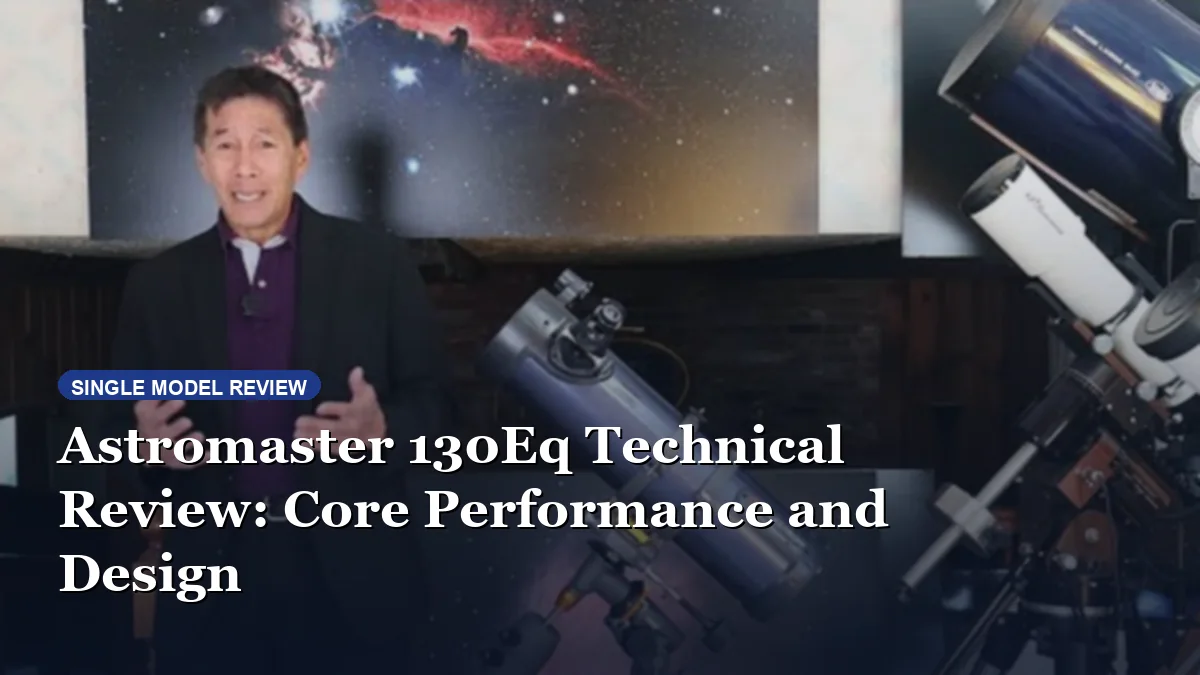

The Astromaster 130Eq offers solid optics housed in a carbon-fiber wrapped tube. While setup requires technical calibration, its light-gathering power makes it a valuable entry-level instrument for serious stargazers.
See our flagship Best Telescope: Top Backyard Picks for Astronomy.
Verified Specifications
| Optical Design | Newtonian Reflector |
|---|---|
| Aperture Diameter | 130 mm (5.1 inches) |
| Focal Length | 650 mm (f/5) |
| Mount Type | German Equatorial Mount |
| Optical Coatings | Fully-Coated Glass |
| Tripod Construction | Adjustable Aluminum Alloy |
| Included Eyepieces | Standard 1.25-inch design |
| Accessory Package | 1.5X Barlow and Moon Filter |
What We Liked
- Generous 130mm aperture collects ample light for faint deep-sky targets.
- Sturdy aluminum tripod provides a stable platform during extended viewing sessions.
- German equatorial mount enables smooth manual tracking of celestial bodies.
- Comprehensive accessory bundle includes essential filters and smartphone adapters.
Trade-Offs
- Equatorial mount setup can prove challenging for absolute beginners without experience.
- Included plastic components on the mount require careful handling during transport.
- Collimation adjustments are occasionally needed to maintain optimal optical sharpness.
Optical Architecture and Build Quality
The optical tube assembly features a 130mm primary mirror designed to capture faint photons from distant nebulae. Its carbon-fiber wrapped exterior enhances structural rigidity while keeping total weight manageable for field transport.
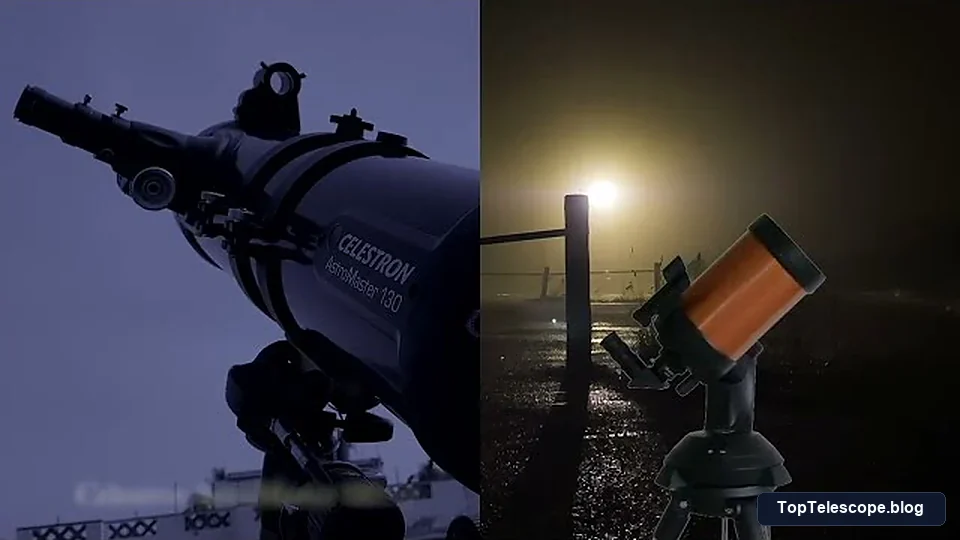
Fully-coated glass optics maximize light transmission through the system, reducing internal scattering. This treatment ensures that lunar craters and planetary cloud bands appear with notable contrast during high-magnification viewing sessions.
The optical tube assembly features a 130mm aperture Newtonian reflector design housed in a sturdy aluminum chassis. This configuration provides a 650mm focal length at an f/5 focal ratio for wide-field views.
Internal baffling minimizes stray light reflections while the primary mirror utilizes aluminum and SiO2 coatings for enhanced reflectivity. Alignment stability is maintained by a robust three-point mirror cell construction during transport.
- 130mm aperture yields high resolution.
- Carbon-fiber wrap improves durability.
- Fully-coated glass minimizes light loss.
Mirror Substrate and Mechanical Housing
The internal mirror cell secures the primary optics firmly without inducing pinching forces. Proper cell design prevents wavefront distortion during temperature shifts encountered in outdoor observation environments.
A straight-through finderscope mounts securely near the focuser, allowing users to align targets rapidly. The rack-and-pinion focuser accepts standard accessories smoothly with minimal mechanical backlash.
- Stress-free mirror cell mounting.
- Smooth rack-and-pinion focuser mechanism.
Equatorial Mount Mechanics and Ergonomics
A German equatorial mount provides the necessary mechanics for tracking celestial objects along their curved diurnal paths. Dual setting circles and fine-turned control cables allow precise manual positioning during long observation runs.
Adjusting the latitude bolt alters the polar axis angle to match your specific geographic location. Securing these knobs tightly prevents slippage while tracking planets across the night sky.
The CG-3 equatorial mount incorporates setting circles and slow-motion cables for precise manual tracking. Its cast-metal housing ensures mechanical rigidity when balancing the counterweight shaft loaded with the included mass.
Ergonomic adjustment knobs allow smooth polar axis alignment without requiring specialized tools in field conditions. The sturdy steel legs provide a solid foundation that dampens ambient vibrations during high-power terrestrial observation sessions.
- German equatorial design facilitates tracking.
- Fine-turned control cables offer precision.
- Adjustable latitude settings for alignment.
Tripod Stability and Accessory Tray
An adjustable aluminum alloy tripod elevates the optical tube to comfortable viewing heights. The wide stance dampens vibrations quickly after manual adjustments or sudden breezes strike the instrument.
A rigid accessory tray locks the tripod legs firmly into place while holding extra eyepieces. This integrated tray design adds necessary deadweight stability to the entire mounting assembly.
- Wide-stance aluminum tripod legs.
- Integrated tray for secure bracing.
Video Review: Celestron AstroMaster 130 Review - Not Recommended, But...
Real-World Output and Optical Performance
Under dark skies, the 130mm aperture resolves globular clusters and bright Messier objects clearly. Planetary details such as Jupiter's equatorial belts emerge cleanly when paired with appropriate high-power eyepieces.
The included 1.5X erecting Barlow lens extends focal length for higher magnification targets. However, pushing magnification too high can dim the image brightness significantly due to light spread.
Practical stargazing reveals sharp lunar craters and bright planetary details when using standard eyepieces. Exploring our starter telescope rankings helps beginners find reliable instruments featuring accurate collimation and dependable optical components.
Wide-field deep-sky objects appear bright due to the fast focal ratio, though peripheral coma is noticeable. Users can manage aberrations by avoiding ultra-wide eyepieces and maintaining proper focus wheel tension during extended viewing.
- Resolves Messier objects effectively.
- Reveals planetary cloud belts.
- Barlow lens extends focal reach.
Managing Optical Aberrations in the Field
Fast Newtonian reflectors naturally exhibit some spherical aberration near the outer edges of the field. Using quality eyepieces helps maintain edge-to-edge sharpness across wide star fields.
The bundled moon filter reduces glare effectively during bright lunar phases, enhancing surface contrast. This accessory protects night-adapted eyes when viewing a full moon at high magnifications.
- Addresses spherical aberration concerns.
- Moon filter controls intense glare.
Thermal Management and Maintenance Protocols
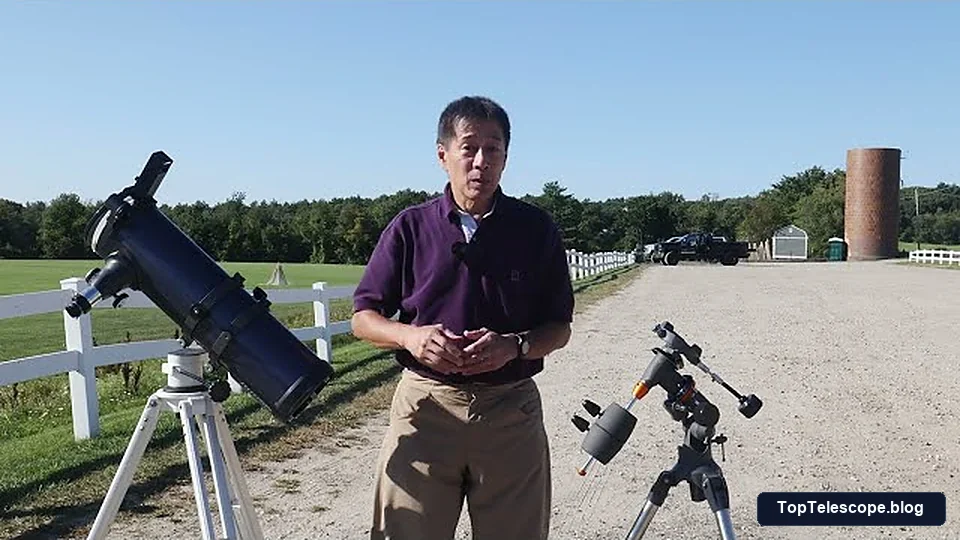
Newtonian optical tubes require thermal equilibrium with ambient outdoor temperatures to prevent internal air currents. Reviewing our top telescope recommendations assists users in choosing equipment suited for optimal backyard astronomical viewing sessions.
Dust covers must remain attached whenever the instrument is stored to protect delicate mirror coatings. Routine exterior cleaning preserves optical performance over years of regular backyard astronomical use.
Ambient thermal equilibrium requires allowing the optical tube assembly thirty minutes to acclimate outdoors before critical observations. Routine mirror cleaning should be minimized by storing components with secure dust cap accessories attached.
Mechanical fasteners on the mount require periodic inspection and tightening to prevent loosening from regular transport stress. Lubricate gear tracks annually using approved silicone grease to ensure smooth manual tracking motion across the sky.
- Requires thirty-minute thermal acclimatization.
- Dust covers protect delicate mirrors.
Collimation Procedures for Sharp Focus
Periodic collimation aligns the primary and secondary mirrors to maintain peak optical performance. Using a simple collimation cap ensures your optical axis stays true for crisp planetary observations.
Adjustment screws on the rear mirror cell make manual alignment straightforward with minimal technical background. Regular alignment checks guarantee maximum light delivery to your observing eyepieces.
- Periodic mirror alignment maintains sharpness.
- Simple adjustment screws ease maintenance.
Setup, Calibration, and Alignment Procedures
Initial assembly requires attaching the equatorial head to the tripod before mounting the optical tube. Careful balancing along both right ascension and declination axes prevents excessive wear on internal gears.
Polar alignment involves pointing the polar axis toward celestial north for accurate tracking. Reviewing our beginner telescope guide helps novices practice proper mechanical steps and build essential operational familiarity.
Polar alignment demands leveling the tripod base and pointing the polar axis toward celestial north for tracking. Utilizing a finder scope properly aligned with the main optics simplifies locating faint deep-sky targets successfully.
Newtonian collimation relies on adjusting the primary and secondary mirror screws using a dedicated Cheshire eyepiece tool. Precise alignment guarantees maximum optical transfer efficiency and sharp, undistorted planetary images during high magnification viewing runs.
- Balance axes to prevent gear wear.
- Polar alignment ensures smooth tracking.
Smartphone Adapter Integration
The included smartphone adapter mounts securely to the eyepiece for afocal astrophotography sessions. Aligning your phone camera lens requires patience to capture crisp lunar and planetary snapshots.
Tightening the adapter clamps prevents shifting while capturing celestial images through the eyepiece. This feature introduces beginners to basic astrophotography without requiring expensive dedicated camera equipment.
- Adapter allows quick phone mounting.
- Enables beginner lunar astrophotography.
Comprehensive Buyer Verdict and Recommendations
The Astromaster 130Eq represents a capable optical instrument for hobbyists. When evaluating options, consulting our astromaster comparison guide helps buyers select the ideal equatorial Newtonian reflector configuration for backyard astronomy.
While initial setup demands patience, the resulting performance rewards careful calibration efforts. This telescope suits amateur astronomers ready to step beyond basic tabletop models into true equatorial viewing.
This Newtonian reflector balances optical aperture size with mechanical portability for dedicated beginner astronomers entering the hobby. Careful attention to polar alignment and routine collimation unlocks the full potential of this versatile imaging platform.
Prospective buyers should evaluate their storage space and willingness to perform regular manual calibration before purchase. Investing time in proper telescope maintenance ensures reliable mechanical operation and clear astronomical observations for years.
- Outperforms smaller refractor telescopes.
- Rewards patience with deep-sky views.
Ideal User Profiles and Alternatives
Intermediate hobbyists and enthusiastic beginners will extract maximum value from this Newtonian system. Those seeking instant grab-and-go setup might prefer simpler alt-azimuth mounted instruments instead.
Proper expectations regarding collimation and polar alignment ensure long-term satisfaction with this setup. Investment of time into proper calibration unlocks the true potential of its optics.
- Best for committed hobbyists.
- Requires willingness to learn mechanics.
Frequently Asked Questions
How difficult is the equatorial mount to set up for beginners?
Setting up a German equatorial mount requires careful initial learning, particularly regarding accurate polar alignment and precise axis balancing procedures to ensure smooth tracking across the night sky.
Patience during daylight practice sessions will make subsequent nighttime celestial tracking much more intuitive and rewarding for new astronomy enthusiasts stepping into advanced telescope operation throughout the year.
Why is collimation necessary for this Newtonian reflector?
Collimation is essential because it aligns the primary and secondary mirror assemblies to maintain peak optical sharpness during your extended stargazing sessions under dark skies.
Performing routine alignment checks with a simple collimation cap prevents image degradation and guarantees maximum light delivery to every single eyepiece you utilize throughout the entire night.
Can I use a smartphone to take pictures with this telescope?
The bundled smartphone adapter mounts securely to the eyepiece housing for exciting introductory afocal astrophotography exploration of the Moon and bright planets.
Aligning your phone camera lens properly requires practice and patience, but it lets you capture clear lunar snapshots without purchasing expensive dedicated camera hardware for your optical system.
How long should the telescope acclimate to outdoor temperatures?
Allowing the heavy Newtonian optical tube thirty minutes to reach ambient outdoor temperatures is crucial for eliminating internal thermal air currents inside the sealed housing structure.
Proper thermal acclimatization effectively prevents distorted planetary images and ensures crisp, stable views before you begin your serious observation sessions outdoors at night.
Who is the ideal target buyer for this specific model?
This telescope suits intermediate hobbyists and enthusiastic beginners who are willing to learn equatorial mechanics and basic optical maintenance procedures over time.
Committed amateur astronomers will deeply appreciate its impressive deep-sky light gathering power despite the initial setup learning curve involved with German equatorial mounts during early observing sessions.