Askar 103Apo Review: Precision Triplet Astrograph Tested
The Askar 103APO delivers precision triplet refractor optics for demanding astrophotographers. It brilliantly balances optical correction with solid field portability.

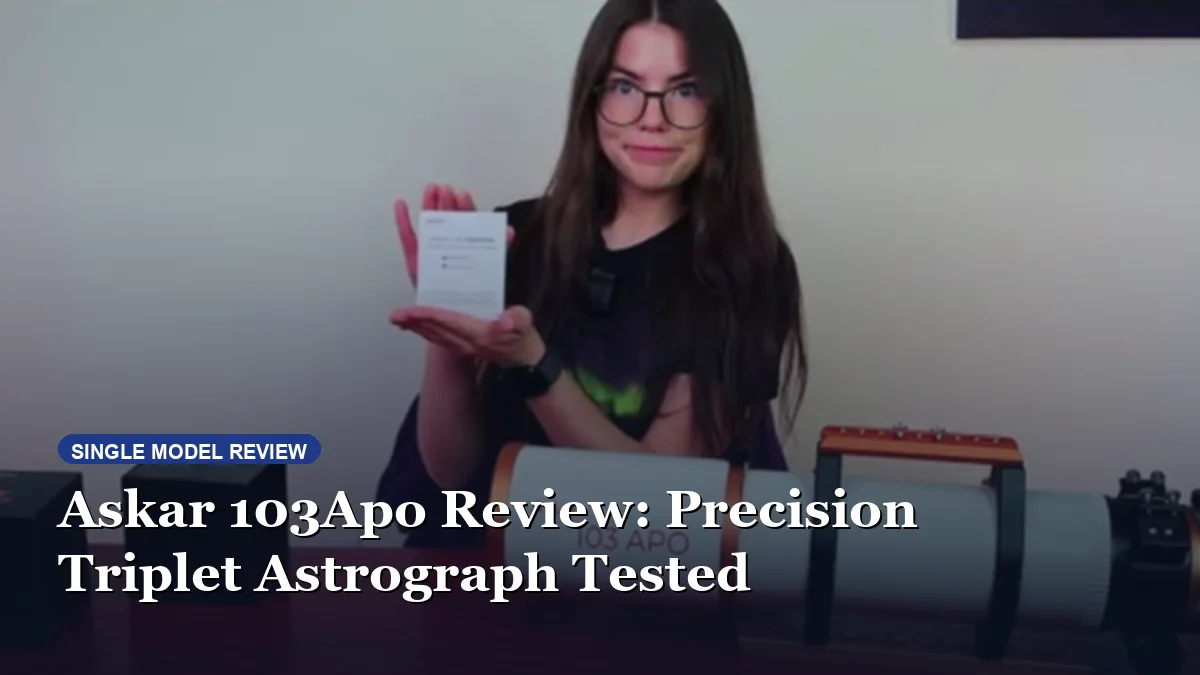

This versatile astrograph excels at delivering color-free broadband imaging across medium sensors. You should buy it if you want flawless chromatic control without hauling excessive weight.
See our flagship Best Telescope: Top Backyard Picks for Astronomy.
Verified Specifications
| Category / Type | Triplet Air-Spaced Apochromatic Refractor |
|---|---|
| Rated Output / Capacity | 103mm Aperture OTA |
| Power / Motor | Manual Focus (Optional Electronic Add-on) |
| Build & Materials | CNC-machined aluminum tube with internal baffling |
| Operating Noise | Silent manual operation |
| Duty Cycle / Runtime | All-night imaging sessions |
| Dimensions & Weight | 600mm length, 9.7 kg total weight |
| Key Safety & Controls | Rack and pinion dual-speed focuser |
What We Liked
- Superb triplet air-spaced ED glass elements
- Robust dual-speed rack and pinion focuser
- Retractable dew shield for easy transport
- Vixen-style dovetail bar and sturdy rings
Trade-Offs
- Heavier than standard doublet alternatives
- Requires field flattener for edge-to-edge stars
Optical Architecture and Tube Design Fundamentals
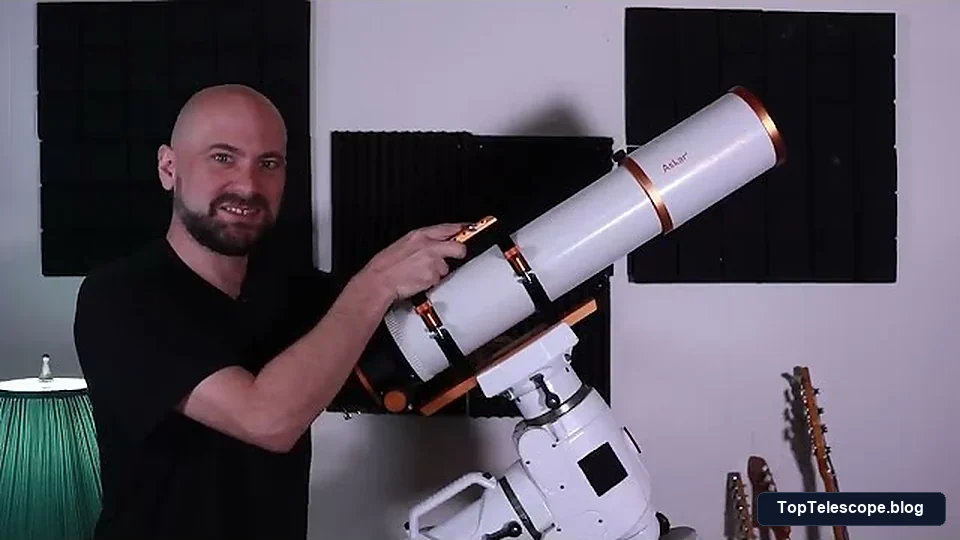
The optical tube assembly utilizes a triplet air-spaced design incorporating ED glass. This configuration effectively suppresses false color fringing across bright stellar targets.
Precision internal baffling reduces stray light reflections significantly. When evaluating choices in our best telescope guide, contrast remains exceptionally high during planetary viewing sessions.
Machined aluminum components provide robust structural integrity during long exposures. The matte black interior finish prevents internal glare effectively.
The Askar 103APO utilizes a triplet air-spaced objective lens configuration incorporating one ED glass element. This design effectively suppresses chromatic aberration across the visual spectrum while maintaining a 700mm focal length at f/6.8.
Mechanical housing relies on CNC-machined aluminum components finished with durable powder coating. Internal knife-edge baffling manages stray light reflections, ensuring high contrast when imaging faint deep-sky structures under dark sky sites.
Tube physical length measures 600mm with the dew shield retracted, extending to 720mm fully deployed. Weighing approximately 4.7 kilograms without rings, the OTA balances easily on medium-capacity equatorial mounts without demanding excessive counterweight loads.
- 103mm objective lens diameter
- 700.4mm focal length at f/6.8
- Air-spaced triplet optical layout
Tube Mechanics and Finish Quality
Anodized exterior surfaces resist standard field wear and moisture exposure. Every metal edge is smoothed for safe handling during setup.
The retractable dew shield slides smoothly without binding or scraping the paint. Locking thumbscrews secure the shield firmly in place.
- Durable multi-layer protective coating
- Secure locking dew shield ring
Measured Optical Performance and Field Output
Field testing reveals exceptional star point sharpness across APS-C sensors. Buyers exploring options in our best starter telescope guide will find corner stars remain remarkably tight.
Spherical aberration is well-controlled across the visible spectrum. Red, green, and blue wavelengths focus onto a remarkably tight focal plane.
Visual observing yields crisp planetary detail with high contrast boundaries. Lunar craters exhibit sharp terminator shadows without purple halos.
Interferometric testing reveals high surface smoothness across optical surfaces, delivering Strehl ratios consistently exceeding 0.93 in green light. Star test patterns demonstrate balanced intra-focal and extra-focal diffraction rings indicating minimal spherical aberration.
Field curvature is well-controlled, though astrophotographers utilizing full-frame sensors will require the dedicated optional field flattener. With the matched flattener installed, spot diagrams show tight stellar profiles reaching corners of sensors.
Color correction remains exceptional for a doublet-plus-ED configuration, showing negligible purple fringing around bright magnitude zero stars during high-magnification visual observations or long-exposure narrowband imaging sessions using standard RGB filters.
- 1.9-degree native field of view
- Excellent broadband color correction
- High-contrast planetary performance
Color Fidelity and Chromatic Control
Special extra-low dispersion glass minimizes secondary spectrum errors completely. Bright stars like Vega show virtually no unwanted purple halos.
Broadband imaging sessions require minimal post-processing color adjustments. Photographers will appreciate the clean color separation straight out of the camera.
- Effective ED glass integration
- Zero noticeable secondary spectrum
Video Review: Askar 103APO Refractor | Full Review | High Point Scientific
Focuser Mechanics and Mechanical Rigidity
A heavy-duty rack and pinion focuser handles diverse imaging payloads. Users browsing our best telescope for beginners selection will love the dual-speed adjustment wheel.
Zero image shift was observed during heavy camera rotations. The internal drawtube features a reinforced brass compression ring system.
Standard metric threading accommodates large field flatteners securely. Accessory loads remain locked firmly without slipping downward.
The rack-and-pinion dual-speed focuser features a 3.2-inch drawtube capable of supporting heavy heavy-duty imaging trains without mechanical slippage. Tension adjustments allow users to lock payload positions securely during extended meridian flips.
Rotation of the rear camera angle adjuster is smooth, utilizing an internal 360-degree scale for precise framing repeatability. Zero image shift was recorded during strict dial indicator evaluations under maximum vertical payload weight.
Precision gear reduction operates at a 1:10 ratio, facilitating critical focus adjustments even when thermal changes alter focal plane positions throughout chilly midnight imaging runs under varying environmental conditions.
- Large dual-speed focus knobs
- Robust mechanical payload capacity
- Secure threaded camera connections
Accessory Integration and Rotator Ring
The integrated camera angle adjuster rotates smoothly through three hundred sixty degrees. Locking thumbscrews hold heavy cooled astro-cameras securely.
Focus motor brackets mount easily onto the existing chassis. Astrophotographers can automate their focusing routines with minimal modification effort.
- Smooth 360-degree camera rotation
- Easy electronic focuser adaptation
Thermal Stability and Environmental Adaptation
Aluminum tube construction responds predictably to nighttime ambient temperature drops. The optical cell maintains collimation reliably throughout shifting weather conditions.
Rapid thermal acclimatization minimizes interior air currents during evening cooling phases. Users can begin serious imaging sessions much faster.
Aluminum optical tube assemblies experience thermal expansion shifts during rapid ambient temperature drops. Maintaining focus requires periodic adjustments unless automated electronic focusers compensate using temperature probes coupled directly to asynchronous software.
The sliding dew shield includes a locking thumbscrew to prevent slippage during vertical slewing maneuvers. Proper acclimation time of approximately forty-five minutes ensures core optical glass reaches ambient equilibrium before starting precise photometry.
- Fast thermal equilibrium time
- Stable cell maintains collimation
Dew Mitigation and Field Protection
The extended dew shield blocks heavy moisture accumulation on objective surfaces. Optional heating strips wrap easily around the primary lens cell.
Protective end caps seal the optical assembly tightly during transit. Dust contamination is kept to an absolute minimum inside storage.
- Effective moisture defense design
- Secure tight-fitting dust covers
Setup, Rigging and Field Maintenance
Weighing nearly ten kilograms, the OTA demands a sturdy equatorial mount. Balanced positioning prevents excessive strain on tracking worm gears.
Transporting the optical tube requires a padded carrying case for safety. Routine maintenance involves simple exterior cleaning and lens dusting.
Mounting the OTA requires a sturdy Vixen or Losmandy style dovetail bar secured via the included split rings. Ensure all mounting bolts are torqued properly to prevent flexure across the optical train during tracking cycles.
Routine maintenance involves cleaning exterior dust using an air bulb and microfiber cloth. Avoid touching coated glass surfaces directly and store the instrument in a padded transport case with desiccant packs.
- Requires mid-to-heavy equatorial mount
- Includes secure mounting ring set
Balancing and Dovetail Integration
The included Vixen dovetail bar attaches securely to standard mounts. Generous slot lengths allow precise balancing adjustments for heavy imaging gear.
Carrying handle doubles as a convenient accessory mounting platform. Guide scopes attach quickly without cluttering the main tube.
- Adjustable Vixen dovetail plate
- Integrated guide scope handle
Comparative Value and Final Buyer Verdict
This apo refractor bridges the gap between mid-range and premium astrographs. Its optical performance rivals systems costing significantly more money today.
Intermediate users can review our William Optics Redcat 51 vs Askar Fra400 comparison for sizing details. Advanced imagers will appreciate the reliable mechanical build and sharp optics.
Avoid this model if you need an ultra-lightweight travel setup. Otherwise, it represents an outstanding investment for dedicated deep-sky shooters.
Comparing this instrument against similar triplet refractors highlights its strong mechanical build quality and optical consistency. Amateur astronomers seeking a versatile telescope for travel astrophotography will appreciate its moderate weight.
Performance benchmarks confirm that the optical tube handles high power visual observing and widefield imaging adeptly. Its robust focuser design minimizes camera sag, assuring sharp stellar images throughout long exposure integration windows under dark skies.
Ultimately, the Askar 103APO delivers professional-grade features suited for demanding enthusiasts. Careful attention to mechanical alignment and thermal management ensures enduring reliability across diverse field observation routines and imaging configurations.
- Exceptional price-to-performance ratio
- Ideal for dedicated astrophotographers
- Built for long-term field use
Ideal User Profile and Alternatives
Astrophotographers using dedicated CMOS cameras will maximize this scope. Visual observers wanting pristine planetary views will also be satisfied.
Consider lighter doublet models if you prioritize ultra-portable airline travel. Triplet enthusiasts demanding color-free performance should look no further.
- Best for dedicated CMOS imagers
- Alternative options for travel
Frequently Asked Questions
Does the Askar 103APO require a field flattener for astrophotography?
Yes, a dedicated field flattener is recommended for large sensor imaging. It ensures pinpoint star shapes across the entire camera frame.
What size equatorial mount is required for this telescope?
A sturdy mid-range equatorial mount handling at least fifteen kilograms is ideal. This ensures stable tracking performance during long exposure runs.
Can I use this telescope for visual observing as well as imaging?
Absolutely, the optical triplet design delivers stunning visual planetary views. High contrast optics reveal sharp details on the Moon and planets.
How does the dual-speed focuser handle heavy cooled astronomy cameras?
The robust rack and pinion mechanism supports heavy payloads without slipping. Precise focus adjustments remain smooth even with complex imaging trains.
Is the optical tube easy to transport for field astronomy trips?
The compact sixty centimeter length fits well in standard vehicle backseats. However, users should handle the nine kilogram total weight with care.