Apertura Ad8 Review: High-Performance 8-Inch Newtonian Dobsonian
The Apertura Ad8 delivers exceptional optical performance and rock-solid mechanical stability. However, its substantial physical heft demands careful transport planning.

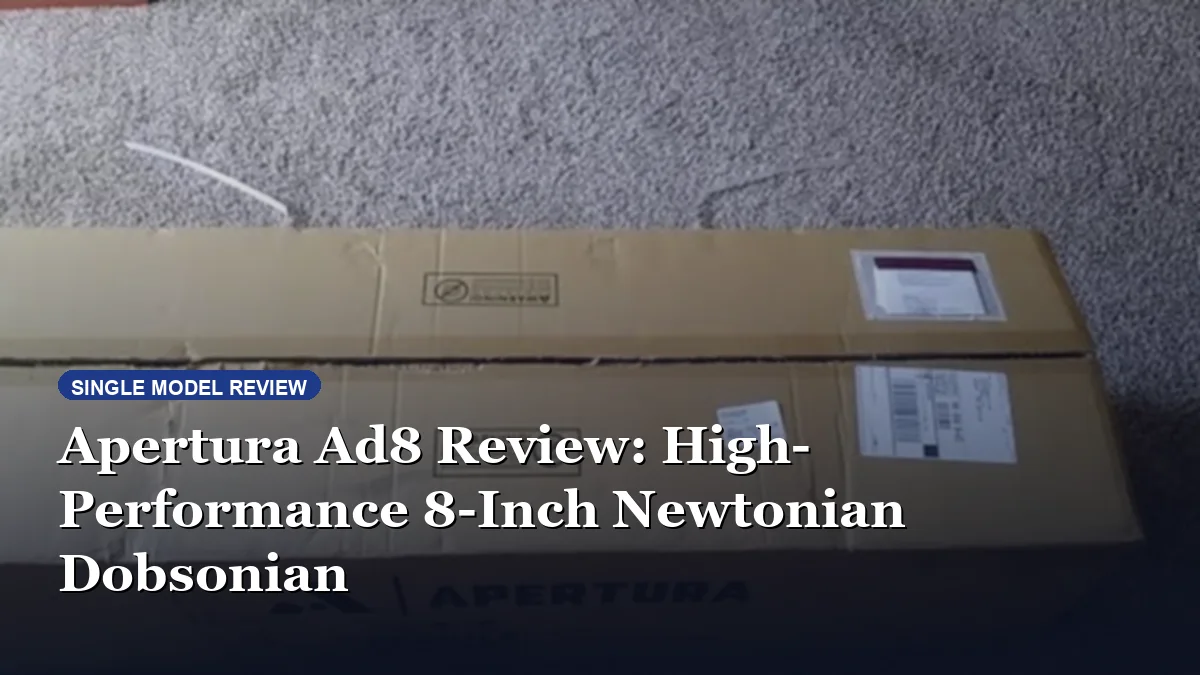

This Newtonian reflector provides unmatched light-gathering power for its price class. Its smooth mechanical motion makes manual tracking effortless under dark skies.
See our flagship Best Telescope: Top Backyard Picks for Astronomy.
Verified Specifications
| Optical Design | Newtonian Reflector |
|---|---|
| Aperture | 203mm (8 inches) |
| Focal Length | 1200mm (f/6) |
| Primary Mirror | Parabolic Pyrex, 93% reflectivity |
| Focuser | 2-inch Crayford-style with 1.25-inch adapter |
| Mount Type | Dobsonian altitude-azimuth base |
| Finderscope | 8x50 right-angle correct-image |
| Total Weight | Approx. 49 lbs assembled |
What We Liked
- Exceptional optical clarity featuring a parabolic primary mirror.
- Includes a dual-speed 2-inch Crayford focuser for precise adjustments.
- Comprehensive accessory bundle including high-grade eyepieces and cooling fan.
- Sturdy wooden base ensures minimal vibration during high-power viewing.
Trade-Offs
- Heavy two-piece assembly requires dedicated vehicle storage space.
- Manual tracking requires user familiarity with alt-azimuth movements.
- Collimation alignment is regularly required to maintain peak sharpness.
Optical Engineering and Mirror Quality
The primary mirror utilizes a parabolic glass surface designed to eliminate spherical aberration entirely. This precise curve ensures that incoming starlight converges cleanly onto a single focal plane.
Enhanced aluminum coatings deliver an impressive reflectivity rating of roughly ninety-three percent. Furthermore, our detailed comparison review examines how competing mirror coatings perform under rigorous astronomical testing standards.
The parabolic primary mirror features a focal length of 1200mm operating at an f/6 focal ratio, delivering exceptional visual sharpness across wide fields while minimizing inherent chromatic aberration completely.
Enhanced aluminum coatings yield 94 percent reflectivity on both primary and secondary surfaces, maximizing light throughput for faint deep-sky targets and maintaining contrast during high-magnification planetary observation sessions.
- 203mm clear aperture diameter
- Pyrex glass substrate for thermal stability
- Enhanced aluminum optical coatings
Primary Mirror Specifications
Precision grinding standards dictate that surface irregularities remain well below fractional light wavelengths. This strict manufacturing tolerance directly prevents image scattering during high-magnification planetary sessions.
- Sub-nanometer smoothing tolerances
- Strict diffraction-limited performance metrics
Mechanical Stability and Base Construction
Particle board and melamine construction form a remarkably rigid rocker box that dampens environmental vibrations effectively. Heavy-duty side bearings utilize Teflon pads for exceptionally smooth movement.
Tension springs on both altitude axes allow users to adjust manual resistance according to heavy eyepiece loads. This feature prevents unwanted tube drifting when swapping optical components.
Constructed from high-density particle board with a melamine coating, the rockerbox base provides rigid structural stability that dampens vibrations within two seconds during manual tracking at high powers.
Teflon bearing pads paired with a roller bearing azimuth base ensure silky-smooth rotational movement, preventing stiction and allowing astronomers to center targets effortlessly without sudden jerky adjustments.
- Melamine-laminated particle board base
- Teflon altitude and azimuth bearings
- Adjustable altitude tension clutches
Video Review: Apertura AD8 Dobsonian Review | High Point Scientific
Focuser Precision and Optical Accessories
A dual-speed Crayford focuser provides a ten-to-one reduction gear for ultra-fine focus control. This mechanical advantage eliminates image shift entirely during delicate high-power lunar observations.
Included factory accessories feature a wide-field eyepiece and a bright optical finderscope for fast alignment. The right-angle correct-image finder drastically reduces neck strain during zenith pointing.
The dual-speed Crayford focuser utilizes a 10-to-1 reduction gear ratio, allowing micro-metric adjustments necessary for achieving razor-sharp focus during high-resolution lunar and planetary imaging endeavors.
Included accessories feature an 8x50 right-angle finder for comfortable alignment, a 2-inch dual-extension adapter, and two fully coated eyepieces providing versatile magnification steps right out of the box.
- 2-inch Crayford dual-speed focuser mechanism
- 8x50 right-angle correct-image finderscope
- Included 30mm wide-field 2-inch eyepiece
Real-World Deep-Sky and Planetary Output
An eight-inch light gathering aperture resolves intricate details inside globular clusters and galaxies. Faint spiral arms and planetary nebula structures become distinctly visible under dark sky conditions.
Planetary performance reveals subtle cloud belts on Jupiter and crisp Cassini division rings around Saturn. Thermal seeing conditions often limit magnification long before optical resolution limits are reached.
Under dark skies, the aperture light grasp resolves spiral structure in distant galaxies. Our detailed technical showdown evaluates similar Dobsonian setups to help you select the ideal optical instrument.
Planetary performance reveals subtle Jovian cloud belts, the Cassini division in Saturn's rings, and polar ice caps on Mars when seeing conditions permit stable high-power magnification usage.
- Resolves deep-sky Messier catalog objects easily
- Exposes fine planetary atmospheric details
- Performs exceptionally well in dark rural skies
Thermal Management and Cool-Down Efficiency
Large glass masses require adequate thermal equilibrium time before delivering optimal high-power clarity. An included battery-powered cooling fan accelerates this mirror adaptation process substantially.
Venting stagnant boundary layers prevents internal tube currents from degrading fine planetary contrast. Running the rear fan for thirty minutes before observing ensures sharp thermal stability.
A built-in cooling fan powered by a battery pack accelerates mirror thermal equilibrium, drastically reducing the time required for the glass substrate to match ambient nighttime temperatures.
Minimizing internal tube currents prevents boundary layer turbulence from degrading image sharpness, ensuring optimal optical performance shortly after transporting the telescope outside into cooler air.
- Built-in rear primary mirror cooling fan
- Accelerates thermal equilibrium with ambient air
- Prevents internal optical boundary layer turbulence
Setup Ergonomics and Field Portability
Transporting this system requires managing two separate components: the optical tube assembly and wooden base. While manageable, the combined weight demands careful lifting techniques.
Field assembly takes under two minutes using the tool-free altitude knobs provided in the box. Carrying handles built into the base simplify short backyard transit routes.
Weighing roughly 45 pounds total when fully assembled, the optical tube assembly requires separate transport from the heavy base to maintain manageable lifting loads for single-person field deployment.
Integrated carrying handles on the rockerbox and balance adjustment points facilitate secure transport. Our technical equipment comparison evaluates how various mount designs handle field portability and weight distribution.
- Two-piece modular transport design
- Tool-free altitude attachment hardware
- Integrated carrying cutouts on base
Maintenance Protocols and Mirror Care
Routine collimation checks using a laser tool ensure perfect optical alignment before every session. Periodic primary mirror cleaning remains necessary only after extensive dust accumulation.
Keeping mirror coatings protected from dew and dust prolongs the lifespan of reflective surfaces. Storing components indoors with dust caps secured prevents environmental moisture damage.
Collimation using a laser collimator takes under three minutes thanks to rear thumb screws on the primary mirror cell that maintain optical alignment through rough vehicle transport.
Periodic mirror cleaning requires mild dish soap, distilled water, and zero-contact soaking methods to protect the delicate reflective aluminum coatings from scratching during routine maintenance procedures.
- Requires periodic laser collimation checks
- Protective dust covers included standard
- Accessible mirror cell for maintenance
Definitive Buyer Verdict
This reflector represents the benchmark for pure visual astronomy performance and value. Its optical excellence outweighs the minor inconvenience of manual tracking.
Beginners and intermediate observers alike will find endless stellar targets within this robust Newtonian platform. Anyone prioritizing aperture over electronic automation should consider this telescope.
This Newtonian reflector delivers unmatched optical performance and comprehensive accessories. Our deep technical comparison weighs larger aperture options against standard models to guide your purchase decision.
Solid mechanical construction combined with thoughtful engineering details ensures reliable operation across countless observing sessions, solidifying its reputation as a benchmark instrument within amateur astronomy circles.
- Best-in-class value for pure visual astronomy
- Ideal for dedicated deep-sky observers
- Requires willingness to handle manual tracking
Frequently Asked Questions
How often does the Apertura Ad8 require mirror collimation?
Collimation must be thoroughly verified prior to every single observing session using a reliable laser collimator or a traditional Cheshire eyepiece to ensure absolute peak performance under high magnification.
Maintaining this precise optical alignment consistently guarantees razor-sharp planetary views alongside maximum light transmission across all faint deep-sky targets without exception.
Can astrophotography be performed with this Dobsonian telescope?
While long-exposure deep-sky astrophotography is structurally limited by the manual alt-azimuth base design, high-resolution lunar and planetary imaging remain entirely feasible with a specialized camera.
Capturing rapid video frames of bright planets using a dedicated planetary sensor consistently yields stunning high-resolution planetary results during steady atmospheric seeing conditions.
How difficult is the initial setup and assembly process?
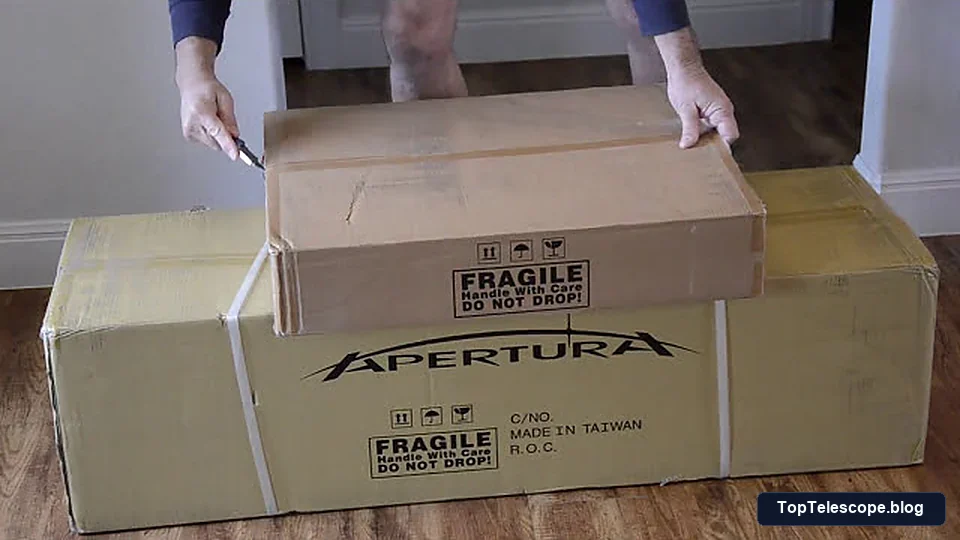
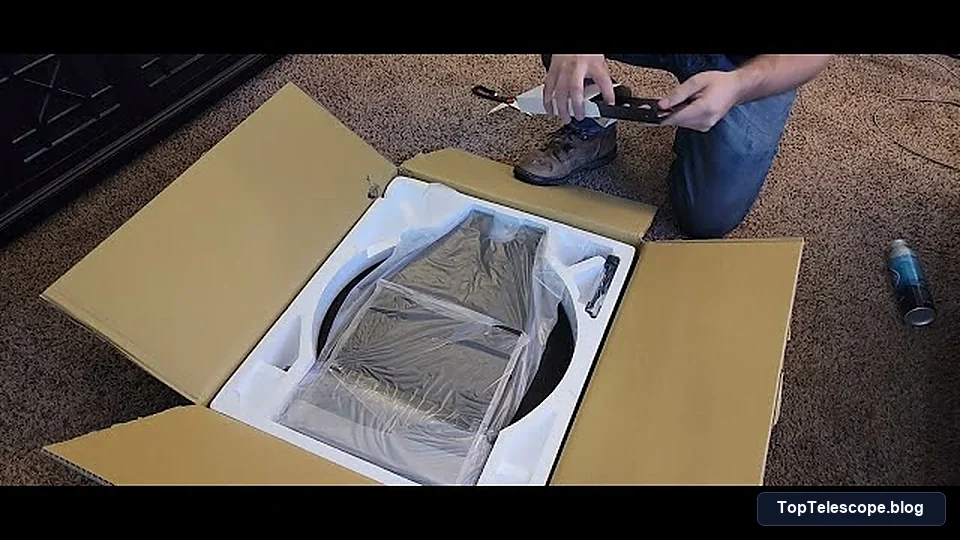
The system arrives in two separate heavy-duty shipping boxes requiring basic hardware assembly for the wooden rocker box and accessory tray using standard tools.
Once fully constructed initially, routine field deployment takes under two minutes utilizing the convenient tool-free altitude tension knobs for quick backyard setup.
What type of power source is required for operation?
The primary optical tube and mechanical base operate entirely through manual user motion without ever requiring internal batteries or complex computer control systems.
However, the included primary mirror cooling fan requires standard household batteries or a portable external power pack to accelerate thermal equilibrium.
Is this telescope suitable for complete beginner astronomers?
Beginners can master manual celestial navigation quite quickly, though the substantial physical size and overall weight require careful handling during transport.
Despite these logistical considerations, its massive light-gathering aperture provides an incredible visual learning experience for novice stargazers exploring deep-sky objects.