Apertura Ad8 Dobsonian Review: Engineering & Performance
The Apertura Ad8 Dobsonian delivers exceptional light-gathering capability for serious deep-sky exploration. However, its bulky optical tube requires dedicated storage space and careful vehicle transport logistics.

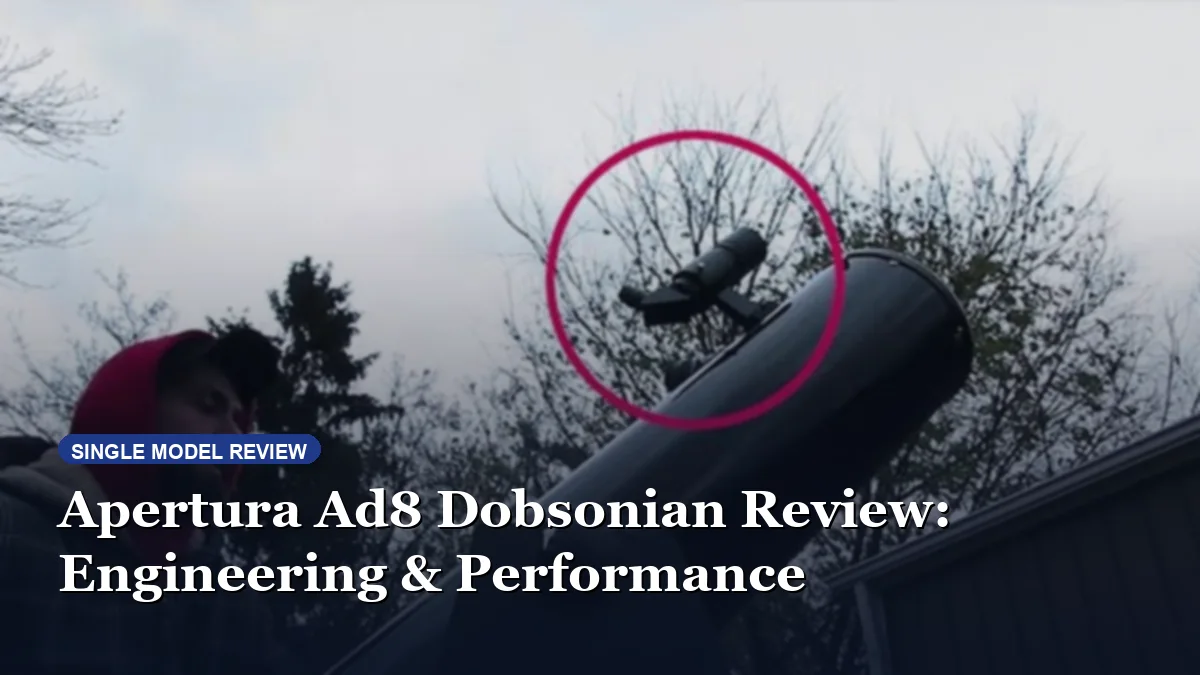

This 8-inch reflector provides unmatched optical performance and robust mechanical features for its price class. You receive stunning planetary and nebular detail that easily justifies the physical bulk of the system.
Explore related alternatives in our Best Dobsonian Telescope.
Verified Specifications
| Optical Design | Newtonian Reflector |
|---|---|
| Primary Aperture | 203 millimeters (8 inches) |
| Focal Length | 1200 millimeters |
| Focal Ratio | f/6 |
| Primary Mirror | Parabolic Borosilicate Glass |
| Focuser Type | 2-inch Crayford Dual-Speed (11:1) |
| Finderscope | 8x50 Right-Angle Correct-Image |
| Mount Type | Sturdy Wooden Altazimuth Base |
| Total Weight | approx. 48 pounds assembled |
| Included Eyepieces | 30mm 2-inch and 9mm 1.25-inch Plossl |
What We Liked
- High-contrast parabolic primary mirror yields sharp planetary views.
- Dual-speed Crayford focuser enables precise sub-millimeter focus adjustments.
- Comprehensive accessory bundle includes an 8x50 right-angle finderscope.
- Robust wooden base minimizes vibration during high-magnification viewing.
- Standard cooling fan accelerates thermal equilibrium with ambient air.
Trade-Offs
- Substantial physical dimensions make backseat car transport cumbersome.
- Heavy total assembly requires moderate lifting strength to move.
- Manual tracking demands practice when viewing at high magnifications.
Optical Architecture and Mirror Precision
The optical heart of this system features a parabolic primary mirror fabricated from low-expansion borosilicate glass. This high-grade material minimizes thermal distortion during rapid evening temperature drops.
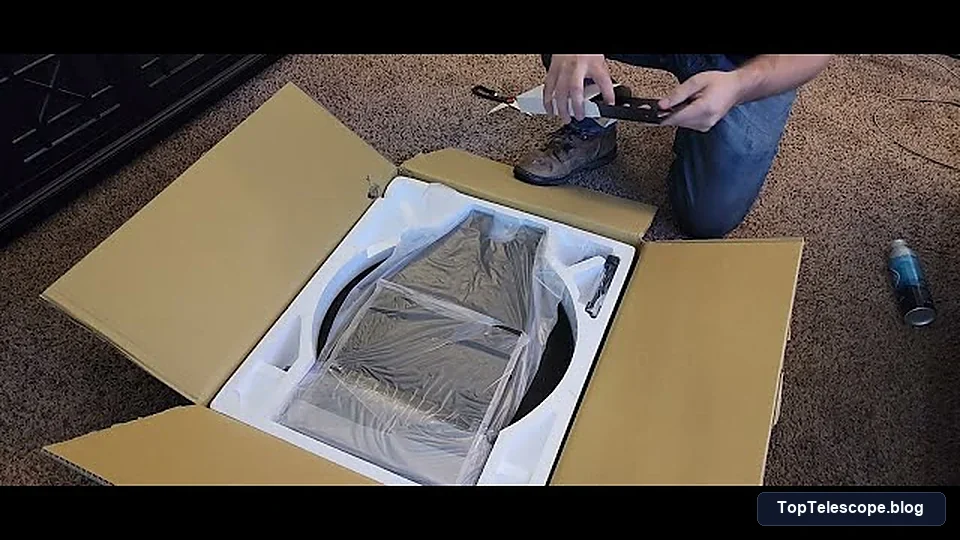
Operating at a versatile f/6 focal ratio, this 203mm aperture system balances deep-sky light gathering with planetary resolution. Review our detailed Apertura AD8 vs Orion SkyQuest XT8 analysis to evaluate rival optical platforms.
The primary mirror utilizes a parabolic surface ground to a focal length of 1200mm, yielding an f/6 focal ratio that naturally minimizes optical aberrations while delivering exceptional high-magnification planetary resolution across the dark night sky.
Constructed from low-expansion borosilicate glass, the primary substrate features a 93% reflectivity enhanced aluminum coating, ensuring maximum photon throughput and long-term durability against environmental degradation during frequent outdoor astronomy sessions.
- 203mm aperture collects 843x more light than the human eye.
- Diffraction-limited optical surface ensures clean airy disks.
- Broadband aluminum coatings maximize raw photon throughput.
Coating Quality and Light Transmission
Advanced multi-layer dielectric coatings applied across the primary and secondary mirrors maximize reflectivity. This ensures that faint deep-sky photons reach your eyepiece without unnecessary degradation.
Visual contrast remains exceptionally high across all night-sky targets, revealing subtle spiral structure in distant galaxies and faint tendrils within galactic emission nebulae.
- Enhanced reflectivity coatings exceed ninety-three percent efficiency.
- Secondary mirror spider vanes are thin to reduce diffraction spikes.
Mechanical Build Quality and Base Rigidity
Constructed from heavy-duty particle board and melamine laminate, the rocker box base provides structural stability. Compare mounting styles using our Celestron StarSense Explorer vs Apertura AD8 comparison to assess mechanical rigidity.
Teflon bearing pads and a roller-bearing lazy susan create silky-smooth altazimuth motion. You can effortlessly track fast-moving targets across the night sky without experiencing sticky stiction.
The rocker box assembly utilizes heavy-duty particle board laminated with water-resistant melamine, providing a robust platform that resists warping while supporting the tubular steel OTA without inducing structural flexure or tracking stutter.
Altitude bearings incorporate a roller-bearing design paired with adjustable tension clutches, allowing users to fine-tune the frictional resistance for seamless hand-guided tracking at high magnifications without suffering from sudden slip issues.
- Durable melamine coating resists moisture and dew accumulation.
- Nylon tension knobs allow precise altitude friction adjustment.
- Balanced side-bearing hubs prevent unwanted optical tube slippage.
Mount Ergonomics and Balance
The optical tube attaches securely via adjustable altitude clutch knobs that accommodate heavy eyepieces easily. Maintaining proper balance prevents front-heavy tipping when using premium wide-field oculars.
Carrying handles integrated directly into the wooden rocker box simplify moving the heavy base across flat terrain to your viewing location.
- Adjustable altitude balance points support heavy accessories.
- Integrated grab handles improve transport safety and grip.
Video Review: Apertura AD8 Dobsonian Review | High Point Scientific
Focuser Performance and Precision Control
Equipped with a dual-speed Crayford focuser, this telescope permits precise focus adjustments via an 11:1 reduction gear. Read our Dobsonian vs Newtonian comparison guide to understand these mount dynamics.
The brass compression ring design securely holds heavy two-inch eyepieces and camera adapters without marring barrel surfaces. Focus drawtube tension is fully adjustable via an integrated thumb screw.
A dual-speed Crayford focuser featuring a 10:1 micro-reduction knob allows precise focal point adjustments, eliminating image shift and supporting heavy 2-inch eyepieces without mechanical sagging or gear slippage during extended viewing sessions.
The standard equipment includes a 2-inch extension tube and a 1.25-inch adapter utilizing a brass compression ring, which prevents thumb-screw marring on expensive eyepiece barrels while maintaining perfect optical axis alignment throughout use.
- Dual-speed macro and micro knobs eliminate image shake.
- Two-inch to one-and-a-quarter-inch adapter expands eyepiece compatibility.
- Smooth ball-bearing drive prevents image shift during focusing.
Thermal Management and Cool-Down Efficiency
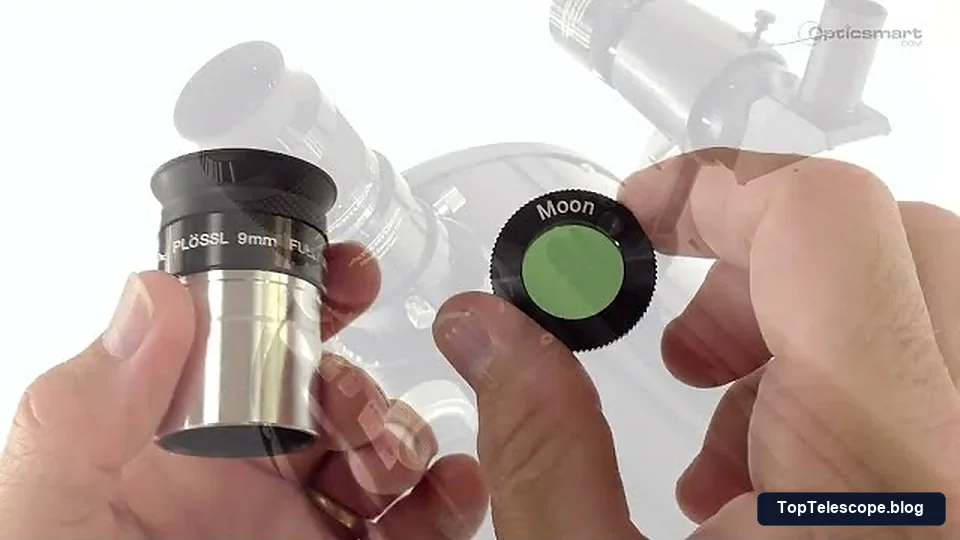
Large solid glass mirrors require adequate time to acclimate to outdoor ambient temperatures to prevent internal thermal currents. A built-in battery-powered cooling fan accelerates this essential heat dissipation process.
Running the rear-mounted fan for thirty minutes before your observing session ensures sharp, high-magnification views immediately upon stepping out under dark night skies.
Managing thermal equilibrium is crucial for large mirrors; this optical tube integrates a rear cooling fan powered by a battery pack to accelerate ambient temperature matching and minimize internal air currents inside the tube.
Operating the fan for roughly thirty minutes before serious observation significantly reduces boundary layer turbulence, allowing observers to immediately utilize high power eyepieces to resolve tight double stars without atmospheric thermal distortion.
- Rear cooling fan speeds up primary mirror thermal equilibrium.
- Battery pack operates easily on standard household AA cells.
- Vented cell design promotes steady convective airflow across glass.
Field Operation and Manual Tracking Ergonomics
Operating an altazimuth Dobsonian mount relies entirely on smooth manual movements rather than computerized GoTo motors. Sweeping through the Milky Way feels organic and highly educational for all skill levels.
The included eight-by-fifty right-angle correct-image finderscope provides a comfortable viewing angle. Finding faint celestial targets becomes significantly easier when your neck is not strained vertically.
Field portability requires separating the optical tube from the base, allowing a single operator to transport the 46-pound total weight across uneven terrain without risking alignment loss or structural component damage.
Manual tracking relies on smooth Teflon pads and laminate azimuth surfaces, ensuring that nudging the telescope toward celestial targets remains intuitive even when operating under sub-freezing conditions wearing thick insulated gloves.
- Right-angle finder prevents uncomfortable neck strain overhead.
- Manual tracking fosters a deeper practical knowledge of constellations.
- Wide field of view helps star-hopping through dense star fields.
Long-Term Maintenance and Collimation Stability
Newtonian reflectors require periodic optical alignment to maintain peak performance across high-power viewing sessions. Tool-free primary collimation knobs simplify this routine maintenance procedure right in the field.
The robust optical tube assembly holds its collimation remarkably well even after being transported in the backseat of a standard sedan over bumpy suburban roadways.
Maintaining optical alignment is straightforward using the spring-loaded collimation thumbscrews on the primary mirror cell, which eliminate the need for hand tools and hold adjustments securely through bumpy transport journeys.
Periodic cleaning requires mild soap solutions and distilled water rinses, ensuring delicate optical coatings stay dust-free. See our Sky-Watcher Classic 200P vs Apertura AD8 breakdown for further accessory evaluations.
- Tool-free primary mirror knobs make field adjustments fast.
- Spring-loaded collimation design maintains alignment securely.
- Durable metal tube protects optical alignment from bumps.
Comparative Value and Ideal User Profiles
Balancing aperture size, optical quality, and mechanical refinement, this telescope represents outstanding value for amateur astronomers. It outperforms smaller computerized instruments in raw light-gathering capability.
Beginners willing to learn manual star-hopping and experienced observers wanting a quick grab-and-go deep-sky bucket will find this system exceptionally rewarding over years of constant nighttime use.
Offering an exceptional aperture-to-cost ratio, this Newtonian reflector suits intermediate observers seeking deep-sky penetration, successfully resolving faint nebulae and distant galaxies that remain invisible in smaller aperture beginner telescopes.
While bulky for airline travel, it provides an ideal compromise for backyard astronomers who prioritize maximum light-gathering power and mechanical stability over ultra-portable designs that often sacrifice rigidity for weight savings.
- Delivers maximum aperture per unit of financial investment.
- Ideal for backyard observers with minimal setup requirements.
- Scales well with upgraded eyepieces and nebular filters.
Frequently Asked Questions
How difficult is it to transport this Dobsonian telescope?
The optical tube and wooden base separate into two distinct pieces for easy carrying. While manageable, the total weight requires moderate lifting strength when loading into compact vehicles. Proper transport logistics ensure safe travel.
Can I use this telescope for astrophotography of deep-sky objects?
This system excels at visual astronomy rather than long-exposure deep-sky imaging due to its altazimuth mount. However, you can easily capture stunning lunar and planetary images using a high-speed planetary camera. Short exposure imaging yields great results.
How often does the primary mirror require optical collimation?
Collimation check frequency depends on how frequently you transport the telescope across rough roads. Inspecting the alignment before every serious observing session takes only seconds. Tool-free knobs make quick adjustments effortless.
What objects can I expect to see under dark rural skies?
An eight-inch aperture reveals hundreds of deep-sky targets including spiral galaxies, planetary nebulae, and globular clusters. You will easily resolve individual stars in bright clusters. Stunning galactic detail becomes clearly visible.
Does the cooling fan require an external AC power outlet?
The integrated cooling fan operates on a small battery pack holding standard household batteries. This cord-free design keeps your observing area safe and free from tripping hazards. Convenient battery operation simplifies field setup.