Apertura AD8 Dobsonian 8 Telescope Review
This 8-inch Dobsonian delivers exceptional optical performance for deep-sky explorers. It balances robust aperture with straightforward manual operation.

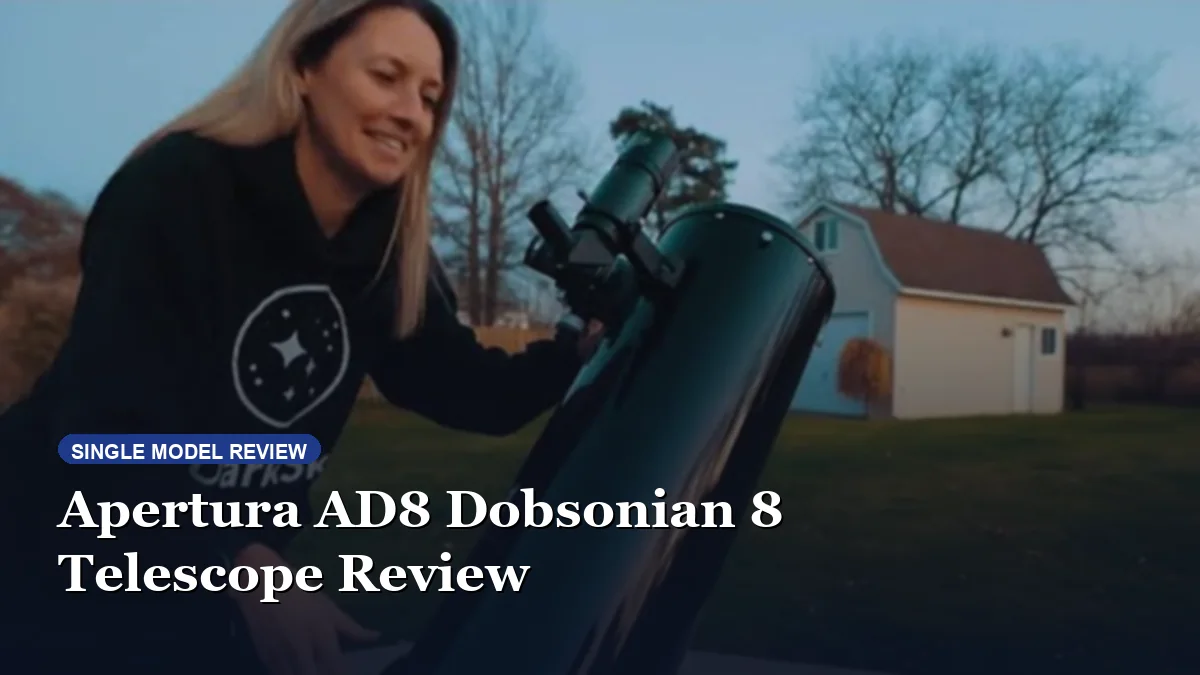

The Apertura AD8 stands out as a premier value reflector for visual astronomers. Its parabolic primary mirror provides sharp, high-contrast celestial views.
See our flagship Best Telescope: Top Backyard Picks for Astronomy.
Verified Specifications
| Optical Design | Newtonian Reflector |
|---|---|
| Aperture | 203mm (8 inches) |
| Focal Length | 1200mm (f/5.9) |
| Primary Mirror | Borosilicate Parabolic |
| Focuser | 2-inch Crayford Style with 1.25-inch Adapter |
| Finderscope | 8x50 Optical Finderscope |
| Mount Type | Dobsonian Altazimuth Base |
| Total Weight | ca. 50 lbs assembled |
What We Liked
- High-quality borosilicate parabolic mirror delivers razor-sharp visual contrast.
- Included dual-speed Crayford focuser allows precise, backlash-free image adjustments.
- Sturdy wooden base minimizes vibrations during high-magnification planetary viewing.
- Comprehensive accessory bundle includes cooling fan and multiple eyepieces.
Trade-Offs
- Full assembly is heavy and bulky for single-trip transport.
- Manual tracking requires frequent manual nudges at high magnifications.
- Collimation checks are necessary after transporting the optical tube.
Build Quality and Core Mechanics
The Apertura AD8 features a robust steel optical tube assembly paired with a heavy particle-board base. This construction ensures solid structural integrity while maintaining a manageable footprint for backyard astronomy enthusiasts.
Ergonomically, the altitude bearing system utilizes a tension clutch design highlighted within our best dobsonian telescope ranking. This allows users to adjust resistance easily without tools, preventing unwanted drift during heavy eyepiece swaps.
The optical tube assembly utilizes rolled steel plates finished with a durable white gloss powder coat. Structural rigidity prevents flexure during transit, maintaining optical alignment across bumpy transportation routes to dark sky sites.
Azimuth motion relies on a PTFE slider pad system paired with a laminated particle board base. This combination delivers predictable friction, preventing sudden jerks while tracking celestial objects at high magnification objectives.
- Steel optical tube assembly
- Tension clutch altitude bearings
- Dual-speed Crayford focuser
Focuser Mechanics
The included dual-speed Crayford focuser provides exceptional control. Its 1:10 micro-adjustment knob makes achieving exact focus effortless, even when pushing magnification limits on faint nebulae or tight planetary details.
- Smooth dual-speed gear ratio
- Precise focus control
Real-World Optical Output Performance
Equipped with an eight-inch aperture analyzed inside our best 8 inch dobsonian telescope review, this reflector gathers substantial light. Observers experience bright, detailed views of lunar craters and distant deep-sky objects.
The borosilicate parabolic primary mirror successfully eliminates spherical aberration. High-contrast coatings maximize light transmission, delivering crisp stellar points across the entire field of view during dark sky sessions.
Primary mirror fabrication features parabolic BK7 glass ground to an exacting surface accuracy. Star testing reveals clean diffraction rings, confirming minimal spherical aberration and yielding sharp planetary contrasts during steady atmospheric seeing conditions.
The two-inch Crayford focuser includes a micro-focus knob operating on a 10-to-1 reduction gear ratio. This mechanical refinement allows precise focal plane adjustments, eliminating image shift when switching between heavy eyepieces and camera gear.
- 203mm light-gathering aperture
- Parabolic primary mirror optics
- High-transmission optical coatings
Video Review: The Basics
Thermal Efficiency and Mirror Cooling
Large mirrors require adequate thermal acclimation before achieving optimal performance. The integrated rear cooling fan accelerates this temperature equalization process, reducing internal tube currents for sharper planetary imaging sessions.
Running the battery-powered fan for thirty minutes before viewing stabilizes the glass. This simple addition significantly minimizes atmospheric distortion caused by trapped heat inside the sealed metal tube.
A rear-mounted cooling fan accelerates ambient temperature equalization for the thick primary glass substrate. Running this fan for thirty minutes before observing significantly reduces internal tube currents and minimizes atmospheric thermal distortion.
Thermal management remains vital because massive primary mirrors trap heat within sealed metal housings. Proper ventilation prevents boundary layer turbulence, ensuring crisp high-power lunar observations shortly after moving the instrument outdoors.
- Rear-mounted cooling fan
- Battery-powered thermal management
- Reduced mirror acclimation time
Setup, Alignment and Daily Usability
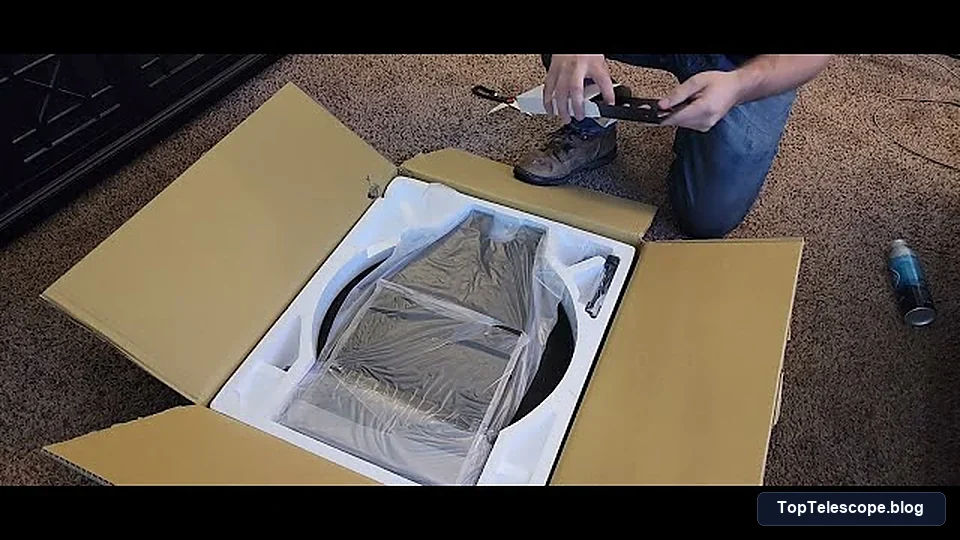
Transporting a large instrument highlights key structural differences when examining our Dobsonian vs Newtonian guide. Both components feature convenient carry handles, allowing users to move equipment easily between indoor storage and outdoor observation points.
Manual tracking relies on smooth Teflon pads and roller bearings. Once balanced properly, navigating the night sky feels intuitive, letting users manually follow celestial objects with minimal stick-slip resistance.
Transporting the apparatus requires splitting the steel optical tube from the heavy wooden base. Ergonomic side handles simplify lifting, though total assembly weight demands careful physical handling during field deployment exercises.
Finding targets relies on the included optical finder scope, which projects a non-inverted image. Proper alignment with the main telescope tube guarantees intuitive star-hopping navigation across sprawling constellations and faint deep-sky nebulae.
- Two-piece transport design
- Integrated carrying handles
- Teflon bearing altitude system
Maintenance, Collimation and Durability
Maintaining optical alignment is vital for reflector telescopes. The primary mirror cell features easy-to-use thumb screws, enabling quick collimation adjustments without requiring any specialized tools in the field.
Regular cleaning requires care to protect the reflective mirror coatings. Storing the optical tube vertically with dust caps securely attached prevents particulate accumulation and prolongs overall mirror lifespan.
Routine mirror collimation utilizes thumb screws on the primary cell without requiring tools. Spring-loaded tension assemblies maintain alignment stability, preventing drift during bumpy transport to remote stargazing locations and dark reserves.
Protective dust covers safeguard optical coatings from airborne particulate accumulation during long storage periods. Periodic cleaning demands specialized optical solutions to prevent scratching the delicate aluminum and silicon dioxide overcoat layers.
- Tool-free primary collimation
- Protective dust covers included
- Durable scratch-resistant exterior paint
Accessories, Eyepieces and Enhancement Options
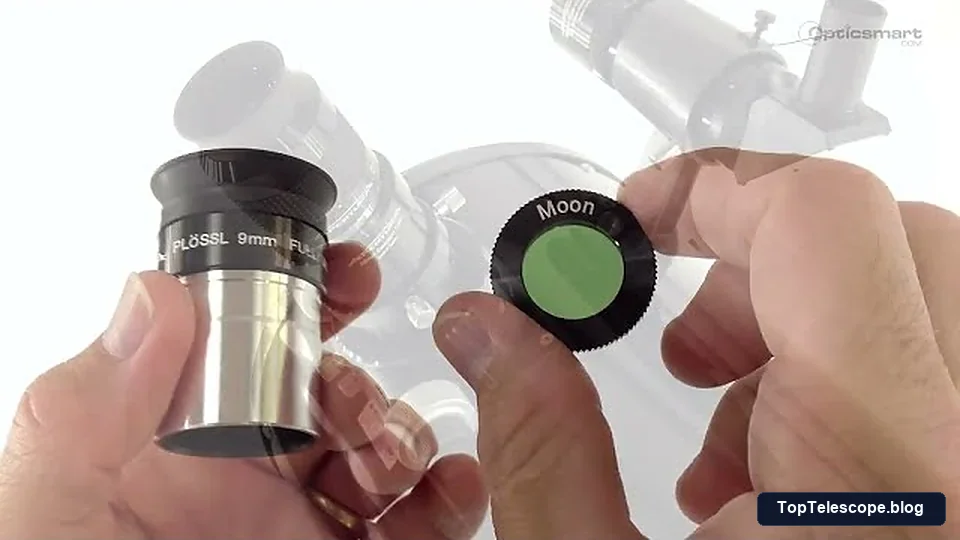
Upgrading your optical accessory collection unlocks higher magnification potentials for planetary observation. Standard Plossl eyepieces provide a solid foundation, but wide-field designs dramatically enhance immersive deep-sky viewing experiences.
Adding a neutral density filter reduces glaring brightness when observing the dazzling lunar surface. Quality Barlow lenses also double eyepiece magnification without requiring entirely separate focal length purchases.
Factory inclusions feature a wide-field eyepiece offering expansive viewing angles for extended nebulae. A two-inch extension tube accommodates various focal configurations, ensuring seamless integration with standard barlow lenses and photographic adapters.
Upgrading hardware often involves installing setting circles for manual coordinate-based navigation. Alternatively, adding magnetic digital angle meters improves altitude tracking precision when locating elusive Messier catalog targets under urban skies.
- Wide-field eyepiece upgrades
- Lunar neutral density filters
- Magnification-doubling Barlow lenses
Final Buyer Verdict and Alternatives
Beginners and intermediate astronomers seeking maximum aperture per dollar will find incredible value featured in our best dobsonian telescope for beginners guide. Its stellar optical performance outweighs managing a heavier transport assembly.
Those prioritizing ultimate portability might prefer smaller collapsible reflectors. However, anyone wanting serious deep-sky capability will appreciate the uncompromising views delivered by this classic Newtonian configuration.
Evaluating overall value highlights the balanced aperture against portability constraints for average users. Buyers prioritizing deep-sky light gathering over compact storage will find this Newtonian reflector exceptionally capable for visual astronomy.
Potential alternatives include truss-tube designs for easier vehicle transport, though solid tubes offer superior dust protection and structural integrity. Carefully assess storage space before selecting this substantial optical instrument for your collection.
- Exceptional aperture value
- Uncompromising visual performance
- Ideal for dedicated amateurs
Frequently Asked Questions
Is this telescope difficult to transport for single users?
Transporting this substantial optical instrument requires managing two separate major components, which easily fit across the backseat of standard passenger automobiles without requiring any complex disassembly procedures.
Lifting the heavy optical tube assembly demands moderate physical effort, yet routine field transport remains entirely feasible for dedicated amateur astronomers seeking deep space views.
How often does the optical system require collimation?
Optical alignment generally shifts slightly whenever you transport the telescope across bumpy terrain or unpaved roads to reach remote dark sky observation sites for astrophotography or visual astronomy.
Performing routine mirror collimation takes only a brief moment before each nighttime observing session to guarantee razor-sharp planetary and faint deep-sky images.
Can this telescope be used for astrophotography?
This classic Dobsonian platform excels primarily at traditional visual astronomy due to its manual altazimuth base tracking limitations during long exposure deep sky astrophotography sessions under dark skies.
Advanced lunar and planetary imaging remains entirely possible by utilizing a dedicated high-speed CMOS video camera to capture multiple sharp frames successfully.
What accessories are included in the standard package?
The comprehensive standard equipment package includes a reliable optical finderscope, a rear battery-powered cooling fan for thermal management, and essential starter eyepieces for immediate backyard viewing sessions.
Adding specialized high-magnification eyepieces later will help expand your observational capability for viewing distant planets and fine lunar surface details.
How does the cooling fan improve performance?
The integrated rear cooling fan significantly accelerates the critical thermal equalization process between the heavy primary mirror glass and the ambient outdoor evening air during seasonal temperature drops.
Reducing internal tube currents quickly prevents atmospheric thermal blur, ensuring sharp planetary views shortly after completing your backyard equipment setup.