Apertura AD10 Dobsonian Review: Optical Power & Ergonomics
This ten-inch reflector delivers exceptional light-gathering capability. Its sturdy mechanical design ensures stable tracking during high-magnification viewing sessions.

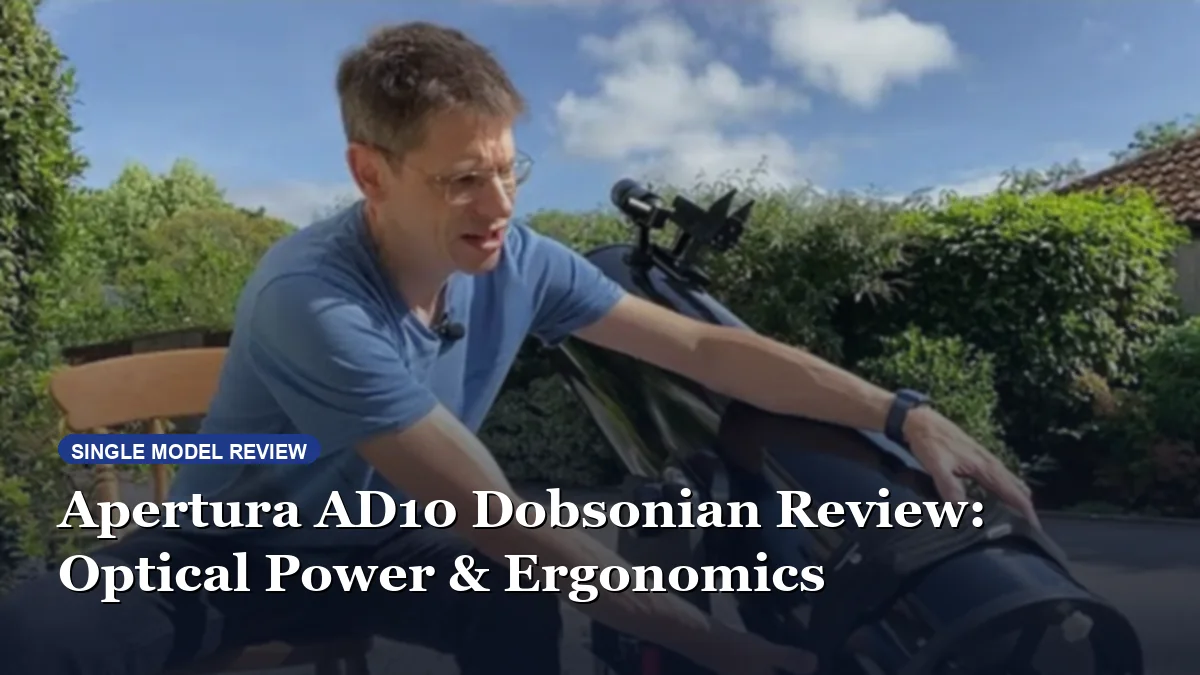

The Apertura AD10 offers unmatched optical value for serious observers. Exceptional mirror quality and robust mechanics make it a premier choice for visual astronomers.
Explore related alternatives in our Best Dobsonian Telescope.
Verified Specifications
| Category / Type | Newtonian Reflector Dobsonian |
|---|---|
| Rated Output / Capacity | 254mm Objective Aperture |
| Power / Motor | Manual Altazimuth Operation |
| Build & Materials | Pyrex Glass Mirror, Laminate Wood Base |
| Operating Noise | Silent Mechanical Movement |
| Duty Cycle / Runtime | Unlimited Visual Observing Sessions |
| Dimensions & Weight | 60 lbs Total Assembled Weight |
| Key Safety & Controls | Dual-Speed Crayford Focuser, Tension Brakes |
What We Liked
- Massive 254mm primary mirror captures incredible faint deep-sky details reliably.
- Dual-speed 10:1 Crayford focuser provides silky micro-metric focusing adjustments.
- Included cooling fan accelerates thermal equalization for faster optical readiness.
- Comprehensive accessory bundle includes finderscope and quality eyepieces.
Trade-Offs
- Combined weight of sixty pounds makes portability challenging for smaller users.
- Particle board base requires protection from heavy moisture and dew accumulation.
Optical Design and Primary Mirror Engineering
The optical tube houses a 254mm parabolic mirror crafted from high-grade optical glass. This generous aperture captures immense starlight, revealing faint deep-sky nebulae and sharp planetary details with ease.
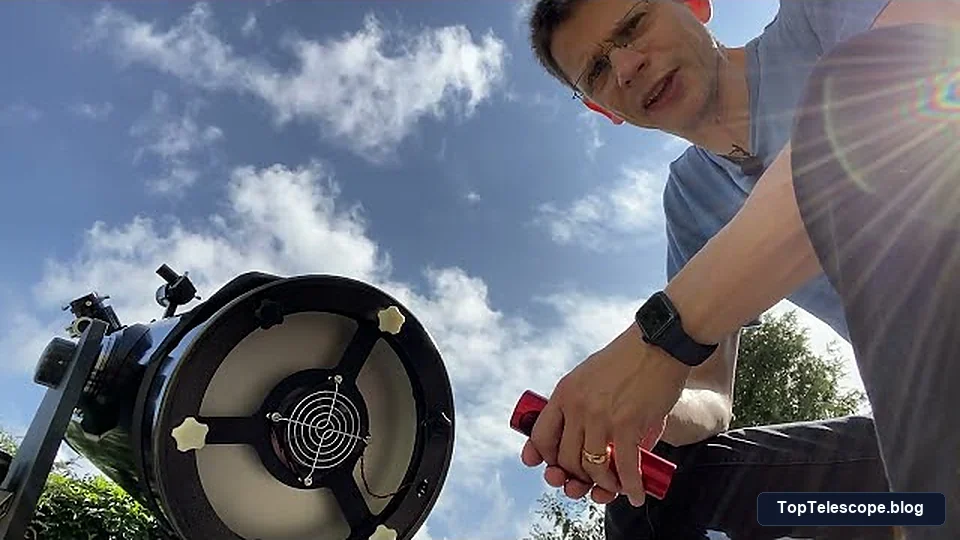
A focal length of 1200mm at f/4.7 strikes an optimal balance. It delivers wide rich-field vistas while supporting high magnification outputs for splitting tight double stars effectively.
The parabolic primary mirror features a 254mm aperture, detailed further in our Apertura AD10 vs Orion XT10 comparison, delivering a fast f/5 optical system that yields rich, wide-field views of faint deep-sky nebulae.
Constructed from low-expansion BK7 glass, the substrate minimizes thermal distortion during rapid temperature shifts, while the 93% reflectivity enhanced aluminum coatings maximize light throughput for exceptionally bright, high-contrast planetary observations.
- Parabolic primary mirror minimizes spherical aberration across wide fields.
- Generous ten-inch light grasp resolves globular clusters brilliantly.
- Fast focal ratio supports wide-angle eyepiece performance without vignetting.
Mirror Coatings and Reflectivity Standards
Enhanced aluminum coatings provide a 93% reflectivity rate. This specialized dielectric overcoat protects the glass substrate from oxidation, ensuring long-term optical efficiency under heavy field use.
Quality optical coatings maximize light transmission directly to the eyepiece lens. Every photon counts when hunting faint distant galaxies hiding in deep space.
- Dielectric protective overcoat prevents premature mirror degradation.
- High reflectivity maximizes image brightness across faint targets.
Mechanical Build Quality and Base Stability
The particle board rocker box features a durable white laminate finish. Heavy-duty Teflon bearings ensure smooth altitude and azimuth movements without unwanted stiction during tracking.
Tension clutches on both altitude bearings allow precise resistance adjustments. Users can balance heavier eyepieces easily without experiencing optical drift or sudden vertical slippage.
The robust particle board rocker box incorporates heavy-duty laminated surfaces for moisture resistance, utilizing tension clutches on the altitude bearings to ensure smooth balancing even when mounting heavy 2-inch ocular accessories.
Azimuth movement relies on a sturdy roller-bearing lazy Susan plate sandwiched between dual melamine boards, providing butter-smooth rotation that eliminates stiction and allows precise manual tracking at high magnifications without target jitter.
- Laminate wood construction resists minor bumps during transport.
- Teflon bearing pads provide buttery-smooth manual tracking motions.
- Adjustable altitude clutches accommodate heavy modular accessory setups.
Base Ergonomics and Mount Mechanics
A sturdy ground board anchors the entire mechanical assembly firmly. Large carrying cutouts simplify lifting the heavy base short distances across uneven terrain.
Precision roller thrust bearings in the azimuth axis eliminate jerky rotations. Smooth panning ensures effortless tracking of fast-moving celestial objects at high power.
- Integrated carrying cutouts improve base portability significantly.
- Thrust bearings ensure effortless horizontal rotation during tracking.
Video Review: Apertura AD10 Dobsonian Telescope 🔴 LIVE Review
Focuser Precision and Eyepiece Integration
A dual-speed Crayford focuser delivers buttery-smooth adjustments. The 10:1 reduction knob allows micro-metric focus tuning, which is essential when observing faint planetary structures at extreme magnification.
The included 2-inch adapter accommodates heavy wide-angle glass elements. Compression rings prevent barrel marring, ensuring your expensive eyepieces remain secure during vertical slewing maneuvers.
Equipped with a dual-speed Crayford focuser, the instrument offers a 10:1 reduction gear ratio that enables microscopic focus adjustments critical for resolving tight double stars and subtle lunar surface features without mechanical backlash.
The drawtube includes a standard 2-inch adapter alongside a 1.25-inch compression ring insert, securing optical accessories safely with brass clamping screws that prevent marring of expensive eyepiece barrels during intense viewing sessions.
- Ten-to-one gear reduction enables pinpoint focus precision.
- Brass compression ring securely holds heavy eyepieces without scratching.
- Robust metal drawtube prevents any mechanical sagging under load.
Accessory Compatibility and Optical Train
Standard 2-inch and 1.25-inch sizing offers endless upgrade paths. Observers can easily integrate barlow lenses, filter wheels, or specialized planetary cameras.
Generous inward focus travel accommodates most DSLR and astro-imaging gear. This versatility expands the scope beyond purely visual observing into casual imaging.
- Standard drawtube sizing fits nearly all aftermarket accessories.
- Sufficient back-focus travel supports basic astrophotography needs.
Thermal Management and Cool-Down Performance
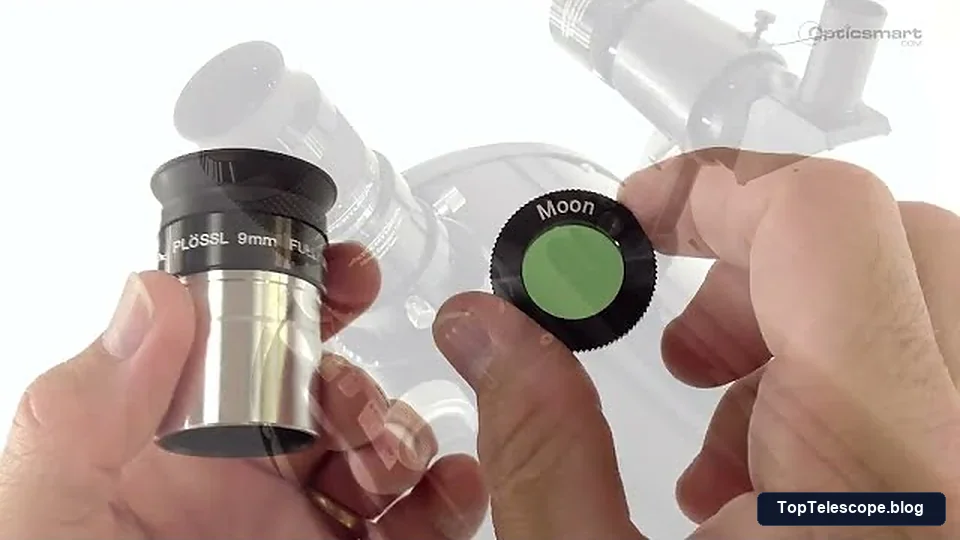
Large mirrors require adequate thermal acclimation before peak performance. A rear-mounted cooling fan accelerates ambient temperature equalization, reducing internal tube currents for crisp planetary imaging.
Proper insulation management prevents boundary layer turbulence directly above the glass surface. Allowing thirty minutes of thermal settling guarantees optimal high-contrast visual output.
Managing boundary layer currents requires active intervention, facilitated by the rear-mounted cooling fan powered by an external battery pack to accelerate thermal equilibrium between the massive glass substrate and ambient evening temperatures.
Operating this exhaust fan for roughly thirty minutes prior to observing sessions drastically reduces internal tube currents, effectively preventing thermal plumes from blurring high-resolution planetary details when observing under changing skies.
- Battery-powered rear fan speeds up primary mirror cooling times.
- Rapid thermal equilibrium eliminates internal tube current distortion.
- Active cooling ensures immediate high-magnification readiness outdoors.
Managing Ambient Temperature Shifts Effectively
Significant nighttime temperature drops challenge large glass mirrors constantly. Running the cooling fan intermittently helps maintain thermal equilibrium as ambient conditions change rapidly.
Eliminating internal heat plumes restores pinpoint star images across the field. Proper thermal care unlocks the true theoretical resolution of your aperture.
- Intermittent fan use counters sudden nighttime temperature drops.
- Thermal management directly preserves high-contrast planetary details.
Usability, Setup, and Field Ergonomics
Transporting a ten-inch reflector requires handling two distinct components, analyzed within our Dobsonian vs Newtonian guide. The optical tube weighs thirty-three pounds, and the solid wooden base adds another twenty-seven pounds.
Ergonomic carrying handles simplify moving the optical tube assembly safely. Setting up the instrument takes less than five minutes on flat, stable ground surfaces outdoors.
Transporting the optical tube assembly requires mindful handling due to its substantial length and weight, yet integrated carrying handles on the metal tube facilitate safe loading into standard automotive backseats for dark-site travel.
Ergonomic placement of the finder scope near the upper optical ring ensures comfortable head positioning, while the right-angle corrector provides upright, unreversed celestial views that minimize neck strain during prolonged zenith observations.
- Two-piece modular design separates weight for easier transport.
- Balanced optical tube simplifies lifting into vehicle backseats.
- Quick assembly process requires no specialized tools whatsoever.
Field Deployment and Operational Workflow
Placing the base on level ground ensures stable tracking performance. Lifting the optical tube into the side cradle requires proper lifting form to prevent strain.
Attaching the finderscope and inserting an eyepiece completes field deployment. You are immediately ready to begin your evening tour of the cosmos.
- Level ground placement guarantees optimal tracking mechanics.
- Simple cradle attachment streamlines nighttime field deployment.
Maintenance, Collimation, and Long-Term Durability
Routine collimation keeps the optical train aligned for sharp views. Center-spot marked primary mirrors simplify using a laser collimator or Cheshire eyepiece during pre-session alignment checks.
Storing the optical tube with dust caps attached protects internal surfaces. Periodic cleaning of the primary glass should only occur when dust accumulation severely impacts contrast.
Routine alignment of the optical train relies on accessible thumb screws on the primary cell, allowing quick field collimation without tools to maintain pinpoint stellar images even after bumpy transit over rough backroads.
Long-term mechanical integrity depends on keeping mirror surfaces pristine by storing the assembly in dry environments, while periodic inspection of base hardware prevents loosening of structural fasteners during active observational use.
- Factory center-spot makes optical collimation fast and accurate.
- Durable exterior finishes resist scratches during routine transport.
- Protective dust covers shield optics between viewing sessions.
Collimation Routine and Optical Alignment
Maintaining precise mirror alignment guarantees maximum image sharpness always. Adjusting the rear primary collimation knobs requires only a few seconds of careful fine-tuning.
Checking collimation before every observing session ensures optimal planetary contrast, noted in our best Dobsonian telescope overview. Regular maintenance preserves the optical integrity of your telescope investment over years of use.
- Easy rear adjustment knobs simplify primary mirror alignment.
- Pre-session checks guarantee peak optical performance every night.
Comprehensive Buyer Verdict and Final Analysis
This Dobsonian system represents the pinnacle of value in amateur astronomy. Outstanding aperture-to-price ratio and robust mechanical features satisfy both novice stargazers and seasoned veterans alike.
Investing in a ten-inch reflector opens up countless deep-sky treasures, as detailed in our Dobsonian vs Newtonian reflector verdict. Despite its physical weight, the optical rewards justify every single transport effort.
Combining stellar light-gathering capacity with robust mechanical engineering, this system offers an unmatched value proposition for intermediate astronomers seeking serious deep-sky performance without entering complex equatorial platform investments.
Careful consideration of physical dimensions and storage requirements ensures long-term satisfaction, confirming that its optical excellence and rugged build quality reward diligent observers across countless nights under dark skies.
- Unbeatable light grasp per unit of financial investment.
- Robust mechanical build ensures decades of reliable stargazing.
- Comprehensive accessory package delivers immediate out-of-box utility.
Who Should Buy This Reflector System?
Intermediate astronomers looking to upgrade will find immense satisfaction here. Beginners with vehicle space and physical strength will also thrive using this instrument.
Avoid this model if portability is your absolute primary concern. Smaller tabletop Dobsonians suit urban apartment dwellers better than large reflectors.
- Ideal for backyard astronomers with dedicated storage space.
- Not recommended for users with strict physical lifting limits.
Frequently Asked Questions
How often does the primary mirror require collimation?
Collimation checks should happen before every single viewing session. Frequent minor adjustments ensure your optical train delivers maximum sharpness and contrast.
Can I use this telescope for astrophotography?
It excels at visual astronomy and casual lunar snapshots. Long-exposure deep-sky imaging remains difficult due to field rotation on Dobsonian bases.
How difficult is transport for a single person?
Transporting the system requires two separate trips for safety. Modular heavy components allow most adults to manage loading without major difficulty.
What power source powers the cooling fan?
A standard battery pack powers the rear cooling fan efficiently. Alkaline battery replacements ensure quick thermal acclimation during cold evening sessions.
Does the package include any eyepieces?
It includes essential starter eyepieces for immediate use. Quality optical accessories provide both wide-field views and high-magnification planetary detail right away.