127Eq Telescope Review: Technical Performance Guide
The Celestron PowerSeeker 127EQ delivers decent light gathering for beginners, though its complex manual equatorial mount demands careful alignment.

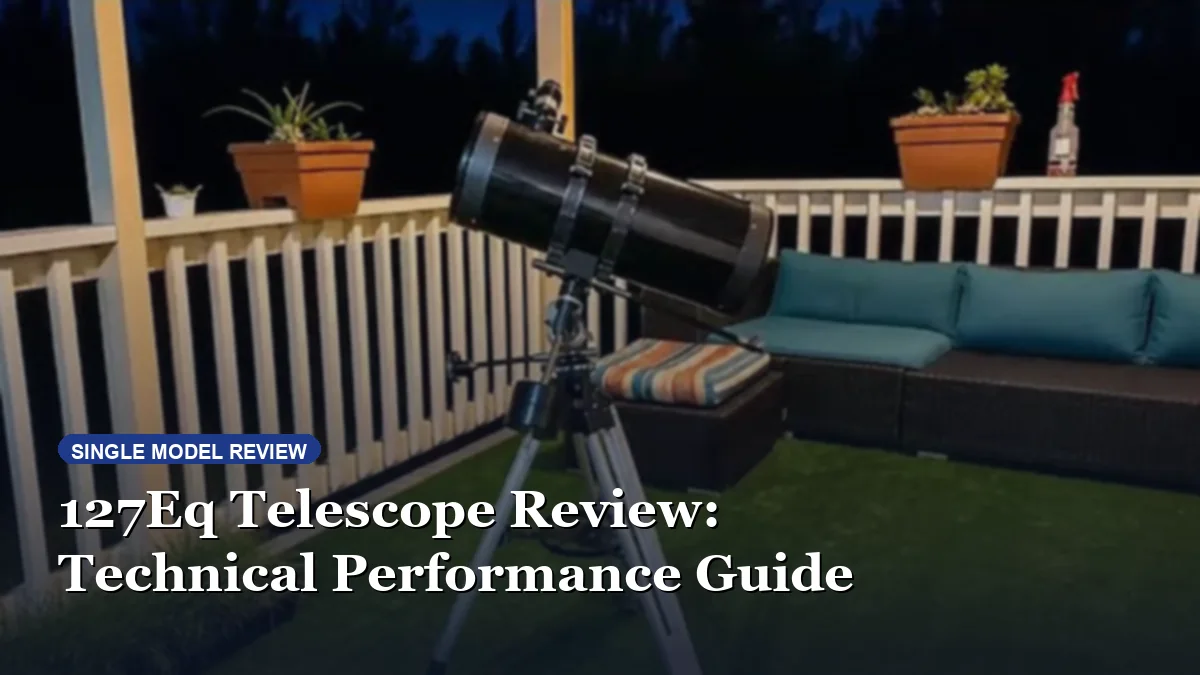

This reflector suits budget-conscious novices willing to learn polar alignment, but advanced users should seek sturdier optics.
See our flagship Best Telescope: Top Backyard Picks for Astronomy.
Verified Specifications
| Category / Type | Newtonian Reflector |
|---|---|
| Rated Output / Capacity | 127mm Objective Aperture |
| Power / Motor | Manual Slow-Motion Control |
| Build & Materials | Aluminum Tube and Tripod |
| Operating Noise | Silent Mechanical Operation |
| Duty Cycle / Runtime | Unlimited Visual Observing |
| Dimensions & Weight | 33D x 33W x 54H inches |
| Key Safety & Controls | Manual Equatorial Mount |
What We Liked
- Generous 127mm light-gathering aperture
- Compact optical tube design for transit
- Includes two eyepieces and 3x Barlow
- Smooth manual slow-motion altitude rods
Trade-Offs
- Tripod transmits minor focusing vibrations
- Complex equatorial setup for absolute novices
- Corrector lens introduces optical limitations
Optical Architecture and Engineering Design
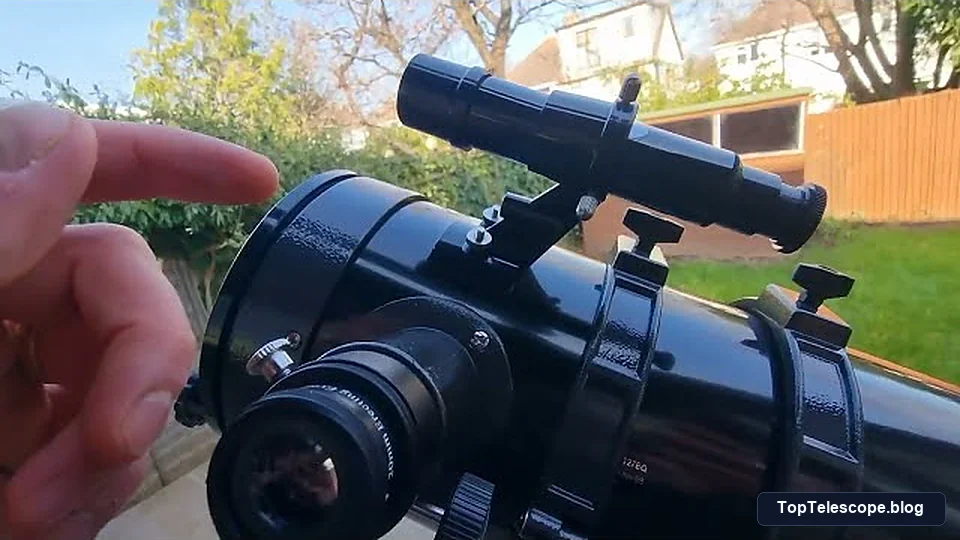
The optical tube features a 127mm objective lens diameter combined with a notable 1000mm focal length. This folded design keeps the physical chassis surprisingly compact for easy transport.
Exploring our best telescope for beginners guide highlights how glass mirrors utilize protective aluminum coatings to preserve reflectivity while managing specific optical trade-offs.
The 127mm aperture primary mirror gathers significant light, while the spherical figure paired with a built-in corrector lens manages focal length extension. This hybrid layout introduces specific optical tolerances requiring careful evaluation.
Manufacturing tolerances dictate that spherical primary mirrors at f/4 base focal ratios rely heavily on the internal corrector to achieve a 1000mm effective focal length. Proper alignment of this optical train remains vital.
- 127mm aperture collects substantial light.
- 1000mm focal length yields high base power.
- Corrector lens alters traditional Newtonian physics.
Internal Optical Components
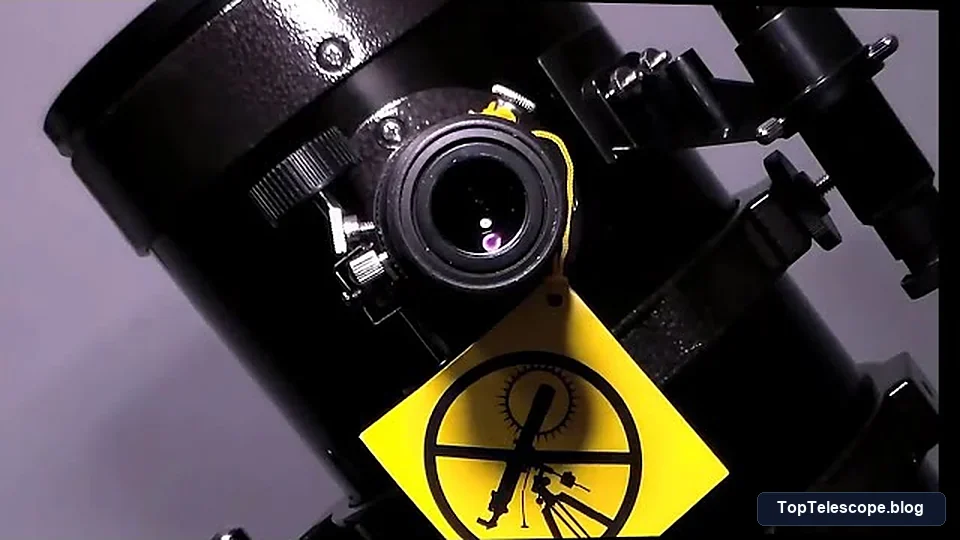
Internal baffling controls stray light reflections inside the lightweight aluminum optical tube. Users must handle the primary mirror cell gently to maintain factory collimation benchmarks during regular transit.
- Baffling reduces stray glare.
- Mirror cell requires gentle handling.
Real-World Astronomical Output and Resolution
Consulting our best telescope for looking at planets review reveals crisp lunar craters alongside sharp views of Jovian cloud bands under steady conditions.
Deep-sky objects like the Orion Nebula appear dim due to the focal ratio constraints. Pairing the system with the included 20mm eyepiece yields moderate fields of view.
Resolving lunar craters demands high contrast, which the 1.10 arcsecond Dawes limit theoretically permits under steady seeing. Users regularly observe Jovian cloud belts and Saturnian rings using medium-power eyepieces like the 10mm design.
Deep-sky performance on Messier objects is governed by light grasp rather than sheer magnification. Dim nebulae require dark skies because the exit pupil drops significantly when pairing short focal length glass with this scope.
- Resolves major planetary features clearly.
- Fails on faint deep-sky nebulae details.
- Eyepieces demand careful focusing adjustments.
High-Magnification Performance
Inserting the bundled 3x Barlow lens pushes magnification to aggressive limits that frequently exceed atmospheric stability. Images often degrade into blurry artifacts unless viewing conditions remain exceptionally calm.
- Barlow lens triples raw power.
- Turbulence degrades high magnification.
Video Review: Celestron 127EQ Telescope Review
Mechanical Rigidity and Thermal Stability
The aluminum tripod provides basic support but suffers from residual vibrations during focusing adjustments. Users must allow sufficient thermal equilibration time before attempting critical high-power planetary observations outdoors.
Plastic accessory trays help stabilize the spreader legs against accidental lateral bumps. Upgrading to heavier damping pads significantly reduces settling times when touching the manual slow-motion control knobs.
Aluminum tripod legs provide baseline support, but the equatorial head encounters dampening time limitations during heavy wind gusts. Securing the spreader tray locks the spider assembly and minimizes unwanted lateral vibration loops.
Glass thermal acclimation requires at least 45 minutes in ambient outdoor temperatures before achieving stable planetary focus. The closed aluminum tube traps air currents, necessitating patience during seasonal temperature drops.
- Aluminum legs transmit slight mechanical vibrations.
- Thermal acclimatization requires thirty cooling minutes.
- Tray integration locks the tripod firmly.
Setup Workflow and Mount Ergonomics
Operating the manual German equatorial mount requires basic understanding of celestial coordinates. Aligning the polar axis toward Polaris lets observers track stars easily using slow-motion altitude rods.
Choosing a quality best telescope option helps balance the optical tube assembly along both axes to prevent excessive internal gear strain during tracking sessions.
Polar alignment mandates setting the latitude scale to your local geographic coordinate and indexing Polaris within the finder scope. Balancing counterweights along the declination axis prevents excessive gear wear over time.
Flexible slow-motion cables allow smooth tracking adjustments without touching the main OTA tube. Proper cable routing prevents snagging during meridian flips and ensures precise manual control during extended viewing sessions.
- Equatorial tracking requires polar alignment.
- Slow-motion rods offer smooth manual tracking.
- Counterweights balance heavy optical tube assemblies.
Maintenance, Collimation, and Long-Term Care
Newtonian reflectors require periodic mirror alignment checks using a simple collimation cap. Dust accumulation on primary glass surfaces demands careful cleaning with specialized optical wipes to prevent scratches.
Storing the optical tube in a dry environment prevents premature coating degradation over seasonal changes. Securing all mounting thumbscrews tightly prevents accidental slippage during transport to remote dark locations.
Collimating a catadioptric Newtonian involves adjusting the primary mirror tilt using rear-mounted hex screws after centering the corrector element. Always utilize a cheshire eyepiece for reliable optical axis verification.
Dust accumulation on the corrector lens demands compressed air rather than liquid solvents to protect optical coatings. Regular fastener checks on the tube ring mounting blocks prevent accidental equipment slippage outdoors.
- Collimation tools ensure sharp focus alignment.
- Regular dusting protects fragile mirror coatings.
- Secure storage prevents optical tube damage.
Comparative Value and Buyer Persona Analysis
Selecting a reliable best starter telescope model appeals directly to beginners seeking an immersive stargazing introduction without encountering overly complex mount mechanics during nighttime sessions.
Families and students benefit from the portable footprint and intuitive assembly process. Careful management of expectations ensures long-term satisfaction with lunar and bright planetary viewing tasks.
Entry-level equatorial platforms suit dedicated hobbyists willing to master manual tracking mechanics rather than casual stargazers seeking instant setup. The optical tube assembly demands patience to bridge the gap toward deep-sky astrophotography.
Budget-conscious beginners find immense educational value in learning manual coordinates and polar alignment fundamentals. Experienced astronomers recognize this setup as a portable field scope for quick visual astronomy excursions.
- Ideal starter kit for enthusiastic novices.
- Not suitable for deep-sky astrophotography.
- Exceptional portability for backyard observing sessions.
Frequently Asked Questions
Can I use this telescope for serious astrophotography?
This manual equatorial system is generally unsuited for serious deep-sky astrophotography because the mount lacks motorized tracking capabilities required for long exposure times.
However, enthusiastic beginners can still capture decent lunar snapshots by mounting a compatible smartphone securely to the eyepiece adapter during favorable planetary alignments without expensive tracking gear.
How do I maintain mirror alignment on this Newtonian reflector?
Collimating a Newtonian reflector requires adjusting the primary and secondary mirror alignment screws carefully until incoming light reflects perfectly and symmetrically.
You should perform this routine maintenance check regularly using a simple laser collimator or Cheshire eyepiece to maintain optimal image sharpness during high-power planetary viewing sessions across the night sky.
What is the actual impact of using the included 3x Barlow lens?
The included 3x Barlow lens triples the magnification power of any inserted eyepiece, but it often pushes optical systems beyond practical limits.
Users frequently experience dimmer, blurrier images because atmospheric turbulence magnifies optical flaws just as much as it magnifies the actual celestial targets you are trying to observe.
Is the German equatorial mount difficult for beginners to operate?
Setting up the German equatorial mount requires pointing the polar axis roughly toward Polaris if you are observing in the Northern Hemisphere.
Mastering this crucial polar alignment process allows you to track celestial objects smoothly by turning only a single slow-motion control rod as Earth rotates.
Why does thermal acclimation matter before viewing planets?
Allowing the optical tube to acclimatize outdoors for at least thirty minutes before viewing helps eliminate disruptive internal thermal air currents.
Managing this temperature stabilization period ensures that residual heat trapped inside the sealed aluminum tube does not degrade fine details when you view high-contrast planetary features.