William Optics Redcat 51 vs Askar Fra400: Concise Verdict
Choosing between these premium astrographs requires balancing focal length reach against ultra-portable field convenience. Both instruments offer exceptional optics, but their distinct engineering approaches serve very different deep-sky imaging workflows.

Choose the William Optics Redcat 51 for ultimate portability and wide-field Milky Way mosaics. Select the Askar Fra400 when you need longer reach, a built-in flattener, and tighter resolution on smaller galaxy targets.
Compare all top models in our Best Telescope: Top Backyard Picks for Astronomy.
Side-by-Side Breakdown
| Criteria | William Optics Redcat 51 | Askar Fra400 | Edge |
|---|---|---|---|
| Core Design / Build | Petzval / 4-element | Quintuplet / Petzval | Askar Fra400 |
| Real-World Performance | 250mm focal length | 400mm focal length | Askar Fra400 |
| Ease of Setup & Use | Ultra-lightweight helical | Rigid rack-and-pinion | William Optics Redcat 51 |
| Durability & Reliability | Premium anodized aluminum | Robust tube rings | Tie |
| Efficiency / Operating Footprint | Compact backpack size | Requires sturdier mount | William Optics Redcat 51 |
| Maintenance Requirements | Standard dust cleaning | Collimation check rarely needed | Askar Fra400 |
| Best Ideal Use Case | Wide nebulae mosaics | Small galaxy details | Split |
Core Design and Optical Engineering
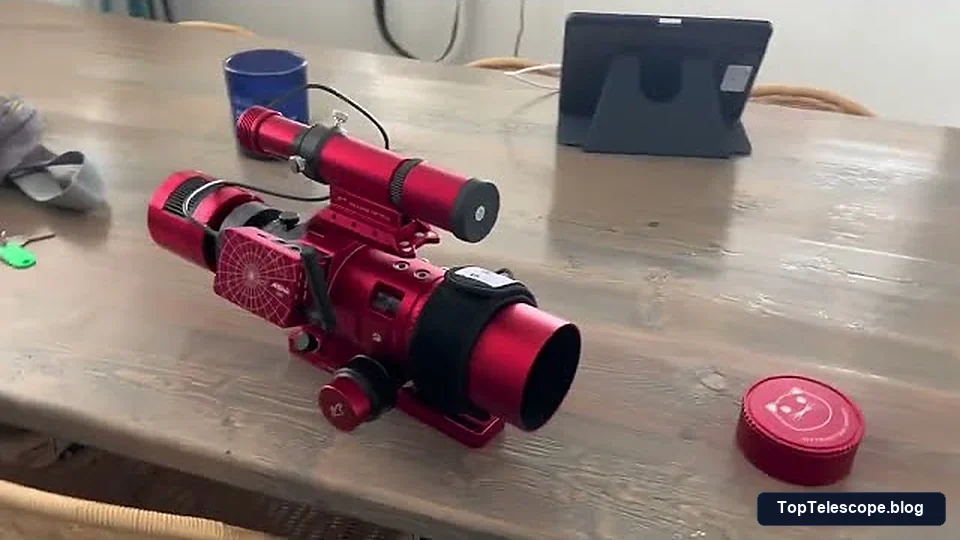
Modern astrophotography demands exceptional glass architectures to eliminate chromatic aberrations across broad spectrums. The William Optics Redcat 51 utilizes a unique 4-element design featuring synthetic fluorite glass.
In contrast, the Askar Fra400 deploys a sophisticated 5-element quintuplet Petzval configuration. This integrated optical layout incorporates two ED glass elements to ensure superior color correction.
The William Optics RedCat 51 utilizes a patented Petzval design with four optical elements. For larger apertures, our William Optics RedCat 71 field review explores comparable mechanical rigidity and imaging performance.
Conversely, the Askar FRA400 employs a quintuplet petzval astrograph configuration featuring a rear flattener built directly into the optical tube assembly, ensuring flat fields across full-frame sensors without external spacers.
- William Optics uses FPL-53 synthetic fluorite glass elements.
- Askar features a built-in correcting lens group natively.
- Both designs eliminate the need for external field flatteners.
Glass Quality and Color Correction
Color fringing ruins high-contrast astrophotography targets like bright star clusters or lunar limbs. Both telescopes manage secondary spectrum dispersion exceptionally well through advanced glass pairings.
Users consistently report pristine stellar profiles across broad luminance filters without ever managing complex back-focus spacing tolerances during nightly field setups.
- Fluorite substrates deliver ultra-sharp contrast profiles.
- Quintuplet layouts suppress chromatic dispersion effectively.
Focal Length and Field of View Realities
Focal length dictates your framing capabilities for expansive nebulae versus tiny planetary nebulae. The Redcat 51 operates at a remarkably wide 250mm focal length, covering enormous celestial expanses effortlessly.
Meanwhile, our detailed Askar FRA400 review highlights how this scope doubles down on reach with a 400mm focal length, isolating smaller galaxies and compact star clusters with striking resolution clarity.
Operating at a native 250mm focal length, the RedCat delivers an exceptionally wide field of view, making it ideal for framing massive emission nebulae like the California Nebula with substantial sky margin.
Stepping up to a 400mm focal length, the Askar FRA400 provides a tighter image scale that resolves smaller galaxies and globular clusters, requiring precise guiding and accurate polar alignment to prevent tracking errors.
- Redcat 51 frames large targets like the Veil Nebula.
- Askar Fra400 resolves details inside the Bode's Galaxy pair.
Sensor Compatibility and Image Circles
Modern CMOS sensors demand large illuminated image circles to prevent unwanted vignetting in corners. The Redcat projects a generous full-frame image circle, satisfying demanding astronomical camera formats.
Similarly, the Askar provides a robust image circle capable of supporting large sensors without noticeable light falloff or optical degradation across the frame edges.
- Full-frame sensors fit both optical trains comfortably.
- Corner sharpness remains high on large chips.
Mechanical Build Quality and Focuser Mechanics
Mechanical rigidity prevents flexure during long exposures. Drawing from insights in our William Optics Zenithstar 73 review, the brand relies on an innovative helical focuser with a precision locking mechanism.
Askar opts for a traditional rack-and-pinion focuser featuring a dual-speed reduction knob. This heavy-duty mechanical approach supports heavier imaging trains without slipping during vertical zenith imaging.
William Optics integrates a helical roto-lock focuser featuring a smooth internal ring mechanism that centers cameras securely without marring adapter surfaces during rigorous cold weather imaging sessions in the field.
The Askar competitor utilizes a robust dual-speed rack and pinion focuser equipped with a 3-inch collar, effortlessly supporting heavy dedicated astronomy cameras and filter wheels without noticeable drawtube slip.
- Helical focusers offer backlash-free manual adjustments.
- Rack-and-pinion designs handle heavy filter wheels easily.
Ring Systems and Dovetail Plates
Mounting hardware must absorb vibrations and secure expensive cameras safely against wind gusts. Both manufacturers supply robust mounting rings and integrated Vixen-style dovetail bars standard.
The included mounting hardware feels reassuringly solid, ensuring your optical tube stays perfectly aligned throughout multi-hour imaging runs under harsh outdoor conditions.
- Anodized aluminum rings resist thermal expansion shifts.
- Integrated mounting bars simplify tripod balancing routines.
Weight, Balance, and Mount Compatibility
Portability heavily influences how often you actually pack your gear for remote dark sky excursions. The lightweight Redcat 51 weighs under three kilograms, making it ideal for star trackers.
Conversely, the heavier Askar Fra400 weighs over three kilograms, demanding a considerably sturdier equatorial mount for optimal tracking stability during long exposure sessions.
As detailed in our Williams Optics RedCat 51 review, this 1.8-kilogram OTA places minimal demands on lightweight tracker mounts, allowing astrophotographers to travel extensively with compact carbon fiber tripods.
Tipping the scales near 2.6 kilograms, the Askar FRA400 demands sturdier intermediate mounts, utilizing an integrated vixen-style dovetail bar and robust mounting rings to maintain rigid mechanical balance.
- Star trackers support the ultra-light Redcat effortlessly.
- Equatorial mounts are necessary for the heavier Askar.
Field Transport and Storage Safety
Transporting sensitive glass requires durable protective cases designed to absorb accidental transit bumps. Both brands include high-quality padded soft or hard cases for safe travel.
Compact physical dimensions allow convenient airline carry-on storage, ensuring your valuable optics travel safely alongside your personal luggage without checked baggage risks.
- Custom foam inserts protect internal optical elements.
- Compact footprints fit standard overhead airline bins.
Field Flattening and Image Circle Coverage
Achieving flat star fields across large sensors requires precise optical correction elements built into the tube. The Petzval design in the Askar natively includes all necessary correcting lenses.
Meanwhile, William Optics integrates its patented flat-field design directly into the optical tube assembly, completely eliminating external back-focus measurement headaches for beginners.
The integrated optical layout of the RedCat projects a clean 44mm image circle, illuminating full-frame sensor diagonals uniformly while maintaining tight spot diagrams across the extreme corners of the CMOS sensor.
Similarly, the Askar FRA400 delivers a corrected 44mm image circle, ensuring stars remain pinpoint across large sensors while avoiding troublesome optical aberrations like field curvature and chromatic fringe artifacts.
- Built-in flatteners remove curved field distortions.
- Back-focus distance calibration becomes entirely unnecessary.
Star Pinpoint Accuracy at Edges
Corner stars reveal the true quality of any flat-field astrograph optical train. Both instruments maintain pinpoint star shapes right up to the extreme sensor corners.
Astrophotographers will truly appreciate the complete absence of coma or astigmatism when pairing these scopes with modern high-resolution monochrome cameras.
- Corner stars remain crisp and round universally.
- Optical aberrations are successfully minimized across frames.
Setup, Calibration, and Field Ergonomics
Streamlined field workflows reduce setup fatigue during freezing late-night imaging sessions. The Redcat features a built-in tilt adjuster and a rotatable camera angle reader for easy framing.
The Askar offers a smooth 360-degree rotator as well, allowing precise framing of elongated galaxies or complex molecular cloud structures without binding cables.
Field deployment of the RedCat is remarkably swift due to its integrated tilt adjuster and built-in camera angle rotator, which streamlines the framing process during freezing astrophotography outings under dark skies.
Setting up the Askar unit requires careful balancing of its longer optical tube, utilizing standard extension tubes when transitioning between visual diagonals and heavy astrophotography camera configurations.
- Rotators simplify target composition without twisting cables.
- Integrated tilt plates correct minor sensor alignment errors.
Focus Precision and Temperature Shifts
Temperature drops cause metal tubes to contract, shifting optimal focus during extended imaging runs. Electronic autofocus motor integration remains straightforward on both optical systems.
Users working in extreme climates will find mechanical focus locks particularly helpful for maintaining absolute sharpness through severe morning temperature swings.
- Focus locks prevent slippage during thermal contractions.
- Electronic bracket kits attach securely to focusers.
Maintenance, Optics Care, and Longevity
Protecting delicate multi-coatings ensures your investment retains peak optical transmission for decades. Routine cleaning requires optical-grade microfiber cloths and specialized cleaning solutions.
Sealed optical tubes like the Petzval design prevent dust accumulation on internal lens surfaces, reducing deep maintenance requirements over years of active service.
Routine maintenance for the RedCat involves gentle cleaning of the exposed objective lens using approved optical wipes and compressed air to prevent particulate accumulation on the multicoated glass surfaces.
Protecting the Askar FRA400 requires secure storage in a padded hard case, alongside regular inspection of internal lens cells to prevent moisture ingress and dust contamination during seasonal temperature shifts.
- Sealed internal lenses minimize dust contamination risks.
- Regular lens coating inspections prevent fungal growth.
Long-Term Resale and Build Durability
Premium astronomy equipment holds resale value remarkably well if maintained in pristine cosmetic condition. The robust metal machining withstands years of heavy field deployment.
Protective anodized exterior finishes resist scratching and saltwater corrosion, ensuring your telescope looks and performs like new despite rugged outdoor usage.
- Anodized coatings prevent oxidation in humid environments.
- Strong resale markets favor well-maintained premium brands.
Frequently Asked Questions
Can I use a DSLR camera with both the William Optics Redcat 51 and the Askar Fra400?
Yes, both telescopes easily accept standard DSLR and mirrorless camera bodies using a standard T-ring adapter. You will enjoy flawless full-frame sensor coverage without experiencing mechanical vignetting issues across your exposures.
Do these telescopes require an external field flattener for astrophotography?
No, both optical systems feature built-in field flattening lenses designed into their optical tube assemblies. This integrated engineering completely removes back-focus measurement stress for beginner astrophotographers.
Which telescope is better suited for lightweight travel setups?
The William Optics Redcat 51 is significantly lighter and more compact, making it ideal for portable star trackers. Its smaller physical footprint fits easily into standard airline carry-on luggage.
How does the focuser differ between the Redcat 51 and the Askar Fra400?
The Redcat utilizes a unique helical focusing ring with an integrated locking mechanism for precise adjustments. In contrast, the Askar features a traditional rack-and-pinion focuser that handles heavier imaging gear.
Can I attach an electronic autofocuser to these optical tubes easily?
Yes, both models support popular electronic automatic focusing motors through readily available third-party mounting brackets. This upgrade ensures perfect thermal focus stability throughout long overnight imaging sessions.