Vaonis Stellina vs Evscope 2: Technical Comparison
Choosing between these elite smart telescopes requires balancing optical design, sensor technology, and field portability. We examine every technical dimension to help you decide.

Choose the Vaonis Stellina for automated mosaic framing and seamless landscape imaging. Opt for the Evscope 2 when demanding eyepiece immersion, high-resolution planetary detail, and deep-sky sensitivity.
Compare all top models in our Best Telescope: Top Backyard Picks for Astronomy.
Side-by-Side Breakdown
| Criteria | Vaonis Stellina | Evscope 2 | Edge |
|---|---|---|---|
| Core Design / Build | Apo doublet refractor with sleek integrated enclosure. | Newtonian reflector with electronic OLED viewfinder. | Split |
| Real-World Performance | Excels at wide-field nebulas and automated stacking. | Delivers sharper planetary detail and deep-sky reach. | Evscope 2 |
| Ease of Setup & Use | Fully automated zero-touch calibration routine. | Simple star field alignment via smartphone app. | Vaonis Stellina |
| Durability & Reliability | Weather-resistant monolithic chassis protects optics. | Sturdy open-tube design requires careful dust management. | Vaonis Stellina |
| Efficiency / Operating Footprint | Compact integrated unit with internal battery storage. | Slightly taller tripod footprint with external battery. | Vaonis Stellina |
| Maintenance Requirements | Sealed optical tube prevents internal dust accumulation. | Open Newtonian mirrors demand occasional user collimation. | Vaonis Stellina |
| Best Ideal Use Case | Backyard astrophotography with zero manual intervention. | Interactive stargazing sessions utilizing digital eyepieces. | Split |
Optical Architecture and Integrated Smart Systems
Modern smart telescopes rely on sophisticated internal computing to handle complex imaging workflows. Both instruments integrate automated alignment protocols that eliminate traditional polar-alignment hurdles for amateur observers.
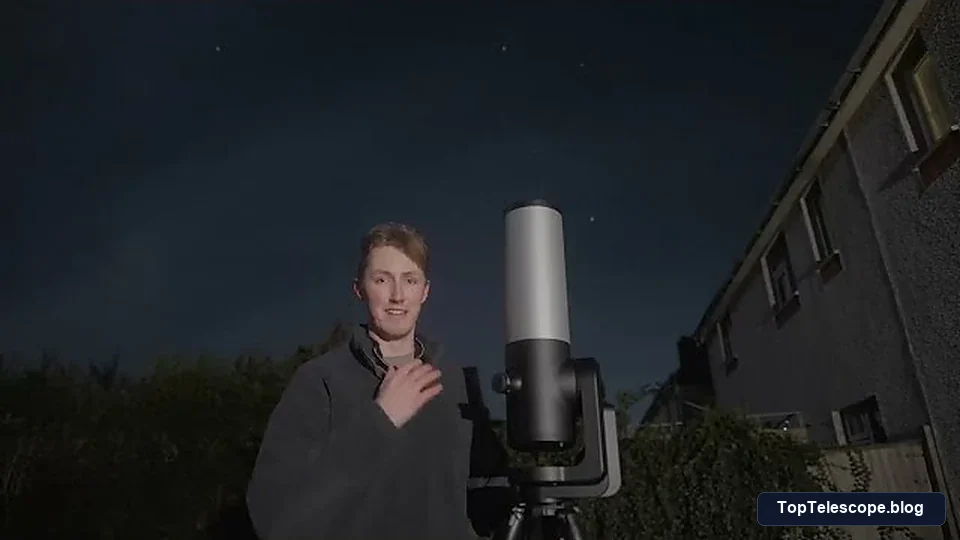
The hardware configurations differ substantially, impacting how light travels from distant celestial targets to your digital sensor. Understanding these foundational optical structures helps clarify their respective strengths.
Engineers designed these platforms to function as complete ecosystems, combining optics, tracking motors, and image processing into unified housings. This approach redefines traditional backyard astronomy standards entirely.
For instance, insights from our Vaonis Stellina review show that the Stellina relies on a doublet apochromatic design paired with a Sony sensor, whereas alternative systems feature Newtonian architectures.
Integrated field flatteners within the optical train ensure pin-point star profiles across the entire sensor surface, eliminating the severe coma traditionally associated with fast focal ratios found in compact consumer smart telescopes.
Internal image processing computers handle automated stacking and mosaic generation seamlessly, relying on passive thermal management enclosures to dissipate heat without introducing vibration into sensitive exposure sequences during long-duration imaging sessions.
- Stellina utilizes a 80mm ED doublet apochromatic refractor design.
- Evscope 2 features a custom 114mm Newtonian reflector optical tube.
- Both systems incorporate automated field-of-view stacking algorithms.
Sensor Technology and Resolution Metrics
Digital sensors dictate how effectively faint photons translate into breathtaking celestial photographs during long exposure sessions. Sony sensor integration provides exceptional low-light sensitivity across both platforms.
Resolution limits depend heavily on pixel pitch and focal length matching. Pixel optimization ensures that deep-sky objects maintain crisp structural details without introducing unwanted digital artifacts.
- Stellina features a Sony IMX178 sensor with robust noise reduction.
- Evscope 2 utilizes a high-resolution Sony IMX347 sensor architecture.
Field Portability and Ergonomic Deployment
Transporting heavy astronomical gear often discourages frequent stargazing excursions into dark-sky locations. Both manufacturers prioritized manageable form factors to encourage regular field use.
Ergonomic handle placement and balanced weight distribution simplify lifting the assemblies onto sturdy tripods. Streamlined cable management further reduces setup friction during evening sessions.
Secure locking mechanisms prevent accidental slippage while transporting the equipment across uneven terrain or rocky ground.
Weighing roughly eleven point two kilograms, the Stellina utilizes a robust single-arm fork mount integrated directly into a heavy-duty aluminum tripod base designed for rapid deployment on uneven outdoor terrain.
The eVscope 2 reduces overall transport weight to about nine kilograms, incorporating a carbon-fiber tripod that optimizes stiffness-to-weight ratios while maintaining structural integrity under moderate wind loading conditions at dark sites.
Leveling both systems requires careful attention to bubble indicators, though automated initialization routines utilize onboard GPS modules and plate-solving algorithms to streamline alignment without requiring manual star-hop procedures from users.
- Stellina weighs approximately 11.2 kilograms in its single-unit chassis.
- Evscope 2 weighs roughly 9 kilograms including its modular tripod.
- Integrated carrying handles ensure secure transport during field deployments.
Power Management and Field Endurance
Reliable power delivery remains paramount during extended imaging runs far away from conventional household electrical outlets. Internal battery capacities dictate operational windows before requiring external recharges.
As noted within our Vaonis Vespera II review, smart energy distribution circuits prevent sudden shutdowns during critical automated stacking sequences, actively preserving valuable scientific data throughout the night.
- Stellina includes an internal 10,000mAh battery rated for hours.
- Evscope 2 supports extended sessions via compatible USB-C power banks.
Software Ecosystems and Secure Connectivity
Software interfaces serve as the primary control center for managing target acquisition, focus adjustments, and data transfer. Robust wireless protocols ensure stable communication between devices.
Encrypted data streams protect user observation logs and captured image files during remote cloud syncing operations. Developers regularly issue firmware updates to enhance tracking accuracy.
Intuitive menu layouts allow beginners to navigate complex astronomical catalogues without requiring prior technical training or star-chart memorization.
Operating via dedicated mobile applications, both platforms generate secure local Wi-Fi hotspots to maintain reliable communication between the optical unit and your tablet or smartphone interface in remote field locations.
The proprietary software environments manage live image stretching and histogram adjustments dynamically, allowing novice astronomers to observe faint nebulae details emerge progressively during extended exposure stacking intervals.
Firmware updates deliver continuous performance improvements, expanding catalog databases and refining internal dark-frame subtraction algorithms to minimize thermal noise accumulation during warm summer observation nights.
- Dedicated mobile applications run smoothly on modern iOS and Android hardware.
- Automated database matching identifies thousands of deep-sky objects instantly.
- Secure local Wi-Fi networks prevent interference in urban environments.
Cloud Integration and Collaboration Tools
Modern observers frequently share their astronomical discoveries across global scientific networks and social platforms instantly. Seamless cloud integration facilitates effortless backup of raw FITS files.
Collaborative tools enable educators to stream live celestial feeds directly to classroom projectors or remote student devices.
- Direct FITS export supports advanced post-processing workflows.
- Live streaming protocols accommodate multi-user viewing experiences effortlessly.
Optical Performance and Target Specialization
Evaluating raw optical performance requires examining how each telescope handles different categories of celestial targets. Refractor designs generally offer superior contrast for sprawling emission nebulae.
Reflector configurations excel at gathering faint light from distant galaxies due to their larger primary mirror apertures. Target selection ultimately depends on individual aesthetic preferences.
Detailed analysis inside our Unistellar eVscope 2 review highlights how specialized field flattening lenses ensure pinpoint stars across the photographic frame without visible chromatic aberration or edge distortion.
With a focal length of four hundred millimeters, the Stellina excels at framing sprawling emission nebulae and large galaxies, providing wide apparent fields of view tailored for extended celestial structures.
Conversely, the eVscope 2 operates at four hundred fifty millimeters with a smaller pixel scale, favoring compact planetary nebulae and distant globular clusters requiring higher spatial resolution capabilities.
Light pollution rejection filters built permanently into both optical tubes enable successful suburban imaging by aggressively attenuating common mercury and sodium vapor emission lines generated by municipal street lighting grids.
- Stellina shines when capturing wide-field nebulae and star clusters.
- Evscope 2 dominates in planetary and galaxy resolution metrics.
Eyepiece Innovation Versus Screen Viewing
Viewing methods represent a fundamental philosophical divide between these two competing smart telescope manufacturers. Traditional screen viewing contrasts sharply with specialized optical eyepieces.
Electronic viewfinder technology recreates an authentic telescopic experience while retaining digital stacking benefits for human eyes.
- Evscope 2 features a patented OLED electronic eyepiece module.
- Stellina relies strictly on connected tablet and smartphone displays.
Maintenance Protocols and Long-Term Durability
Protecting sensitive optical coatings from dust, humidity, and physical impact ensures lasting equipment reliability over years of service. Routine inspections prevent premature hardware degradation.
Sealed optical tubes offer superior defense against environmental pollutants compared to open-air truss designs. Proper storage habits remain essential for preserving internal mechanical gears.
Manufacturer warranty programs provide necessary security for purchasers investing in high-end automated astronomical equipment.
Sealed optical tubes protect primary optics from accumulating dust and ambient moisture, significantly reducing the frequency required for manual mirror cleanings or internal lens maintenance procedures over years of service.
Routine exterior care involves wiping down aluminum alloy chassis components with microfiber cloths and inspecting mechanical locking levers to ensure secure tension during azimuth and altitude axis tracking movements.
Battery maintenance remains critical for lithium-ion power packs; operators should store units at moderate charge levels in temperature-controlled environments to preserve overall cell longevity across multiple operational seasons.
- Stellina features a sealed chassis requiring minimal cleaning.
- Evscope 2 mirrors require occasional user collimation procedures.
Mechanical Wear and Thermal Acclimation
Thermal equilibrium affects tracking precision and image sharpness during rapid temperature drops at night. Internal cooling fans help stabilize sensor temperatures effectively.
Precision-machined gears resist backlash during high-magnification tracking routines, ensuring smooth photographic results.
- Internal thermal management prevents excessive digital image noise.
- High-torque stepper motors maintain rock-steady tracking accuracy.
Investment Value and Ideal User Profiles
Selecting the correct instrument involves matching technical capabilities with your personal astronomy goals and experience level. Beginners often prefer fully automated workflows over manual configurations.
Advanced astrophotographers might demand greater customization options, as detailed in our eVscope 2 review, requiring modular component upgrades and specialized research projects to evaluate total system utility effectively.
Both platforms represent significant investments in modern automated stargazing technology.
Choosing between these sophisticated instruments depends heavily on your specific observational goals, whether prioritizing wide-field photographic compositions or immersive eyepiece experiences utilizing advanced electronic viewing technology.
Educators and outreach coordinators often favor the ocular immersion provided by the eVscope 2, whereas casual astrophotographers appreciate the hands-off automation and sleek aesthetic of the Stellina design.
Evaluating your local sky conditions and setup preferences ensures long-term satisfaction with your chosen automated telescope ecosystem, maximizing return on investment for years of deep-sky exploration adventures.
- Stellina suits users wanting zero-maintenance wide-field imaging.
- Evscope 2 attracts observers seeking eyepiece immersion and reach.
Summary of Technical Trade-Offs
Balancing aperture size, optical design, and viewing interfaces clarifies which system fits your backyard observatory best. Careful planning guarantees rewarding stargazing experiences.
Reviewing core specifications highlights the distinct engineering priorities driving each manufacturer forward.
- Refractor optics prioritize contrast and zero maintenance.
- Reflector systems maximize light-gathering power for faint targets.
Frequently Asked Questions
Can these smart telescopes operate without an internet connection?
Yes, both instruments create secure local Wi-Fi networks for direct smartphone communication. This ensures complete offline operation in remote dark-sky locations.
Do I need prior astrophotography experience to use these units?
Neither system requires prior technical knowledge or manual polar alignment. Automated routines handle calibration and stacking seamlessly for absolute beginners.
How do these telescopes handle light pollution in urban backyards?
Advanced image processing algorithms and digital filters successfully mitigate urban skyglow. Internal software extracts stunning details despite severe light pollution.
Can I capture images of planets with the Vaonis Stellina?
Stellina specializes primarily in wide-field deep-sky objects rather than planetary details. Its optical design is optimized for nebulae and galaxies.
What maintenance is required for the optical tube assemblies?
Stellina features a sealed chassis requiring virtually no internal cleaning. Evscope 2 requires occasional mirror checks and standard collimation maintenance over time.