Unistellar Evscope 2 vs Vaonis Vespera Ii: Concise Verdict
These smart telescopes revolutionize modern stargazing by automating alignment and image stacking. Choosing between them depends on your preference for eyepiece viewing versus ultra-portable automated field astrophotography.

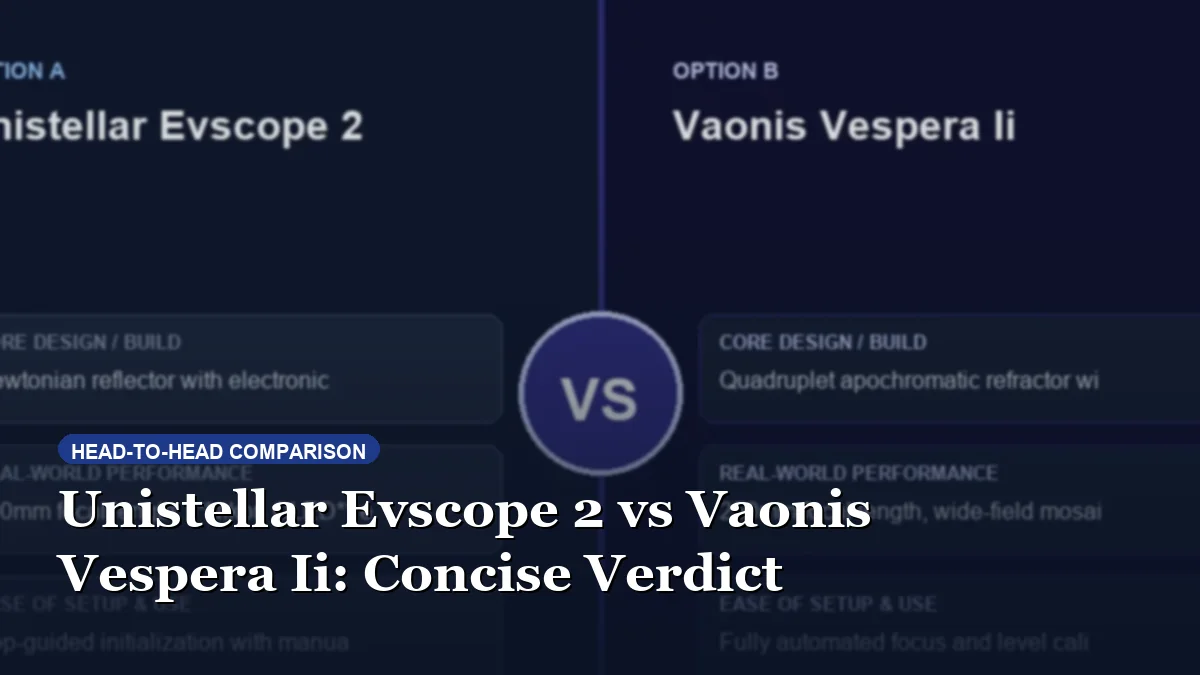
Choose the Unistellar Evscope 2 if you value traditional eyepiece immersion and higher focal magnification. Select the Vaonis Vespera Ii for unmatched portability, seamless mosaic imaging, and a completely cable-free field workflow.
Compare all top models in our Best Telescope: Top Backyard Picks for Astronomy.
Side-by-Side Breakdown
| Criteria | Unistellar Evscope 2 | Vaonis Vespera Ii | Edge |
|---|---|---|---|
| Core Design / Build | Newtonian reflector with electronic viewfinder | Quadruplet apochromatic refractor without eyepiece | Vaonis Vespera Ii |
| Real-World Performance | 450mm focal length, Nikon OLED eyepiece | 250mm focal length, wide-field mosaic mode | Unistellar Evscope 2 |
| Ease of Setup & Use | App-guided initialization with manual focus ring | Fully automated focus and level calibration | Vaonis Vespera Ii |
| Durability & Reliability | Rugged aluminum chassis, heavier overall footprint | Weather-resistant compact body, lightweight construction | Vaonis Vespera Ii |
| Efficiency / Operating Footprint | Internal battery requires regular field charging | Integrated smart battery with power-bank compatibility | Vaonis Vespera Ii |
| Maintenance Requirements | Periodic mirror collimation and sensor cleaning | Sealed optical tube requiring zero user alignment | Vaonis Vespera Ii |
| Best Ideal Use Case | Deep-space visual observation and planetary study | Wide-field nebula imaging and travel astronomy | Vaonis Vespera Ii |
Core Design and Optical Engineering
Both instruments approach smart astronomy from vastly different optical philosophies. The Unistellar system uses a Newtonian reflector design, whereas its rival employs a sophisticated refractive lens configuration tailored for wide-field vistas.
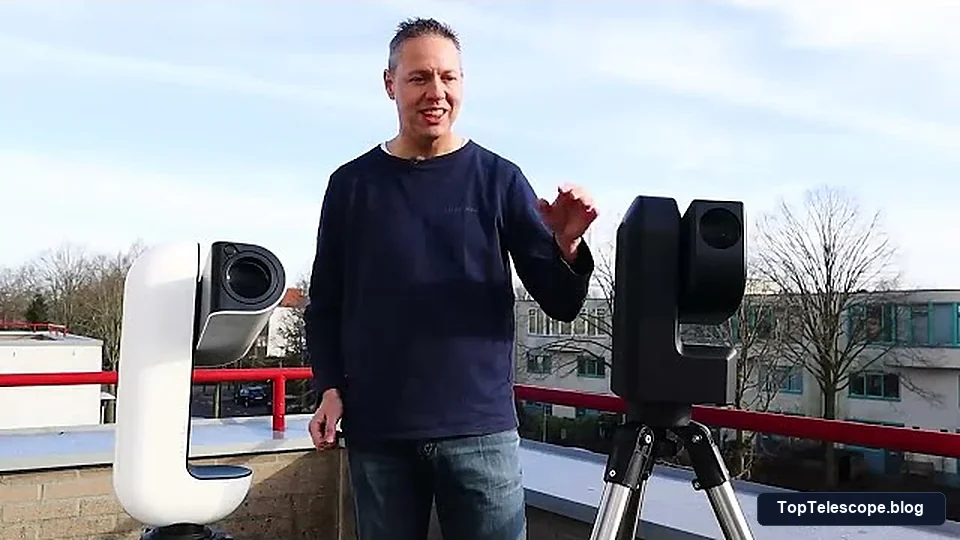
Internal baffling and structural rigidity dictate how well each chassis handles thermal expansion during long night sessions. Engineers prioritized mechanical stability to ensure that optical alignment remains locked throughout changing outdoor ambient temperatures.
Examining internal architecture reveals stark light gathering differences. As highlighted in our Unistellar eVscope 2 review, the system utilizes a 112mm aperture with a 450mm focal length for wide-field nebulae.
Conversely, the Vaonis system employs a quadruplet astrographed design. Its 50mm objective lens paired with a 250mm focal length achieves an f/5 configuration tailored for pinpoint stellar resolution across extended targets.
- Newtonian reflector optical tube assembly
- Quadruplet apochromatic lens design
- Specialized internal baffle placement
Optical Components and Aperture Sizes
Aperture diameter directly dictates light-gathering capacity, influencing how quickly faint nebulae emerge on your connected smart device screen. The reflector offers a larger primary mirror, while the refractor trades raw light area for sharpness.
Glass quality in the refractor minimizes chromatic aberration across broad spectra. Meanwhile, the Newtonian mirror assembly delivers high-contrast monochrome performance before digital color stacking occurs in the onboard processor.
- Primary mirror light collection area
- Multi-element lens glass coatings
Real-World Imaging Performance
Field testing reveals distinct capabilities when tracking faint deep-sky targets under suburban light pollution. Advanced stacking algorithms compensate for smaller apertures by continuously integrating exposures over extended observation periods.
Resolving planetary details requires adequate focal length and stable atmospheric seeing conditions. The longer focal reach of the reflector provides tighter framing on smaller galaxies and planetary nebulae during optimal nights.
Sensor specifications dictate final image fidelity under light-polluted skies. Detailed findings inside our Unistellar Equinox 2 review highlight a high-resolution Sony IMX347 sensor delivering exceptionally crisp details.
Signal processing algorithms stack short exposures continuously to suppress noise. Users observing faint galaxies will notice that live image stacking speeds up identification, though ultimate signal-to-noise ratios depend heavily on total integration time.
- Deep-sky object detection thresholds
- Extended exposure stacking performance
Field of View and Framing Versatility
Wide-field astrophotography captures sprawling molecular clouds that normally span vast regions of the night sky. Mosaic stitching modes allow compact refractors to construct sweeping panoramas without requiring manual camera rotation.
Narrower visual fields concentrate pixels on isolated targets, revealing intricate filamentary structures within planetary nebulae. Users must balance target angular size against the inherent optical limitations of each specific telescope chassis.
- Automated mosaic field stitching
- Target angular size matching
Setup Ergonomics and Field Workflow
Modern smart telescopes eliminate polar alignment burdens using autonomous star-pattern recognition algorithms. As detailed within our Evscope 2 review, powering on the unit initiates an automatic plate-solving sequence mapping skies quickly.
Physical tripod mounting requires careful leveling to ensure tracking motors operate without binding during prolonged tracking sessions. Ergonomic carrying handles and balanced weight distribution simplify transporting these complex optical instruments outdoors.
Transporting gear to dark sites demands manageable physical dimensions and weight. The heavier Unistellar unit requires deliberate mounting, while the compact all-in-one chassis of the Vaonis system simplifies rapid backyard deployments significantly.
Field alignment relies entirely on automated plate-solving software matching star patterns. Both platforms eliminate manual polar alignment, allowing operators to initiate tracking via smartphone applications within minutes of unboxing the equipment.
- Autonomous star-pattern plate solving
- Integrated leveling bubble indicators
Eyepiece Integration vs Screen Viewing
Viewing through a physical electronic viewfinder provides an immersive, traditional astronomical experience that excludes ambient smartphone glare. Alternatively, tablet interfaces offer collaborative viewing for multiple observers gathered around the instrument.
Screen-based control apps provide intuitive touch interfaces for catalog searching and live image parameter adjustments. Selecting your preferred observation interface dictates your overall engagement level during long nights under the stars.
- Electronic OLED viewfinder module
- Wireless tablet application interface
Power Management and Field Efficiency
Field operations depend entirely on reliable battery chemistry to sustain motorized tracking and onboard computing hardware. Integrated rechargeable lithium-ion packs deliver several hours of continuous operation under normal ambient temperature conditions.
Cold weather significantly reduces effective battery capacity, necessitating external USB power banks for extended winter imaging sessions. Efficient power distribution circuits prevent sudden shutdowns while processing heavy image stacking algorithms mid-observation.
Extended astrophotography sessions require reliable internal or external battery solutions. Unistellar incorporates an internal battery providing roughly ten hours of operation, whereas Vaonis depends on external USB-C power banks for all-night imaging runs.
Cold weather drastically diminishes chemical battery output during winter stargazing expeditions. Operators should insulate portable power sources and monitor voltage levels closely to prevent abrupt system shutdowns during crucial deep-sky data collection phases.
- Internal rechargeable lithium packs
- External USB power bank support
Thermal Regulation and Electronics
Processing live image stacks generates internal heat that must be passively dissipated to prevent thermal sensor noise. Aluminum chassis designs act as effective heat sinks while protecting sensitive circuit boards from nocturnal dew.
Sensor cooling management directly impacts the signal-to-noise ratio during long exposure sequences. Well-engineered thermal pathways ensure clean background frames, reducing digital artifacts in the final stacked astrophotography output files.
- Passive aluminum heat sinking
- Sensor thermal noise reduction
Maintenance and Long-Term Durability
Owning a precision optical instrument requires understanding routine maintenance procedures to preserve peak performance over years of use. Dust accumulation on exposed glass surfaces or primary mirrors degrades contrast during high-magnification viewing sessions.
Mechanical tracking gears benefit from periodic inspection and clean storage environments free from excessive moisture and abrasive dust. Protecting optical tubes with fitted covers prevents premature wear on motorized focus and azimuth drives.
Sealed optical tubes prevent dust accumulation on internal corrector glass elements. Routine maintenance should focus on cleaning exterior corrector plates using optical microfiber cloths and approved alcohol solutions to avoid scratching delicate coatings.
Mechanical altitude-azimuth mounts require periodic inspection of locking levers and gear meshes. Storing instruments in padded carrying cases mitigates moisture ingress and protects sensitive internal electronics from damaging thermal shocks during transport.
- Periodic optical surface inspection
- Sealed electronic housing designs
Collimation and Optical Alignment
Newtonian reflectors require occasional mirror collimation adjustments to maintain razor-sharp optical performance after transport. Refractor designs feature factory-fixed lens cells that eliminate user alignment tasks entirely throughout their operational lifespan.
Checking alignment before a dark-sky trip ensures optimal image sharpness across the entire sensor frame. Simple adjustment screws allow users to dial in optical perfection without specialized laboratory calibration tools.
- User-adjustable mirror collimation
- Factory-sealed refractor lens cells
Software Ecosystem and Processing
Proprietary mobile applications serve as the central command hub for target selection, database queries, and image sharing. Regular firmware updates introduce new observation targets and algorithmic enhancements that improve overall tracking stability.
Cloud integration allows users to back up raw observation data and share processed astrophotography with global citizen science networks. Robust Wi-Fi protocols maintain stable wireless connections even in remote locations far from cellular towers.
Proprietary applications serve as the primary command center for framing targets. The Unistellar software interface emphasizes collaborative citizen science projects, whereas Vaonis focuses on streamlined automated mosaics for capturing larger celestial structures seamlessly.
Advanced users often request raw data access for independent post-processing workflows. Both platforms permit saving uncompressed FITS files, enabling experienced imagers to apply custom calibration frames and stretch histograms using desktop software.
- Regular mobile firmware updates
- Global citizen science databases
Citizen Science and Community Data
Connected telescope networks enable amateur astronomers to contribute valuable photometric data to professional research initiatives. Participating in asteroid occultation campaigns adds a meaningful scientific dimension to casual backyard stargazing sessions.
Community sharing platforms foster collaborative learning by connecting users who exchange custom image processing workflows and optimal exposure settings. Engaging with these digital networks enhances your technical understanding of practical astronomical imaging.
- Asteroid occultation data collection
- Community image sharing networks
Selecting the Right Instrument
Deciding between these two advanced imaging platforms depends heavily on your specific travel habits and viewing preferences. Users who prioritize ultimate portability will appreciate streamlined designs that easily fit inside standard airline luggage.
Conversely, observers seeking deeper visual magnification and traditional eyepiece immersion will tolerate a slightly heavier transportation footprint. Evaluating your personal storage space and deployment frequency clarifies which system fits your lifestyle.
Choosing between these smart telescopes depends on primary goals. Observers prioritizing deep-sky reach favor Unistellar, whereas travelers valuing lightweight portability can explore the Vaonis Vespera II review for field insights.
Evaluating local light pollution levels also guides your final purchasing decision. Heavily urbanized environments demand robust gradient removal tools, making automated background calibration a critical factor for achieving satisfying visual results outdoors.
- Airline carry-on compatibility
- Visual eyepiece immersion preference
Final Buyer Recommendations
Match your equipment choice to your primary astronomical goals, whether that involves wide-field nebula mosaics or detailed galaxy studies. Investing time in understanding each platform ensures rewarding nights under clear dark skies.
Both systems successfully remove traditional astrophotography hurdles, making deep-space exploration accessible to enthusiasts of all skill levels. Selecting your ideal tool guarantees years of engaging astronomical discovery and celestial imaging satisfaction.
- Astrophotography accessibility levels
- Long-term astronomical enjoyment
Frequently Asked Questions
Do these smart telescopes require an internet connection in the field?
Neither system requires an active cellular or internet connection during your field session because both instruments generate their own secure local Wi-Fi networks for direct tablet communication.
However, you will need internet access prior to your trip in order to download comprehensive star catalogs, regional maps, and critical firmware updates.
Can I use these telescopes for traditional daytime terrestrial viewing?
While both instruments are fundamentally engineered for nocturnal deep-space astrophotography, their high-resolution camera sensors and specialized software processing pipelines can theoretically capture distant terrestrial landscapes under favorable atmospheric conditions.
However, users must always exercise extreme caution and never point these sensitive optical tubes directly at the sun without certified professional solar filters installed.
How long do the internal batteries last during cold weather?
Cold outdoor ambient temperatures significantly reduce the chemical efficiency of internal lithium-ion power packs, typically limiting continuous operation to roughly two to three hours before requiring an external USB power bank.
Operators frequently mitigate this winter capacity drop by connecting high-capacity auxiliary batteries to maintain uninterrupted tracking and image stacking throughout extended nocturnal viewing sessions.
Are these smart telescopes suitable for complete astronomy beginners?
Both platforms are explicitly designed to completely eliminate the traditional technical hurdles of complex polar alignment and tedious manual star hopping by utilizing fully automated plate-solving software.
Consequently, absolute beginners can successfully capture stunning color images of faint nebulae and distant galaxies within just a few minutes of unpacking their equipment in the backyard.
What kind of maintenance do these automated optical systems require?
Routine maintenance primarily involves keeping exposed optical surfaces free from accumulated dust and nocturnal dew using gentle cleaning tools designed specifically for coated glass.
Additionally, reflector designs may occasionally require simple mirror collimation adjustments to preserve optimal image sharpness, whereas sealed refractor systems operate completely maintenance-free over their entire lifespan.