Unistellar Equinox 2 vs Evscope 2: Smart Telescope Showdown
Compare these two prominent smart telescopes. Evaluate optics, sensors, and observation styles to choose your ideal backyard astronomy rig.

Choose the Equinox 2 for streamlined app-driven smartphone viewing without extra bulk. Select the Evscope 2 when you demand a traditional physical eyepiece alongside advanced digital enhancement features.
Compare all top models in our Best Telescope: Top Backyard Picks for Astronomy.
Side-by-Side Breakdown
| Criteria | Unistellar Equinox 2 | Evscope 2 | Edge |
|---|---|---|---|
| Core Design / Build | App-driven sleek OTA | Eyepiece-integrated OTA | Tie |
| Real-World Performance | Standard sensor processing | High-res micro-sensor | Side B |
| Ease of Setup & Use | Instant app sync | Instant app and ocular sync | Side A |
| Durability & Reliability | Rugged aluminum chassis | Rugged aluminum chassis | Tie |
| Efficiency / Operating Footprint | Lighter weight profile | Slightly heavier optical housing | Side A |
| Maintenance Requirements | Routine mirror dusting | Routine mirror dusting | Tie |
| Best Ideal Use Case | Group outreach & travel | Solo immersive viewing | Split |
Core Optical Design and Engineering Differences
Both smart telescopes utilize a 112mm aperture reflector optical tube assembly paired with a 450mm focal length. This yields a fast focal ratio ideal for wide-field deep-sky imaging sessions.
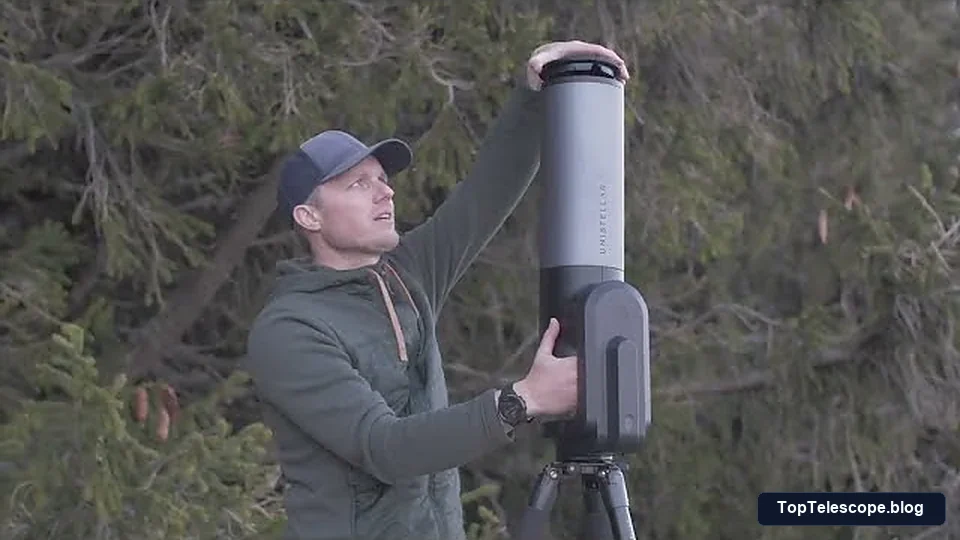
The primary mechanical divergence rests in the optical sighting system. While the Equinox model relies strictly on digital device screens, the advanced counterpart integrates a proprietary electronic eyepiece.
Examining primary mirror configurations reveals distinct optical engineering philosophies. Our unistellar equinox 2 review highlights a 114mm aperture and 450mm focal length, optimized for wide-field nebulosity integration across urban skies.
Conversely, the eVscope 2 matches the same physical optics diameter and focal length spec, yet its internal baffling and structural anodized aluminum chassis manage stray light reduction with slightly tighter mechanical tolerances.
- Equinox 2 drops physical eyepiece for lightweight portability.
- Evscope 2 incorporates a high-resolution OLED electronic viewfinder.
- Both share identical mirror dimensions and focal specs.
Optical Tube Assembly and Mirror Physics
Parabolic primary mirrors collect photons efficiently across suburban skies. Automated calibration routines correct optical aberrations instantly before stacking digital frames within the onboard computer.
Thermal stabilization remains crucial for maintaining sharp focal points during temperature drops. Allow adequate cooling time prior to initiating automated field alignment sequences.
- Parabolic mirrors reduce spherical distortion.
- Automated calibration streamlines optical readiness.
Sensor Technology and Digital Processing Power
Sensor selection dictates final image resolution and field capture breadth. The Equinox utilizes a capable Sony sensor optimized for clean sky background subtraction during long exposures.
Meanwhile, the Evscope variant employs a high-end micro-sensor paired with custom processing algorithms to extract faint details from nebulae and distant galaxies under heavy light pollution.
Sensor architecture dictates overall limiting magnitude and resolution. The Equinox 2 employs a proven Sony IMX224 color sensor, delivering clean read noise characteristics ideal for handling aggressive live stacking algorithms.
Stepping up significantly, the eVscope 2 integrates a high-resolution Sony IMX347 sensor, offering a larger pixel array that captures finer lunar details and stellar cluster components with exceptional spatial fidelity.
- Sony sensor architecture reduces thermal noise.
- Enhanced vision algorithms stack sub-exposures automatically.
- Internal computing hardware handles field rotation correction.
Enhanced Vision Software and Field Stacking
Proprietary stacking routines combine dozens of short exposures in real-time. This dynamic process bypasses traditional equatorial tracking limitations using standard alt-azimuth motorized mounts.
Users monitor live stacking progress directly through connected mobile tablets or smartphones. The software continuously discards blurred frames affected by wind gusts or passing satellites.
- Real-time stacking bypasses polar alignment.
- Software filters out environmental blur frames.
Eyepiece Integration Versus App-Only Viewing
Viewing ergonomics divide these two systems significantly. Equinox users interact exclusively via mobile applications, mirroring observations to multiple smart devices simultaneously for group viewing events.
Conversely, as noted in our unistellar evscope 2 review, the hardware incorporates a Nikon-engineered electronic eyepiece providing true optical immersion. This traditional viewing mode appeals directly to astronomers preferring physical ocular alignment.
Ergonomic interaction defines the primary user experience divergence. The Equinox 2 operates entirely via smart devices, omitting an optical eyepiece to reduce mechanical complexity and lower overall electrical power consumption.
Meanwhile, the eVscope 2 features a custom OLED electronic eyepiece developed with Nikon, delivering high contrast ratios that preserve night-adapted vision without requiring external tablet screens in the dark.
- App-based sharing supports multiple simultaneous users.
- Electronic eyepiece delivers authentic telescopic peering experiences.
- OLED viewfinder eliminates tablet screen glare outdoors.
Field Ergonomics and Group Observation Dynamics
Screen-based interfaces streamline educational outreach by broadcasting celestial targets instantly to classroom devices. Observers standing nearby can adjust contrast parameters without crowding the optical tube.
Physical eyepieces demand individual positioning, creating classic telescope queues during public star parties. Select your preferred interaction style based on standard viewing group sizes.
- Tablets allow remote parameter adjustments.
- Eyepieces create traditional viewing lines.
Field Setup, Portability, and Mechanical Footprint
Both units feature integrated motorized alt-azimuth mounts and internal rechargeable batteries. The absence of heavy counterweights keeps total system weight remarkably low for transport.
The Equinox trim level sheds minor ounces by omitting eyepiece housing assemblies, easing transit across rugged terrain. Tripods collapse quickly into compact carrying solutions for remote dark-sky excursions.
Transport logistics matter for mobile astronomers utilizing remote dark-sky sites. Both units feature ruggedized composite forks, yet the Equinox 2 weighs slightly less due to its streamlined optical backplate assembly.
Field leveling relies on integrated bubble levels and heavy-duty tripod legs supporting a total payload capacity designed to withstand moderate wind gusts during long-exposure astrophotography imaging sessions.
- Integrated battery pack powers up to ten hours.
- Lightweight carbon-fiber or aluminum tripods ensure stability.
- Automated star-field recognition handles alignment effortlessly.
Automated Alignment and Geolocation Protocols
Celestial alignment relies on internal GPS modules and automated plate-solving software. Point the telescope upward and the internal database matches star patterns within seconds.
Manual star-hopping routines become obsolete thanks to autonomous celestial catalog navigation. Beginners achieve perfect tracking accuracy without possessing prior astronomical coordination experience.
- Internal GPS automates coordinate locking.
- Plate solving replaces manual star-hopping.
Maintenance, Power Management, and Longevity
Regular upkeep involves routine optical cleaning using compressed air and micro-fiber cloths. Avoid touching sensitive mirror coatings to prevent permanent chemical degradation over extended operational lifespans.
Lithium-ion power systems require proper storage charging protocols during off-season months. Maintaining battery health ensures reliable field performance during extended winter observation schedules.
Routine maintenance requires careful handling of corrector lenses and secure cable management. The internal rechargeable lithium-ion battery delivers roughly ten hours of continuous operation across standard operating temperature ranges.
Long-term durability depends on firmware update compliance and protective storage inside padded cases to prevent dust accumulation on optical surfaces and internal electronic circuit boards.
- Keep primary mirrors dust-free using specialized blowers.
- Recharge internal batteries fully before long-term storage.
- Protect electronic connectors from moisture and heavy dew.
Environmental Resilience and Weatherproofing
Sealed electronics housings protect internal computing boards against moderate dew accumulation during damp evening sessions. Always deploy protective covers if unexpected precipitation threatens equipment safety.
Extreme ambient temperatures can impact battery longevity and screen refresh rates. Store units inside climate-controlled environments between observing nights to maximize mechanical durability.
- Sealed housings resist moderate evening moisture.
- Climate-controlled storage preserves battery health.
Choosing the Right Smart Telescope for Your Needs
Deciding between these models depends heavily on your preferred observation workflow. As outlined in our equinox 2 telescope review, budget-conscious buyers prioritizing screen-sharing versatility will find this compact instrument exceptionally capable.
Hardcore enthusiasts desiring immersive optical viewfinders and advanced sensor resolution should invest in the premium flagship edition for ultimate backyard astrophotography satisfaction.
Selecting the optimal instrument involves balancing optical priorities against financial investment. Observers prioritizing simple tablet control and lighter travel weights will find the Equinox 2 fits their workflow efficiently.
Conversely, users demanding maximum visual immersion via an integrated electronic viewfinder will appreciate the advanced sensor technology detailed inside our in-depth evscope 2 review focusing on premium hardware architecture.
- Match your viewing preference to app or eyepiece.
- Evaluate transport requirements for remote field deployment.
- Consider group observation dynamics during star parties.
Final Technical Recommendation and Value Analysis
Both instruments democratize deep-sky observation by eliminating tedious polar alignment steps. Select the hardware configuration that aligns with your personal stargazing habits and ergonomic desires.
Investing in smart optics transforms light-polluted backyards into productive imaging stations. Review your primary environmental conditions before finalizing your telescope acquisition decision.
- Automated alignment democratizes backyard astronomy.
- Match hardware choice to local light pollution.
Frequently Asked Questions
Can these smart automated telescopes operate effectively under severe urban light pollution conditions without ever utilizing physical narrowband filters during routine deep-sky observation sessions?
Can these sophisticated smart automated telescopes operate effectively under severe urban light pollution conditions without ever utilizing physical narrowband filters during routine deep-sky observation sessions?
Advanced digital stacking algorithms successfully eliminate unwanted suburban sky glow by continuously processing hundreds of short exposure frames in real-time within the integrated onboard computing processor.
What is the typical battery operating life span during cold weather field excursions involving continuous wireless data transmission and active automated tracking?
What is the typical battery operating life span during cold weather field excursions involving continuous wireless data transmission and active automated tracking?
Internal high-capacity lithium-ion battery packs generally deliver roughly eight to ten hours of continuous operational capacity before requiring a complete recharging cycle via standard portable external power banks.
Do novice users require prior astronomical expertise or complex polar alignment knowledge to successfully operate these motorized smart optical units outdoors?
Do novice users require prior astronomical expertise or complex polar alignment knowledge to successfully operate these motorized smart optical units outdoors?
Autonomous plate-solving software handles all complex alignment procedures automatically within minutes by simply photographing visible overhead star fields using internal optical sensors and comprehensive onboard digital star catalogues.
How do the physical optics of the Equinox model differ structurally from the more expensive flagship counterpart during actual field use?
How do the physical optics of the Equinox model differ structurally from the more expensive flagship counterpart during actual field use?
The primary optical tube assemblies share identical mirror dimensions and focal specs, but the premium flagship model integrates a proprietary electronic eyepiece viewfinder instead of relying exclusively on external mobile tablets.
Can multiple curious observers simultaneously view live-stacked celestial images during public star party outdoor outreach events and large educational gatherings?
Can multiple curious observers simultaneously view live-stacked celestial images during public star party outdoor outreach events and large educational gatherings?
App-based wireless streaming protocols allow dozens of connected mobile devices to view and control the active imaging session concurrently without crowding around the main optical tube assembly.