Truss Tube vs Solid Tube Dobsonian: Technical Verdict
Choosing between a truss tube and a solid tube Dobsonian dictates your transport workflow, optical maintenance routines, and storage footprint. Evaluating these structural frameworks ensures you invest in the ideal aperture for your observing conditions.

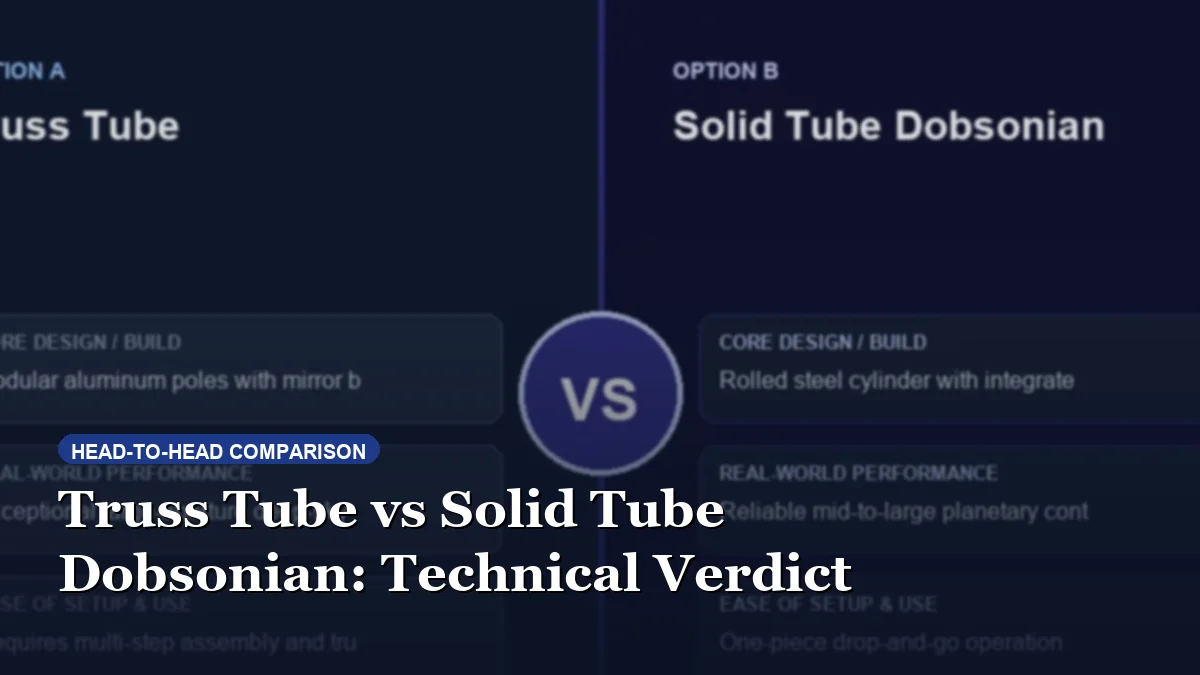
Select the truss tube design if you need a large aperture that disassembles for transit inside compact vehicles. Choose the solid tube variant if you prioritize rigid factory collimation and rapid, tool-free field setup.
Compare all top models in our Best Telescope: Top Backyard Picks for Astronomy.
Side-by-Side Breakdown
| Criteria | Truss Tube | Solid Tube Dobsonian | Edge |
|---|---|---|---|
| Core Design / Build | Modular aluminum poles with mirror box | Rolled steel cylinder with integrated cell | Solid Tube for Rigidity |
| Real-World Performance | Exceptional large-aperture deep-sky views | Reliable mid-to-large planetary contrast | Tie |
| Ease of Setup & Use | Requires multi-step assembly and truss mounting | One-piece drop-and-go operation | Solid Tube |
| Durability & Reliability | Exposed optics require careful handling | Enclosed tube protects primary mirror | Solid Tube |
| Efficiency / Operating Footprint | Breaks down into small trunk-friendly components | Requires large back seat or truck bed | Truss Tube |
| Maintenance Requirements | Frequent collimation check after transport | Holds optical alignment exceptionally well | Solid Tube |
| Best Ideal Use Case | Remote dark-sky travel with large mirrors | Backyard stargazing and quick sessions | Context Dependent |
Core Engineering and Mechanical Design
The fundamental architecture separating these instruments lies in how they maintain the precise focal distance between primary and secondary mirrors. Structural rigidity under gravity remains the primary engineering hurdle for large amateur reflectors.
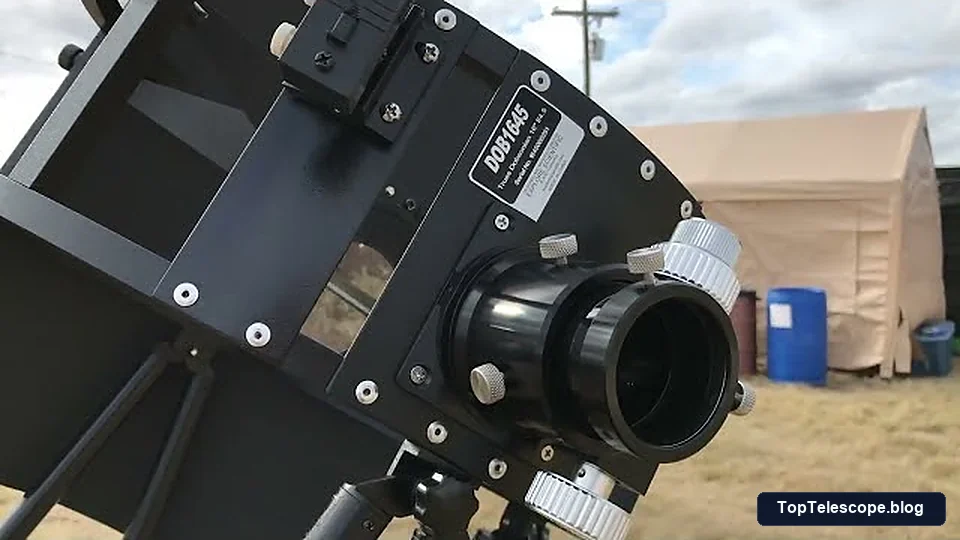
Solid tube Dobsonians utilize a continuous rolled steel or aluminum cylinder to maintain optical axis alignment. As highlighted in our apertura ad8 dobsonian review, this seamless housing prevents lateral flexure.
Truss tube configurations replace the solid cylinder with a skeletal framework of interlocking aluminum poles. This open-air truss geometry drastically reduces total structural weight while maintaining high torsional stability across larger diameters.
Solid tube dobsons rely on rolled steel sheets offering uniform structural rigidity across the optical axis, minimizing flexure under heavy loads during high-magnification planetary tracking sessions.
Conversely, truss tube assemblies utilize modular aluminum poles arranged in triangulated geometry to distribute mechanical stress effectively while drastically reducing total instrument weight for easier field transport.
Engineers must balance material thickness against overall heft, ensuring that rocker box bearings maintain smooth azimuth rotation regardless of whether a monolithic cylinder or open truss framework is deployed.
- Solid tubes use continuous metal cylinders for maximum protection.
- Truss systems employ modular poles to distribute heavy structural loads.
Material Science and Weight Distribution
Heavy steel cylinders demand robust rocker box designs to manage friction and balance points effectively. Aluminum truss assemblies shift weight distribution toward the mirror box and altitude bearings for easier transport.
Engineers select materials that resist thermal expansion to prevent focal shift during rapid nighttime temperature drops. Steel maintains uniform dimensions, whereas aluminum poles may require minor focus adjustments as air cools.
- Aluminum truss poles reduce overall system weight significantly.
- Steel cylinders offer predictable thermal contraction rates.
Optical Alignment and Collimation Stability
Maintaining precise optical alignment across observing sessions is critical for achieving high-magnification planetary resolution. Collimation drift directly impacts star sharpness and planetary surface detail during long viewing nights.
Solid tube Dobsonians excel at holding factory collimation because the primary mirror cell and focuser are permanently fixed. Even after rough transport over bumpy roads, the optical axis rarely shifts beyond a minor tweak.
Truss tube assemblies require frequent collimation because pole connections introduce micro-variations during assembly. Utilizing high-precision clamps and laser tools becomes an essential part of the pre-observation ritual for truss owners.
Monolithic solid tubes maintain exceptional primary mirror cell position because continuous metal walls resist gravitational sagging, ensuring collimation retention throughout long observation nights without frequent user intervention.
Open truss systems introduce slight mechanical play at pole connection points, which requires precision clamps and periodic laser collimator checks to preserve pinpoint stellar diffraction patterns at high powers.
Secondary spider vanes must maintain rigid tension in both designs, preventing rotational shift of the diagonal mirror during aggressive tube movements or temperature shifts across the observing field.
- Solid tubes retain collimation through rigid factory-welded alignments.
- Truss systems demand laser collimation tools before every session.
Collimation Hardware and Adjustment Screws
Upgraded primary mirror cells on large truss scopes feature heavy-duty springs and large knobs. These tactile adjustments allow observers to dial in precise optical alignment without tools in the dark.
Solid tube cells are often concealed inside the bottom housing, requiring specialized screwdrivers or Allen wrenches. This protective enclosure limits accidental bumps but makes quick field adjustments slightly more cumbersome.
- Truss cells feature tool-free hand knobs for rapid collimation.
- Enclosed solid cells protect adjustment screws from accidental impacts.
Transportability and Field Ergonomics
Telescope footprint dictates how frequently an amateur astronomer travels to dark-sky locations. Choosing the proper best dobsonian telescope prevents a massive instrument from remaining trapped in a garage.
Solid tube Dobsonians with apertures exceeding ten inches quickly become cumbersome cylinders that overwhelm standard passenger vehicles. Transporting them safely usually requires dedicated backseat space and custom padding.
Truss tube variants solve this spatial limitation by breaking down into manageable, modular components. The mirror box, rocker base, and pole bundles fit easily into the trunk of a compact sedan.
Solid tubes demand substantial vehicle cargo space due to their fixed diameter, often requiring a dedicated backseat or truck bed to transport safely without denting the rolled aluminum body.
Truss configurations disassemble into manageable components like the rocker box, mirror box, and separate poles, fitting effortlessly into compact sedans while improving lifting safety for solo operators.
Ergonomic carrying handles and balanced center of gravity points dictate whether field setup causes physical strain or remains an enjoyable part of the astronomy workflow.
- Solid tubes require substantial back seat space in standard cars.
- Truss designs dissemble into compact components for small vehicles.
Handling Heavy Components in the Dark
Lifting a heavy solid tube into a vehicle cradle alone poses significant safety risks to your back. Modular truss components allow you to lift lighter individual sections sequentially with minimal strain.
Ergonomic carrying handles bolted directly onto mirror boxes prevent accidental drops during transit. Manufacturers design these contact points to balance the heavy primary glass safely against your body.
- Modular assembly prevents heavy lifting strain in dark environments.
- Integrated handles provide secure grip points on heavy mirror boxes.
Thermal Equilibrium and Environmental Adaptation
Large optical glass must reach ambient outdoor temperature before delivering stable, high-magnification planetary views. Trapped warm air inside closed tubes creates internal thermal currents that blur fine details.
Solid tubes act as thermal insulators, trapping heat inside the metal cylinder for extended periods. Cooling fans mounted near the primary mirror are virtually mandatory to accelerate temperature acclimation.
Truss tubes benefit from an open-air architecture that allows cooling breezes to sweep naturally across the primary mirror surface. This open design eliminates boundary layer thermal currents much faster than enclosed cylinders.
Solid tubes trap stagnant warm air currents inside the closed cylinder boundary layer, requiring rear cooling fans to accelerate thermal acclimatization before achieving sharp planetary views.
Truss designs inherently allow rapid ambient air circulation around the primary glass substrate, minimizing internal thermal plumes and speeding up overall optical readiness under falling nighttime temperatures.
Observers must remember that open trusses also expose optics to heavy morning dew accumulation, necessitating protective dust covers and strategic dew heater installations during damp seasons.
- Solid tubes require active cooling fans to shed heat effectively.
- Truss structures utilize natural airflow for rapid thermal equilibrium.
Stray Light Mitigation and Dew Shielding
Open truss structures expose the primary mirror to nearby streetlights and ambient ground illumination. Installing a flexible light shroud around the poles is necessary to maintain image contrast.
Enclosed solid tubes naturally block lateral stray light without requiring secondary accessories. However, adding a dew shield to the front aperture helps prevent moisture accumulation on secondary mirrors.
- Light shrouds are mandatory accessories for open truss Dobsonians.
- Solid tubes block lateral stray light naturally via the cylinder.
Maintenance Protocols and Component Longevity
Routine equipment maintenance ensures your optical investment performs at peak efficiency for decades. Choosing a quality best dobsonian telescope for beginners protects delicate mirror coatings from environmental contaminants.
Solid tubes offer superior long-term protection because the enclosed optical tube shields the primary mirror. Dust, dew, and accidental fingerprints rarely reach the reflective glass surfaces during storage.
Truss tubes leave optical surfaces exposed during transport and assembly, increasing the risk of accidental contact. Regular mirror cleaning and careful storage inside protective cases become routine tasks.
Solid tube interiors require occasional repainting with flat black anti-reflective coatings to suppress stray light reflections, preserving optimal contrast ratios when observing faint deep-sky nebulae.
Truss poles demand regular inspection of threaded fasteners, nylon bushings, and quick-release mechanisms to prevent structural wobbling caused by standard field wear over many years.
Primary mirror cell cleaning procedures remain identical, yet open truss systems expose the optical coatings to airborne dust particles more frequently, requiring careful mirror washing routines.
- Enclosed tubes shield delicate mirror coatings from accidental impacts.
- Exposed truss mirrors demand careful handling during every setup phase.
Mirror Coatings and Protective Covers
Modern aluminum reflective coatings protected by quartz overcoats withstand multiple cleanings over their operational lifespan. Applying dust covers immediately after observing sessions preserves coating integrity across seasons.
Mechanical fasteners on truss poles require periodic inspection and lubrication to prevent binding. Keeping moving parts clean ensures smooth assembly and prevents premature wear on aluminum threads.
- Quartz overcoatings protect mirror surfaces during gentle cleanings.
- Truss fasteners require routine lubrication to ensure smooth assembly.
Assembly Complexity and Setup Efficiency
The time required to transition from packed gear to observing faint deep-sky objects influences overall usability. Complex setups can dampen enthusiasm after a long, tiring workday.
Solid tube Dobsonians offer the ultimate drop-and-go simplicity for backyard observing sessions. You simply carry the base outside, drop the optical tube into the cradle, and start viewing immediately.
Truss assemblies require mounting the rocker box, inserting the truss poles, securing the upper secondary ring, and attaching cables. This multi-step process demands patience and good lighting during field assembly.
Solid tube setups offer near-instantaneous readiness because users simply place the cylinder into the rocker box bearings, bypassing any complex assembly steps in dark conditions.
Truss assemblies demand meticulous alignment of multiple poles, securing upper rings, and attaching light shrouds, increasing total field prep time before actual stargazing can commence.
Practicing assembly routines under red flashlight illumination helps mitigate setup fatigue, ensuring astronomers avoid dropped screws or misthreaded poles during cold winter nights on location.
- Solid tubes provide instantaneous drop-and-go field readiness.
- Truss systems require methodical assembly of multiple structural parts.
Tool-Free Engineering and Fasteners
Modern manufacturers utilize captive thumbscrews and quick-release pins to eliminate the need for wrenches. These ergonomic improvements speed up truss assembly significantly while preventing lost hardware in the grass.
Factory tolerances on solid tube mounts ensure smooth altitude and azimuth movements without requiring adjustments. Teflon pads and laminate bearings deliver reliable resistance right out of the shipping carton.
- Captive thumbscrews prevent lost hardware during field assembly.
- Pre-tuned bearing pads deliver smooth manual tracking movements.
Ideal Observer Profiles and Final Suitability
Matching telescope architecture to your specific observing habits guarantees long-term satisfaction and frequent usage. Real-world constraints like storage space dictate why the best 8 inch dobsonian telescope remains an ideal choice.
Choose a solid tube Dobsonian if you have dedicated garage storage and primarily observe from your backyard. The minimal maintenance and instant readiness outweigh the bulky transport footprint for home astronomers.
Select a truss tube Dobsonian if your observing goals involve traveling to dark-sky parks in a compact car. The massive aperture potential and trunk-friendly breakdown justify the extra setup steps required.
Fixed solid tube Dobsonians suit backyard astronomers with garage storage or large vehicles, prioritizing maximum structural simplicity and rapid grab-and-go viewing over ultra-deep aperture sizes.
Dedicated mobile deep-sky observers benefit immensely from large truss architectures, trading straightforward assembly for manageable component sizing and superior portability across rugged rural terrain.
Evaluating individual storage constraints, physical fitness, and optical collimation patience ensures buyers select the correct optical tube configuration for lifelong astronomical enjoyment.
- Solid tubes suit backyard astronomers with ample ground storage.
- Truss scopes reward travelers seeking massive deep-sky light grasp.
Aperture Scaling and Practical Limits
Apertures below ten inches are universally practical in solid tube formats due to manageable weights. Above twelve inches, solid tubes become impractical for most humans to lift safely into vehicles.
Truss configurations become essential for apertures exceeding fourteen inches to keep component weights manageable. Engineering larger light buckets without truss poles is structurally unfeasible for field transport.
- Solid tubes work best for apertures under twelve inches.
- Truss designs are mandatory for mirrors exceeding fourteen inches.
Frequently Asked Questions
Do truss tube Dobsonians lose collimation easily during transport?
Yes, breaking down the pole structure introduces minor alignment shifts that require laser collimation. Utilizing high-precision clamps helps maintain stability across travel.
Can I use a truss tube Dobsonian without a light shroud?
Operating without a shroud exposes your optics to stray ground lighting and reduces image contrast. Installing a flexible light shroud is essential for dark-sky viewing.
Are solid tube Dobsonians too heavy for backyard astronomers?
Standard models under ten inches remain easily manageable for single-person backyard transport. Choosing integrated carrying handles makes lifting much safer and more secure.
Which design reaches thermal equilibrium faster outdoors?
Truss tube systems cool down much faster due to open-air airflow across the mirror. Solid tubes require active cooling fans to eliminate internal thermal boundary layers.
What size aperture makes the switch to truss tubes necessary?
Apertures exceeding twelve inches generally require truss designs to remain portable. A modular framework keeps individual lifting weights safely within standard limits.