Smart Telescope vs Traditional Telescope: Verdict
Choosing between automated digital optics and manual optical instruments defines modern amateur astronomy. Understanding mechanical and electronic differences ensures optimal field performance.

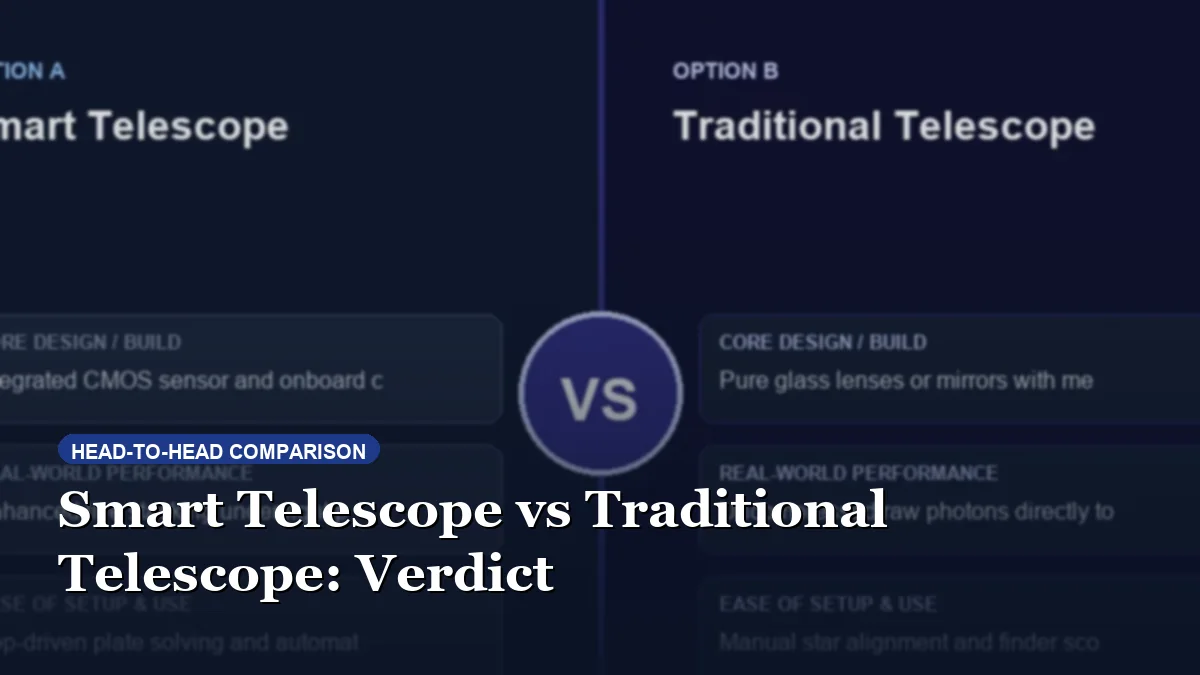
Choose smart telescopes for automated astrophotography and effortless setup, but select traditional telescopes for pure visual clarity and hands-on mechanical mastery.
Compare all top models in our Best Telescope: Top Backyard Picks for Astronomy.
Side-by-Side Breakdown
| Criteria | Smart Telescope | Traditional Telescope | Edge |
|---|---|---|---|
| Core Design / Build | Integrated CMOS sensor and onboard computer | Pure glass lenses or mirrors with mechanical focuser | Traditional Telescope |
| Real-World Performance | Enhanced live stacking under light pollution | Uncompressed raw photons directly to the eye | Traditional Telescope |
| Ease of Setup & Use | App-driven plate solving and automated alignment | Manual star alignment and finder scope calibration | Smart Telescope |
| Durability & Reliability | Dependent on firmware updates and internal batteries | Mechanical longevity lasting decades without power | Traditional Telescope |
| Efficiency / Operating Footprint | Compact all-in-one unit with wireless control | Requires heavy mounts, counterweights, and power tanks | Smart Telescope |
| Maintenance Requirements | Sealed optics requiring rare factory servicing | User-accessible mirror cleaning and collimation | Traditional Telescope |
| Best Ideal Use Case | Urban deep-sky imaging and quick observation sessions | Detailed planetary viewing and deep dark-sky exploration | Split Verdict |
Understanding Optical Architecture and Common Usage
Modern stargazing relies heavily on distinct optical philosophies. Smart units integrate digital sensors directly into the focal plane, whereas traditional designs prioritize pure glass purity for direct human viewing.
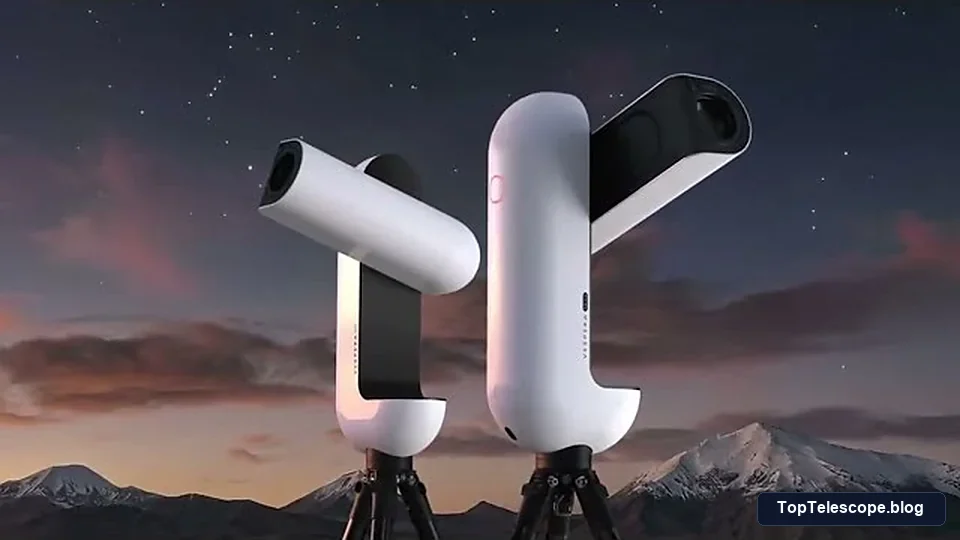
Common usage patterns diverge sharply in the field. Automated digital systems excel in light-polluted urban backyards, while classic optical tubes demand dark rural skies to reveal faint deep-sky nebulae and galaxies.
Traditional systems rely on manual Newtonian or refractor optical designs requiring precise collimation. Users must physically align mirrors using laser tools before capturing any deep-sky celestial objects during night sessions.
Conversely, smart telescopes integrate CMOS sensor technology into compact altazimuth assemblies. Many users pair these with equipment highlighted in our best smart phone telescope roundup to route digital photon data straight to mobile devices via Wi-Fi networks.
- Smart units replace eyepieces with high-sensitivity CMOS sensors.
- Traditional setups rely on human eye adaptation and eyepiece magnification.
- Urban observers favor digital stacking to bypass local light pollution.
- Primary mirror alignment tolerances demand frequent verification in Newtonian optical trains.
- Electronic sensor integration removes traditional eye relief constraints for observers.
Evaluating Field Effectiveness and Variations
Effectiveness in astronomy depends entirely on aperture and tracking precision. Digital rigs use internal field rotators and software stacking to simulate long exposures without tracking error.
Structural variations range from compact smart refractors to massive Newtonian reflectors. Each variation alters how light travels from distant cosmic sources to your chosen viewing interface.
- Software stacking multiplies effective exposure time automatically.
- Manual Dobsonians offer massive aperture per dollar invested.
Optical Coatings and Light Transmission
Multi-layer dielectric mirror coatings maximize reflectivity across visible spectrum wavelengths. Traditional glass lenses utilize broadband anti-reflective treatments to minimize internal scattering and ghosting artifacts during high-contrast planetary viewing.
Smart telescopes rely on smaller sensor windows treated with IR-cut filters. These specialized glass elements prevent near-infrared light pollution from degrading faint nebula imaging performance in urban environments.
- Anti-reflective coatings improve light transmission efficiency across glass air boundaries.
- IR-cut filters preserve natural stellar color rendering during electronic sensor integration.
Workflow Efficiency and Technical Acronyms
Navigating modern equipment requires understanding specific industry acronyms. Terms like EAA for electronically assisted astronomy define how digital scopes capture faint photons in real time.
Traditional workflows involve star charts, celestial coordinates, and manual setting circles. This analog approach builds deep spatial awareness but demands patience during cold winter observation nights.
Mastering operational workflows involves understanding key technical acronyms like FITS format data and plate solving. Smart units automate astrometric calibration, matching star fields against internal catalogs instantly without manual intervention.
Traditional workflows demand manual star-hopping using equatorial mount setting circles. Operators calculate right ascension and declination coordinates by hand, ensuring precise tracking using motor-driven clock drives or manual slow-motion cables.
- EAA transforms short exposures into vivid color images.
- GOTO systems automate pointing using internal star databases.
- Manual star hopping trains users in celestial navigation.
- Plate solving calculates telescope pointing coordinates via digital image matching algorithms.
- FITS files store raw astronomical data alongside comprehensive observation metadata headers.
Establishing Clear Observation Goals
Defining your astronomical targets prevents costly equipment mistakes. Evaluating models featured in our best telescope buyer guide helps planetary observers secure high focal lengths, while deep-sky imagers prioritize wide fields.
Structuring your observation plan ensures you select the correct optical accessories, power supplies, and mounting hardware before heading out to remote dark-sky locations.
- Planetary targets demand high magnification and good seeing conditions.
- Deep-sky objects require wide apertures and dark skies.
Calibration and Alignment Protocols
Automated smart platforms execute gyro-assisted alignment routines by scanning overhead constellations autonomously. The internal computer calculates sensor orientation without requiring manual star centering through high-magnification eyepieces.
Traditional equatorial mounts require careful polar alignment using an illuminated reticle polar scope. Correctly aligning the rotational axis toward Celestial Pole markers ensures long-exposure tracking accuracy without field rotation blurring.
- Polar scope reticles facilitate precise alignment with celestial rotation poles.
- Autonomous alignment routines reduce setup times for mobile astrophotography rigs.
Mechanical Build Quality and Durability
Traditional instruments boast exceptional mechanical longevity. Solid aluminum tubes, brass gears, and glass optics can last for generations with basic preventative maintenance and careful storage.
Smart variants incorporate delicate circuit boards, internal batteries, and wireless modules. These electronic components introduce potential failure points during extreme cold weather or high humidity.
Mechanical housing integrity depends heavily on anodized aluminum alloys and stainless steel fasteners. Traditional German equatorial mounts use heavy-duty cast metals designed to dampen vibrations during windy outdoor observation sessions.
Smart telescopes combine integrated optical tubes and altitude-azimuth forks into single molded chassis structures. These compact designs reduce mechanical connection points but require careful handling to protect internal circuit boards.
- All-glass optics resist degradation for decades of use.
- Integrated electronics require careful battery management in sub-zero temps.
- Cast aluminum fork arms provide robust structural rigidity for heavy optical tube assemblies.
- Weather-sealed electronic housings protect sensitive circuit boards from nocturnal condensation and dust.
Maintenance Protocols and Cleaning Standards
Maintaining traditional gear involves periodic mirror collimation and dust removal. Users can easily access internal mirrors and lenses using standard optical cleaning kits.
Digital systems are largely sealed units to protect internal sensors. If electronic components fail, owners must rely on manufacturer repairs rather than simple field adjustments.
- Collimation keeps reflector optics sharply focused.
- Sealed smart units prevent user-serviceable internal repairs.
Tripod Stability and Vibration Damping
Heavy stainless steel tripod legs minimize harmonic settling times after manual focusing adjustments. High payload capacities prevent structural flexure when mounting heavy counterbalance weights alongside large refractor optical tubes.
Smart telescopes utilize lighter carbon fiber or extruded aluminum tripods optimized for portability. Their integrated leveling bases rely on bullseye bubble levels for rapid deployment across uneven terrain surfaces.
- Stainless steel legs absorb high-frequency environmental vibrations effectively.
- Spiked tripod feet anchor equipment securely into soft outdoor ground surfaces.
Power Management and Field Portability
Field portability dictates how often your equipment actually gets used. As detailed in our Stellina smart telescope review, these lightweight, integrated designs deploy in minutes without heavy counterweights or external battery packs.
Traditional equatorial setups require careful balancing, polar alignment, and multiple cables. However, modular designs let users upgrade individual mounts, cameras, and optical tubes over time.
Power consumption profiles differ drastically between manual setups and automated imaging systems. Traditional mounts draw minimal current primarily for DC motor sidereal tracking, running efficiently on small external battery packs.
Smart telescopes demand substantial electrical current to power onboard computers, Wi-Fi radios, and cooled sensors. Operators frequently utilize lithium iron phosphate batteries to sustain multi-hour imaging sessions in remote dark-sky locations.
- Integrated battery systems power smart scopes for hours.
- Equatorial mounts demand precise polar alignment wedges.
- External DC power distribution hubs prevent tangled cables during complex astrophotography setups.
- Integrated lithium battery packs provide cordless operation for automated field capture sessions.
Financial and Resource Allocation Strategies
Budget allocation differs vastly between these two telescope categories. Digital units bundle cameras, computers, and mounts into one upfront cost, simplifying initial purchasing decisions.
Classic scopes let enthusiasts build custom rigs incrementally. You can buy a basic optical tube first, then upgrade your mount, filters, and eyepieces as your personal skills improve.
- All-in-one pricing covers complete imaging ecosystems.
- Modular purchasing spreads gear investments across years.
Transport Logistics and Weight Distribution
Field portability involves balancing total packed weight against individual component ergonomics. Traditional modular setups require careful distribution of counterweights, optical tubes, and heavy tripods across padded transport cases.
Smart telescopes offer streamlined transport configurations by consolidating optical systems and mounts. Their all-in-one chassis designs fit easily into backpack-style containers optimized for hiking to remote viewpoints.
- Padded transport cases protect delicate glass elements from mechanical shock impacts.
- Compact chassis designs minimize footprint dimensions inside standard vehicle trunks.
Software Integration and Ancillary Resources
Smart technology relies heavily on companion mobile applications and cloud databases. These software suites handle plate solving, object identification, and automated firmware updates seamlessly.
Traditional observers utilize printed star atlases, planetarium software, and community forums. Additional resources like observer handbooks help users track transient events like comets and occultations.
Modern astrophotography relies heavily on robust mobile application interfaces for instrument control. Selecting hardware from our best smart telescope for beginners guide ensures seamless smartphone integration with live stacking and guided target selection menus.
Traditional observers utilize standalone planetarium software, paper star atlases, and manual filter wheels. These ancillary resources foster deep astronomical knowledge through active star-hop planning and independent constellation identification exercises.
- Mobile apps guide alignment using smartphone cameras.
- Printed star charts remain reliable without battery power.
- Live image stacking algorithms combine short exposures dynamically to reveal faint nebulosity.
- Planetary software updates ensure accurate ephemeris calculations for solar system targets.
Final Selection Criteria for Serious Buyers
Weighing automation against manual control depends on your lifestyle. If you have limited free time and want instant color images, digital scopes deliver unmatched operational convenience.
If you cherish the meditative process of finding faint targets with your own eyes, classic optical instruments provide an infinitely rewarding connection to the night sky.
- Choose automation for fast, frustration-free imaging sessions.
- Choose manual optics for authentic stargazing experiences.
Firmware Maintenance and Data Archiving
Smart telescope owners must manage regular firmware updates to maintain operational compatibility. Cloud storage solutions enable seamless data archiving protocols for raw FITS files captured during extended imaging runs.
Traditional equipment requires no software dependencies, ensuring long-term mechanical reliability. Observers store notes in physical logbooks while processing analog photographs or digital camera files using desktop stacking applications.
- Firmware updates introduce new tracking algorithms and camera control features.
- Cloud backup solutions safeguard valuable astrophotography datasets against local drive failure.
Frequently Asked Questions
Can smart telescopes replace traditional optical setups?
They offer superior imaging in light-polluted areas, but traditional scopes deliver better pure visual clarity for planetary viewing.
Do smart scopes require an internet connection?
Most units generate a local Wi-Fi network to connect with your phone, meaning zero internet is needed at the dark site.
How difficult is collimation on traditional reflectors?
Collimation becomes simple with a laser tool, ensuring your optics remain sharp across every viewing session.
Which option is better for absolute beginners?
Smart scopes reduce the steep learning curve significantly, allowing novices to capture deep-sky objects within minutes of setup.
Can traditional telescopes be used for astrophotography?
Yes, but they require sturdy equatorial mounts, dedicated astronomy cameras, and complex guiding software to match smart scopes.