Skywatcher Heritage 130P vs 150P: Full Comparison
Choosing between these tabletop reflectors involves weighing optical aperture against physical portability. Both deliver exceptional views, but their physical footprints differ significantly.

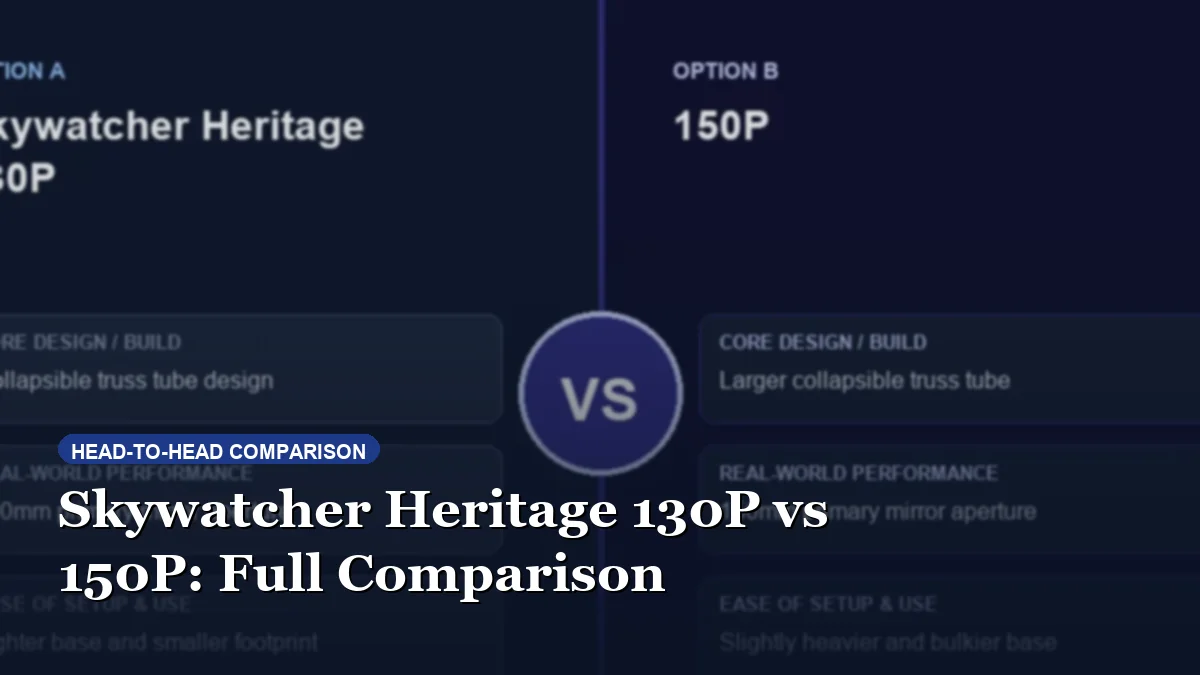
Choose the 130P if ultimate portability and lighter weight matter most for casual travel. Opt for the 150P if you need extra light gathering for deep-sky observation.
Compare all top models in our Best Telescope: Top Backyard Picks for Astronomy.
Side-by-Side Breakdown
| Criteria | Skywatcher Heritage 130P | 150P | Edge |
|---|---|---|---|
| Core Design / Build | Collapsible truss tube design | Larger collapsible truss tube | 150P |
| Real-World Performance | 130mm primary mirror aperture | 150mm primary mirror aperture | 150P |
| Ease of Setup & Use | Lighter base and smaller footprint | Slightly heavier and bulkier base | Side A |
| Durability & Reliability | Sturdy steel rockerbox structure | Reinforced wooden rockerbox build | Tie |
| Efficiency / Operating Footprint | Fits easily on small tables | Requires a sturdier observation table | Side A |
| Maintenance Requirements | Frequent truss collimation checks | Standard parabolic mirror alignment | Tie |
| Best Ideal Use Case | Grab-and-go backyard astronomy | Advanced deep-sky resolution tasks | 150P |
Optical Tube Assembly and Aperture
The primary mirror size dictates everything about a reflector telescope optical performance. Both systems use parabolic glass to eliminate spherical aberration effectively.
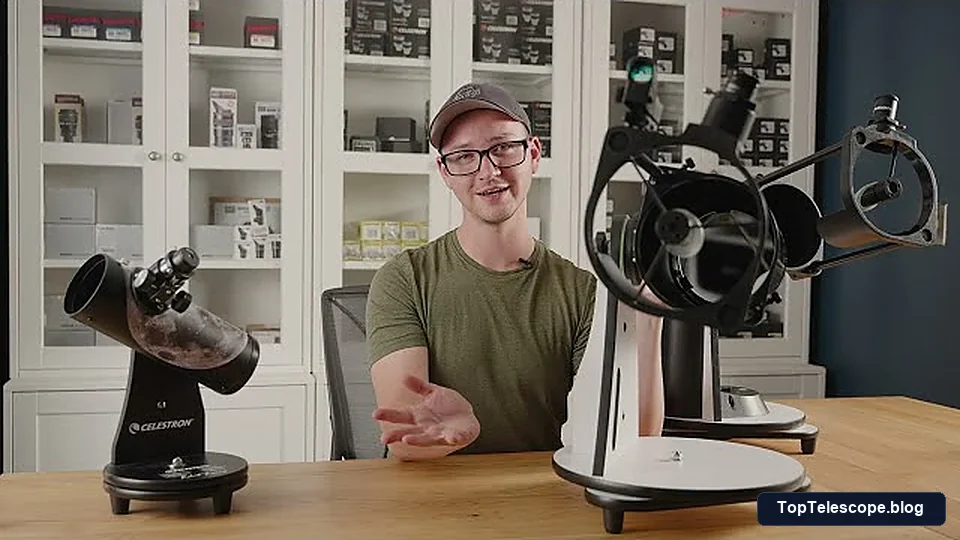
Stepping up to a larger mirror diameter provides noticeable improvements in faint galaxy resolution. As outlined in our Skywatcher Heritage 150P Virtuoso review, heavier glass directly increases total system weight.
Choosing the right optical tube means balancing raw light gathering against physical lifting constraints during transport.
Stepping up from a 130mm mirror to a 150mm parabolic primary yields a noticeable thirty-three percent increase in light-gathering power. This extra aperture exposes fainter deep-sky structures with greater structural clarity.
Both telescopes utilize a collapsible flex-tube truss design that reduces physical storage length significantly. However, the larger 150mm optical tube demands a slightly more robust locking mechanism to maintain optical alignment during transportation.
Optical coatings on both mirrors feature high-transmission aluminum with a protective silicon dioxide overcoat. Users must regularly inspect these surfaces for dust accumulation while avoiding direct physical contact to prevent scratching the optically sensitive coatings.
- Parabolic primary mirrors ensure sharp on-axis optical performance.
- Collapsible truss tubes reduce storage length significantly.
- Aperture differences impact faint deep-sky object visibility.
Light Gathering Power Differences
The 150mm aperture collects roughly thirty percent more light than its smaller sibling. This extra illumination reveals fainter spiral arms in distant galaxies.
Observers living under light-polluted skies will appreciate the additional optical throughput provided by the larger mirror surface area.
- Increased diameter yields brighter planetary nebula views.
- Resolution limits improve slightly with increased aperture.
Mount Design and Mechanical Stability
Tabletop Dobsonians rely on stable surface placement to dampen vibrations quickly during focusing. Both telescopes feature single-arm fork mounts attached to circular wooden bases.
The rockerbox friction system allows smooth manual tracking of celestial targets at high magnifications. Proper tension adjustment prevents unwanted tube drift.
Securing these instruments to a flat, vibration-free platform remains essential for maintaining steady high-power planetary observations.
The tabletop Dobsonian base structure relies on particle board construction coated for moisture resistance. It provides smooth azimuth rotation using Teflon pads, though balancing heavy eyepieces requires careful attention to friction tensioning.
Placing either mount on a stable, level platform is mandatory for high-magnification tracking. Ground vibrations dampen within two seconds on solid concrete, but wooden decks can amplify environmental tremors during windy observing sessions.
Altitude movement relies on side-bearing tension clutches that allow users to adjust resistance manually. Keeping these tension knobs properly tightened prevents the heavier 150mm tube from slipping downward when viewing near the zenith.
- Circular laminate bases provide smooth azimuth rotation.
- Altitude clutch knobs allow custom tension adjustments.
- Compact footprints fit easily on standard picnic tables.
Base Footprint and Weight Distribution
Transporting the 130P base requires minimal effort due to its lighter wood construction. You can read our comprehensive Skywatcher Heritage 150P review to compare dimensional specs and load capacities.
Balancing the heavier optical tube of the 150P requires careful attention during assembly to prevent tipping.
- Lighter bases improve overall grab-and-go usability.
- Wider footprints offer enhanced stability for heavier tubes.
Focuser Mechanics and Image Sharpness
Rack and pinion focusers on these instruments accept standard eyepieces securely without slipping. Upgrading to a dual-speed focus control improves fine-tuning precision.
Maintaining proper collimation ensures pinpoint star images across the entire field of view. Thermal acclimatization before viewing sessions prevents internal air currents.
Both systems deliver sharp lunar details when optical alignment is carefully dialed in using a Cheshire eyepiece.
Both models feature standard rack-and-pinion focusers constructed primarily from molded composite plastics and metal drawtubes. While functional, they exhibit minor image shift when reversing focus direction due to inherent gear backlash.
Achieving critical focus requires patience, especially at fast focal ratios where the depth of field is exceptionally shallow. Upgrading to a dual-speed micro-focuser or adding tension strips significantly improves everyday focusing precision.
Fast parabolic mirrors inherently produce coma at the field edges, stretching stars into tiny cometary shapes. Utilizing a coma corrector lens becomes beneficial for wide-angle eyepiece users seeking pinpoint stars across the entire peripheral view.
- Standard focusers accommodate common 1.25-inch accessories.
- Tension screws prevent heavy eyepieces from sagging.
- Precise focusing is critical for resolving planetary details.
Eyepiece Compatibility and Focus Drift
Heavy wide-angle eyepieces can strain standard rack and pinion focusers over extended viewing sessions. Securing locking screws tightly mitigates unwanted mechanical play.
Using lightweight glass helps maintain optimal balance across the altitude axis during tracking.
- Standard rack and pinion mechanisms operate reliably.
- Locking rings protect inserted optical diagonals securely.
Portability and Field Ergonomics
Grab-and-go convenience defines the core appeal of these innovative collapsible tabletop telescopes. Users can easily store them in small car trunks for weekend camping trips.
The collapsible truss design eliminates the need for bulky full-length optical tubes during transit. Quick-release mounting brackets streamline field assembly procedures.
Ergonomic carrying handles built directly into the bases simplify moving the equipment across uneven terrain.
Packing a compact telescope into a vehicle requires assessing total combined weight. As noted in our Skywatcher Heritage 130P review, the 14-pound total weight makes it an effortless grab-and-go system for spontaneous stargazing trips away from home.
Stepping up to the 150p increases total system weight past 20 pounds, which alters how comfortably you can transport the gear. It still fits easily across a back seat, but requires two-handed lifting for safety.
Ergonomic placement in the field dictates whether you sit or stand during observations. Because these are tabletop designs, securing a sturdy, appropriately sized folding camp table ensures comfortable posture during prolonged planetary viewing sessions.
- Truss poles collapse smoothly for compact storage.
- Integrated handles aid safe transport to dark sites.
- Quick setup times maximize actual stargazing duration.
Transport and Storage Dimensions
Storing the optical tube in its retracted position saves valuable space in apartment closets or vehicle trunks. Protective covers prevent dust accumulation on mirrors.
Checking mechanical alignment after transit ensures crisp views every single night.
- Retracted lengths fit small vehicle footwells easily.
- Dust caps protect optical surfaces during storage.
Deep-Sky and Planetary Performance
Planetary observation requires high magnification and excellent thermal stability from your primary mirror. Both scopes resolve cloud belts on Jupiter and rings around Saturn.
Deep-sky targets benefit immensely from the additional light grasp of the larger optical configuration. Faint nebulae display more internal structure under dark skies.
Matching eyepiece focal lengths to local seeing conditions ensures optimal visual contrast and sharp planetary details.
Light grasp dictates deep-sky visibility under dark skies, and the extra diameter of the 150mm mirror resolves fainter globular clusters clearly. Faint fuzzies reveal subtle mottling that remains completely invisible in smaller apertures.
Planetary observing demands sharp optics and thermal acclimatization before viewing high-contrast details. Our Skywatcher Heritage 130P Flextube review details how a thirty-minute cool-down lets the primary mirror reach ambient temperature equilibrium.
Atmospheric seeing conditions ultimately limit maximum useful magnification more than aperture constraints. Using high-grade planetary eyepieces helps extract maximum useful magnification when observing lunar craters and subtle Martian surface albedo features.
- Bright planets show crisp atmospheric contrast details.
- Messier catalog objects appear clear in dark skies.
- Aperture advantage favors deep-sky resolution tasks.
Lunar and Solar System Resolution
Crater walls and lunar rilles pop into sharp focus when atmospheric turbulence remains low. High-magnification planetary filters enhance subtle surface hues.
Proper cool-down times prevent thermal plumes from distorting high-power planetary images.
- Lunar craters display sharp shadow transitions.
- Planetary filters improve cloud band contrast.
Collimation and Routine Maintenance
Reflector telescopes require periodic mirror alignment to maintain peak optical performance. User-friendly thumbscrews on the rear cell simplify primary mirror adjustments.
Collapsible truss designs may require minor alignment checks after each transport phase. Developing a quick collimation routine ensures consistently sharp images.
Keeping primary and secondary mirrors clean preserves maximum reflectivity over years of regular astronomical use.
Newtonian reflectors require periodic mirror alignment to maintain pinpoint star images across the field of view. Using a laser collimator simplifies aligning the primary and secondary mirrors, ensuring optimal optical performance every night.
The open truss design exposes optics to ambient dust and dew, necessitating occasional mirror cleaning procedures. Never clean dry mirrors; always use photographic-grade air blowers to remove loose debris before applying any liquid cleaning solutions.
Transporting collapsible tube assemblies can occasionally knock primary mirror clips out of adjustment. Regularly checking the collimation screws on the rear cell guarantees your optical system remains sharp throughout bumpy car rides to dark sites.
- Tool-free adjustment knobs simplify mirror alignment.
- Cheshire eyepieces provide accurate optical centering.
- Routine checks ensure peak high-power resolution.
Mirror Care and Alignment Tips
Avoiding direct contact with optical coatings prevents accidental scratching during cleaning procedures. Storing tubes vertically minimizes dust settling on primary surfaces.
Professional optical cleaning should only occur when dust buildup severely degrades contrast.
- Never touch bare reflective glass mirror surfaces.
- Use specialized air blowers to remove loose dust.
Value and Ideal User Profiles
Selecting between these instruments depends heavily on your specific transport needs and storage limitations. Beginners seeking ultimate simplicity will appreciate the lighter platform.
Intermediate observers wanting deeper celestial reach will find the larger optical tube exceptionally rewarding. Both systems offer unmatched performance relative to their physical size.
Investing in quality eyepieces unlocks the true potential of these remarkable collapsible reflector telescopes.
Choosing between these two instruments depends heavily on your physical storage constraints and commitment to astronomy. Beginners seeking ultimate portability will appreciate the lightweight nature and forgiving focal ratio of the smaller model.
Experienced observers prioritizing deep-sky resolution over sheer convenience will find the larger optical tube delivers superior performance. Its enhanced light gathering satisfies hobbyists wanting a capable telescope that does not require permanent observatory housing.
Both options provide exceptional optical performance relative to their physical footprint and mechanical complexity. Selecting the right model ultimately hinges on balancing your personal storage limits against your desire for maximum deep-sky reach.
- Lighter models suit younger or casual stargazers.
- Larger tubes satisfy dedicated deep-sky enthusiasts.
- Both designs offer exceptional portability value.
Choosing Your Ideal Telescope
Evaluate your available storage space and physical lifting comfort before making a final purchasing decision. Prioritizing ease of use ensures your telescope gets frequent field use.
Matching the equipment to your local sky conditions guarantees satisfying astronomical observations.
- Assess storage capacity prior to final selection.
- Consider local light pollution levels carefully.
Frequently Asked Questions
Do these telescopes require regular optical alignment?
Yes, reflector telescopes need periodic mirror adjustments using tool-free thumbscrews. Maintaining proper collimation ensures consistently sharp planetary and deep-sky views during every session.
Can I mount these optical tubes on standard tripods?
Both instruments feature integrated Vixen-style dovetail bars attached to their bases. This allows mounting them onto sturdy equatorial mounts if you prefer tracking capabilities.
What accessories should I purchase alongside these scopes?
Adding a quality Barlow lens and a planetary eyepiece enhances your magnification options significantly. A dedicated headlamp with a red LED preserves your dark adaptation.
Are these tabletop reflectors suitable for total beginners?
Their intuitive manual design makes them fantastic introductory instruments for novice astronomers. The simple point-and-view operation encourages frequent backyard stargazing sessions.
How well do they perform under suburban light pollution?
Brighter planets, the Moon, and prominent double stars remain clearly visible from urban backyards. Deep-sky nebulae require darker rural travel locations for optimal contrast.