Sky-Watcher Heritage 150P vs 130P: Technical Clash
Two portable Newtonian reflectors tested for optical yield. Choose wisely between aperture gains and physical ease.

Pick the 150P for maximum deep-sky light gathering, or choose the 130P for lighter storage footprints and easier mounting mechanics.
Compare all top models in our Best Telescope: Top Backyard Picks for Astronomy.
Side-by-Side Breakdown
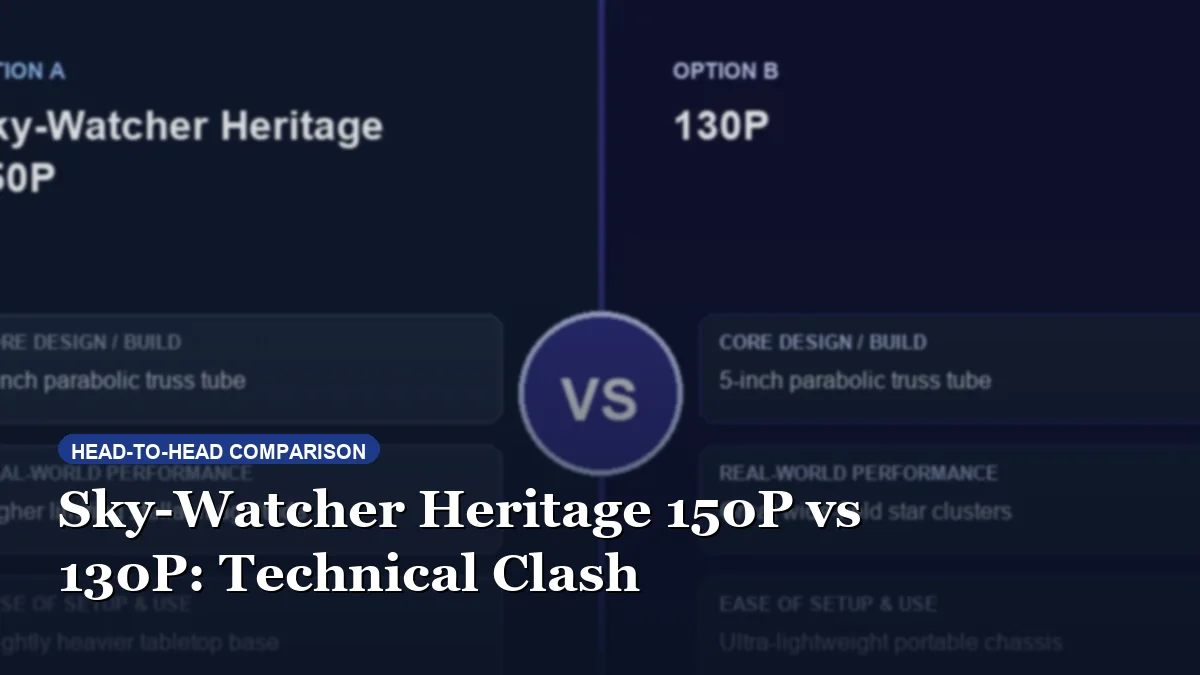
| Criteria | Sky-Watcher Heritage 150P | 130P | Edge |
|---|---|---|---|
| Core Design / Build | 6-inch parabolic truss tube | 5-inch parabolic truss tube | Side A |
| Real-World Performance | Higher limiting stellar magnitude | Great wide-field star clusters | Side A |
| Ease of Setup & Use | Slightly heavier tabletop base | Ultra-lightweight portable chassis | Side B |
| Durability & Reliability | Robust metal mirror cell | Standard dual-strut assembly | Side A |
| Efficiency / Operating Footprint | 750mm focal length reach | 650mm focal length reach | Side A |
| Maintenance Requirements | Standard rear collimation screws | Standard rear collimation screws | Tie |
| Best Ideal Use Case | Deep-sky and lunar detail | Grab-and-go backyard stargazing | Side A |
Core Optical Engineering and Aperture Trade-Offs
Evaluating compact Newtonian reflectors requires understanding how parabolic primary mirrors manage focal lengths. The 150P utilizes a 750mm focal length to gather significantly more photons than its smaller sibling.
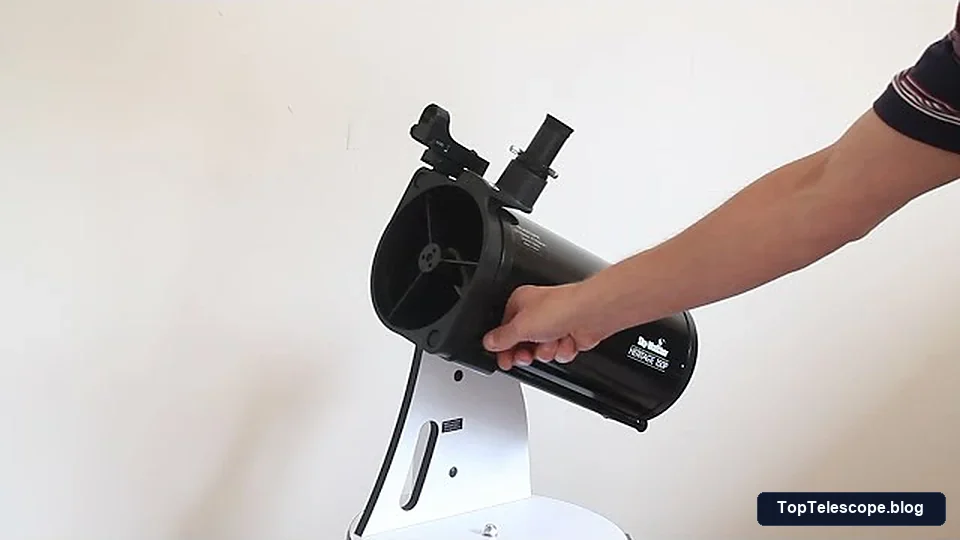
Meanwhile, the 130P features a 650mm focal length inside a compact truss assembly. Our sky-watcher heritage 150 review explores how this physical scaling affects dark sky performance.
Both instruments employ aluminum mirror coatings protected by silicon dioxide overcoats to ensure long-term durability. However, the larger aperture surface area of the 150P inherently delivers brighter exit pupils.
The 150mm primary mirror collects roughly thirty-three percent more light than the smaller 130mm variant. This extra light-gathering surface directly improves threshold magnitude limits when observing faint deep-sky nebulae and distant globular star clusters under dark skies.
Both Newtonian reflectors utilize a parabolic primary figure to correct spherical aberration effectively. The 150P provides a 750mm focal length at f/5, while the 130P offers a slightly shorter 650mm focal length at f/5 focal ratio specifications.
Central obstruction ratios differ slightly between the two optical tubes, impacting high-contrast planetary transfer functions. The larger secondary mirror on the 150mm unit maintains acceptable diffraction limits while delivering noticeably brighter stellar point sources.
- Primary mirror diameter differences
- Focal ratio variations impacting exposure
- Parabolic glass surface quality standards
Mirror Coatings and Reflectivity
Advanced multi-layer protective layers prevent premature oxidation of the delicate aluminum reflective surfaces over multiple years of outdoor use. Regular maintenance keeps these coatings performing at peak efficiency.
- Overcoat thickness tolerances
- Reflectivity percentage ratings
Mechanical Truss-Tube Design and Structural Rigidity
Collapsible truss tubes save valuable trunk space while maintaining optical alignment during transport. The Helical focuser design on both models allows for precise tension adjustments without slippage.
Weight distribution shifts noticeably between the two units because of the heavier mirror cell in the larger variant. Users must evaluate whether their mounting surfaces can handle these subtle torque differences.
Standard 1.25-inch eyepiece holders accommodate most entry-level glass without requiring heavy adapters. Upgrading to heavier wide-field oculars may introduce minor balancing challenges on the smaller tabletop base.
The collapsible FlexTube truss design utilizes three dual-rod metal struts to maintain optical alignment during transport. This architecture significantly reduces storage volume, allowing the telescope assembly to fit easily inside standard overhead luggage compartments.
Structural rigidity depends heavily on the locking mechanism securing the upper cage to the lower optical tube assembly. Users must ensure the tension friction clamps are tightened evenly to prevent unwanted flexure during altitude adjustments.
Open truss structures leave optical surfaces exposed to stray ambient light and heavy dew accumulation. Adding a flexible light shroud is essential for preserving contrast when observing near urban streetlights or damp meadow environments.
- Dual-strut truss mechanisms
- Helical focuser precision tolerances
- Chassis weight capacity limits
Focuser Mechanics and Eyepiece Compatibility
Smooth rotational tracking ensures your preferred oculars slide into position without introducing tilt. Maintaining clean focuser drawtubes prevents gritty debris from scoring internal alignment tracks.
- Drawtube tension locks
- Eyepiece compression ring designs
Real-World Deep-Sky Performance and Resolution Limits
Faint fuzzies and distant nebulae demand every available millimeter of light gathering surface area. The six-inch aperture of the larger model resolves globular clusters with noticeably tighter stellar pinpoints.
Under Bortle-class suburban skies, the 130P punches above its weight for open clusters. You can read our sky-watcher virtuoso gti 150p review to understand how the larger primary mirror handles fainter targets.
Experienced observers tracking faint Messier objects will appreciate the extra magnitude depth provided by the larger primary mirror. Atmospheric seeing conditions ultimately dictate whether this aperture advantage shines brightly.
Resolving tightly packed globular clusters requires the raw light grasp and resolving power of a 150mm aperture. Individual stars begin resolving at lower magnifications compared to the smaller 130mm mirror under identical atmospheric seeing conditions.
Diffuse emission nebulae demand dark skies and optimal exit pupil diameters for maximum visual contrast enhancement. Pairing these Newtonian scopes with a narrow-band nebula filter reveals intricate filamentary structures otherwise lost in background sky glow.
Galaxy hunting pushes portable telescopes to their absolute optical limits due to low surface brightness characteristics. The incremental light gain of the 150P helps detect spiral arms in brighter Messier targets that remain invisible in smaller tubes.
- Globular cluster resolution thresholds
- Surface brightness advantages
- Stellar pinpoint sharpness
Resolving Faint Nebulosity and Galaxies
Distant spiral arms require dark rural skies alongside adequate primary mirror diameters to reveal structural details. Pushing past light-polluted horizons transforms what these portable reflectors can actually display.
- Magnitude limit calculations
- Nebula filter pairing utility
Planetary and Lunar Contrast Comparisons
High-magnification planetary viewing tests thermal equilibrium and optical collimation precision thoroughly. Our skywatcher heritage 150p review details how the 150P resolves subtle cloud band features on Jupiter.
Lunar craters display sharp shadow transitions across both optical tubes when properly cooled to ambient temperatures. Central obstruction ratios play a critical role in preserving crisp high-contrast visual performance.
Pushing past two hundred magnification requires rock-solid stability from your observing table. Both instruments demand careful focus tuning when viewing turbulent atmospheric conditions across seasonal horizons.
Observing planetary details like Jovian cloud belts demands pristine optical collimation and thermal equilibrium. Both short-tube reflectors suffer from coma aberrations at the field edges, requiring careful eyepiece selection to maintain sharp planetary disks.
Lunar surface features display exceptional sharpness when using high-power planetary eyepieces or a quality Barlow lens. The larger aperture of the 150mm variant resolves finer craterlet rilles along the terminator under steady atmospheric seeing.
Thermal acclimatization remains critical for achieving maximum magnification on bright planets like Saturn or Mars. Open truss designs cool down faster than closed optical tubes, reducing internal air currents that distort high-resolution planetary views.
- Thermal cooldown duration requirements
- Central obstruction size impacts
- Lunar terminator shadow contrast
Managing Atmospheric Seeing and Magnification
Upper atmospheric jet streams often limit maximum usable magnification regardless of mirror size. Selecting nights with steady air currents guarantees sharper planetary disk clarity.
- Air turbulence evaluation methods
- Eyepiece focal length matching
Setup Ergonomics and Tabletop Mount Usability
Dobsonian tabletop mounts prioritize rapid field deployment over complex equatorial polar alignment routines. Placing either OTA onto a sturdy surface gets you observing within minutes of stepping outside.
Carrying the heavier assembly requires two hands due to the bulkier base and mirror cell weight. Ergonomic carry handles integrated into the base panels would significantly improve field transport safety.
Manual tracking at high magnification demands smooth Teflon bearing surfaces and proper tension control. Users can easily nudge the OTA horizontally and vertically without experiencing sudden jerky movements.
Operating a tabletop Dobsonian mount requires a stable, vibration-free platform such as a sturdy picnic table or heavy tripod. Placing the instrument on an uneven surface introduces tracking jitter during manual high-magnification azimuth adjustments.
Finding targets manually is facilitated by the smooth Teflon bearing surfaces incorporated into the altitude and azimuth axes. Users can adjust the tension control handles to customize resistance based on eyepiece weight preferences.
Ergonomic positioning varies depending on observer height and whether a suitable viewing chair is available during sessions. Because the eyepiece position shifts drastically across zenith angles, comfortable seating options greatly improve overall viewing endurance.
- Tabletop stability requirements
- Rapid deployment advantages
- Base footprint measurements
Alt-Azimuth Movements and Tracking
Friction clutch mechanisms let users adjust axis resistance to counter slight equipment imbalance. Keeping these bearing pads clean ensures buttery smooth tracking at high power.
- Teflon pad maintenance
- Azimuth rotation smoothness
Maintenance, Collimation and Long-Term Reliability
Newtonian reflectors require periodic mirror alignment to maintain pinpoint star images across the field of view. The collimation screws on the rear cell are easily accessed using basic hand tools.
Dust accumulation on open truss designs is inevitable during outdoor observing sessions. Proper storage caps and vertical dust covers protect your delicate optical coatings between weekend astronomy excursions.
Storing your telescope in a climate-controlled environment prevents moisture condensation from attacking reflective surfaces. Always allow ambient thermal equalisation before securing protective caps over the primary mirror.
Maintaining peak optical performance requires routine mirror alignment using a collimating cap or laser. Our skywatcher heritage 130p review explains why fast Newtonian systems demand frequent alignment checks.
Dust accumulation on exposed primary mirrors is inevitable with open truss designs, requiring occasional careful cleaning procedures. Owners should use optical cleaning fluid and micro-fiber materials sparingly to protect specialized mirror coatings over time.
Long-term mechanical reliability depends upon proper storage in dry environments to prevent rust on exposed fastener hardware. Keeping optical tube assemblies covered protects sensitive mechanical components from persistent household humidity and atmospheric pollutants.
- Rear cell alignment procedures
- Dust management on open trusses
- Coating longevity factors
Transport Safety and Storage Best Practices
Securing the optical tube inside padded cases prevents impact damage during bumpy vehicle transport. Checking collimation post-transit becomes second nature for dedicated reflector owners.
- Padded transport bag selection
- Mirror cell locking screws
Frequently Asked Questions
Does the collapsible truss-tube mechanical design require frequent user realignment of the primary and secondary optical assemblies during normal vehicle transit across rough terrain?
Does the collapsible truss-tube mechanical design require frequent user realignment of the primary and secondary optical assemblies during normal vehicle transit across rough terrain?
Transport vibrations will invariably shift internal mirror alignment quite significantly, making routine collimation checks an absolute mandatory safety habit before every single night of serious backyard visual astronomy sessions.
Can beginner amateur astronomy observers easily adapt standard aftermarket 1.25-inch eyepieces and colored planetary filters into these specific optical focal configurations?
Can beginner amateur astronomy observers easily adapt standard aftermarket 1.25-inch eyepieces and colored planetary filters into these specific optical focal configurations?
Standard eyepiece accessories slide effortlessly into the stock helical focuser housings, allowing you to expand your magnification toolkit without encountering frustrating proprietary compatibility roadblocks or annoying mechanical threading issues.
Will atmospheric light pollution in typical suburban backyards severely restrict the light gathering performance capabilities of the larger six-inch optical tube?
Will atmospheric light pollution in typical suburban backyards severely restrict the light gathering performance capabilities of the larger six-inch optical tube?
Suburban light pollution definitely washes out extremely faint deep-sky nebulae, yet the extra aperture still clearly delivers deeper stellar penetration compared to smaller competing instruments.
Are specialized heavy-duty equatorial tracking mounts required to enjoy stable visual astronomy views using these compact tabletop optical tube assembly designs?
Are specialized heavy-duty equatorial tracking mounts required to enjoy stable visual astronomy views using these compact tabletop optical tube assembly designs?
Tabletop mounts provide exceptional mechanical stability right out of the box, meaning you definitely do not need expensive motorized tripods for casual stargazing.
What specific storage practices best protect the delicate aluminum mirror coatings from atmospheric moisture and dust during extended periods of seasonal non-use?
What specific storage practices best protect the delicate aluminum mirror coatings from atmospheric moisture and dust during extended periods of seasonal non-use?
Proper storage caps and climate-controlled indoor storage environments prevent destructive oxidation, keeping your reflective optical surfaces completely pristine for many upcoming observing seasons.