Sky-Watcher Classic 200P vs Apertura AD8: Technical Comparison
Choosing an eight-inch Newtonian reflector involves balancing optical accessories and mount mechanics. This guide contrasts two benchmark Dobsonians for serious amateur astronomers.

Choose the Sky-Watcher Classic 200P for its straightforward, lightweight optical tube assembly and reliable rocker box base. Opt for the Apertura AD8 if you require premium bundled accessories like a dual-speed Crayford focuser.
Compare all top models in our Best Telescope: Top Backyard Picks for Astronomy.
Side-by-Side Breakdown
| Criteria | Sky Watcher Classic 200P | Apertura Ad8 | Edge |
|---|---|---|---|
| Core Design / Build | Traditional Sonotube-style metal OTA | Rolled steel tube with ventilation | Apertura Ad8 |
| Real-World Performance | Parabolic primary mirror delivers sharp images | Diffraction-limited optics show high contrast | Tie |
| Ease of Setup & Use | Simple tension clutch altitude bearings | Roller bearing azimuth base and adjustable altitude | Apertura Ad8 |
| Durability & Reliability | Robust particle board rocker box | Durable laminate-coated particle board base | Tie |
| Efficiency / Operating Footprint | Standard 203mm aperture footprint | Standard 203mm aperture footprint | Tie |
| Maintenance Requirements | Standard primary mirror collimation | Standard primary mirror collimation with rear fan | Apertura Ad8 |
| Best Ideal Use Case | Budget-minded visual observers | Observers wanting out-of-the-box accessory value | Apertura Ad8 |
Core Optical Design and Engineering Principles
Both telescopes utilize an 8-inch parabolic primary mirror housed inside a traditional Newtonian reflector configuration. This specific aperture gathers enough light to resolve faint deep-sky objects clearly during dark sky sessions.
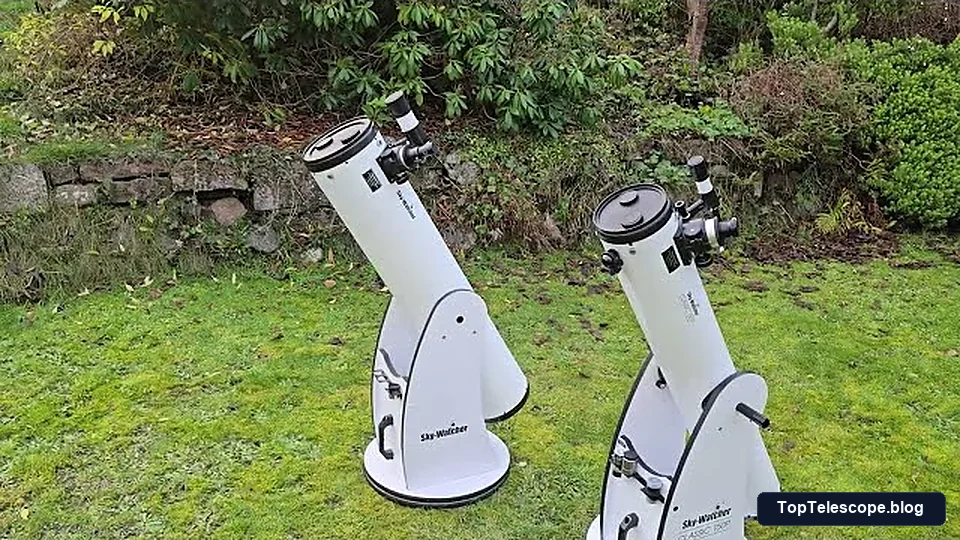
Optical figuring quality remains remarkably consistent across both manufacturing lines. Observers can expect diffraction-limited performance capable of splitting tight double stars and revealing planetary details under steady atmospheric seeing conditions.
Parabolic mirrors require precise figuring to eliminate spherical aberration at fast focal ratios. Both scopes utilize an f/6 focal length which relaxes eyepiece tolerance while maintaining sharp planetary performance across wide apparent fields.
Aluminum primary coatings protected by a silicon dioxide overcoat ensure high reflectivity. Proper optical alignment demands regular collimation using a Cheshire eyepiece to align the parabolic primary and flat secondary mirror accurately.
- Primary mirror diameter of 203 millimeters for deep light gathering.
- Focal length of 1200mm yielding versatile magnifications.
- Pyrex or similar low-expansion glass substrates for thermal stability.
Optical Coatings and Light Transmission
High-reflectivity coatings applied to the primary and secondary mirrors maximize photon throughput. These protective layers ensure that maximum light reaches the eyepiece without significant degradation or premature oxidation.
Proper optical alignment remains critical for achieving peak performance from fast parabolic mirrors. Regular collimation using laser tools or Cheshire eyepieces keeps your optical train performing at absolute maximum efficiency.
- Enhanced aluminum coatings exceeding 90 percent reflectivity.
- Secondary mirror obstruction optimized for minimal diffraction spikes.
Mechanical Mounting and Base Architecture
The mounting systems utilize traditional Dobsonian rocker box configurations built from compressed wood products. These heavy wooden bases provide exceptional stability compared to shaky equatorial tripods found on beginner telescopes.
Ground board rotation utilizes different bearing materials between the two brands. Understanding these mechanical variations helps users select the smoothest panning action for tracking planets at high magnifications.
Traditional Dobsonian mount architecture relies on particle board or laminated wood assemblies. As noted in our Sky-Watcher Classic 200P Dobsonian review, the Sky-Watcher employs standard Teflon bearing pads for smooth motion control.
Side-bearing tension brakes allow users to compensate for heavy dual-inch eyepieces. Proper balancing prevents sudden optical tube slips during high-magnification sessions, ensuring stable tracking of celestial targets near the zenith.
- Heavy-duty particle board construction with moisture-resistant laminate.
- Teflon pads or roller bearings for smooth azimuth movement.
Altitude Bearing Adjustments
Altitude tension mechanisms dictate how well the optical tube stays balanced during eyepiece swaps. Friction clutches allow users to dial in exact resistance levels without adding bulky counterweights.
Proper altitude balance prevents the front-heavy tube from slipping downward during viewing sessions. Both models provide adjustable knobs to secure the heavy optical tube safely in place.
- Spring tension or tension knob systems for secure altitude friction.
- Balanced center of gravity along the altitude trunnion axes.
Real-World Deep-Sky Performance and Resolution
Venturing past our solar system reveals the true power of an eight-inch primary mirror. As detailed in our Apertura AD8 review, faint nebulae, distant star clusters, and external galaxies show distinct structural details under dark rural skies.
Planetary observation demands steady air and precise thermal acclimation before observing fine cloud belts. Jupiter and Saturn display striking atmospheric features when magnification exceeds one hundred fifty power.
An eight-inch aperture gathers roughly 800 times more light than the unaided human eye. This light-gathering power exposes faint spiral structure in galaxies and resolves globular clusters into countless individual stars.
Seeing conditions heavily dictate high-power planetary resolution on any given night. Utilizing a cooling fan accelerates thermal equilibrium, directly improving contrast transfer across Jupiter cloud belts and Saturnian rings.
- Resolving globular clusters into individual pinpoint stars successfully.
- Detecting subtle spiral structure in bright Messier galaxies.
Lunar and Solar System Imaging Potential
While primarily designed for visual astronomy, these large Dobsonians allow casual planetary webcam imaging. High-speed video captures permit stacking software to extract impressive surface details from blurred frames.
Lunar craters and mountain ridges appear breathtakingly sharp through wide-field oculars. High contrast optics ensure shadows inside deep craters look remarkably crisp during terminator viewing phases.
- Excellent lunar contrast utilizing neutral density planetary filters.
- Short exposure webcam capability for bright solar system targets.
Optical Accessories and Factory Outfitting
Factory accessory bundles represent a major differentiator when comparing these two popular beginner telescopes. Upgraded inclusions save new astronomers considerable money on essential secondary equipment purchases immediately after delivery.
Evaluated items include finderscopes, focusers, and included eyepieces shipped directly in the standard retail box. Evaluating these included extras helps determine the true total value of your initial investment.
Stock finderscopes drastically alter initial target acquisition ease under dark skies. As discussed in our Sky-Watcher Virtuoso GTi 150P review, a 9x50 optical finder provides significantly brighter images than red dot pointers.
Included oculars vary between manufacturers, typically featuring wide-field Erfle designs or basic Plössls. A dual-speed focuser with a 10:1 reduction gear ensures precise focal point adjustments for demanding visual observers.
- Standard rack-and-pinion versus dual-speed Crayford focusers.
- Optical finderscopes versus wide-field red dot units.
Focuser Mechanics and Eyepiece Upgrades
A dual-speed Crayford focuser offers micro-adjustment capabilities that simplify achieving razor-sharp focus. This mechanical advantage proves especially valuable when swapping between high-power planetary eyepieces and heavy glass.
Standard eyepieces usually include a low-power wide-field design and a high-power planetary ocular. Supplementing these basic lenses with premium wide-angle eyepieces significantly enhances your overall viewing experience.
- Micro-focus knob ratios of 10 to 1 for precision.
- Two-inch adapter barrels accommodating large format oculars.
Setup Ergonomics and Transport Footprint
Transporting large Dobsonians requires careful vehicle packing due to the rigid optical tube dimensions. Both instruments separate into two manageable components comprising the optical tube and wooden base.
Lifting a bulky eight-inch optical tube assembly demands proper lifting techniques to protect your back. Car trunk compatibility varies depending on sedan or hatchback vehicle configurations available.
Managing a solid metal optical tube requires awareness of vehicle cargo space limits. The full-length tube demands backseat transport in compact cars, whereas observatory domes or garages offer permanent storage convenience.
Carrying handles bolted onto the rocker box simplify moving the heavy wooden base outdoors. Proper lifting mechanics protect your lower back when hauling the heavy assembly across damp backyard grass surfaces.
- Separate OTA and base weights totaling around forty pounds.
- Carrying handles positioned for balanced two-person transport.
Field Assembly and Site Preparation
Assembling your telescope at an observing site takes only a few minutes without tools. Simply place the rocker box on level ground and drop the optical tube into place.
Checking site levelness ensures smooth panning without binding during manual tracking sweeps. Carrying a small bubble level guarantees your Dobsonian base sits flat on uneven ground.
- Tool-free assembly utilizing captive thumb screws and brackets.
- Compact storage footprint occupying minimal garage floor space.
Maintenance Protocols and Thermal Management
Managing mirror temperature differentials prevents internal tube currents from blurring planetary details during cold nights. Allowing adequate cool-down time ensures optimal thermal equilibrium before starting serious observation sessions.
Integrated cooling fans help accelerate mirror acclimation by exhausting trapped boundary layer heat quickly. Routine cleaning should be avoided unless dust accumulation severely impacts overall optical reflection performance.
Dust accumulation on primary mirrors is inevitable during extended outdoor observing sessions. Avoid aggressive cleaning and instead use distilled water rinses alongside photographic-grade optical cleaning solutions to preserve coatings.
Bringing optics outdoors an hour before sunset allows the glass to shed accumulated heat. A rear cooling fan accelerates thermal adaptation, preventing internal air currents from blurring high-magnification planetary views.
- Battery-powered rear cooling fans for rapid thermal stabilization.
- Periodic primary mirror cleaning using distilled water and detergent.
Collimation Frequency and Alignment Tools
Regular mirror alignment checks guarantee sharp images across all targeted astronomical objects. Transporting your telescope over bumpy roads usually necessitates minor adjustments using rear collimation knobs.
Laser collimators simplify daytime alignment procedures for beginners lacking extensive optical experience. Maintaining proper optical alignment remains the single most important routine maintenance task for Newtonian owners.
- Spring-loaded collimation thumbscrews for effortless adjustment.
- Cheshire eyepiece verification for absolute optical precision.
Long-Term Durability and Upgradability
Constructing robust telescopes ensures decades of reliable service under frequent nighttime use conditions. High-quality metal tubes and reinforced particle board bases resist normal wear during regular field transport.
Upgrading your instrument over time expands its capabilities as your astronomical interests evolve. Popular modifications include adding setting circles, upgraded finders, or specialized narrow-band nebula filters.
Steel optical tubes resist warping and environmental moisture better than traditional pressed cardboard tubes. Investing in a sturdy metal chassis guarantees decades of reliable backyard astronomy under varied weather conditions.
Owners can easily upgrade standard accessories by adding digital setting circles or replacement focusers. Upgrading to a premium eyepiece unlocks wider fields of view, maximizing the potential of your Newtonian optical system.
- Rugged metal construction protecting internal optical alignments safely.
- Modular design supporting future accessory additions effortlessly.
Resale Value and Ecosystem Support
Popular Dobsonian telescopes retain strong resale values within local astronomy club communities. Our Apertura AD8 Dobsonian 8 telescope review highlights active user forums providing endless troubleshooting advice and modification tutorials.
Sourcing replacement parts or aftermarket upgrades proves exceptionally straightforward due to standardized sizing. This universal ecosystem ensures your investment remains serviceable for many years of stargazing adventures.
- Active community forums offering extensive DIY modification guides.
- Standard two-inch focuser sizing ensuring wide accessory compatibility.
Frequently Asked Questions
Which telescope is better for absolute beginners?
Choosing between these two exceptional instruments depends entirely on your personal preference for comprehensive factory accessories versus a simpler traditional configuration.
The Apertura model typically includes superior bundled extras like a cooling fan and dual-speed focuser, whereas the Sky-Watcher offers a reliable time-tested design for casual visual observers starting out.
Do these telescopes require frequent optical collimation?
Yes, both Newtonian reflectors require routine optical alignment checks before every serious observing session to guarantee maximum image sharpness and contrast.
Transporting the heavy optical tube assembly over bumpy roads naturally shifts the primary and secondary mirrors slightly, making a reliable laser collimator an essential investment for maintaining crisp planetary views during your outings.
Can I use these Dobsonians for astrophotography?
These manual Dobsonian mounts completely lack the motorized tracking capabilities necessary for long-exposure deep-sky astrophotography targeting faint nebulae and distant galaxies.
However, you can successfully capture impressive high-speed video frames of bright lunar and planetary targets using a standard smartphone adapter or dedicated planetary camera connected directly to your upgraded focuser.
How heavy are these telescopes to transport?
The complete observing setup weighs approximately forty pounds overall, but it safely separates into two distinct, manageable pieces for easy field transport.
Lifting the bulky optical tube assembly requires proper lifting technique, while the wooden base fits easily into the back seat or trunk of most standard passenger vehicles without any transportation complication.
What accessories should I buy first?
Purchasing a comfortable high-magnification planetary eyepiece and a reliable laser collimation tool will significantly improve your initial stargazing experiences immensely.
Additionally, investing in a comfortable adjustable observing chair and a dimmable red LED flashlight preserves your precious dark adaptation while carefully locating faint deep-sky treasures spread across the dark night sky.