Reflector vs Refractor Telescope: Which Is Better?
Choosing between these classic optical designs defines your entire astronomy experience. We evaluate the core engineering and practical field performance.

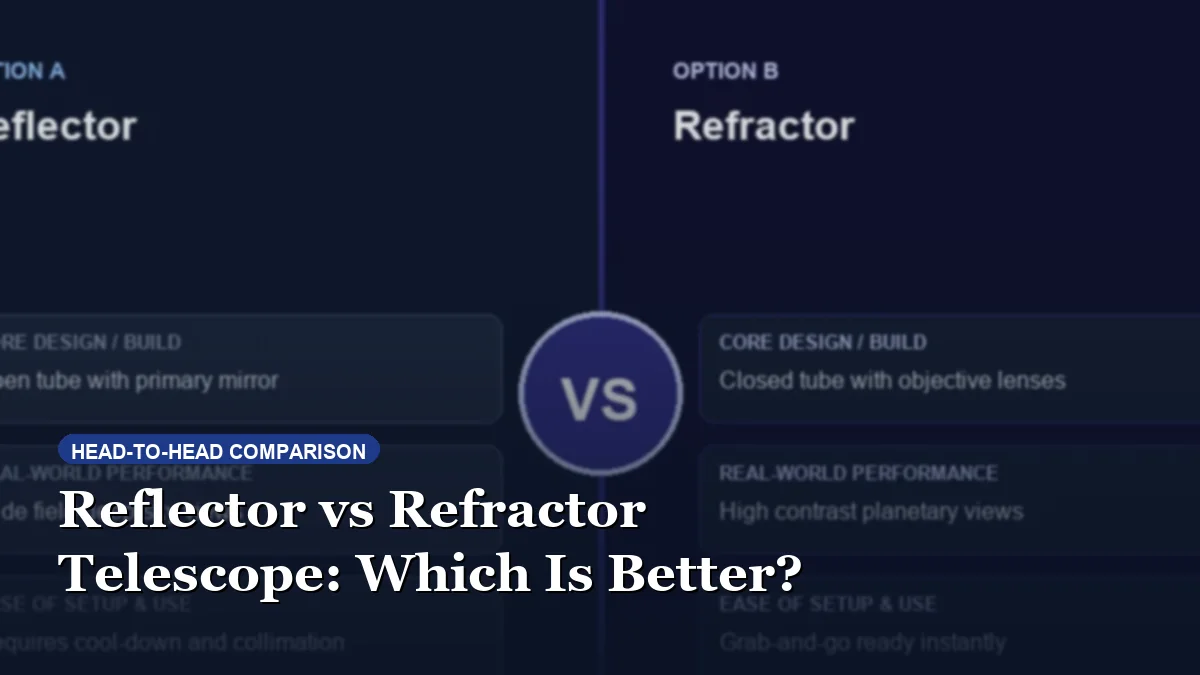
Choose reflectors for maximum light gathering per unit cost, or pick refractors if you prioritize zero maintenance and razor-sharp planetary contrast.
Compare all top models in our Best Telescope: Top Backyard Picks for Astronomy.
Side-by-Side Breakdown
| Criteria | Reflector | Refractor | Edge |
|---|---|---|---|
| Core Design / Build | Open tube with primary mirror | Closed tube with objective lenses | Refractor |
| Real-World Performance | Wide field deep-sky views | High contrast planetary views | Tie |
| Ease of Setup & Use | Requires cool-down and collimation | Grab-and-go ready instantly | Refractor |
| Durability & Reliability | Sensitive to optical misalignment | Fixed lenses resist shifting | Refractor |
| Efficiency / Operating Footprint | High aperture per budget | Aperture limited at scale | Reflector |
| Maintenance Requirements | Regular mirror alignment needed | Virtually maintenance-free optics | Refractor |
| Best Ideal Use Case | Deep-sky nebulae and galaxies | Lunar, solar, and bright planets | Tie |
Core Optical Design and Engineering Architecture
Understanding how light travels through your telescope helps you appreciate these distinct optical systems. Newtonian reflectors use a curved primary mirror at the rear tube to gather and focus incoming starlight forward.
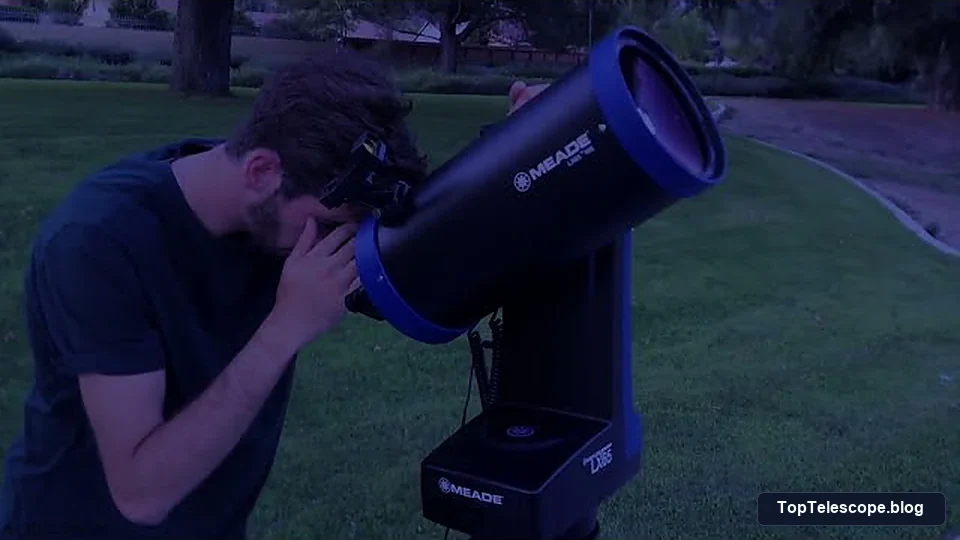
Conversely, refractor telescopes use precision glass lenses at the front aperture to bend light waves. Many models featured in our best refractor telescope for beginners guide offer manageable tube weights.
Newtonian reflectors rely on a parabolized primary mirror and an angled secondary flat to direct light toward the side of the tube, eliminating chromatic aberration entirely through pure reflection mechanics.
Conversely, classic achromat and apochromat refractors use multi-element glass lens configurations at the front aperture to bend incoming starlight down a sealed optical tube assembly toward the rear focuser.
- Reflectors utilize reflective aluminum coatings on glass substrates.
- Refractors rely on multi-coated crown and flint glass elements.
- Light paths differ entirely between front lens and rear mirror setups.
Light Path Mechanics
Reflectors bounce light back up toward a secondary flat mirror before directing it into the eyepiece. This folded optical path allows manufacturers to build massive apertures without excessive physical tube lengths.
Refractors send light in a straight line directly down a sealed optical tube assembly. While this guarantees uninterrupted transmission, it demands longer tubes for higher focal lengths to manage chromatic dispersion.
- Folded light paths reduce physical mounting leverage.
- Straight-through refractor tubes require sturdy pier mounts.
Optical Physics and Aberration Control
Managing optical aberrations separates elite telescopes from basic entry-level instruments. Reflectors suffer from coma, an optical artifact causing off-axis stars to appear elongated like tiny flying comets near the field edge.
Refractors avoid coma entirely due to their symmetrical lens configurations. However, standard doublet lenses suffer from false color fringes around bright objects unless costly apochromatic glass elements are employed.
Refractors inherently struggle with secondary spectrum chromatic fringe unless utilizing expensive ED glass or triplet layouts, whereas reflectors suffer zero glass transmission loss across visible spectrum wavelengths.
However, fast Newtonian mirrors introduce noticeable coma aberration near the extreme field edges, requiring specialized optical field correctors to maintain pinpoint star images across modern digital sensor formats.
- Spherical mirrors require parabolic shapes to eliminate spherical aberration.
- Apochromatic refractors use extra-low dispersion glass to eliminate false color.
Thermal Equilibrium and Glass Stress
Large glass masses inside thick lenses require extended cooling time outdoors. Premium optical tubes highlighted in our best refractor telescope for astrophotography roundup manage thermal equilibrium efficiently.
Open reflector tubes expose primary mirrors directly to outside air, promoting faster cooling cycles. However, air currents inside the tube can still create image shimmering unless cooling fans are installed.
- Active cooling fans accelerate reflector thermal stabilization.
- Thick glass lenses trap heat longer than thin mirrors.
Real-World Visual Performance Across Targets
Observing deep-sky nebulae, faint galaxies, and globular star clusters demands maximum light-gathering surface area. Large reflector apertures collect significantly more photons, revealing intricate spiral structures invisible in smaller scopes.
Lunar and planetary observers often prefer refractors for their unobstructed light paths. The absence of a secondary mirror spider vane eliminates diffraction spikes, delivering unsurpassed image contrast for subtle cloud belts.
Large aperture reflectors deliver superior light grasp, making deep-sky objects like faint nebulae and distant galaxies visibly brighter than what smaller aperture refractors can reveal under identical rural skies.
Conversely, refractors provide higher contrast transfer for splitting tight double stars and resolving delicate planetary features on Jupiter and Saturn due to an unobstructed optical path.
- Aperture diameter dictates faint nebula detection limits.
- Unobstructed optical paths maximize high-contrast planetary detail.
Field of View and Magnification Limits
Wide-field star fields look stunning through short focal ratio reflectors paired with wide eyepieces. You can easily sweep across dense Milky Way star clouds with breathtaking immersion and clarity.
Refractors excel at high magnification lunar viewing without image breakdown. Their pinpoint star images make them exceptional tools for splitting tight double stars with demanding observers.
- Short focal ratios maximize rich-field scanning potential.
- High focal lengths deliver crisp planetary magnification.
Mechanical Stability, Ergonomics, and Setup Footprint
Your physical observing environment heavily influences your choice. Reviewing options in our best refractor telescope for viewing planets and galaxies roundup helps you pick sturdy mounts.
Dobsonian mounted reflectors offer exceptional physical stability with low centers of gravity. Their intuitive up-down and left-right movements make backyard astronomy sessions remarkably straightforward and frustration-free.
Refractor optical tubes remain compact and sealed against dust, placing minimal torque on standard equatorial mounts while offering instant readiness for spontaneous backyard astronomy sessions.
Newtonian reflectors require robust heavy-duty mounts to manage longer moment arms, and their eyepieces often end up in awkward viewing positions that demand rotating tube rings.
- Dobsonian bases provide stable alt-azimuth tracking performance.
- Long refractors require tall, heavy-duty tripod systems.
Portability and Transport Logistics
Transporting long refractor optical tubes to dark sky sites can prove challenging inside standard compact vehicles. Their rigid fixed-lens cells also require careful handling to prevent mechanical impacts.
Truss-tube reflectors break down into manageable modular components for effortless field transport. This clever modular engineering allows astronomers to deploy massive aperture sizes without needing large trucks.
- Truss assemblies simplify transport for large aperture reflectors.
- Fixed tubes demand dedicated backseat vehicle space.
Maintenance Protocols, Alignment, and Longevity
All precision optical instruments require routine care to maintain peak performance standards. Reflector collimation is a mandatory procedure involving manual mirror alignment using specialized tools before serious observing sessions.
Refractor optics are permanently factory-aligned inside sealed metal cells, requiring virtually zero user maintenance. This set-and-forget reliability makes refractors appealing for casual users who dislike tinkering.
Regular mirror collimation is mandatory for Newtonian reflectors before every serious observing session to ensure optical axes align perfectly using simple thumb screws or laser tools.
Refractors feature permanently aligned lenses housed in robust metal cells, requiring virtually zero user intervention over decades besides occasional exterior cleaning of the front objective lens.
- Laser collimators simplify mirror alignment procedures.
- Sealed lens cells protect internal optical coatings effectively.
Long-Term Coating Care
Exposed mirror coatings on reflectors gradually degrade over decades from atmospheric oxidation and dust accumulation. Fortunately, primary mirrors can be professionally recoated when reflectivity drops noticeably.
Refractor internal lens elements remain protected from atmospheric pollutants for generations. Their durable outer multi-coatings resist cleaning wear when proper optical microfiber cloths are utilized.
- Reflective mirror surfaces require eventual recoating services.
- Lens objectives maintain performance over decades of use.
Making Your Final Choice Based on Observing Goals
Selecting the right telescope ultimately depends on your primary astronomical interests and local viewing conditions. Deep-sky enthusiasts on strict budgets should invest in large aperture reflectors for maximum photon collection.
Observers focused on lunar craters, double stars, and effortless grab-and-go setups will find refractors unmatched. Evaluate your storage space and patience for maintenance before purchasing your setup.
Choose a large aperture Newtonian reflector if your primary goal is hunting faint deep-sky objects. Just remember that mastering our reflector telescope collimation guide is essential for keeping sharp planetary focus.
Select a premium refractor if you prioritize rapid setup times, zero thermal acclimation delays, and pristine lunar contrast without ever touching alignment adjustment screws.
- Match instrument aperture directly to your local light pollution levels.
- Consider storage constraints when evaluating large optical tube lengths.
Balancing Budget and Performance
Reflectors deliver the lowest cost per millimeter of light-gathering aperture available today. This economic advantage lets beginners explore faint deep-sky objects without breaking their financial limits.
Refractors demand higher financial investments per unit aperture due to complex lens manufacturing. However, their lifelong durability and low maintenance costs justify the premium price tag.
- Reflectors provide unmatched aperture value per currency unit.
- Refractors offer long-term investment security through sealed durability.
Frequently Asked Questions
Do reflectors require constant realignment before every session?
Yes, mirror alignment is necessary to maintain sharp focus and clear planetary resolution. Using a laser tool makes this routine check fast.
Why do refractors cost more per inch of aperture?
Crafting multiple optical glass surfaces requires precision polishing and expensive materials. This drives manufacturing costs higher than simple mirrors.
Can beginners easily operate a Newtonian reflector telescope?
Beginners master collimation steps quickly with proper practice and helpful guides. The huge light gathering rewards justify the minor learning curve.
What causes false color fringes in standard refractor lenses?
Different light wavelengths bend at varying angles through simple glass. Apochromatic designs solve this issue by utilizing special extra-low dispersion elements.
Which design is better for viewing faint distant galaxies?
Reflectors excel at deep-sky targets because larger apertures gather more faint photons. This reveals spiral structures that smaller lenses cannot resolve.