Prime Focus vs Eyepiece Projection: Technical Breakdown
Choosing between prime focus and eyepiece projection shapes your astrophotography journey. Understanding optical physics helps astrophotographers select the ideal setup for crisp images.

Select prime focus astrophotography for expansive deep-sky nebulae and wide fields. Choose eyepiece projection systems when capturing planetary details and tiny lunar craters with your telescope.
Compare all top models in our Best Telescope: Top Backyard Picks for Astronomy.
Side-by-Side Breakdown
| Criteria | Prime Focus | Eyepiece Projection | Edge |
|---|---|---|---|
| Core Design / Build | T-adapter attaches camera directly to optical tube. | Eyepiece inserted inside projection tube for magnification. | Prime Focus |
| Real-World Performance | Delivers wide native focal length and bright exposures. | Amplifies focal length for high-magnification planetary targets. | Eyepiece Projection |
| Ease of Setup & Use | Simple mechanical connection requiring minimal optical alignment. | Complex multi-component stack demanding precise distance tuning. | Prime Focus |
| Durability & Reliability | Fewer glass elements reduce internal reflection risks. | Additional ocular lenses introduce potential alignment shifts. | Prime Focus |
| Efficiency / Operating Footprint | Lightweight train minimizes focuser strain and sag. | Extended mechanical leverage increases strain on focusers. | Prime Focus |
| Maintenance Requirements | Clean primary optics and sensor surfaces regularly. | Requires cleaning internal eyepiece surfaces and adapters. | Prime Focus |
| Best Ideal Use Case | Deep-sky galaxies, large nebulae, and wide-field mosaics. | High-resolution lunar and planetary surface imaging. | Tie |
Optical Architecture and Light Path Mechanics
Prime focus configuration removes all intermediary glass lenses from the optical path. Light travels directly from the primary mirror or objective lens straight onto your dedicated camera sensor.
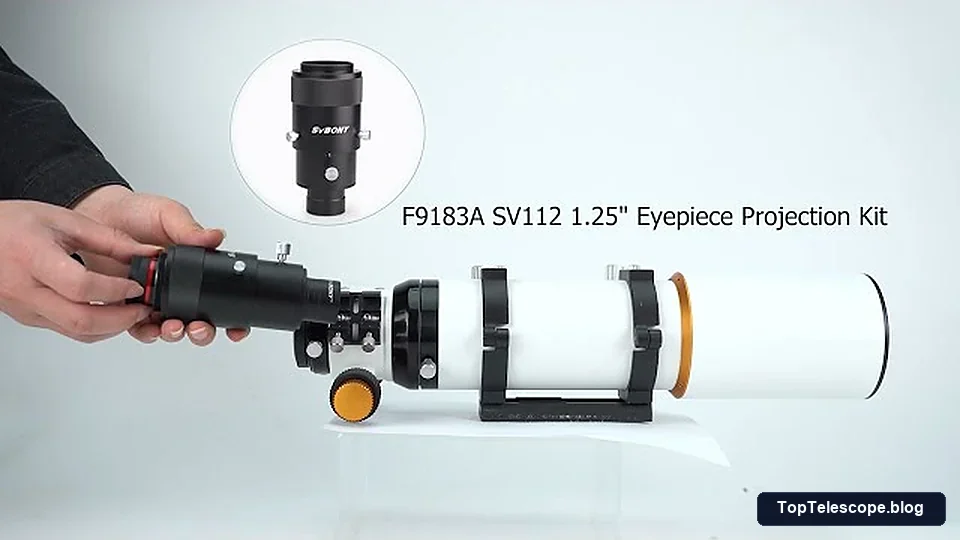
Eyepiece projection inserts a specialized ocular lens into the imaging train. This extra optical element magnifies the primary image before it reaches the focal plane of the camera.
- Removes internal ocular glass elements entirely
- Utilizes native telescope focal length cleanly
- Projects magnified virtual images via eyepieces
Light Transmission Efficiency
Removing optical glass maximizes photon throughput and preserves spectral integrity. Every single glass surface introduces minor light loss through reflection and scattering during long exposures.
Projection systems sacrifice some overall throughput for increased image scale. Managing internal reflections requires high-grade multicoatings on all participating ocular elements.
- Maximizes photon throughput across broad spectra
- Minimizes internal ghost reflections and glare
Optical Architecture and Light Path Mechanics
Prime focus routes incoming photons straight from the primary mirror to the focal plane without intervening glass elements, maximizing light transmission efficiency and preserving natural contrast across the entire optical train.
Eyepiece projection introduces a negative lens or ocular assembly into the light cone, diverging rays to create an extended focal length that pairs seamlessly with the best eyepiece for planetary viewing to resolve tiny planetary features.
Magnification Scaling and Image Scale Variables
Operating at native focal length limits your image scale to what the telescope provides. Deep-sky objects benefit immensely from this wide field because tracking errors remain manageable.
Varying the projection distance allows precise control over final magnification. Sliding the camera backward along the projection tube increases the effective focal length substantially.
- Fixed native focal length limits scaling flexibility
- Adjustable projection distance alters final image scale
- Ideal for resolving tiny planetary disc features
Focal Length Manipulation
Prime focus users must rely on barlow lenses for magnification changes. These external lenses change the focal ratio without altering physical distance variables in the imaging train.
Eyepiece projection offers continuous magnification adjustments through sliding tubes, which helps when selecting the best eyepiece for Jupiter to dial in your planetary camera sampling rate precisely.
- Requires barlow lenses for focal length boosts
- Provides continuous variable projection adjustments
Magnification Scaling and Image Scale Variables
Prime focus image scale depends strictly on the telescope objective's focal length and pixel pitch, requiring Barlow lenses for scaling rather than changing internal optical elements during standard deep-sky imaging sessions.
Eyepiece projection allows continuous scaling by adjusting the projection distance between the ocular and the sensor, providing precise focal ratios ideal for resolving tiny lunar craters and planetary disks.
Mechanical Coupling and Rigidity Requirements
Connecting a camera body directly requires a simple T-ring and T-adapter combination. This robust mechanical connection prevents flexure and maintains optical collimation during long tracking sessions.
Projection assemblies feature extended metal barrels that hold delicate eyepieces securely. This extended length creates mechanical leverage that can strain standard rack and pinion focusers.
- Simple T-ring and adapter mechanical connection
- Extended metal barrels create mechanical leverage
- Requires heavy-duty focusers to prevent sagging
Focuser Strain and Flexure Control
Rigid direct coupling eliminates unwanted tilt and optical axis misalignment. Maintaining tight tolerances ensures stars remain perfectly pinprick across the entire camera sensor surface.
Heavy projection tubes demand compression rings and locking thumbscrews to secure gear. Preventative tension adjustments stop the camera assembly from slipping during zenith tracking.
- Eliminates optical axis tilt during tracking
- Demands secure compression rings for stability
Mechanical Coupling and Rigidity Requirements
Prime focus imaging demands robust T-adapters and locking rings to prevent camera sag, ensuring the optical axis remains perfectly perpendicular to the focuser drawtube during long exposures.
Projection setups require multi-piece projection tubes that cantilever significant weight off the back of the telescope, necessitating heavy-duty focusers and counterweights to maintain tracking stability and prevent flexure.
Field of View and Sensor Coverage Limits
Native focal imaging exposes the largest possible field of view for your optical tube. Large sensor formats capture sprawling emission nebulae without suffering from severe vignetting.
Magnifying the image circle through an eyepiece restricts your usable field of view, making it vital to pair your setup with the best eyepiece for solar viewing to safely frame bright targets.
- Unlocks maximum possible native field of view
- Restricts usable field through eyepiece magnification
- Suited for small, high-resolution planetary sensors
Vignetting and Sensor Illumination
Large sensors require adequate back-focus and wide adapter bores to prevent mechanical vignetting. Proper illumination across full-frame sensors demands careful matching of telescope baffling.
Projection systems naturally vignette corners due to narrow ocular barrel diameters. Planetary imagers ignore this limitation since target planets occupy only a few central pixels.
- Prevents mechanical vignetting on large sensors
- Confinines usable illumination to central areas
Field of View and Sensor Coverage Limits
Prime focus naturally illuminates large sensor formats like full-frame CMOS chips, provided the telescope's corrected field covers the diagonal without introducing mechanical vignetting or severe off-axis optical aberrations.
Eyepiece projection drastically restricts the usable field of view, funneling light through a tiny ocular aperture that causes severe vignetting on sensors larger than standard planetary camera formats.
Setup Workflow and Field Ergonomics
Field assembly remains fast and straightforward when utilizing direct prime focus adapters. Fewer moving parts mean fewer opportunities to lose small thumb screws in dark environments.
Balancing a complex projection setup requires careful positioning of multiple sliding components. Nighttime adjustments take longer because operators must focus both the telescope and projection distance.
- Fast field assembly with minimal loose parts
- Requires balancing multiple sliding mechanical components
- Demands dual focus adjustments in darkness
Nighttime Operational Efficiency
Streamlined workflows keep your telescope operational during freezing astronomical observation sessions. Quick equipment changes preserve dark adaptation and reduce frustration under dim red headlamps.
Complex projection rigs demand patient alignment while juggling camera cables and adapters. Mastering this setup requires practice during daylight hours to build necessary muscle memory.
- Preserves dark adaptation with simple connections
- Demands daylight practice for smooth operation
Setup Workflow and Field Ergonomics
Configuring a prime focus imaging train involves straightforward thread-on connections, significantly reducing field assembly time and minimizing the risk of dropped components during dark-sky observing sessions.
Eyepiece projection requires meticulous adjustments of projection tube lengths and the best eyepiece to view planets in the dark, demanding high tactile precision and patience from outdoor astrophotographers.
Maintenance Protocols and Optical Alignment
Routine maintenance focuses on keeping exposed camera sensor windows and primary optics pristine. Dust particles on primary mirrors affect flat-field calibration frames rather than direct focus.
Projection systems require meticulous cleaning of multiple internal eyepiece lens surfaces. Trapped dust or moisture inside projection tubes degrades high-resolution planetary image clarity.
- Routine cleaning targets sensor windows and optics
- Requires inspecting multiple internal eyepiece surfaces
- Dust trapped inside tubes degrades planetary clarity
Optic Longevity and Care
Protecting exposed optical surfaces from dew accumulation ensures long equipment lifespans. Proper storage caps prevent abrasive dust from settling on expensive corrector plates or mirrors.
Ocular elements inside projection tubes need specialized cleaning solutions to protect coatings. Regular inspection prevents fungal growth on delicate glass elements stored in humid environments.
- Protects exposed glass from harmful dew accumulation
- Requires specialized solutions for coated oculars
Maintenance Protocols and Optical Alignment
Prime focus imaging requires regular primary and secondary mirror collimation using a Cheshire eyepiece or laser tool to maintain sharp point sources across wide astrophotography fields.
Projection setups demand pristine optical cleanliness on both the eyepiece and camera window, because dust particles magnified by the projected light cone appear as prominent dark spots on planetary frames.
Deep-Sky Imaging Versus Planetary Capture
Deep-sky astrophotography relies almost exclusively on direct prime focus configurations. Faint nebulae require maximum light gathering and wide fields of view to reveal delicate gas structures.
Planetary and lunar imaging thrive when utilizing controlled eyepiece projection methods. High focal ratios spread planetary details across enough pixels to resolve subtle cloud belts.
- Optimal for faint deep-sky nebulae and galaxies
- Maximizes light gathering for faint deep-sky objects
- Excels at resolving lunar and planetary details
Target Selection and Sampling
Matching your camera pixel size to the native telescope optics ensures optimal sampling. Over-sampling ruins faint deep-sky signal strength by spreading photons too thinly across sensors.
Planetary imaging deliberately over-samples to capture high-frequency details through atmospheric turbulence. High focal ratios achieved via projection make this specialized sampling technique possible.
- Matches pixel size to native optical resolution
- Leverages over-sampling for high-frequency details
Deep-Sky Imaging Versus Planetary Capture
Prime focus is universally preferred for deep-sky objects because it captures faint nebulae and galaxies with maximum focal speed and minimal exposure times under dark rural skies.
Planetary capture relies on projection methods to scale up tiny planetary disks, matching the telescope resolution to the small pixel sizes of modern high-speed planetary video cameras.
Investment Decisions and Hardware Longevity
Investing in quality T-adapters provides a permanent foundation for deep-sky imaging systems. These durable aluminum parts outlast multiple camera body upgrades thanks to universal threading standards.
Projection adapters incorporate intricate sliding mechanisms that require durable mechanical construction. High-grade materials prevent stripping and ensure reliable clamping force over years of service.
- Provides permanent foundation for deep-sky systems
- Universal threading standards survive camera upgrades
- Requires robust metal construction for durability
Long-Term Hardware Value
Simple adapters represent cost-effective investments due to their lack of moving mechanical parts. Fewer failure points translate to reliable field performance across decades of astronomical use.
Advanced projection setups offer versatile focal length scaling for specialized planetary work. Choosing the right hardware depends entirely on your primary astronomical observing targets.
- Cost-effective investments with zero moving parts
- Versatile scaling serves specialized planetary work
Investment Decisions and Hardware Longevity
Investing in durable aluminum T-rings and dedicated adapters ensures long-term reliability, protecting your telescope and camera investment against threaded wear and mechanical failure over decades of use.
Quality projection adapters featuring brass compression rings prevent marring on expensive eyepieces, safeguarding your optical accessories from physical damage during repeated assembly and field teardown procedures.
Frequently Asked Questions
Can I use prime focus for taking pictures of Jupiter?
Jupiter appears very small at native focal lengths. Use a barlow lens or projection for planets.
Do I need an eyepiece for prime focus photography?
No eyepieces are used in prime focus. Light strikes the camera sensor directly from the mirror.
Why is eyepiece projection better for lunar craters?
It magnifies the image scale significantly. This reveals fine surface details on the Moon.
Does projection cause a loss of image brightness?
Yes, high magnification spreads light out. Exposures must be longer or gain increased.
Which method is easier for beginners to master?
Prime focus is simpler because it has fewer components. Beginners should start there.