NexStar 6SE vs 8SE Images: Ultimate Optics Clash
Choosing between these Schmidt-Cassegrain telescopes impacts your astrophotography payload limits. Understanding optical resolution differences helps optimize planetary and deep-sky imaging outcomes.

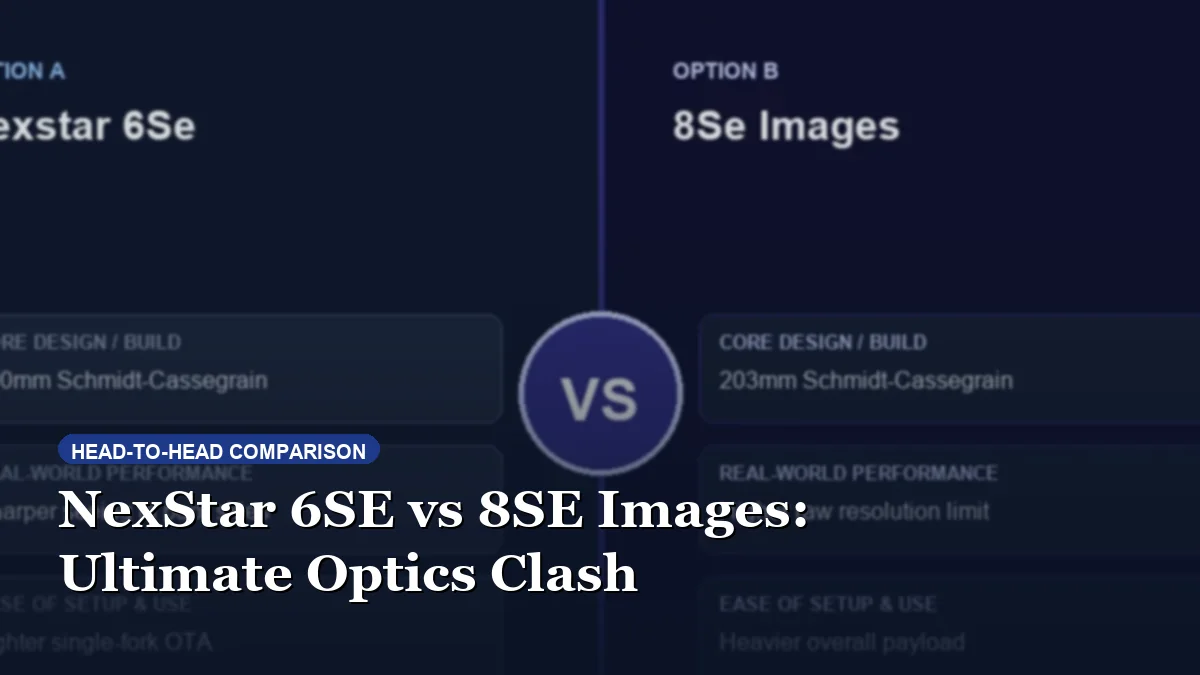
Choose the NexStar 6SE for superior portability and rapid thermal equilibrium. Opt for the 8SE if your primary goal is maximizing light-gathering surface area for faint deep-sky objects.
Compare all top models in our Best Telescope: Top Backyard Picks for Astronomy.
Side-by-Side Breakdown
| Criteria | Nexstar 6Se | 8Se Images | Edge |
|---|---|---|---|
| Core Design / Build | 150mm Schmidt-Cassegrain | 203mm Schmidt-Cassegrain | 8SE |
| Real-World Performance | Sharper seeing in poor skies | Higher raw resolution limit | 8SE |
| Ease of Setup & Use | Lighter single-fork OTA | Heavier overall payload | NexStar 6SE |
| Durability & Reliability | Cast aluminum housing | Cast aluminum housing | Tie |
| Efficiency / Operating Footprint | Shorter moment arm | Larger moment arm on tripod | NexStar 6SE |
| Maintenance Requirements | Standard mirror care | Standard mirror care | Tie |
| Best Ideal Use Case | Mobile planetary imaging | Deep-sky detail capturing | Context Dependent |
Optical Design and Aperture Physics
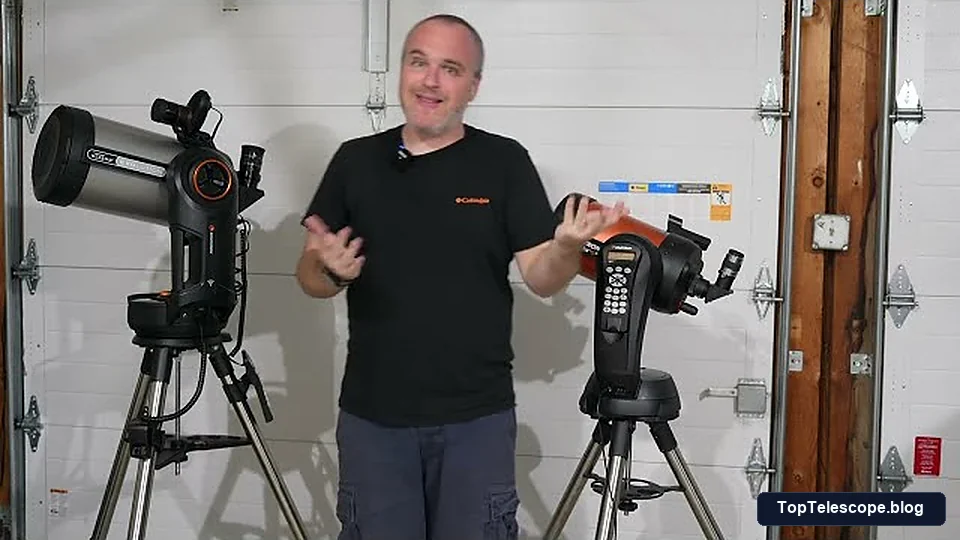
Evaluating optical performance requires examining the core aperture diameters of both instruments. The smaller system utilizes a 150mm mirror while its larger sibling deploys a full 203mm primary mirror for capturing more photons.
Light gathering power dictates your ultimate imaging clarity when photographing faint nebulae. A larger aperture provides tighter airy disks, allowing advanced imagers to resolve tighter double stars and intricate lunar craters.
The 6-inch aperture gathers roughly seventy-eight percent less light than the larger 8-inch optical tube, directly limiting faint deep-sky object visibility during long exposure astrophotography sessions under dark rural skies.
Schmidt-Cassegrain correctors introduce minimal chromatic aberration, yet the f/10 focal ratio demands precise collimation maintenance to preserve pinpoint star images across standard APS-C sensor formats during planetary imaging sequences.
- Aperture diameter directly controls light collection surface area.
- Central obstructions affect overall image contrast during high magnification.
- Star bright magnitude limits shift favorably with the larger aperture.
Focal Length and Image Scale
Both optical tubes share an identical focal ratio of f/10, resulting in different absolute focal lengths. The smaller variant operates at 1500mm, whereas the larger system reaches 2030mm focal length.
Longer focal lengths naturally produce a tighter image scale on standard camera sensors. This requires precise mount tracking to prevent tracking errors during long exposure deep-sky astrophotography sessions.
- Focal length dictates native pixel scale on standard CMOS sensors.
- Barlow lenses can artificially extend focal ratios when needed.
Mount Stability and Payload Capacities
Single fork arm mounts support both optical tubes using identical steel tripod legs. However, the physical weight of each optical tube places different mechanical demands on the internal altitude drive motor.
Careful balance along the declination axis minimizes gear wear. You can read our comprehensive celestron nexstar 8se review to understand how heavier loads affect motorized tracking accuracy.
Single-fork arm mounts on both models utilize steel tripod legs, but the heavier 8-inch OTA pushes structural damping limits, increasing settling times significantly when focusing manually in moderate wind conditions.
Managing total payload balance requires careful dovetail rail positioning to prevent motor stalling, because exceeding standard gear load thresholds leads to tracking errors during extended deep-sky astrophotography exposures.
- Steel tripod legs provide a rigid foundation for tracking.
- Altitude clutch design prevents unwanted optical tube slippage.
- Internal gear boxes require periodic tension checks.
Fork Arm Rigidity
The physical mass of the larger optical tube pushes the single fork design closer to its engineering limits. Wind gusts can introduce micro-vibrations that instantly ruin long exposure astrophotography frames.
Adding vibration suppression pads beneath the tripod tips significantly dampens settling times. Solid surface placement on concrete rather than wooden decks also improves mechanical stability during imaging.
- Wind resistance increases with larger tube surface areas.
- Vibration damping accessories improve overall stability.
Astrophotography Imaging Performance
Capturing sharp images of planetary targets demands excellent seeing conditions and thermal stability. The larger aperture resolves finer atmospheric details on Jupiter and Saturn when atmospheric turbulence remains low.
Deep-sky imaging often requires a focal reducer for an f/6.3 ratio. As detailed in our nexstar 8se review, this accessory widens the field and shortens exposures for faint galaxies.
Planetary imaging benefits immensely from the longer focal length of the larger model, resolving finer cloud belts on Jupiter when seeing conditions cooperate exceptionally well during high-altitude opposition nights.
Deep-sky imaging with these alt-azimuth mounts causes field rotation artifacts, necessitating an equatorial wedge for exposures exceeding thirty seconds to prevent star trails at the sensor corners.
- Planetary imaging benefits heavily from increased aperture resolution.
- Focal reducers flatten the field for larger camera sensors.
- Guiding cameras are often necessary for long exposures.
Planetary Resolution Limits
Dawes limit calculations prove that the larger optical tube separates closer binary star systems. High-resolution planetary cameras capture exceptional cloud belt details when seeing conditions cooperate fully.
Thermal plumes inside closed optical tubes can severely degrade high magnification planetary sharpness. Allowing adequate cool-down time ensures optimal contrast before starting your imaging sequence.
- Dawes limit scales directly with primary mirror diameter.
- Atmospheric seeing dictates actual resolved planetary detail.
Setup Portability and Field Ergonomics
Field mobility often dictates your ideal stargazing setup. Our celestron nexstar 6se review highlights how the lighter ten pound optical tube simplifies transport and field setup.
Transporting heavier gear to dark sky sites involves managing multiple bulky components safely. Protecting corrector plates from accidental impacts requires sturdy padded carry cases for both telescope models.
Transporting the 21-pound optical assembly of the larger variant requires careful two-handed lifting, whereas the smaller six-inch configuration fits comfortably into standard padded transport cases for solo observers.
Ergonomic accessory trays and captive leveling knobs improve field setup speed, reducing setup fatigue significantly when assembling complex gear configurations in freezing temperatures without dropping vital fasteners.
- Total packed weight affects backyard mobility and travel convenience.
- Carrying handles simplify mounting the optical tube securely.
OTA Weight Trade-Offs
The heavier optical tube adds substantial heft, complicating single-person assembly in the dark. Careful handling prevents accidental strikes against the fork arms during the nighttime mounting procedure.
Ergonomic dovetail mounting bars allow quick attachment without straining your back muscles. Always double-check safety clamping knobs before releasing your grip on the heavy optical tube.
- Dovetail bars secure the optical tube quickly and safely.
- Single-person setup requires mindful lifting techniques.
Thermal Stabilization and Optics Maintenance
Sealed Schmidt-Cassegrain optical tubes trap internal heat effectively during storage. Ambient temperature drops require up to forty-five minutes for the primary mirror to reach thermal equilibrium with outdoor air.
Dew formation on corrector plates poses a persistent challenge during humid observing sessions. Installing flexible dew shields and powered heating rings prevents moisture accumulation on glass surfaces.
Enclosed optical tubes trap ambient heat efficiently, requiring at least forty-five minutes of thermal acclimation time before achieving stable diffraction patterns necessary for high-resolution planetary imaging work.
Correctly cleaning the Schmidt corrector plate demands optical-grade microfiber cloths and specialized fluid mixtures to avoid damaging specialized anti-reflective coatings applied during factory manufacturing processes.
- Sealed tubes slow down internal thermal exchange rates.
- Dew straps protect corrector glass from moisture buildup.
- Dust covers should remain on during daytime storage.
Mirror Cool-Down Times
Larger glass masses hold onto daytime heat significantly longer than smaller mirrors. Without proper thermal adaptation, internal convection currents will blur high magnification planetary imaging frames.
Optional ventilation fans can accelerate the active cooling process for enclosed optical systems. Store your telescope in an unheated garage to reduce initial temperature differentials before observing.
- Active cooling fans reduce thermal stabilization wait times.
- Garage storage minimizes temperature gaps before sessions.
Electronic Alignment and GoTo Systems
Computerized hand controllers automate celestial object location using internal alignment routines. SkyAlign technology allows users to center any three bright celestial objects without knowing star names.
Powering these computerized mounts requires reliable external battery packs or AC adapters. Voltage drops from weak batteries can cause erratic hand controller behavior and erratic tracking errors.
The proprietary SkyAlign procedure uses three bright reference stars to build an internal pointing model, simplifying alignment for beginners without requiring prior knowledge of celestial coordinates or constellations.
Integrating external hand controllers with computerized mounts requires stable power supplies, because voltage drops below twelve volts trigger erratic motor behavior and corrupt alignment data mid-session.
- SkyAlign routine simplifies automated computerized alignment.
- External power tanks prevent sudden mid-session voltage drops.
- Database stores tens of thousands of celestial targets.
SkyAlign Precision
Accurate initial star centering directly improves GoTo pointing precision. Consult our celestron nexstar 8 se review to see how illuminated reticle eyepieces help alignment stars sit dead center.
Firmware updates can be installed via computer connection to fix software bugs. Keeping your hand controller updated ensures compatibility with modern astronomical software suites.
- Illuminated eyepieces improve initial alignment star accuracy.
- Firmware updates maintain long-term hand controller reliability.
Ultimate Buyer Fit and Long-Term Value
Selecting the ideal telescope depends heavily on your physical storage space and commitment level. Casual backyard astronomers usually prefer the lighter setup for frequent impromptu weeknight observing sessions.
Dedicated imagers chasing faint deep-sky galaxies will appreciate the extra light-gathering capability. Carefully assess your physical strength and vehicle trunk space before purchasing either complete system.
Choosing between these systems depends heavily on your physical storage space limitations and whether your primary imaging goals prioritize lunar planetary details or faint deep-sky nebulae.
Evaluating long-term durability involves inspecting cast aluminum fork structures and internal gear tolerances to ensure reliable tracking accuracy over years of frequent backyard astronomy sessions.
- Storage space limits overall physical equipment size.
- Commitment level dictates how often gear gets deployed.
- Resale value remains strong for both popular models.
Upgrading Path Potential
Many hobbyists eventually transition from visual astronomy to specialized deep-sky astrophotography. Upgrading your mount later allows you to reuse the optical tube on an equatorial wedge.
Investing in quality eyepieces and camera adapters provides long-term value across various telescopes. Choose accessories with standard thread sizes to ensure future compatibility with upgraded gear.
- Equatorial wedges enable long exposure astrophotography tracking.
- Standard thread sizes ensure universal accessory compatibility.
Frequently Asked Questions
Can I use standard DSLR cameras for imaging with these telescopes?
Yes, you can easily attach DSLR cameras using a standard T-ring and T-adapter. This setup unlocks fantastic lunar and planetary astrophotography potential.
Do these telescopes require regular optical collimation adjustments?
Schmidt-Cassegrain optics hold collimation quite well during normal transport. However, secondary mirror alignment checks should be performed periodically using a defocused star.
What power source is recommended for field operation?
A dedicated rechargeable lithium power tank provides stable voltage throughout long sessions. Avoid standard alkaline batteries because they drain quickly in cold weather.
Are these systems suitable for beginners entering astrophotography?
They offer automated GoTo tracking that helps locate faint deep-sky objects effortlessly. Long focal lengths can challenge beginners, but patience yields rewarding results.
Can I observe deep-sky nebulae and galaxies from urban backyards?
Bright planets and the moon appear crisp under light-polluted skies. Faint galaxies and nebulae require dark sky travel for high-contrast visual observations.