Nexstar 4Se vs 5Se vs 6Se: Technical Comparison
Evaluating three iconic Schmidt-Cassegrain telescopes reveals critical optical and mechanical trade-offs. Discover which aperture size matches your backyard astronomy routine and optical expectations.

Choose the 4Se for portability and lunar viewing, while the 6Se offers deep-sky resolution for dedicated observers. Balance your physical strength against light-gathering needs before buying.
Compare all top models in our Best Telescope: Top Backyard Picks for Astronomy.
Side-by-Side Breakdown
| Criteria | Nexstar 4Se | 5Se Vs 6Se | Edge |
|---|---|---|---|
| Core Design / Build | Maksutov-Cassegrain optical tube | Schmidt-Cassegrain optical tubes | 6Se |
| Real-World Performance | Narrower field, sharp planetary views | Wider field, higher light grasp | 6Se |
| Ease of Setup & Use | Lightest fork mount assembly | Heavier tubes requiring careful lifting | 4Se |
| Durability & Reliability | Robust cast aluminum fork arms | Sturdy metal construction across models | Tie |
| Efficiency / Operating Footprint | Compact footprint for small balconies | Requires wider clearance zones outside | 4Se |
| Maintenance Requirements | Closed tube protects internal optics | Standard corrector plate cleaning needed | Tie |
| Best Ideal Use Case | Travel and bright lunar targets | Deep-sky objects and versatile imaging | 6Se |
Optical Architecture and Light Gathering
The optical design dictates how much light enters the system. A larger aperture collects photons exponentially faster than smaller instruments, revealing faint nebulae and distant star clusters.
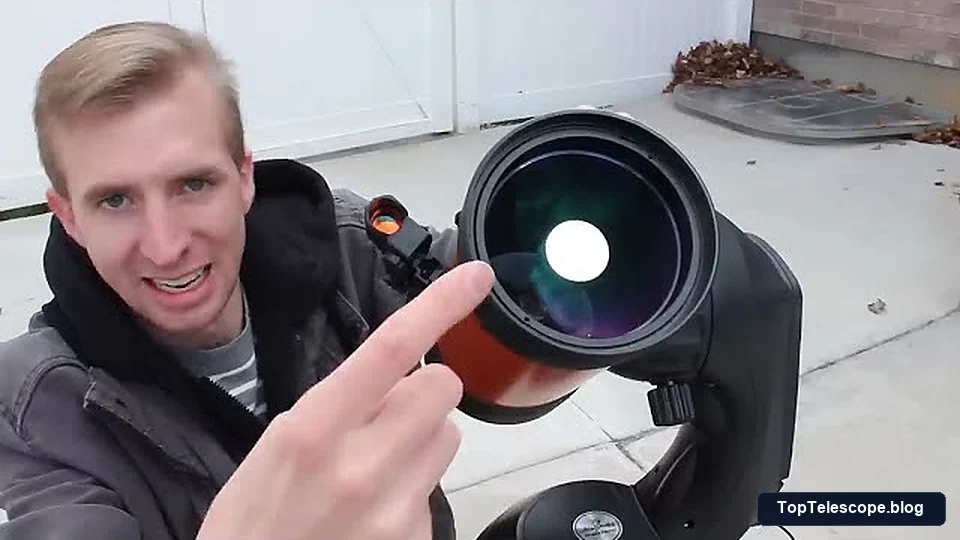
Celestron utilizes distinct optical configurations across these models, as explored in our Celestron NexStar 4SE review, where the four-inch utilizes Maksutov optics while larger variants rely on traditional Schmidt-Cassegrain designs.
Focal lengths also vary significantly among these systems. Longer focal lengths yield higher magnifications, yet they demand superior tracking stability during long-exposure astrophotography sessions.
The Maksutov-Cassegrain design of the 4SE utilizes a thick meniscus corrector lens, lengthening the focal length to 1325mm while maintaining a compact optical tube assembly for sharp lunar and planetary viewing.
Stepping up to the Schmidt-Cassegrain optical system, the 5SE and 6SE incorporate a spherical primary mirror paired with a thin corrector plate to reduce overall physical length without sacrificing aperture.
Light-gathering capacity scales significantly across the lineup, with the six-inch model collecting nearly eighty percent more light than the five-inch version, directly improving deep-sky resolution on faint nebulae and distant star clusters.
- Aperture differences alter ultimate resolution limits.
- Maksutov systems offer longer native focal lengths.
- Schmidt correctors reduce spherical aberration effectively.
Resolution and Planet Viewing
Planetary observers require high contrast to resolve subtle cloud belts on Jupiter and polar ice caps on Mars. Larger apertures inherently resolve finer structural details under steady atmospheric seeing conditions.
The six-inch model delivers superior resolution compared to smaller siblings. However, thermal acclimatization takes longer for larger glass masses enclosed within sealed aluminum tubes.
- Higher light grasp benefits faint planetary moons.
- Thermal equilibrium is vital for sharp focus.
Mount Mechanics and Tracking Systems
Computerized GoTo mounts simplify navigation across the night sky. Each model employs a single fork arm featuring internal servo motors driven by optical encoders for precision pointing.
SkyAlign technology enables fast initialization using any three bright celestial objects. This process calculates alignment parameters automatically without requiring manual polar alignment for casual visual use.
Power consumption remains a critical operational factor during extended field sessions. Using external lithium power tanks prevents voltage drop issues common with standard internal battery configurations.
Each mount utilizes a single-fork arm design housing internal DC servo motors geared to drive aluminum worm wheels for steady, motorized tracking across the celestial sphere during extended observation sessions.
The integrated SkyAlign technology allows users to center three bright celestial objects in the eyepiece, calculating exact internal coordinates without requiring prior knowledge of star names or precise geographical coordinates.
Power distribution relies on standard alkaline batteries or an optional external 12V DC adapter, ensuring consistent voltage supply to prevent erratic motor behavior and tracking drift during long imaging runs.
- Single fork design balances weight and rigidity.
- GoTo databases store tens of thousands of targets.
- External power supplies ensure consistent motor tracking.
Sturdiness and Vibration Dampening
Mount stability directly affects high-power viewing experiences. Sturdy steel tripods mitigate wind vibrations much better than older aluminum iterations found on legacy entry-level systems.
Dampening time increases when mounting heavier optical tubes onto standard forks. Users must allow several seconds for image stabilization after focusing or manual adjustments.
- Steel tripod legs provide superior torsional rigidity.
- Vibration suppression pads enhance overall stability.
Portability and Physical Ergonomics
Field portability influences how often an astronomer actually uses their equipment. Heavy assemblies often remain indoors, while compact setups encourage frequent stargazing adventures in remote locations.
The four-inch model excels in travel friendliness due to its exceptionally lightweight optical tube and integrated fork base. Lifting the heavier six-inch assembly requires cautious maneuvering.
Carrying handles built into the base simplify transport. Ergonomic placement reduces accidental drops during field assembly under dark sky conditions.
Transporting these instruments requires balancing optical performance against physical bulk, with the lightweight 4SE easily fitting into standard backpacks for remote dark-site travel and rapid backyard deployment.
The rugged steel tripod provides a stable foundation, and as highlighted in the Celestron NexStar 6SE optical review, the heavier 6SE optical tube demands careful handling on its single-fork arm.
Ergonomic carrying handles built directly into the base simplify moving the fully assembled mount, reducing accidental impacts against doorways or vehicle frames during transit to your favorite viewing spot.
- Total system weight dictates backyard mobility.
- Compact tubes fit easily into airline overhead bins.
- Ergonomic handles prevent clumsy field drops.
Storage and Space Footprint
Apartment dwellers and urban observers prioritize minimal storage footprints. Small optical tubes tuck away neatly inside small closets without dominating living space.
Larger apertures require dedicated permanent storage areas or large protective transport cases. Consider your available vehicle trunk space before selecting larger optical variants.
- Small footprints suit limited urban living spaces.
- Transport cases add protective bulk to transit.
Astrophotography Potential and Tracking
Astrophotography places rigorous demands on telescope mounts, a topic covered in the Celestron NexStar 4SE computerised telescope review, where alt-azimuth tracking introduces field rotation during long exposures.
Equatorial wedges can be attached to tilt the fork base for polar tracking. This modification helps eliminate field rotation during extended exposure deep-sky imaging tasks.
Camera payload capacities must never exceed manufacturer specifications. Overloading the fork clutches causes tracking slippage and ruins delicate planetary alignment routines.
Alt-azimuth mounts inherently suffer from field rotation during long exposures, limiting deep-sky astrophotography to short exposures unless you add an equatorial wedge for proper polar alignment.
Planetary imaging yields exceptional results using lightweight CMOS cameras, leveraging the long focal lengths of these optical systems to capture fine details on Jupiter, Saturn, and lunar craters.
Careful payload management is essential to prevent motor strain, meaning heavy DSLR bodies should be replaced with dedicated astronomical cameras to keep well under the maximum weight limits.
- Alt-azimuth mounts induce natural field rotation.
- Equatorial wedges enable true polar alignment.
- Payload limits restrict heavy DSLR camera usage.
Lunar and Planetary Imaging
High frame rate planetary cameras perform exceptionally well across all three apertures. Capturing thousands of frames allows software to stack sharp moments from turbulent air.
Focal reducers help widen the field of view for lunar mosaic projects. Proper back-focus spacing remains crucial for maintaining corner sharpness across camera sensors.
- High frame rate stacking freezes atmospheric blur.
- Focal reducers adjust native photographic speeds.
Setup Routine and User Calibration
Streamlined setup routines encourage spontaneous stargazing sessions. Quick alignment procedures ensure beginners spend more time observing rather than troubleshooting complicated electronic software.
Finderscopes must be accurately aligned with the main optical axis during daylight hours. Red dot finders provide intuitive targeting for bright alignment stars.
Star testing optics verifies collimation accuracy before observing faint targets. Minor secondary mirror adjustments can be performed using precise hex keys if necessary.
Initial leveling of the tripod using the integrated bubble level prevents uneven gear wear and ensures that computerized GoTo commands accurately slew to targeted celestial coordinates without major errors.
Entering exact time, date, and GPS coordinates into the hand control unit remains critical for successful alignment, directly affecting the tracking accuracy of the internal computer database.
Backlash compensation settings can be adjusted in the menu to eliminate any physical delay in the gear trains when the telescope reverses direction during fine centering procedures.
- Daylight finder alignment saves nighttime frustration.
- Star testing confirms proper optical collimation.
- Quick setup routines maximize viewing time.
Software Updates and Hand Controllers
Hand controllers feature flash memory upgradeable via internet connections. Keeping firmware updated ensures accurate object databases and improved motor tracking algorithms.
Auxiliary ports allow direct computer control through ASCOM compliant software protocols. This connectivity enables seamless automated imaging sequences from laptop interfaces.
- Firmware updates fix historical tracking bugs.
- Auxiliary ports support external computer control.
Maintenance and Long-Term Care
Proper equipment maintenance protects your optical investment over decades of use. Sealed optical tubes prevent dust accumulation on primary mirrors, reducing cleaning frequency.
Corrector plates require specialized optical cleaning solutions to remove organic residues without damaging anti-reflective coatings. Always use compressed air to remove loose abrasive particles first.
Mechanical gears benefit from periodic inspection and professional lubrication service if tracking sounds become unusually loud or erratic during slew movements.
Schmidt corrector plates accumulate dust and dew over time, requiring gentle cleaning with specialized optical wipes and fluid rather than abrasive household materials to protect anti-reflective coatings.
Mechanical clutches should never be forced past their stopping points, as excessive manual rotation can strip internal gears and permanently damage the motor drive assemblies.
Storing the optical tube in a temperature-controlled environment with desiccant packs prevents internal mold growth and optical fogging on the primary mirror surfaces during humid seasonal transitions.
- Sealed optical designs protect internal mirrors.
- Coated glass surfaces demand careful cleaning care.
- Mechanical gears require occasional maintenance checks.
Environmental Protection
Dew formation poses a constant threat during damp evening observing sessions. Using heated dew shields prevents moisture accumulation on glass corrector plates.
Protective dust caps should be secured immediately after finishing sessions. Storing equipment with silica gel packets controls humidity inside enclosed transport cases.
- Heated dew shields prevent optical fogging.
- Silica gel packets control storage humidity.
Choosing the Right Model for Your Needs
Selecting the ideal telescope depends upon your physical strength, transport limitations, and astronomical goals. Prioritize aperture if deep-sky objects represent your primary observing interest.
Casual astronomers seeking effortless grab-and-go convenience will appreciate the compact ergonomics of smaller systems. Advanced imagers should lean toward higher stability platforms.
Balancing budget constraints against long-term optical satisfaction ensures a rewarding astronomy hobby. Invest in quality eyepieces to maximize performance across whichever model you choose.
Selecting the ideal telescope involves weighing portability against resolution, making the 4SE model, featured in our NexStar 4SE technical review, the premier choice for frequent travelers prioritizing rapid setup.
The 5SE serves as a balanced compromise, offering a larger aperture than the smallest model while remaining remarkably light enough for effortless backyard storage and transport.
Enthusiasts seeking deeper visual penetration into faint galaxies should invest in the 6SE configuration, provided they can manage the incremental increase in physical weight and tripod footprint.
- Aperture preference dictates deep-sky visibility.
- Portability favors smaller lightweight optical tubes.
- Quality eyepieces enhance overall visual contrast.
Final Purchasing Recommendations
Review your local light pollution levels before purchasing high-magnification instruments. Dark rural skies make larger apertures dramatically more effective for faint nebulae.
Local astronomy clubs offer valuable opportunities to test these exact models before committing funds. Hands-on experience remains the ultimate guide for telescope buyers.
- Light pollution dictates deep-sky object visibility.
- Club testing provides real-world gear insights.
Frequently Asked Questions
Can these telescopes connect to a computer?
Yes, all models feature an auxiliary port allowing direct connection to laptops for automated software control.
Do these mounts require an external battery?
Internal battery compartments drain quickly, so using an external power tank ensures reliable motor tracking performance.
Is astrophotography possible on the alt-azimuth base?
Short exposure planetary imaging works well, but deep-sky photography requires an equatorial wedge to prevent field rotation.
How often must the optics be cleaned?
Sealed tubes protect mirrors, meaning you should only clean corrector plates when heavy dust visibly impairs views.
Which model offers the best balance of portability?
The four-inch version provides the lightest transport weight, making it ideal for frequent travel and rapid backyard setup.