Newtonian Reflector vs Refractor: Technical Comparison
Choosing between a Newtonian reflector and a refractor requires understanding optical physics. This guide details core design trade-offs for amateur astronomers.

Choose the Newtonian reflector for maximum aperture per dollar in deep-space viewing. Select the refractor for zero maintenance and superior planetary contrast.
Compare all top models in our Best Telescope: Top Backyard Picks for Astronomy.
Side-by-Side Breakdown
| Criteria | Newtonian Reflector | Refractor | Edge |
|---|---|---|---|
| Core Design / Build | Open or closed tube with a primary mirror and secondary flat diagonal mirror. | Sealed optical tube using objective glass lenses to bend and focus incoming light. | Refractor |
| Real-World Performance | Exceptional light gathering power for faint nebulae and distant galaxies. | Pristine high-contrast planetary views free of central obstruction diffraction spikes. | Tie |
| Ease of Setup & Use | Requires frequent optical alignment and cool-down periods before serious observation. | Virtually maintenance-free setup ideal for quick grab-and-go night sky sessions. | Refractor |
| Durability & Reliability | Mirrors can shift during transport, necessitating occasional mechanical adjustments. | Lenses are permanently fixed in cells, providing rugged durability during transit. | Refractor |
| Efficiency / Operating Footprint | Delivers massive apertures in relatively cost-effective, heavy physical packages. | Apertures remain physically limited and expensive at larger scales. | Newtonian Reflector |
| Maintenance Requirements | Demands periodic collimation and mirror cleaning over years of active use. | Requires only occasional exterior lens dusting and secure storage conditions. | Refractor |
| Best Ideal Use Case | Deep-sky astrophotography and budget-friendly wide-field visual astronomy. | Lunar, planetary, and double star viewing with sharp color correction. | Tie |
Core Optical Engineering and Design Principles
Understanding how telescopes manipulate light reveals fundamental structural differences. Newtonian reflectors utilize curved primary mirrors to reflect light back up to a secondary flat mirror.
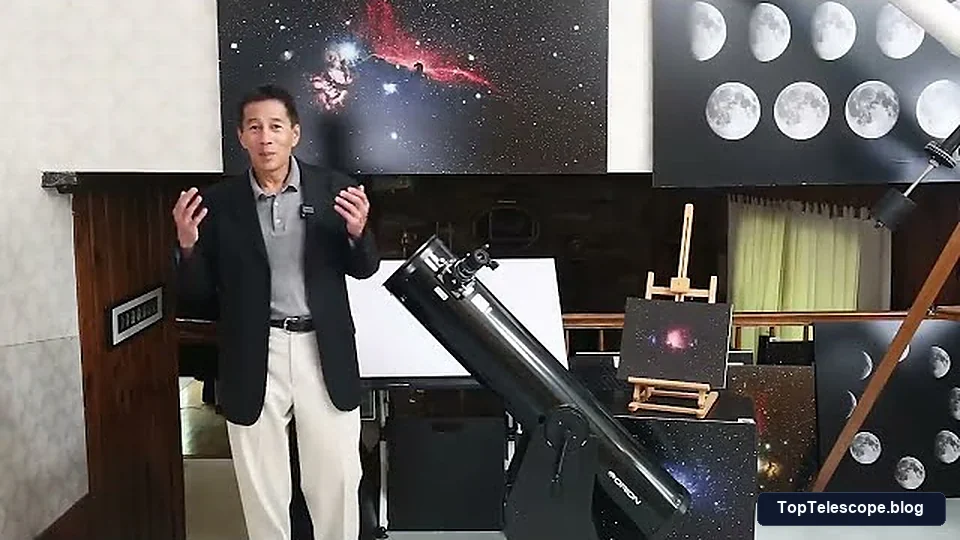
Conversely, refractors bend light through specialized glass objective lenses situated at the front of a sealed tube. This optical path entirely eliminates central obstructions found in reflectors.
Both designs serve distinct observational goals through completely separate physics principles.
Refractors rely on glass lenses to bend incoming starlight to a focal point. This design eliminates central obstructions, but introduces chromatic aberration unless specialized ED glass elements are utilized by manufacturers.
Newtonian reflectors utilize a parabolic primary mirror to gather and reflect light back up toward a flat secondary diagonal mirror. This reflection-based architecture completely avoids chromatic aberration across the visible spectrum.
Optical alignment differs drastically between these two systems because lens cells are factory-set. Reflectors require user-managed mirror collimation to maintain sharp focus, demanding frequent mechanical adjustments using standard allen wrenches.
- Reflectors use reflective aluminum coatings on glass substrates.
- Refractors rely on multi-coated glass elements to minimize chromatic aberration.
- Newtonians place the eyepiece at the top side of the optical tube.
Light Path Architecture
The optical path determines physical tube length and mounting requirements. Reflectors position focusers near the top, while refractors extend light down the entire length.
Achromatic and apochromatic lenses in refractors manage different wavelengths of light differently.
- Glass purity dictates overall refractor manufacturing costs.
- Mirror substrates require precise parabolic shaping.
Real-World Performance on Planets and Deep Space
Observing celestial targets exposes unique performance characteristics of each optical system. Planetary contrast is noticeably sharper in refractors due to the absence of diffraction spikes.
Deep-sky objects benefit from large light-gathering surfaces, while planet hunters can explore top-tier equipment in our guide to the best refractor telescope options, which emphasizes pristine optical clarity for lunar viewing.
Matching your target list to instrument strengths guarantees maximum observational satisfaction.
Planetary observers demand high contrast, which un-obstructed refractor optics deliver exceptionally well. Small-aperture refractors reveal crisp planetary details, whereas reflectors suffer from light scattering caused by the spider vane assembly.
Deep-sky imaging favors large apertures to capture faint nebulae and distant galaxies efficiently. Newtonian reflectors provide massive light-gathering power per dollar, making them superior tools for resolving dim deep-sky objects.
Field curvature affects wide-field astrophotography differently across both optical designs. Correcting off-axis aberrations requires specific field flatteners for refractors, while Newtonian systems often utilize coma correctors to maintain pinpoint stars.
- Reflectors excel at capturing faint photons from distant star clusters.
- Refractors provide pin-point stellar diffraction patterns on bright targets.
- Atmospheric seeing conditions impact both designs with equal severity.
Resolution Limits and Contrast
Theoretical resolution depends primarily on aperture diameter rather than focal length alone. However, internal scattering alters subjective contrast perceptions significantly.
Refractor systems deliver unhindered wavefronts for pristine planetary detail.
- Central obstructions scatter a small percentage of incoming light.
- Air-glass interfaces require advanced anti-reflective coatings.
Maintenance, Collimation, and Structural Longevity
Instrument maintenance routines differ drastically between these two popular telescope types. Collimation is a routine requirement for reflectors to align optical mirrors properly.
Refractors arrive factory-aligned and rarely require user intervention over their operational lifespan. This makes refractors exceptionally reliable for beginners seeking hassle-free astronomy.
Proper storage practices protect delicate optical surfaces from environmental moisture and dust.
Refractor optical tubes are remarkably robust because the heavy objective lenses remain securely fixed inside a sealed cell. This sealed construction prevents dust infiltration and protects the delicate internal optical coatings.
Newtonian reflectors feature open optical tubes that expose primary and secondary mirrors to atmospheric dust, pollen, and humidity. Consequently, owners must perform periodic mirror cleanings and frequent mechanical alignment procedures.
You can evaluate field transport durability in our Celestron StarSense Explorer 114mm review, which emphasizes the critical need for maintaining precise mirror alignment using a reliable collimation tool during regular setup.
- Laser collimators simplify mirror alignment procedures for reflectors.
- Objective lens cells are factory-sealed to prevent internal misalignment.
- Dust accumulation demands careful cleaning using specialized optical solutions.
Long-Term Mechanical Stability
Mechanical chassis rigidity affects how well optics hold alignment during transit. Sturdy metal tubes prevent flexure under heavy equipment loads.
Frequent travel tests the mechanical integrity of mirror cell suspensions.
- Cell mounting design prevents pinch on glass lenses.
- Truss-tube reflectors require careful disassembly between field sessions.
Setup Ergonomics and Field Portability
Transporting equipment to dark sky sites introduces practical weight considerations. Compact refractors mount easily on lightweight alt-azimuth tripods for rapid deployment.
Large Newtonian reflectors require substantial mounting stability and careful vehicular packing. Balancing heavy optical tubes demands robust equatorial or Dobson mounts.
Evaluating your physical capacity prevents gear from staying indoors.
Ergonomics play a major role in how frequently an astronomer takes their equipment outdoors. Refractors generally offer intuitive handling, but long focal ratios require tall, heavily braced sturdy mounting platforms to prevent shaking.
Newtonian reflectors place the eyepiece at the top side of the optical tube, which can create awkward viewing angles when pointing toward the zenith. Using a rotating mounting ring helps mitigate neck strain during long observation sessions.
Physical dimensions dictate whether your telescope fits inside a standard vehicle for dark-sky trips. While short tube refractors travel easily, large-aperture Newtonians demand significant cargo space and careful handling during transit.
- Short tube refractors fit inside standard airline carry-on luggage.
- Dobsonian bases offer intuitive manual tracking for massive reflectors.
- Counterweight systems add significant overall weight to portable kits.
Mount Integration and Balance
Balancing payload weight prevents motor strain on automated telescope mounts. Dovetail bars provide secure attachment points for various optical tubes.
Ergonomic handle placement aids safe transport during nighttime setups.
- Ring clamps allow tube rotation for comfortable eyepiece angles.
- Tripod spreader trays enhance overall mechanical stability.
Thermal Acclimation and Internal Tube Currents
Temperature equilibrium remains vital for achieving high-magnification focus clarity. Thermal currents inside sealed refractor tubes dissipate relatively quickly in open air.
Large reflector mirrors retain heat longer, requiring cooling fans or waiting periods. Unsettled internal air degrades high-resolution planetary viewing quality significantly.
Managing thermal differences ensures optimal optical performance throughout the night.
Glass acts as a thermal insulator, meaning thick refractor objective lenses require substantial time to reach ambient outdoor temperatures. Trapped heat inside the lens cell creates thermal boundary layers that degrade high-magnification views.
Newtonian reflectors also suffer from thermal disequilibrium, often trapping warm air currents inside closed metal tubes. Astrophotographers frequently install cooling fans behind the primary mirror to accelerate temperature stabilization before imaging runs.
Managing thermal plumes is essential for achieving the theoretical resolution limits of any optical system. Allowing adequate cool-down time ensures sharp planetary details emerge without interference from swirling internal air currents.
- Active cooling fans accelerate reflector thermal stabilization times.
- Insulated optical tubes reduce localized boundary layer turbulence.
- Rapid temperature drops test glass thermal expansion coefficients.
Managing Thermal Gradients
External ambient drops create micro-climates directly above optical surfaces. Ventilated mirror cells help flush warm trapped air efficiently.
Consistent temperature management prevents frustrating image distortion during critical viewing.
- Pyrex and low-expansion glass substrates minimize thermal warping.
- Open truss designs promote rapid ambient air circulation.
Cost Efficiency and Aperture Scaling
Budget constraints often dictate final purchase decisions, and you can examine real-world value performance in our Celestron StarSense Explorer Newtonian review, highlighting how aperture-per-dollar ratios favor reflectors for beginners.
Crafting large apochromatic objective lenses involves complex multi-element glass grinding. Consequently, refractor costs scale exponentially as aperture diameters increase.
Balancing financial investment with viewing goals maximizes overall equipment value.
Manufacturing multi-element glass lenses with extreme precision drives the cost of large refractors skyward. Grinding precision glass curves on both sides of multiple elements makes large apertures prohibitively expensive for average hobbyists.
Newtonian reflectors bypass these manufacturing hurdles by utilizing a single front-surface reflective mirror. Because light reflects off the glass rather than passing through it, mirror blanks require polishing on only one front surface.
This fundamental difference in fabrication economics delivers unbeatable aperture per dollar ratios for Newtonian designs. Budget-conscious stargazers can acquire massive light-gathering capacity without exhausting their financial resources on complex glass elements.
- Mass-produced mirrors lower the barrier to entry for beginners.
- Exotic glass types increase refractor manufacturing expenses sharply.
- Accessories like eyepieces add secondary costs to any setup.
Value Assessment Across Sizes
Small aperture refractors remain affordable entry points for casual stargazers. Stepping up to massive light buckets requires reflector configurations.
Evaluating long-term utility prevents early equipment upgrade frustration.
- Achromats offer budget refractor alternatives with minor false color.
- Dobsonian mounts maximize reflector affordability by omitting tripods.
Selecting the Ideal Instrument for Your Setup
Choosing between these designs depends entirely on your specific observing environment. Urban balcony astronomers benefit from the maintenance-free nature of refractor optics.
Rural dark-sky explorers thrive under the immense light-gathering capacity of reflectors. Assess your storage space, travel habits, and target preferences before buying.
Matching instrument mechanics to personal routines guarantees lasting astronomy enjoyment.
Choosing between a Newtonian reflector and a refractor requires evaluating your storage constraints. If you choose a reflector, mastering routine optical maintenance through our guide on collimating a reflector ensures peak image sharpness.
Conversely, dedicated deep-sky enthusiasts prioritize maximum light collection for faint nebulae and distant galaxies. These astronomers benefit immensely from the superior aperture scaling and overall value offered by large Newtonian reflectors.
Ultimately, matching your physical environment, transport capabilities, and willingness to perform routine maintenance ensures lasting satisfaction. Selecting the right optical architecture guarantees many years of rewarding night sky exploration.
- Consider local light pollution levels when selecting aperture size.
- Factor in physical storage space within your home or vehicle.
- Prioritize ease of use if observing with younger family members.
Final Decision Framework
Review your commitment to routine equipment maintenance and alignment tasks. Select instruments that complement your available time and observational dedication.
Clear priorities lead directly to rewarding night sky adventures.
- Test equipment at local astronomy clubs whenever possible.
- Verify warranty support from reputable equipment manufacturers.
Frequently Asked Questions
Why do Newtonian reflectors require periodic collimation while refractors do not?
Newtonian reflectors use movable mirrors mounted on mechanical cells that shift during transit and temperature changes. In contrast, refractor lenses are permanently fixed inside sealed cells at the factory, maintaining optical alignment indefinitely.
Which telescope design provides better planetary viewing contrast?
Refractors deliver superior planetary contrast because their light path has no central obstruction. Newtonian reflectors feature a secondary mirror support spider that introduces minor diffraction spikes and scatters a small amount of light.
Are Newtonian reflectors difficult for beginners to operate safely?
Newtonian reflectors are straightforward once users learn basic collimation and balancing techniques. However, they do demand a brief learning curve compared to grab-and-go refractor systems that require zero alignment.
How does aperture size affect deep-space viewing performance?
Larger aperture sizes gather significantly more photons, making faint deep-space objects appear brighter and more detailed. Newtonian reflectors offer massive apertures at affordable prices, making them ideal for galaxy hunting.
Can I use a refractor for astrophotography of deep-sky nebulae?
Small apochromatic refractors are actually among the most popular choices for deep-sky astrophotography. Their wide fields of view, sharp star points, and lack of false color make them exceptional imaging platforms.