Dobsonian vs Schmidt Cassegrain: Technical Faceoff
Choosing between a Newtonian reflector on a rocker box and a folded catadioptric system shapes your entire observing workflow. Understanding their mechanical differences ensures optimal astronomical productivity.

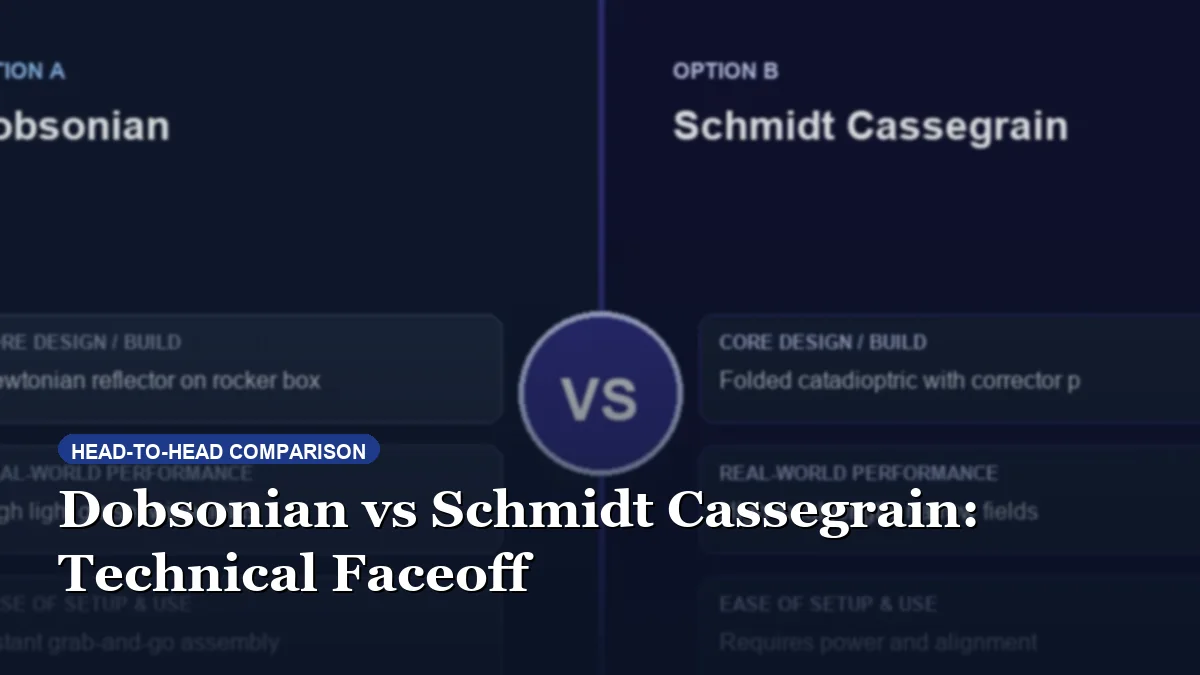
Choose the Dobsonian for maximum light collection per budget and rapid setup. Select the Schmidt Cassegrain if you require portability, compact tube geometry, and long focal lengths for planetary imaging.
Compare all top models in our Best Telescope: Top Backyard Picks for Astronomy.
Side-by-Side Breakdown
| Criteria | Dobsonian | Schmidt Cassegrain | Edge |
|---|---|---|---|
| Core Design / Build | Newtonian reflector on rocker box | Folded catadioptric with corrector plate | Tie |
| Real-World Performance | High light grasp, wide fields | High focal length, narrow fields | Dobsonian |
| Ease of Setup & Use | Instant grab-and-go assembly | Requires power and alignment | Dobsonian |
| Durability & Reliability | Simple wooden and metal build | Complex motorized drive systems | Dobsonian |
| Efficiency / Operating Footprint | Large floor space requirement | Compact vertical footprint | Schmidt Cassegrain |
| Maintenance Requirements | Frequent mirror collimation | Sealed optics, occasional dew care | Schmidt Cassegrain |
| Best Ideal Use Case | Deep-sky visual astronomy | Planetary viewing and imaging | Tie |
Core Optical Design and Engineering Differences
The Newtonian optical tube utilized in Dobsonians features a parabolic primary mirror reflecting light back toward a diagonal secondary mirror near the front aperture, creating simple unobstructed light paths.
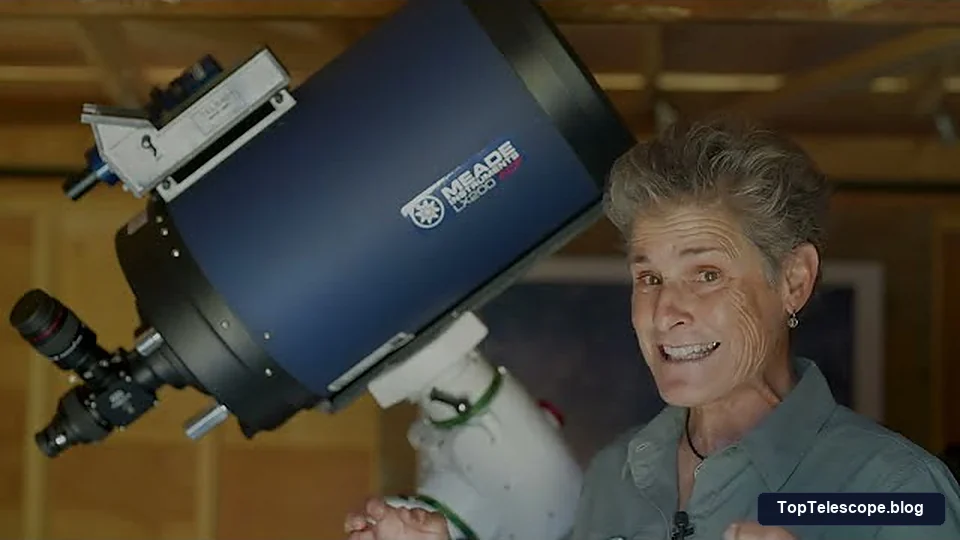
Conversely, our best schmidt cassegrain telescope choices incorporate a thin corrector plate at the front to eliminate spherical aberration before reflecting light off a spherical primary mirror.
Newtonians utilize a simple parabolic primary mirror combined with a flat secondary mirror to reflect light outward, whereas Schmidt-Cassegrains fold the optical path using a spherical primary and a correcting front plate.
This folded design drastically shortens the physical tube length for equivalent focal lengths, but introduces central obstructions from the secondary holder that directly impact contrast transfer across high-frequency planetary spatial details.
Dobsonian reflectors rely on pure Newtonian physics without refractive elements, eliminating chromatic aberration entirely while maintaining a remarkably high aperture-per-dollar ratio for deep-sky astronomical observation and research sessions.
- Unobstructed optical path maximizing contrast
- Folded light path shortening physical tube length
- Corrector plate introducing thermal acclimation challenges
Primary Mirror Physics
Dobsonians typically feature fast focal ratios like f/4 to f/5, which yield wide true fields of view ideal for sweeping expansive nebulae and faint star clusters across dark skies.
Schmidt Cassegrains operate at slower focal ratios near f/10, concentrating light into a narrow cone that excels at high-magnification planetary and lunar viewing sessions.
- Fast focal ratios optimize wide-field views
- Slow focal ratios enhance planetary magnification
Real-World Performance and Optical Aberrations
Optical performance hinges on managing aberrations across the visual spectrum. Dobsonians suffer from coma, an off-axis aberration that distorts stars into tiny comets near the edges of wide eyepieces.
Schmidt Cassegrains mitigate coma effectively through their corrector plate design, though they can exhibit field curvature and slight image shift during primary mirror focusing movements.
Fast Newtonian systems naturally exhibit off-axis coma, distorting stellar points near the frame edge unless a dedicated coma corrector is inserted into the optical train before the eyepiece.
Evaluating options from the best 8 inch schmidt cassegrain telescope category reveals optics that effectively control coma through their spherical correction plate, though they remain susceptible to field curvature.
Observers must balance atmospheric seeing conditions against theoretical resolution limits, remembering that larger aperture mirrors gather more light but also amplify local thermal turbulence interference significantly.
- Coma aberration visible in fast Newtonian setups
- Field curvature managed in folded catadioptric designs
Contrast and Resolution
Large secondary mirror obstructions in catadioptric systems scatter a fraction of incoming light, subtly reducing high-contrast planetary detail compared to a clean, minimalist Newtonian spider vane assembly.
Larger aperture Dobsonians compensate for any minor scattering by sheer light-gathering surface area, revealing faint spiral arms in distant galaxies that remain invisible in smaller apertures.
- Central obstructions scatter marginal light
- Aperture advantage outweighs minor diffraction loss
Mechanical Build Quality and Ergonomic Footprint
Mechanical construction directly dictates field usability. A standard Dobsonian mount consists of a simple wooden rocker box utilizing low-friction laminate bearings for smooth manual alt-azimuth movements.
Schmidt Cassegrains require robust equatorial or fork mounts with motorized tracking drives to counter Earth's rotation, adding electronic complexity and setup time before your first observation session.
Dobsonians traditionally utilize heavy-duty particle board or laminated wood rocker boxes, providing exceptional low-center-of-gravity stability while requiring substantial storage volume within standard home storage closets.
Conversely, Schmidt-Cassegrain telescopes feature cast aluminum tubes that house internal focusing mechanisms, keeping the physical housing compact enough for trunk transport yet demanding robust fork or equatorial mounts.
Ergonomic eyepiece placement varies wildly between platforms, as Dobsonians require side-mounted viewing positions that shift drastically in height compared to the rear-facing visual back of compact catadioptrics.
- Wooden rocker boxes provide intuitive manual control
- Motorized mounts require power distribution systems
Physical Center of Gravity
The eyepiece position on a large Dobsonian can rise significantly near the zenith, occasionally requiring an observing ladder to maintain comfortable posture during extended deep-sky viewing marathons.
Schmidt Cassegrain eyepieces remain at a relatively constant, accessible height regardless of pointing angle, enhancing ergonomic comfort when using heavy star diagonals and ergonomic chairs.
- Zenith viewing on large Dobsonians requires ladders
- Constant eyepiece height improves catadioptric ergonomics
Mount Stability, Tracking, and Tracking Precision
Tracking celestial objects requires rigid mechanical interfaces. Dobsonians rely entirely on user input to manually nudge the tube, requiring skill to keep targets centered at high magnifications.
Equatorial mounts paired with Schmidt Cassegrains provide motorized sidereal tracking, automatically following targets across the night sky for uninterrupted visual study and long-exposure astrophotography applications.
Manual alt-azimuth Dobsonian bases rely on Teflon pads and smooth laminate bearings, allowing intuitive hand-guided panning that requires practice to track objects smoothly at high magnification.
As outlined in our daytime schmidt-cassegrain telescope collimation guide, these instruments are routinely paired with motorized GoTo mounts capable of precise tracking during extended deep-sky imaging.
Tracking jitter becomes highly critical when focal lengths exceed two thousand millimeters, necessitating rigid pier connections and electronic auto-guiders to eliminate wind-induced vibration artifacts.
- Manual nudging required for alt-azimuth Dobsonians
- Sidereal tracking motors automate object retention
Vibration Dampening Times
Heavy particle board rocker boxes absorb minor wind gusts well, but striking the tube can induce brief mechanical vibrations that settle within two to three seconds typically.
Tall metal tripods supporting catadioptric optical tubes often experience longer settling times when bumped, necessitating heavy-duty tripod spreaders and vibration isolation pads for stable high-power viewing.
- Box mounts dampen tactile vibrations quickly
- Tripod legs require robust spreaders
Maintenance, Thermal Acclimation, and Collimation
Routine maintenance differs substantially between these configurations. Dobsonians demand frequent mirror collimation using manual adjustment knobs to maintain sharp optical alignment after transporting the instrument.
Closed tube Schmidt Cassegrains retain optical alignment far longer, but their sealed glass interior creates significant thermal lag, requiring hours to reach ambient outdoor temperature for stable viewing.
Open Dobsonian optical tubes acclimate rapidly to ambient outdoor temperatures, but their exposed primary mirrors accumulate dust and require periodic mirror collimation using specialized tools.
Closed-tube Schmidt-Cassegrains protect optics from airborne contaminants effectively, yet their massive glass corrector plates trap thermal layers inside, demanding hours of cooling time before steady focus.
Following our guide on mastering schmidt-cassegrain telescope collimation, alignment involves adjusting the secondary mirror tilt via accessible front screws, whereas Newtonian adjustments require manipulating both cells in a precise sequence.
- Frequent mirror alignment needed for reflectors
- Sealed tubes extend thermal equilibrium times
Dust and Dew Mitigation
Open optical tubes allow dust accumulation on primary mirrors over time, requiring careful washing procedures every few years to preserve maximal reflectivity across the coated glass surfaces.
Corrector plates on catadioptric telescopes act as massive dew magnets, necessitating flexible dew shields and integrated heating strips to prevent moisture condensation during cold night operations.
- Open reflectors collect primary mirror dust
- Corrector plates require active dew control
Astrophotography Integration and Accessory Compatibility
Capturing deep-sky images demands specialized equipment integration. Dobsonians on alt-azimuth bases suffer from field rotation, making long exposures challenging unless mounted on an expensive equatorial platform.
Schmidt Cassegrains excel in planetary imaging through long focal lengths, though deep-sky astrophotography requires a heavy-duty equatorial mount to manage their focal length and tracking demands.
Alt-azimuth Dobsonians suffer from field rotation during long exposures, restricting astrophotography primarily to lunar and planetary snapshot imaging unless mounted on an equatorial wedge.
Schmidt-Cassegrains accommodate heavy camera payloads and off-axis guiders easily when mounted on equatorial wedges, though their slow focal ratios mandate long integration times for faint nebulae.
Accessory ecosystems for both platforms include specialized focal reducers, electronic filter wheels, and motorized focusers designed to interface seamlessly with standard threaded connections.
- Alt-azimuth bases cause photographic field rotation
- Equatorial mounts enable long-exposure imaging
Focal Reducer Utility
Adding glass focal reducers to catadioptric systems effectively shortens their focal ratio from f/10 to f/6.3, drastically reducing photographic exposure times for large deep-sky nebulas and galaxies.
Newtonian reflectors natively accept wide-field correctors without altering base focal lengths, preserving native optical speeds for bright imaging sessions using modern cooled astronomical camera sensors.
- Focal reducers speed up catadioptric imaging
- Native optical speeds suit fast cameras
Transport, Field Assembly, and Storage Practicalities
Field portability dictates how often your telescope gets used. Dobsonians feature bulky optical tubes that separate from the rocker box, requiring ample back seat space in standard vehicles.
Schmidt Cassegrains offer incredible compactness, packing substantial aperture into a short aluminum tube that easily fits into small carrying cases along with lightweight computer-controlled mounts.
Large aperture Dobsonians demand two-person transport due to bulky tube assemblies and heavy bases, requiring careful clearance checks before loading into compact sedan trunks.
Schmidt-Cassegrain optical tubes fit easily into small vehicle backseats, yet their corresponding tripods, counterweights, and power packs add significant gear weight during field deployment.
Field assembly procedures dictate user fatigue levels, making quick-lock truss poles on large Dobsonians preferable for frequent travelers who demand maximum aperture without cumbersome bulk.
- Large tube splitters ease Dobsonian transport
- Compact optical tubes maximize car trunk space
Total System Weight Distribution
Distributing weight across two separate manageable pieces makes large Dobsonians surprisingly accessible for backyard deployments despite their large total mass and intimidating overall physical appearance.
Catadioptric setups concentrate heavy mirrors and electronic drives into concentrated assemblies, requiring careful lifting technique when mounting the optical tube onto high tripod heads safely.
- Split component weight helps manual lifting
- Concentrated mass requires careful mounting
Frequently Asked Questions
Can beginners easily operate a traditional Dobsonian telescope?
Yes, the intuitive manual motion makes it simple to point at stars without complex software calibration. However, tracking objects at high power requires regular manual corrections.
Do Schmidt Cassegrain telescopes require frequent mirror collimation?
They maintain optical alignment much longer than Newtonian reflectors due to fixed primary mirrors. When adjustment is eventually necessary, secondary mirror screws allow precise calibration.
Which telescope is better for viewing faint deep-sky objects?
Dobsonians provide greater light-gathering aperture per dollar spent, making them superior for faint nebulae. Aperture rules when hunting faint photons across dark skies.
How long do catadioptric systems take to cool down?
Sealed optical tubes trap warm air inside, often requiring up to two hours for thermal equilibrium. Using optional cooling fans significantly accelerates this process.
Can you use a Dobsonian for astrophotography work?
Basic visual models lack equatorial tracking and suffer from field rotation during long exposures. Dedicated astrophotographers must invest in equatorial platforms or alternate mounts.