Dobsonian vs Newtonian Reflector: Concise Verdict
Understanding the core distinctions between these reflector designs helps optimize your visual astronomy setup. Choosing the right optical tube and mount configuration ensures maximum clarity and viewing comfort.

Choose the Dobsonian for maximum aperture per dollar and effortless manual tracking on a rocker box. Select the Newtonian if you require an equatorial mount for long-exposure imaging or specialized tracking.
Compare all top models in our Best Telescope: Top Backyard Picks for Astronomy.
Side-by-Side Breakdown
| Criteria | Dobsonian | Newtonian Reflector | Edge |
|---|---|---|---|
| Core Design / Build | Optical tube on a wooden alt-azimuth rocker box | Optical tube on an equatorial or standard tripod | Dobsonian |
| Real-World Performance | Exceptional light gathering with large apertures | Identical optics optimized for tracking mounts | Tie |
| Ease of Setup & Use | Simple drop-in setup with zero polar alignment | Requires counterweights and polar alignment | Dobsonian |
| Durability & Reliability | Rugged particle board or laminated wood base | Mechanical tripods requiring careful leveling | Dobsonian |
| Efficiency / Operating Footprint | Wide circular footprint sitting directly on ground | Narrower tripod footprint with protruding legs | Newtonian |
| Maintenance Requirements | Routine mirror cleaning and primary collimation | Identical mirror alignment and tube upkeep | Tie |
| Best Ideal Use Case | Deep-sky visual observing sessions | Astrophotography and motorized tracking | Split |
Core Optical Engineering Principles
Both systems utilize a parabolic primary mirror to gather incoming starlight and reflect it toward a flat diagonal secondary mirror. This configuration completely eliminates chromatic aberration found in lower-end refracting telescopes.
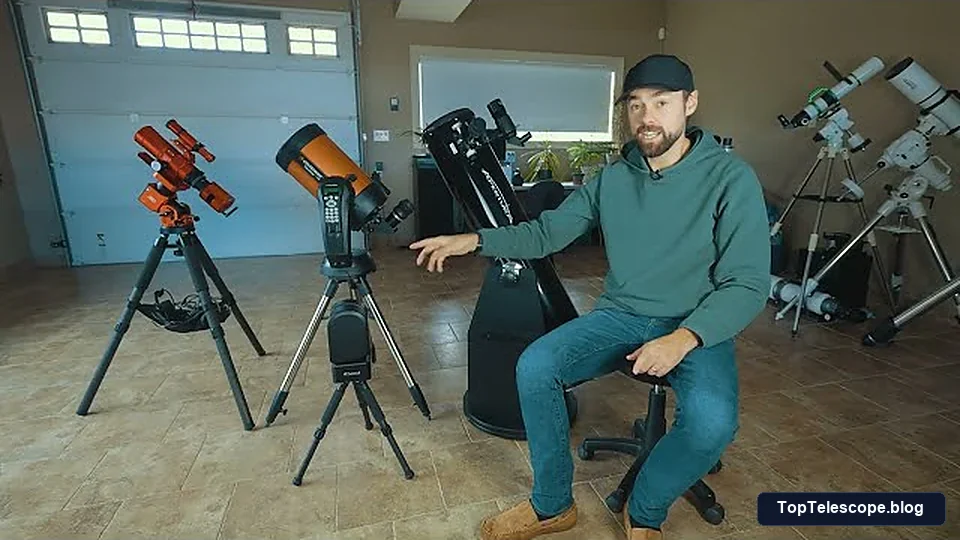
The primary difference lies entirely in how the optical tube assembly is supported mechanically. While optics remain fundamentally identical, structural execution alters operational physics completely during field use.
For example, examining units like the Celestron StarSense Explorer 114mm review shows how reflectors demand precise optical alignment, known as collimation, to maintain crisp planetary and deep-sky resolution.
Newtonians and Dobsons share identical parabolic primary mirrors reflecting light to a flat diagonal secondary. Both collect photons via identical optical physics without intrinsic differences in glass figure quality.
Focal lengths dictate native focal ratios, typically ranging from f/4 to f/6 for portable units. Fast systems demand precise coma correctors to maintain pinpoint star images across wide-field eyepieces.
Central obstruction percentages directly impact high-frequency contrast transfer functions. Secondary mirror minor axes typically occupy twenty to twenty-five percent of the clear aperture diameter across standard production models.
- Parabolic primary mirrors eliminate false color fringe artifacts.
- Secondary mirror spiders create minor diffraction spikes on bright stars.
- Open optical tubes require thermal acclimation before high-power viewing.
Mirror Coatings and Reflectivity
Modern aluminized mirrors feature protective overcoats to prevent rapid oxidation from atmospheric moisture and dew. Enhanced coatings deliver up to ninety-four percent reflectivity across the visible spectrum.
Proper storage prevents dust accumulation and minimizes the frequency of wet cleaning sessions. Always use distilled water and optical-grade solvents when servicing delicate mirror surfaces.
- Silicon dioxide overcoats protect fragile aluminum surfaces.
- Regular inspection catches early signs of coating degradation.
Mechanical Mount Architectures and Stability
The Dobsonian configuration relies on a simplified altitude-azimuth rocker box constructed from engineered wood or heavy-duty plastic laminates. Teflon pads provide smooth friction movements during manual target tracking.
Conversely, analyzing models like the Celestron StarSense Explorer 130mm review reveals how standard Newtonian OTAs mount onto heavy metal tripods using dovetail bars for motorized tracking.
Stability depends heavily on the interface between the optical tube and the ground support system. Heavy-duty wooden bases dampen vibrations faster than lightweight aluminum tripod legs.
Equatorial mounts require heavy counterweights and polar alignment, whereas Dobsons utilize a simplified rocker box resting on azimuth bearings. This alt-azimuth design lowers the overall center of gravity significantly.
Teflon pads combined with laminate surfaces provide smooth manual tracking motion without requiring complex gear trains or electronic motor drives. Friction tensioners prevent drift during high-magnification planetary observation sessions.
Tube rings on equatorial setups allow rotation for eyepiece comfort, while Dobsons require altitude bearing slips or saddle repositioning. Structural rigidity depends heavily on particle board density versus lightweight aluminum honeycomb.
- Alt-azimuth rocker boxes use Teflon pads for motion.
- Equatorial tripods require counterweight balancing for safety.
- Vibration damping times dictate high-magnification usability.
Friction Control and Balance
Maintaining proper balance prevents the optical tube from slipping downward when pointing at low elevation angles. Adjustable tension knobs allow users to fine-tune resistance effortlessly.
Heavy accessories like wide-field eyepieces or barlow lenses shift the center of gravity significantly. Rebalancing the tube assembly ensures smooth manual tracking without sudden jerks.
- Tension clutches manage heavy eyepiece load shifts.
- Center of gravity alignment prevents accidental slip.
Real-World Visual Performance and Aperture
Aperture remains the single most critical specification governing visual deep-sky performance and resolution limits. Larger mirrors capture more photons, revealing faint nebulae and distant galaxies with greater structural detail.
Because the structural design is cost-effective, amateur astronomers can afford massive apertures within modest financial budgets. An eight or ten-inch mirror opens up thousands of deep-sky targets.
Atmospheric seeing conditions often limit maximum usable magnification regardless of mirror size. Selecting optimal nights with steady air currents yields sharper planetary and lunar surface details.
Light-gathering power scales exponentially with aperture diameter, making eight-inch and ten-inch instruments the sweet spot for deep-sky observation. Faintest visible magnitude increases predictably as primary mirror surface areas expand.
Atmospheric seeing conditions frequently limit maximum usable magnification long before optical limits are reached. Standard thresholds rarely exceed fifty times per inch of aperture under typical mid-latitude viewing skies.
Globular clusters and faint nebulae benefit immensely from unobstructed photon collection paths found in large reflectors. Contrast remains high when optical coatings exceed ninety-four percent reflectivity across the visible spectrum.
- Large apertures resolve faint globular clusters and galaxies.
- Cost efficiency favors simple wooden base designs.
- Seeing conditions dictate practical magnification thresholds.
Resolving Power and Magnification
Theoretical resolution scales directly with primary mirror diameter according to classical optical physics formulas. High-magnification eyepieces demand sturdy mounts to prevent image shaking during focusing.
Exit pupil calculations help determine the best eyepiece focal lengths for viewing faint nebulae versus planetary details. Matching exit pupils to eye dilation optimizes contrast.
- Dawes limit defines minimum resolvable double star separations.
- Exit pupil optimization enhances faint nebula contrast.
Setup Ergonomics and Field Transport
Transporting large optical systems requires careful vehicle packing and manageable component weight distribution. Breaking down the system into a separate optical tube and base makes transit easier.
Equatorial mounts demand meticulous polar alignment using a finderscope or polar axis scope before observing faint targets. This extra step adds setup time during cold winter evening sessions.
Observing comfort varies based on eyepiece position when pointing toward the zenith, prompting many observers to consult our best Dobsonian telescope guide for alternative mounting configurations.
Transporting long optical tubes demands careful vehicle packaging to prevent accidental alignment shifts or dented aluminum walls. Splitting Dobsons into two separate loads simplifies handling compared to bulky equatorial tripod assemblies.
Eyepiece height varies drastically depending on the telescope pointing angle toward zenith coordinates. Observers using large Dobsons often require adjustable observing chairs to maintain comfortable viewing posture throughout nights.
Thermal equilibrium remains vital for capturing sharp planetary details during cold autumn observing sessions. Integrated cooling fans accelerate primary mirror acclimatization by rapidly venting trapped boundary layer heat currents.
- Two-piece transport simplifies vehicle trunk loading.
- Polar alignment adds preparation time for equatorial setups.
- Eyepiece height changes require adjustable observing chairs.
Field Ergonomics and Eyepiece Position
Newtonian reflectors mounted on equatorial tripods often position the eyepiece in awkward, hard-to-reach orientations. Rotating the tube within its mounting rings restores comfortable viewing positions.
Using an adjustable observing chair reduces physical fatigue during extended deep-sky viewing sessions by keeping neck angles natural and relaxed.
- Rotating rings prevent awkward neck strain angles.
- Ergonomic seating maintains posture during long sessions.
Collimation, Maintenance, and Optical Longevity
Periodic mirror alignment is mandatory for maintaining peak optical performance across both system variations. Using a laser collimator or Cheshire eyepiece streamlines this mechanical alignment process.
Primary mirrors rest on supportive cell clips designed to prevent pinching or optical distortion from thermal expansion. Proper clearance ensures glass shapes remain true during temperature drops.
Environmental exposure introduces dust, pollen, and dew residue onto optical surfaces over months of outdoor use. Cleaning mirrors requires specialized techniques to avoid scratching delicate coatings.
Newtonian optics demand regular mirror alignment using laser collimators or Cheshire eyepieces before every session. Primary cell designs must incorporate locking push-pull screws to maintain optical alignment during transport.
Protective aluminum coatings over Pyrex or Borosilicate substrates degrade over decades if exposed to high humidity. Re-coating services restore optimum surface reflectivity once micro-scratches or oxidation begin scattering incoming starlight.
Dust accumulation on primary mirrors has negligible impact on performance until coverage becomes exceptionally severe. Cleaning requires distilled water rinses and mild surfactant solutions to prevent damaging delicate optical interference coatings.
- Laser collimators speed up field alignment routines.
- Primary mirror clips prevent optical surface pinching.
- Protective dust covers extend coating lifespan significantly.
Step-by-Step Optical Alignment
Begin collimation by adjusting the secondary mirror tilt until the reflection of the primary mirror centers. Next, adjust the primary mirror leveling screws until the laser returns to its origin.
Performing this check before every major observing session guarantees sharp pinpoint stars and maximum contrast on planetary nebulae.
- Center secondary reflections using alignment hex keys.
- Fine-tune primary mirror screws for laser return.
Astrophotography and Tracking Adaptability
Capturing long-exposure deep-sky images requires precise equatorial tracking to prevent star trailing caused by Earth's rotation. Standard Newtonian OTAs mount easily onto computerized equatorial tracking platforms.
Manual rocker box setups lack the rotational axis needed for long exposures without experiencing field rotation artifacts. Short exposure lucky imaging remains possible with specialized digital cameras.
Equatorial platforms provide motorized tracking solutions for alt-azimuth mounts, bridging the gap between visual convenience and basic astrophotography capabilities.
Long-exposure deep-sky imaging requires equatorial tracking to counteract Earth rotation. However, beginners evaluating the best beginner Dobsonian options must note that standard alt-az bases introduce field rotation errors during extended multi-minute exposures.
Equatorial-mounted Newtonians readily accept autoguiding cameras connected via standard ST-4 guide ports. Balancing heavy imaging payloads demands rigid steel tripods and high-precision worm gear motor drives.
Planetary imaging remains feasible on manual Dobsons using high-speed video capture techniques and software derotation algorithms. Short exposure frames bypass tracking limitations by capturing thousands of frames in seconds.
- Equatorial mounts prevent star trailing during long exposures.
- Alt-azimuth bases suffer from field rotation in photos.
- Equatorial platforms enable basic astrophotography tracking.
Camera Weight and Focuser Limits
Heavy DSLR or cooled CMOS cameras demand robust Crayford or rack-and-pinion focusers with dual-speed adjustments. Upgrading focusers prevents image slip when imaging at high focal lengths.
Coma correctors are essential optical accessories when pairing fast reflector mirrors with modern large-sensor digital cameras to eliminate edge star distortion.
- Dual-speed focusers handle heavy imaging payload loads.
- Coma correctors eliminate edge distortion on sensors.
Selecting the Right Optical System for Your Needs
Choosing between these setups depends primarily on whether your main focus is casual deep-sky viewing or technical astrophotography. Assess your physical storage space and transportation limits carefully.
Backyard astronomers prioritizing maximum light gathering per budget allocation will find simple rocker box designs exceptionally rewarding. Observers desiring motorized tracking should invest in equatorial platforms.
Evaluating your local light pollution levels helps determine if large aperture investments are practical for suburban observing environments or dark sky excursions.
Budget allocation heavily favors optical aperture when purchasing simple alt-azimuth Dobsonian packages over computerized equatorial setups. Prioritizing mechanical simplicity directs more funds toward high-grade glass rather than motors.
Storage space constraints often dictate whether a solid tube or truss-tube design becomes the mandatory choice for larger apertures. Measuring available vehicle trunk dimensions prevents unexpected transport complications later.
Visual astronomers prioritizing deep-sky objects find maximum utility in large, manually operated reflector systems. Astrophotography enthusiasts should instead select motorized equatorial platforms to ensure reliable long-exposure tracking performance.
- Match mechanical mounts to your primary observational goals.
- Evaluate vehicle storage capacity before buying large tubes.
- Consider local light pollution levels and dark sky travel.
Final Decision Framework
Prioritize optical simplicity and intuitive manual control if you want immediate setup without electronic calibration hurdles. Select motorized equatorial tracking if long-exposure photography is your main goal.
Review your physical strength and vehicle capacity to ensure you can manage the weight of larger optical tube assemblies safely in the field.
- Choose manual rocker bases for instant visual sessions.
- Verify weight limits for safe physical transport.
Frequently Asked Questions
What is the primary difference between a Dobsonian and a Newtonian reflector?
The optical tube assembly is identical, but the Dobsonian uses a simplified wooden rocker box instead of an equatorial tripod. This design maximizes aperture while keeping setup remarkably straightforward.
Can I use a Dobsonian telescope for astrophotography?
Basic deep-sky astrophotography is challenging due to the lack of polar tracking and field rotation. However, you can capture stunning lunar and planetary images using short exposures.
How often should I collimate my reflector telescope?
You should check your optical alignment before every observing session to ensure sharp views. Transporting the telescope in a vehicle often shifts mirror positions slightly.
Are larger aperture telescopes difficult to transport in a car?
Large optical tubes require careful packing, but truss-tube designs break down into manageable components. Always measure your vehicle trunk dimensions before purchasing oversized models.
Do I need special tools to perform mirror maintenance?
Basic collimation requires only a simple laser tool or Cheshire eyepiece. Deep cleaning requires distilled water, mild dish soap, and gentle cotton balls.