Dobson vs Newtonian: Concise Verdict
Choosing between these reflector designs involves balancing mount simplicity against equatorial tracking precision. Understanding their structural differences ensures optimal stargazing performance.

Choose the Dobson for maximum aperture and effortless setup, or select the Newtonian for long-exposure astrophotography and equatorial tracking capabilities.
Compare all top models in our Best Telescope: Top Backyard Picks for Astronomy.
Side-by-Side Breakdown
| Criteria | Dobson | Newtonian | Edge |
|---|---|---|---|
| Core Design / Build | Simplified alt-azimuth rocker box | Equatorial or alt-az tripod mount | Dobson |
| Real-World Performance | High light-gathering aperture value | Identical optical tube assembly optics | Tie |
| Ease of Setup & Use | Intuitive manual point-and-look operation | Complex balancing and polar alignment | Dobson |
| Durability & Reliability | Robust wooden or metal base boxes | Mechanical tripods with delicate gears | Dobson |
| Efficiency / Operating Footprint | Wide base requires flat ground space | Narrower tripod footprint with spreaders | Newtonian |
| Maintenance Requirements | Standard mirror cleaning and collimation | Standard mirror cleaning and collimation | Tie |
| Best Ideal Use Case | Deep-sky visual astronomy sessions | Deep-sky imaging with motor drives | Newtonian |
Optical Physics and Mirror Configurations
Both systems share identical optical roots utilizing a parabolic primary mirror that reflects light back to a flat diagonal secondary mirror. This design eliminates chromatic aberration entirely across the visual spectrum.
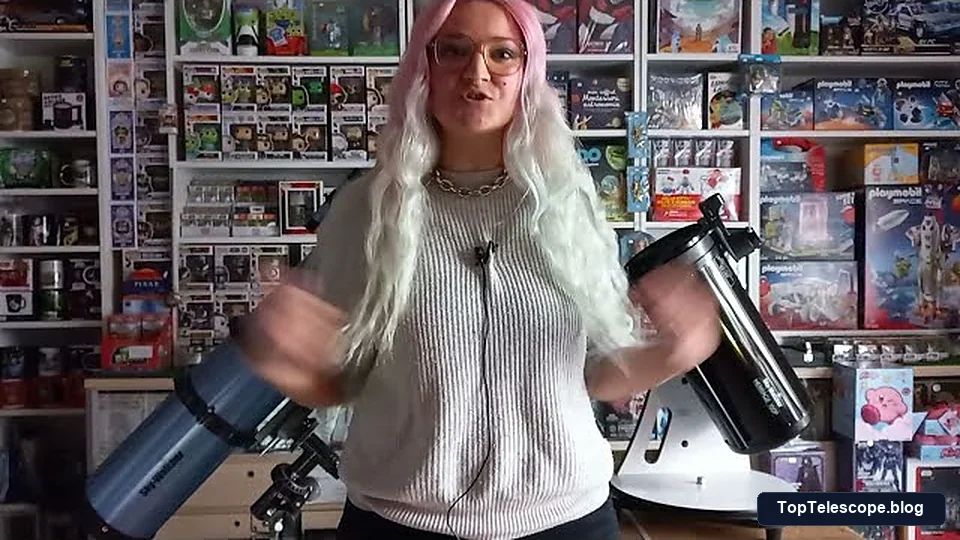
Aperture diameter dictates ultimate resolution limits and light gathering power for faint deep-sky objects. Selecting quality glass with enhanced aluminum coatings maximizes total photon reflection before reaching your eye.
Both designs employ a parabolic primary mirror to eliminate spherical aberration. For long-exposure imaging, many astronomers prefer to consult our best newtonian telescope guide before choosing an equatorial tracking mount.
Optical alignment tolerances remain identical since both configurations utilize a flat secondary diagonal mirror supported by a four-vane spider to direct converging light toward the exterior focuser assembly.
- Parabolic primary mirrors eliminate spherical aberration at fast focal ratios.
- Diagonal secondary mirrors obstruct minimal incoming light while steering beams.
- Enhanced reflective coatings deliver high throughput across visible wavelengths.
Primary and Secondary Mirrors
The primary mirror rests securely at the bottom of the tube on a multi-point flotation cell. This prevents glass sagging and maintains accurate figure alignment during temperature shifts.
Suspended near the top opening, the secondary mirror spider vanes must remain thin to minimize diffraction spikes on bright stars. Proper alignment ensures sharp planetary detail.
- Multi-point float cells distribute glass weight evenly.
- Thin spider vanes reduce unwanted diffraction spikes.
Focal Ratios and Coma Correction
Fast focal ratios below five provide wider fields of view but introduce optical coma near frame edges. Utilizing a dedicated coma corrector lens restores pinpoint stars across wide eyepieces.
Slower focal ratios reduce coma naturally while demanding taller mounting heights for comfortable viewing angles. Balancing focal length against physical ergonomics remains a critical design choice.
- Fast focal ratios require careful coma correction lenses.
- Slower focal ratios ease eyepiece strain but increase tube length.
Mount Mechanics and Stabilization Systems
Mount mechanics represent the single greatest operational divergence between these two configurations. While both share tube assemblies, their supporting structures govern tracking and setup workflows.
Rigid stabilization prevents image jitter when focusing or observing at high magnification powers. Heavy duty materials absorb ambient wind vibrations rapidly during extended field viewing sessions.
Equatorial mounts require heavy counterweights and polar alignment to track celestial rotation, whereas Dobsonian alt-azimuth bases rely on teflon bearing pads sliding against laminate surfaces for smooth movement.
Damping times after manual focusing depend heavily on tripod rigidity for Newtonians, whereas heavy-duty ground boards offer superior vibration suppression during high-magnification planetary observation sessions in the field.
- Mount stability dictates high magnification usability in breezy outdoor conditions.
- Mechanical differences dictate whether manual nudging or motor tracking is used.
Alt-Azimuth Rocker Boxes
The classic rocker box provides smooth altitude and azimuth motion using low-friction bearing materials. This minimalist design eliminates heavy counterweights and complex polar alignment procedures entirely.
Manual tracking at high power requires constant gentle nudging to keep targets centered. Teflon pads and laminate surfaces ensure smooth gliding action without annoying stick-slip friction.
- Teflon bearings offer buttery smooth manual tracking motions.
- Zero polar alignment requirements speed up field deployment.
Equatorial Tripods and Counterweights
Equatorial mounts tilt the polar axis to match Earth's rotational angle for effortless single-axis tracking. Heavy counterweights balance the offset optical tube assembly to prevent motor strain.
Polar alignment demands clear views of celestial poles and careful bubble level calibration. Setup times increase substantially compared to simple ground-based rocker box systems.
- Polar axis tilt enables simple single-axis motor tracking.
- Heavy counterweights balance offset optical tube assemblies securely.
Portability, Ergonomics and Field Footprint
Transporting large optical tubes demands careful vehicle packaging and manageable component weights. Truss-tube variants break down into smaller pieces to fit inside compact passenger cars easily.
Observing comfort relies heavily on eyepiece position relative to the ground. Managing ladder heights for massive aperture tubes requires strict safety precautions during night sessions.
Transporting a standard Newtonian optical tube requires careful handling of protruding rings. New observers can evaluate starter options using our best newtonian telescope guide to minimize mechanical misalignment risks during frequent transit.
Dobsonians separate into two manageable components containing the rocker box and optical tube, allowing astronomers to pack large aperture instruments safely into standard vehicle trunks without sacrificing structural integrity.
- Truss-tube designs simplify transport for large aperture instruments.
- Eyepiece height varies drastically based on mirror diameter and mount type.
Transporting Solid vs Truss Tubes
Solid optical tubes offer ultimate rigidity but take up massive backseat volumes in standard vehicles. Truss poles disassemble rapidly into modular rings and struts for efficient packing.
Assembling truss poles in the dark requires tactile alignment pins and secure fasteners. Keeping optical alignment stable through repeated assembly cycles demands robust structural engineering.
- Solid tubes eliminate assembly steps but demand ample cargo space.
- Truss poles break down into compact modular components.
Eyepiece Height and Observing Angles
Pointing straight up at the zenith places the eyepiece near the top of the tube assembly. Giant aperture instruments often require sturdy observing step stools for shorter observers.
Rotatable tube rings allow users to tilt the eyepiece into comfortable viewing positions. This prevents neck strain during long marathons of deep-sky galaxy hunting.
- Zenith viewing on large scopes requires stable observing steps.
- Rotatable mounting rings enhance comfort during extended sessions.
Collimation Procedures and Optical Maintenance
Maintaining sharp optical performance requires routine mirror alignment checks before every serious observing session. Temperature shifts and transport vibrations inevitably knock delicate mirror cells slightly out of true alignment.
Laser collimators and Cheshire eyepieces simplify the alignment workflow for both configurations equally. Keeping optics pristine ensures maximum contrast on faint planetary detail.
Routine maintenance demands precise alignment of optical elements using a laser collimator or cheshire eyepiece to ensure sharp planetary details across the focal plane during observing sessions.
Newtonian tubes on equatorial mounts frequently require mirror readjustment after transportation. Buyers evaluating portable optical systems can read our Celestron AstroMaster 130EQ review for detailed insights on maintaining optical alignment.
- Routine mirror alignment checks guarantee peak high-magnification contrast.
- Laser tools streamline the collimation process in dark environments.
Laser vs Cheshire Collimation
Laser collimators project a precise red beam onto center-marked primary mirrors for fast adjustments. Cheshire eyepieces provide high-contrast optical references for daytime calibration checks.
Combining both tools ensures absolute optical precision across fast focal length systems. Proper screw tension prevents mirrors from shifting during transport over rough roads.
- Laser tools offer rapid alignment feedback in dark fields.
- Cheshire eyepieces provide reliable daytime optical reference checks.
Dust Mitigation and Mirror Coatings
Exposed optical tubes accumulate dust over time and require occasional professional washing. Protective mirror coatings prevent oxidation and maintain high reflectivity across years of service.
Never touch optical glass surfaces directly with bare fingers or harsh dry cloths. Using compressed air bulbs safely blows away loose particles without scratching delicate coatings.
- Protective mirror coatings prevent long-term oxidation and wear.
- Compressed air safely removes loose dust without scratching glass.
Astrophotography Capability and Tracking Limits
Imaging faint deep-sky nebulae demands continuous tracking to counteract Earth rotation during long exposures. Alt-azimuth mount designs suffer from field rotation over extended exposure durations.
Equatorial tracking platforms or equatorial mounts eliminate field rotation entirely. This makes equatorial configurations the superior choice for serious long-exposure astrophotography projects.
Equatorial mounted Newtonians excel at prolonged deep sky imaging because motorized axis rotation counteracts apparent field rotation naturally, enabling clean integration of faint nebulae.
Standard Dobsonians lack equatorial tracking capability, causing target drift that restricts users primarily to visual observation or brief planetary video captures unless mounted on an equatorial platform.
- Long exposures require precise tracking to prevent star trailing.
- Field rotation affects alt-azimuth systems during multi-minute exposures.
Field Rotation in Alt-Azimuth
Alt-azimuth mounts rotate the image plane while tracking celestial objects across curved sky paths. This geometric reality causes background stars to streak during exposures exceeding several minutes.
Adding an equatorial wedge or tracking platform solves field rotation limitations successfully. However, these accessories add complexity and weight to simple observer setups.
- Field rotation streaks background stars during long exposures.
- Equatorial wedges counteract natural alt-azimuth rotation geometry.
Motorized Tracking Platforms
Equatorial tracking platforms provide motorized drive capability for manual rocker box setups. These clever mechanical bases tilt the entire instrument at sidereal rates smoothly.
Autoguider ports enable precise error correction during deep-sky imaging sessions. Proper cable management prevents snagging during automated multi-hour data collection runs.
- Tracking platforms add motorized capability to simple bases.
- Autoguider integration ensures pinpoint stars in deep-sky images.
Cost Efficiency and Aperture Value
Budget allocation dictates how much light-gathering aperture an astronomer can ultimately afford to purchase. Simple rocker box mounts consume minimal manufacturing budget compared to complex gear-driven equatorial heads.
Redirecting funds toward premium eyepieces delivers superior visual returns compared to expensive mounting hardware. Maximizing optical diameter remains the primary goal for visual observers.
Allocating manufacturing budget entirely to primary mirror fabrication allows Dobsonian manufacturers to deliver maximum light gathering capacity per dollar spent compared to complex equatorial setups.
Newtonian configurations distribute expenses evenly between optical tubes and tracking mounts. Shoppers seeking affordable reflector systems can explore our Celestron StarSense Explorer 114mm review to assess aperture sizes matching strict financial budgets.
- Rocker mounts maximize aperture budgets by cutting mechanical complexity.
- Investing in quality glass yields better visual returns than mounts.
Dollar-per-Inch Metrics
Comparing aperture cost reveals that simple optical configurations deliver unmatched light gathering per unit currency. Users gain massive mirrors without paying for heavy equatorial counterweight systems.
Equatorial systems allocate a large percentage of total manufacturing cost toward precise gears. This reduces the maximum primary mirror diameter available at identical price points.
- Simple mounts deliver maximum mirror diameter per currency unit.
- Equatorial gear drives consume significant portions of manufacturing budgets.
Accessory Upgrades and Budgeting
Budgeting for accessory items like high-grade eyepieces and nebulae filters enhances observing experiences. Planning for power tanks and dew heaters prevents unexpected field operational failures.
Incremental upgrades allow observers to expand system capability over several years without financial strain. Prioritizing comfort items improves overall usability during freezing nights.
- Accessory budgeting should include filters and power tanks.
- Incremental upgrades allow gradual capability expansion over time.
Setup Speed and Field Workflow
Minimizing field assembly time encourages frequent observing sessions under clear night skies. Complex mechanical setups often discourage quick weeknight viewing due to lengthy alignment procedures.
Streamlined workflows allow astronomers to begin observing within minutes of stepping outside. Efficient teardown procedures protect sensitive optical tubes during late-night packing.
Assembling a complex equatorial tripod requires leveling, polar axis alignment, and counterweight balancing, which extends the initial preparation time before actual stargazing can officially commence.
Dobsonian systems eliminate calibration delays by allowing users to simply place the rocker box on the ground, drop in the optical tube, and begin observing within minutes.
- Rapid field setup encourages frequent impromptu stargazing sessions.
- Streamlined workflows protect sensitive optical tubes during teardown.
Rapid Assembly in the Dark
Carrying a two-piece rocker and tube system outside takes minimal physical effort. Placing the optical tube into the cradle requires no tools or complex cable connections.
Instant readiness transforms backyard astronomy into an effortless daily habit. Simplicity remains the ultimate advantage for casual stargazers seeking deep-sky views.
- Two-piece designs enable tool-free field assembly quickly.
- Instant readiness transforms backyard astronomy into easy habits.
Power Requirements and Cable Management
Equatorial tracking systems demand reliable 12-volt power sources and numerous USB data cables. Managing these lines in freezing conditions prevents accidental disconnections and gear tangles.
Manual systems operate entirely without electrical power, ensuring absolute reliability in remote dark-sky locations. Eliminating battery anxiety lets observers focus purely on celestial targets.
- Equatorial setups require reliable power tanks and cables.
- Manual systems eliminate battery anxiety in remote locations.
Frequently Asked Questions
Can I use an alt-azimuth rocker setup for deep-sky astrophotography?
You can capture short planetary video clips, but long exposure deep-sky imaging causes field rotation blur. Equatorial mounts remain necessary for extended tracking.
How frequently must primary and secondary mirrors undergo optical collimation?
You should check mirror alignment before every serious observing session to ensure optimal high-power contrast. Laser collimators make this process quick and straightforward.
What is the primary advantage of choosing a truss-tube optical design?
Truss-tube designs break down into smaller modular components to fit inside compact vehicles. Transporting massive apertures becomes feasible without a large truck.
Why do fast focal ratios require specialized optical coma corrector lenses?
Fast focal ratios introduce optical coma that distorts stars near the outer edges of wide fields. Coma correctors restore pinpoint star images completely.
Are heavy counterweights required for standard manual rocker box instrument bases?
Manual rocker boxes use balanced altitude friction bearings instead of heavy counterweights. Simplified physics reduces total setup weight and mechanical complexity.