Diagonal Mirror vs Prism: Ultimate Optics Guide
Choosing between a diagonal mirror and a prism shapes your telescope's optical clarity. Understand how these components impact your everyday viewing experience.

Choose a diagonal mirror for maximum light throughput on faint deep-sky targets. Select a prism for superior contrast and sharp color correction when viewing lunar and planetary details.
Compare all top models in our Best Telescope: Top Backyard Picks for Astronomy.
Side-by-Side Breakdown
| Criteria | Diagonal Mirror | Prism | Edge |
|---|---|---|---|
| Core Design / Build | Glass substrate with aluminum or dielectric coating | Solid block of optical glass utilizing total internal reflection | Prism |
| Real-World Performance | High reflectivity across broad wavelengths without dispersion | Exceptional image contrast with slight chromatic aberration | Tie |
| Ease of Setup & Use | Standard barrel sizes fit most focusers seamlessly | Requires precise back-focus management in refractors | Diagonal Mirror |
| Durability & Reliability | Coatings can degrade or oxidize over extended decades | Solid glass block resists environmental wear effectively | Prism |
| Efficiency / Operating Footprint | Reflects up to ninety-nine percent with dielectric layers | Light loss occurs via absorption and surface reflection | Diagonal Mirror |
| Maintenance Requirements | Requires occasional careful cleaning to protect delicate coatings | Easier to clean due to durable exterior glass surfaces | Prism |
| Best Ideal Use Case | Deep-sky observation requiring maximum photon collection | Lunar and planetary viewing demanding high contrast | Tie |
Core Design and Engineering Differences
Telescope diagonals redirect light at a comfortable viewing angle for the observer. A mirror diagonal uses a reflective aluminum coating on an optical glass substrate to bounce incoming light toward the eyepiece.
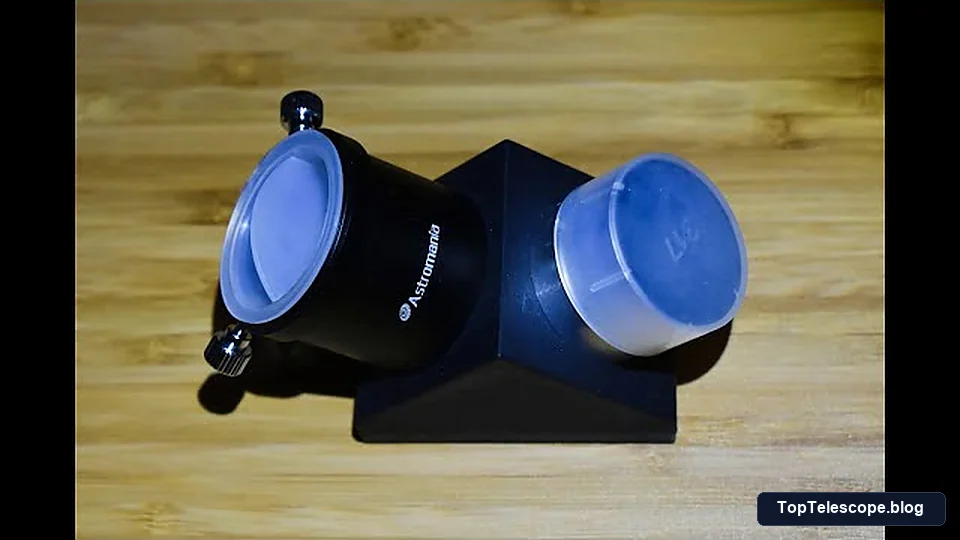
Conversely, a prism diagonal relies entirely on total internal reflection. Incoming light enters the glass block, bounces off the internal faces, and exits toward the observer without needing any traditional metallic mirror coating.
Engineering tolerances differ significantly between these two optical accessories. Precision mirrors require smooth glass flatness, while prisms demand flawless internal glass homogeneity to prevent wavefront distortion during transit.
Mirror diagonals rely on a front-surface aluminum or dielectric coating applied to an optically flat substrate. Discover top optical configurations in our curated best telescope guide to improve your planetary views.
In contrast, prisms utilize total internal reflection inside a solid block of BK7 or BaK-4 glass. Light enters the face, bends, bounces off the hypotenuse, and exits cleanly toward your eyepiece.
Mechanical housings for both designs must maintain precise 90-degree alignment tolerances. Collimation drift can ruin high-magnification planetary views, requiring adjustment screws or rigid one-piece machined bodies for long-term stability.
- Reflective mirrors utilize aluminum or enhanced dielectric surface layers.
- Prisms use solid optical glass blocks to redirect incoming light cones.
- Mechanical housings must maintain precise ninety-degree alignment angles.
Optical Paths and Internal Geometries
The internal geometry of each component alters the light cone differently. Mirrors fold light purely via surface reflection, while prisms refract light through a dense medium, introducing slight chromatic dispersion along the path.
Understanding these physical pathways helps astronomers select gear matching their specific optical tube assemblies. Refractor owners often prioritize glass types, while reflector users focus on coating reflectivity percentages.
- Refraction inside prisms alters the effective focal length slightly.
- Surface reflection preserves exact wavefront integrity without glass absorption.
Real-World Optical Performance Metrics
Observing faint deep-sky nebulae demands high photon throughput. Premium mirror diagonals featuring dielectric coatings achieve up to ninety-nine percent reflectivity, ensuring dim starlight reaches your eye intact.
Planetary observers require sharp contrast to resolve subtle cloud bands on Jupiter. Prisms excel here by scattering less stray light, delivering crisp lunar edges and deep background contrast.
Evaluating real performance requires testing across various seeing conditions. Thermal acclimatization of the glass block or mirror substrate directly influences image stability during high-magnification viewing sessions.
Star diagonals using standard aluminum coatings typically deliver around 88 to 92 percent reflectivity across the visual spectrum. Upgraded dielectric mirrors push this metric past 99 percent for brighter astronomical images.
Prisms introduce chromatic aberration due to the glass path length, which is particularly noticeable in fast refractors operating below f/6. However, they excel at delivering high-contrast lunar and planetary details consistently.
Surface accuracy measured in waves of light is critical for both units. Premium optical components demand at least 1/10-wave flatness to prevent wavefront distortion during high-power astronomical viewing sessions.
- Dielectric mirrors maximize brightness for faint deep-sky targets.
- Amici roof prisms introduce a diffraction spike along the center.
- Standard star prisms deliver excellent contrast for bright planets.
Contrast and Scatter Control
Stray light reduction remains vital for high-resolution planetary astronomy. Internal reflections inside cheap prism housings can cause ghost images, whereas quality multi-coatings suppress unwanted glare effectively.
Mirrors minimize scatter when coatings are applied flawlessly. However, older aluminum surfaces may develop microscopic pinholes that increase light scatter and reduce overall image contrast.
- Multi-coatings on prisms reduce internal ghosting and flare.
- Surface oxidation on mirrors increases unwanted light scatter.
Transmission Efficiency and Light Loss
Light transmission percentages dictate how much starlight successfully reaches your eyepiece. Standard aluminum mirror diagonals reflect roughly ninety percent of light, while upgraded dielectric versions push past ninety-eight percent efficiency.
Prism diagonals experience slight light loss through glass absorption and Fresnel reflection at entry and exit faces. High-grade anti-reflection coatings mitigate this loss, keeping transmission rates exceptionally high across the spectrum.
Comparing transmission curves reveals how different wavelengths behave. Mirrors maintain flat reflection across visual wavelengths, whereas thick glass prisms can absorb minor amounts of short-wavelength violet light.
Dielectric mirror coatings use multiple microscopic layers of dielectric material to maximize reflection. This engineering minimizes light scatter and prevents photonic energy loss across red and blue operational wavelengths.
Uncoated prisms suffer from surface reflection losses at the entrance and exit faces. Applying anti-reflection coatings to these glass surfaces is essential to maximize overall optical throughput and reduce internal glare.
When comparing raw throughput, premium dielectric mirrors and fully multi-coated prisms perform very similarly in the field. Your choice depends heavily on whether you prioritize color purity or maximum reflectivity.
- Standard aluminum mirrors reflect approximately ninety percent of light.
- Dielectric mirror coatings achieve ninety-eight to ninety-nine percent efficiency.
- Prisms require broadband anti-reflection coatings to minimize surface loss.
Wavelength Absorption Factors
Glass type selection dictates how efficiently a prism transmits ultraviolet and blue wavelengths. High-transmission glass formulas prevent unnecessary photon absorption during extended imaging sessions.
Reflective coatings bypass glass absorption entirely by bouncing photons directly off the front surface. This makes mirrors inherently neutral across the entire visible light spectrum.
- Front-surface mirrors avoid internal glass absorption entirely.
- Specialty optical glass minimizes blue-wavelength attenuation in prisms.
Maintenance, Durability and Longevity
Telescope accessories endure frequent field handling and thermal shifts. Review our expert best starter telescope roundup to evaluate durable equipment built for everyday observational use.
Mirror diagonals require cautious maintenance because delicate reflective coatings scratch easily. Cleaning requires specialized optical solutions and compressed air to prevent permanent damage to the protective outer layer.
Proper storage in padded cases extends the operational lifespan of both designs. Keeping dust caps securely in place prevents moisture accumulation and particulate settling on optical surfaces.
Mirror surfaces are exposed and delicate, requiring careful cleaning with optical microfiber cloths and specialized fluid. Aluminum coatings degrade over decades, eventually demanding professional recoating or complete mirror replacement.
Prisms feature rugged glass exterior faces that withstand accidental bumps and frequent cleaning much better than soft aluminum. A sealed prism design also prevents dust from settling on internal reflective surfaces.
Environmental moisture poses risks to both types of equipment during night observing sessions. Storing your diagonals in sealed desiccated cases prevents dew damage, mold growth, and optical coating delamination over time.
- Solid glass prisms resist mechanical shock and thermal stress.
- Reflective mirror coatings demand careful, infrequent cleaning routines.
- Protective housing seals prevent internal dust infiltration over time.
Cleaning Protocols and Safe Handling
Cleaning optical surfaces safely preserves equipment performance for decades. Prisms tolerate gentle wiping with approved solvents much better than fragile soft aluminum mirror coatings.
Aerosol compressed air safely removes loose dust particles before wet cleaning begins. Always avoid dry wiping to prevent abrasive surface scratches on delicate mirror layers.
- Use optical microfiber cloths with designated cleaning fluids.
- Blow away loose debris with bulb blowers before cleaning.
Ergonomics, Setup and Mechanical Fit
Mechanical integration into your existing focuser requires careful back-focus calculation. Consult our comprehensive telescope for beginners guide to ensure seamless optical path compatibility and focus.
Mirror diagonals offer a streamlined mechanical profile that fits standard compression ring focusers securely. Heavy-duty 2-inch models require robust thumbscrews to support large eyepieces without slippage or tilt.
Balanced weight distribution prevents strain on the focuser drawtube during high-angle viewing. Ergonomic barrel designs featuring safety undercut grooves ensure secure attachment under dark sky conditions.
Eyepiece holders require robust clamping mechanisms to secure heavy 2-inch oculars securely. Brass compression rings prevent thumbscrews from marring expensive eyepiece barrels during nighttime telescope setup and accessory swaps.
Optical path length differences impact your telescope focusing range significantly. Prisms consume more inward focus travel due to the glass thickness, which may require extension tubes for certain eyepiece combinations.
The physical weight of the diagonal affects your focuser balance and imaging train stability. Heavy dielectric mirrors demand tension adjustments on rack-and-pinion focusers to prevent unwanted optical slippage overhead.
- Prisms require specific optical path length adjustments for focus.
- Standard mirror diagonals fit seamless compression ring adapters.
- Safety undercuts prevent heavy eyepieces from slipping outward.
Focuser Compatibility and Back-Focus
Matching your diagonal to available focuser travel prevents frustrating focusing failures. Refractor telescopes often accommodate both accessories, while specialized astrographs demand precise back-focus measurements.
Locking mechanisms must hold heavy eyepieces firmly in alignment. Brass compression rings distribute clamping pressure evenly without marring shiny chrome eyepiece barrels.
- Check available focuser inward and outward travel limits.
- Brass compression rings protect eyepiece barrels from scratching.
Which Option Fits Your Telescope Setup
Selecting the ideal optical accessory depends heavily on your primary observing targets. Deep-sky astronomers hunting faint galaxies benefit most from the uncompromised light gathering of high-end dielectric mirrors.
Lunar, solar, and planetary observers find unmatched visual contrast using premium prisms. Evaluating your local seeing conditions and target preferences ensures you make the optimal equipment choice for your observatory.
Budget considerations also influence final purchasing decisions among amateur astronomers. Standard aluminum mirrors offer affordable entry points, while precision-polished prisms represent long-term investments in optical purity.
Refractor owners operating slower optical systems often prefer high-quality prisms for superior axis alignment. Short focal ratio telescopes benefit more from dielectric mirrors that avoid inducing false chromatic color fringes.
Planetary observers demanding maximum contrast usually lean toward premium prisms despite minor glass path trade-offs. Deep-sky astrophotographers prioritize the broadband reflectivity offered by advanced dielectric mirror diagonal systems.
Budget considerations also influence final purchasing decisions for amateur astronomers building modular kits. Standard aluminum mirrors offer affordable entry points, while precision-polished prisms represent lasting investments in optical clarity.
- Choose dielectric mirrors for faint deep-sky astronomical targets.
- Select glass prisms for high-contrast lunar and planetary viewing.
- Match accessory size to your telescope focuser diameter.
Matching Accessories to Telescope Types
Learn more about compatibility in our technical guide to star diagonals for refractor telescopes. Schmidt-Cassegrain systems utilize standard visual backs that accept both mirror and prism diagonals equally well.
Always verify barrel dimensions and locking configurations before purchasing new gear. Ensuring mechanical and optical compatibility guarantees a seamless observing experience under the night sky.
- Refractors pair well with traditional star prisms.
- Schmidt-Cassegrain scopes accept standard 1.25 and 2-inch diagonals.
Frequently Asked Questions
Do diagonal mirrors degrade over time?
Exposed aluminum mirror coatings can oxidize or collect dust over many years. Regular maintenance and proper storage help preserve optimal reflectivity levels for decades.
Why do prisms cause chromatic aberration?
Thick optical glass refracts different wavelengths of light at slightly varying angles. This physical dispersion creates minor false color around bright planetary objects.
Can I use a prism with a reflector telescope?
Prisms consume significant optical path length which prevents focus in reflectors. Newtonian reflectors typically require direct eyepiece insertion or a dedicated mirror diagonal.
Are dielectric mirror coatings worth the cost?
Dielectric coatings push reflectivity past ninety-eight percent while resisting scratches. They provide tangible brightness gains for faint deep-sky observing sessions.
Which diagonal is better for viewing the Moon?
Glass prisms deliver superior image contrast and sharp lunar edge definition. Their internal reflection design minimizes stray light effectively during bright planetary sessions.