Compare Celestron Nexstar 6Se And 8Se vs Standard Telescope
Choosing between these catadioptric systems involves weighing aperture against portability. Standard telescopes offer alternative optical configurations for various budgets.

Pick the NexStar 8SE for maximum planetary detail and light grasp. Choose a standard manual telescope if you prefer unmotorized simplicity and lower initial equipment weight.
Compare all top models in our Best Telescope: Top Backyard Picks for Astronomy.
Side-by-Side Breakdown
| Criteria | Compare Celestron Nexstar 6Se And 8Se | Standard Telescope | Edge |
|---|---|---|---|
| Core Design / Build | Folded Schmidt-Cassegrain optics | Traditional Newtonian or refractor | Side A |
| Real-World Performance | High magnification and GoTo tracking | Varies by optical tube size | Side A |
| Ease of Setup & Use | Quick-release fork mount setup | Manual rings and balancing | Side A |
| Durability & Reliability | Sealed tube protects optics | Open tubes require frequent care | Side A |
| Efficiency / Operating Footprint | Compact portable footprint | Longer physical tube length | Side A |
| Maintenance Requirements | Minimal factory collimation hold | Regular mirror cleaning/alignment | Side A |
| Best Ideal Use Case | Planetary and lunar observation | Wide-field visual astronomy | Side A |
Optical Aperture and Light Gathering
To see how these optical metrics perform in the field, explore details in our Celestron Nexstar 8Se telescope review focusing on aperture performance and tracking precision.
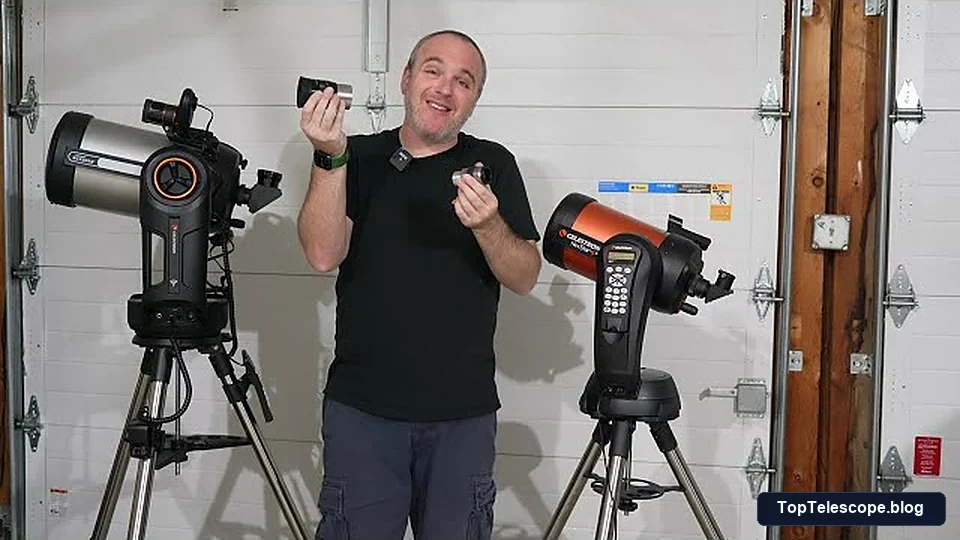
Light gathering power directly scales with aperture diameter, dictating your ability to resolve faint deep-sky objects. The jump from a six-inch to an eight-inch mirror provides a substantial brightness increase.
- 6-inch aperture collects roughly 459 times more light than the human eye.
- 8-inch aperture increases light grasp by nearly 78 percent over the smaller model.
- Standard scopes vary wildly in aperture depending on the chosen optical formula.
Primary Mirror Dimensions
Schmidt-Cassegrain optics fold light paths inside compact optical tubes, making large focal lengths manageable. This folded design keeps the instrument length short while delivering high magnification potential.
Standard Newtonian or refractor designs often feature longer physical tubes that require heavier mounts. Choosing between these configurations depends heavily on your available storage space and transportation methods.
- Folded optics reduce overall tube length significantly.
- Longer tubes demand heavier counterweights and sturdier mounts.
Mount Mechanics and Tracking Accuracy
Motorized fork mounts utilize internal gears to track celestial objects smoothly across the night sky. Earth rotation compensation requires precise alignment routines to keep targets centered in your eyepiece.
Transitioning from manual adjustments to automated tracking, features highlighted in our Celestron NexStar 6SE optical review show how motorized fork mounts eliminate tedious hand corrections.
- Computerized go-to tracking automatically centers thousands of celestial targets in seconds.
- Manual friction controls demand patience and continuous physical adjustments from the user.
- Proper gear balancing prevents excessive motor wear during prolonged astronomical observation runs.
Alt-Azimuth Motorization
Single-fork arm designs support both the six-inch and eight-inch optical tubes with adequate stability. Internal servo motors drive the axes smoothly while requiring proper balance during setup.
Standard equatorial mounts track along a polar axis, simplifying long-exposure photography but increasing mechanical complexity. Selecting the right mount type dictates your overall setup time and tracking reliability.
- Fork arms integrate drive motors directly into the casting.
- Equatorial platforms require polar axis alignment before use.
Rapid Deployment and Field Setup
Field deployment demands efficient mechanical interfaces that snap together without specialized tools. You can examine assembly mechanics further within our Celestron NexStar 8SE review detailing practical setup routines.
Standard telescope setups often involve separate counterweights, rings, and dovetail bars. Managing multiple loose components in the dark increases the risk of accidental equipment drops or misalignment.
- Steel tripod construction minimizes annoying damping times during windy observation nights.
- Integrated carry handles simplify transporting heavy optical assemblies to remote dark locations.
- Standard mounting plates require careful alignment to prevent accidental slippage hazards.
Tripod Stability
Steel tripod legs provide a rigid foundation that dampens wind vibrations quickly after manual focusing touches. Lightweight aluminum alternatives save weight but suffer from longer settling times during breezes.
Accessory trays lock the tripod spreader legs securely into a rigid operational stance. Ensuring firm ground contact prevents unwanted rocking motion during high-magnification planetary observation sessions.
- Rigid spreaders lock legs firmly into position.
- Rubber feet absorb ground vibrations effectively.
Digital Integration and Firmware Updates
Hand controllers house extensive databases containing tens of thousands of cataloged deep-sky objects. Firmware update capabilities allow users to maintain optimal pointing accuracy and access new software features.
Standard optical configurations leave navigation entirely up to paper star charts and manual star-hopping skills. Learning manual celestial navigation builds foundational astronomical knowledge that computerized systems can bypass entirely.
- SkyAlign technology determines your position using three bright alignment stars effortlessly.
- Auxiliary communication ports support modern GPS accessories and wireless control dongles.
- Paper star charts provide reliable navigation without relying on electrical power sources.
Hand Controller Databases
Navigating menu screens requires clear LED illumination that preserves dark-adapted human night vision. Built-in alignment assistants are thoroughly evaluated in our Celestron NexStar 4SE review for beginner usability.
External auxiliary ports enable Wi-Fi module attachments for seamless smartphone or tablet telescope control. Wireless planetarium applications transform digital devices into intuitive visual interfaces for backyard stargazing.
- Red backlight preserves night vision adaptation.
- Wireless dongles enable tablet telescope control.
Astrophotography Potential and Limits
Long focal lengths present unique challenges for deep-sky astrophotography due to tracking requirements. Alt-azimuth mounts introduce field rotation during long exposures, limiting deep-sky imaging times without equatorial wedges.
Standard Newtonian reflectors on equatorial platforms excel at capturing faint nebulae and distant galaxies. Matching the optical tube to the correct imaging camera maximizes resolution and signal-to-noise ratios.
- High focal ratios demand sensitive camera sensors to capture faint deep-sky targets.
- Equatorial tracking wedges eliminate field rotation during extended photographic exposure sequences.
- Planetary video capture relies on high frame rates to freeze atmospheric blur.
Planetary Imaging
High magnification capabilities make catadioptric systems exceptional instruments for detailed lunar and planetary imaging. Connecting dedicated astronomical cameras captures sharp video files ready for stacking software processing.
Atmospheric turbulence often dictates your maximum usable magnification limit regardless of aperture size. Selecting nights with steady seeing conditions yields the sharpest planetary surface detail and contrast measurements.
- Stacking software combines thousands of video frames into one clear image.
- Steady atmospheric seeing is critical for high-magnification clarity.
Ergonomics and Physical Footprint
Equipment weight distribution plays a crucial role in safe transportation and comfortable field setup. Compact optical tubes fit easily into small vehicle trunks alongside camping gear and accessories.
Standard optical systems often require bulky transport cases due to their extended physical lengths. Evaluating your vehicle storage capacity prevents purchasing equipment that proves too cumbersome for regular travel.
- Compact optical tubes simplify transportation to dark-sky observation sites significantly.
- Ergonomic mounting handles prevent accidental slips during heavy equipment assembly stages.
- Long refractor tubes require tall pier extensions for comfortable eyepiece access.
Tube Weight Distribution
Lifting an eight-inch optical tube requires careful handling to protect the corrector plate glass. Ergonomic carrying handles machined into the fork mounts ensure secure grip during assembly.
Eyepiece positioning shifts dramatically as the telescope tracks targets across different altitude angles. Using adjustable observing chairs helps maintain comfortable posture during long visual astronomy viewing sessions.
- Machined handles improve lifting security.
- Adjustable chairs prevent back strain during long sessions.
Maintenance and Long-Term Reliability
Sealed optical tubes protect primary and secondary mirrors from accumulating dust and ambient moisture. Routine maintenance involves cleaning exterior corrector plates gently using specialized optical solutions and microfiber cloths.
Open optical designs require periodic mirror cleaning and frequent collimation alignment adjustments. Maintaining optical alignment ensures crisp image contrast and prevents degraded performance during high-magnification viewing nights.
- Sealed optical configurations reduce internal dust accumulation over extended operating periods.
- Secondary mirror alignment screws allow precise user collimation adjustments when necessary.
- External power tanks ensure reliable electronic performance during cold winter nights.
Collimation Requirements
Factory-aligned catadioptric mirrors maintain their collimation remarkably well through normal transportation bumps. Minor adjustments to the secondary mirror screws correct any alignment drift over years of use.
Power management is vital when operating computerized mounts during freezing winter observation sessions. Utilizing external rechargeable lithium power tanks prevents unexpected voltage drops during automated tracking sequences.
- Secondary screws adjust optical alignment easily.
- Lithium power tanks prevent cold-weather voltage drops.
Frequently Asked Questions
What is the primary difference between the six-inch and eight-inch models?
The eight-inch model provides significantly greater light gathering capability and planetary resolution. This larger aperture noticeably improves deep-sky brightness while maintaining a similar portable physical form factor.
Can these computerized telescopes be used for deep-sky astrophotography?
They excel at lunar and planetary video imaging using high-speed cameras. However, standard alt-azimuth tracking limits long-exposure deep-sky photography unless you add an equatorial wedge.
How difficult is the initial star alignment procedure for beginners?
Built-in alignment software guides users through selecting three bright reference points in the sky. This automated routine simplifies setup without requiring advanced celestial navigation knowledge.
Do standard telescopes require more maintenance than catadioptric systems?
Open optical designs often need frequent mirror cleaning and manual collimation adjustments. Sealed catadioptric tubes protect internal optics much better against dust and moisture accumulation.
What power source is recommended for these computerized tracking mounts?
A dedicated portable lithium power tank ensures stable voltage throughout long viewing sessions. Standard alkaline batteries often fail prematurely in cold weather conditions.