Celestron Nexstar 8Se vs Evolution 8: Concise Verdict
Comparing two legendary Schmidt-Cassegrain telescopes reveals distinct mechanical philosophies. Evaluate mount stabilization and power systems before purchasing.

Choose the Nexstar 8Se for traditional portability and modular setup simplicity. Opt for the Evolution 8 if you require integrated lithium power and precision worm gears.
Compare all top models in our Best Telescope: Top Backyard Picks for Astronomy.
Side-by-Side Breakdown
| Criteria | Celestron Nexstar 8Se | Evolution 8 | Edge |
|---|---|---|---|
| Core Design / Build | Aluminum single-fork arm with classic styling | Heavy-duty cast aluminum base with worm gears | Evolution 8 |
| Real-World Performance | Identical 203mm optical tube clarity | Identical 203mm optical tube clarity | Tie |
| Ease of Setup & Use | Lightweight modular components | Heavier integrated base unit | Nexstar 8Se |
| Durability & Reliability | Standard consumer electronics and gears | Robust brass worm gears and internal battery | Evolution 8 |
| Efficiency / Operating Footprint | Requires external battery pack or AC adapter | Built-in lithium-ion battery with charging ports | Evolution 8 |
| Maintenance Requirements | Standard corrector plate cleaning and collimation | Standard cleaning plus battery health management | Nexstar 8Se |
| Best Ideal Use Case | Budget-conscious mobile visual astronomers | Tech-forward astrophotographers and outreach hosts | Evolution 8 |
Core Optical Tube Design and Coatings
Both optical tubes feature an identical 203mm aperture with traditional Schmidt-Cassegrain optics. Celestron applies proprietary StarXpert coatings to maximize light transmission across the entire visible spectrum during deep sky viewing.
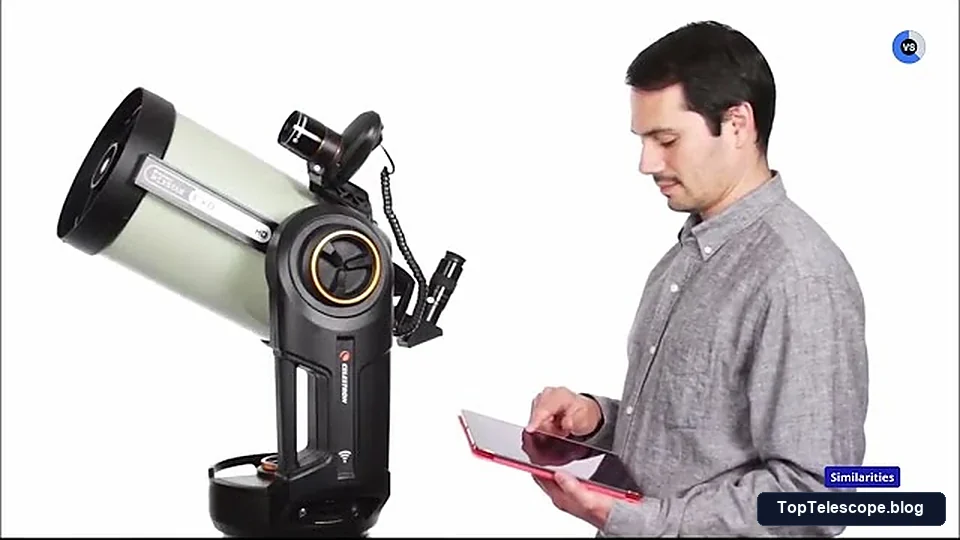
Tube fabrication relies on aluminum stamped components sealed against dust and ambient moisture. Internal baffling reduces stray light reflections, preserving contrast when observing planetary details under heavy urban light pollution.
Thermal acclimatization requires careful management due to the closed tube design. Users must allow adequate cooling time to match ambient outdoor temperatures before attempting high magnification lunar or planetary imaging sessions.
The Schmidt-Cassegrain optical system features an 8-inch aperture with a 2032mm focal length. This configuration delivers an f/10 focal ratio, balancing planetary magnification with deep-sky light-gathering capabilities effectively.
Both models utilize proprietary StarXcelerate multi-coatings on the corrector plate. These advanced chemical applications maximize light transmission, significantly boosting image brightness and contrast across the visible spectrum for optimal viewing.
Internal baffling suppresses stray light reflections within the aluminum tube assembly. Maintaining proper collimation is essential for preserving sharp diffraction patterns during high-power lunar and planetary observing sessions all night long.
- Identical optical prescription with 203mm aperture size
- Proprietary StarXpert multi-coatings for enhanced throughput
- Sealed aluminum tube minimizing internal dust accumulation
Optical Quality and Performance Trade-Offs
Optical figures remain remarkably consistent across manufacturing batches thanks to rigorous factory testing. Users experience sharp on-axis views, though field curvature requires careful eyepiece selection for wide-field vistas.
Collimation stability holds up remarkably well during transport, requiring only minor secondary mirror adjustments over several months of regular backyard observation under typical observing conditions.
- Consistent focal length performance across production runs
- Requires careful eyepiece selection to combat field curvature
Mount Mechanics and Gear Train Engineering
Detailing mechanics, our Celestron NexStar Evolution 8 EdgeHD technical review explains how the Nexstar 8Se uses traditional spur gears. This legacy drive design prioritizes portability but introduces slight backlash during high-power manual centering.
Conversely, the Evolution 8 upgrades to precision brass worm gears on both altitude and azimuth axes. These upgraded gears dramatically reduce backlash and enable smooth manual clutch operation without powering down.
Mechanical tolerances on the Evolution mount reflect a heavier duty engineering philosophy. The robust castings absorb wind gusts more effectively than the lighter fork arm found on the standard series.
The NexStar 8SE utilizes a single-fork arm design driven by brass worm gears and steel ball bearings. This lightweight mechanical layout minimizes overall transport weight but introduces slight backlash during directional reversals.
Conversely, the Evolution 8 features heavy-duty worm gears and improved motor clutches on both axes. This robust engineering provides smoother manual tracking adjustments and superior mechanical stability during extended imaging sessions.
Precision brass gear teeth reduce tracking errors significantly compared to simpler plastic alternatives. Proper mechanical lubrication ensures long-term durability across extreme ambient temperatures encountered during field astronomy outings.
- Spur gears on the Nexstar fork arm design
- Precision brass worm gears on the Evolution base
- Manual clutches allowing non-powered scope repositioning
Tracking Precision and Gear Backlash
Worm gears provide superior tracking accuracy for long exposure astrophotography tasks. Eliminating excessive backlash ensures celestial objects remain centered during extended imaging sessions.
Standard spur gears suffice for casual visual astronomy but demand patience when centering tiny planetary targets at high magnifications.
- Worm gear reduction minimizes tracking slop
- Spur gears require careful backlash compensation settings
Power Management and Internal Battery Integration
Power delivery splits these systems. As noted in our Celestron Nexstar 8Se telescope review, that model relies entirely on external power sources like AA batteries or separate field tanks.
The Evolution 8 features an internal lithium-ion battery capable of powering your mount for up to ten hours continuously. This eliminates dangerous cord wraps and simplifies field deployment procedures significantly.
Charging the internal battery requires a standard AC wall adapter supplied with the instrument. Users operating in remote dark sky locations must monitor battery status indicators carefully during overnight sessions.
Powering the traditional 8SE requires an external 12V DC source or eight AA batteries. Relying on loose batteries often leads to voltage drops during cold weather, affecting computerized hand control performance severely.
The Evolution 8 integrates a built-in lithium-iron phosphate battery providing up to ten hours of continuous operation. This internal power supply eliminates hazardous dangling cords and simplifies setup procedures in dark-sky locations.
Recharging the internal power tank requires a standard AC adapter plugged into household outlets. Monitoring the battery status via indicator LEDs prevents unexpected power loss while tracking celestial objects overhead.
- External battery reliance for the Nexstar platform
- Integrated lithium-ion power pack in the Evolution base
- Convenient auxiliary power ports for charging accessories
Field Power Reliability and Longevity
Internal lithium batteries degrade slowly over years of charge cycles, eventually requiring manufacturer service. External battery packs on the alternative model are easily replaced when chemical capacity drops.
Integrated power hubs also feature accessory charging USB ports, adding immense practical utility for powering dew heaters and digital tablets.
- Internal battery replacement requires servicing over time
- External power setups offer straightforward field swaps
Field Setup, Ergonomics, and Tripod Stability
Portability heavily favors the lighter Nexstar 8Se setup. Similar to findings in our Celestron NexStar 4SE technical review, the steel tripod legs and lightweight fork base assemble quickly without straining your back.
The Evolution 8 introduces a beefier tripod equipped with heavy-duty steel legs and a rigid spreader tray. While heavier to transport, this stable platform minimizes high-frequency vibrations during focusing.
Ergonomic carrying handles integrated directly into the Evolution base simplify lifting the heavier assembly onto the tripod head. Safety clutches prevent accidental slippage during mechanical attachment procedures.
Transporting the classic 8SE involves carrying a separate steel tripod and fork mount assembly. The lightweight steel legs simplify field assembly, though locking knobs require firm tightening to prevent subtle structural vibrations.
The Evolution 8 features a heavier cast-aluminum base with integrated carrying handles for improved portability. Its thicker tripod legs incorporate a heavy-duty spreader bar that dampens environmental wind vibrations much faster.
Ergonomic positioning of accessory trays enhances overall field efficiency during nocturnal observation routines. Securing the optical tube securely onto the mounting platform requires careful alignment of the quick-release dovetail clamp.
- Lightweight modular components on the Nexstar setup
- Rigid steel tripod with vibration-damping properties
- Integrated carrying handles on the Evolution base casting
Transport Footprint and Storage Considerations
Compact storage dimensions make both telescopes suitable for backseat car transport. However, the Evolution base requires dedicated storage space due to its wider diameter and integrated electronics housing.
Always utilize padded transport bags to protect delicate corrector plates and internal circuit boards from severe impact damage during transit.
- Compact dimensions fit standard vehicle backseats
- Padded transport cases recommended for safe transit
Alignment Technology and Computerized Controls
Both telescopes utilize Celestron proprietary SkyAlign software routines for fast celestial calibration. Users center three bright stars in the eyepiece to generate an accurate internal pointing model.
The Evolution model includes built-in WiFi capability, allowing wireless telescope control via tablet or smartphone applications. You bypass traditional hand controllers entirely in favor of interactive planetarium software.
The Nexstar variant ships with a classic wired NexStar+ hand controller featuring a red backlit LCD screen. Many traditional astronomers prefer this tactile interface for gloved operation in freezing weather.
Both telescopes utilize Celestron's intuitive SkyAlign technology for rapid computerized initialization. Users center any three bright celestial objects in the eyepiece without needing to know star names or precise geographical coordinates.
The Evolution model includes built-in WiFi capability, allowing direct control via tablet or smartphone applications. This wireless interface bypasses the traditional hand controller entirely, offering a modern interactive planetarium sky map.
Firmware updates can be downloaded directly through the hand controller or mobile app interfaces. Maintaining updated operating software ensures optimal pointing accuracy and seamless compatibility with modern external guiding cameras.
- SkyAlign routine simplifies multi-star calibration procedures
- Built-in WiFi network transmitter on the Evolution mount
- Wired NexStar+ hand controller with tactile button layout
Wireless Connectivity Versus Wired Reliability
Wireless tablet control offers immersive planetarium navigation and effortless object selection. However, wireless signal drops can occasionally interrupt critical observing sequences in dense urban environments.
Wired controllers guarantee dependable communication links regardless of local radio frequency interference or heavy local device congestion.
- Wireless apps provide rich graphical star charts
- Wired controllers ensure uninterrupted data transmission
Maintenance Protocols, Cleaning, and Longevity
Maintaining Schmidt-Cassegrain optics requires gentle dusting of the corrector plate using specialized optical brushes. Avoid aggressive chemical cleaning unless greasy residues compromise your deep sky contrast.
Mechanical longevity on the Evolution model benefits from sealed worm gear housings that exclude airborne debris. The open fork design of the alternative model requires occasional external lubrication maintenance.
Electronics vulnerability increases with integrated lithium batteries and wireless modules. Simple analog circuit boards found in traditional models often prove easier to repair over decades of ownership.
Schmidt corrector plates accumulate dust over time and require occasional careful cleaning procedures. Using optical-grade microfiber cloths and specialized cleaning fluid prevents scratching the delicate multi-coatings during routine maintenance sessions.
Mechanical gear assemblies demand periodic inspection to verify proper tension and lubrication levels. Applying fresh synthetic grease to the worm tracks preserves smooth motor operation and prevents premature mechanical wear over decades.
Storing optical tubes in padded cases protects internal optics from harmful moisture and dust. Utilizing desiccant packs inside storage containers prevents mold growth on lens surfaces during humid summer storage months.
- Gentle optical cleaning protocols for corrector plates
- Sealed mechanical housings protecting precision internal gears
- Long-term serviceability considerations for built-in electronics
Preventative Care and Storage Best Practices
Store optical tubes in temperature-stable environments with desiccant packs to prevent internal mold growth on optical coatings. Always attach protective dust covers securely after every viewing session.
Inspect power cords and mounting bolts regularly to ensure secure mechanical connections before deploying heavy optical assemblies under dark night skies.
- Desiccant packs prevent internal moisture accumulation
- Routine hardware inspections ensure safe mechanical operation
Choosing the Right System for Your Observing Habits
Selecting the ideal telescope depends heavily on your specific observing style and physical preferences. Visual observers valuing maximum portability will appreciate the straightforward design of the classic model.
Astrophotographers and outreach coordinators benefit immensely from the robust worm gears and internal power supply of the advanced variant. Evaluate your power access and transport needs carefully.
Both instruments deliver breathtaking views of lunar craters, Saturn rings, and faint deep sky nebulae when paired with quality eyepieces and maintained under steady atmospheric seeing conditions.
Selecting the ideal instrument depends heavily on your specific goals. As highlighted in our Celestron NexStar 8 SE review, that model suits budget-conscious astronomers seeking a portable optical tube for weekend lunar excursions.
The Evolution 8 targets enthusiasts desiring integrated power systems and advanced worm gear tracking accuracy. Its heavier mount and built-in battery make it exceptionally well-suited for backyard planetary imaging setups.
Carefully evaluate your physical strength and transport capabilities before committing to a specific model. Assessing your observing environment ensures long-term satisfaction with your chosen computerized telescope investment and daily workflow routines.
- Match instrument features to your primary observing goals
- Weigh portability against integrated power convenience
- Consider future upgrades like wedge mounting for imaging
Final Purchasing Recommendations for Astronomers
Budget-conscious buyers frequently select the lighter system to maximize optical aperture per dollar spent. Premium buyers invest in the integrated technology package for ultimate field convenience.
Assess your local weather patterns and transport limitations before making a final investment in either sophisticated computerized telescope platform.
- Prioritize aperture and budget with the lighter model
- Invest in integrated technology for maximum convenience
Frequently Asked Questions
Can both telescopes use the same optical accessories?
Yes, both instruments share identical 2-inch visual backs and standard thread sizes for diagonals and eyepieces. You can interchange all your favorite oculars seamlessly between platforms.
Is wedge mounting possible for astrophotography?
Both mounts accept equatorial wedges to enable long-exposure tracking. The Evolution base provides superior gear stability for tracking faint deep sky objects.
How long does the internal lithium battery last?
The built-in battery delivers roughly ten hours of continuous operation under normal conditions. External backup power packs can easily supplement this capacity during freezing winter nights.
Are the optical tubes identical in performance?
Both models feature the exact same 203mm aperture Schmidt-Cassegrain optical tube assembly. Visual clarity and light gathering power remain completely identical across both units.
Can I operate the Evolution without using WiFi?
Yes, you can plug a standard wired NexStar+ hand controller directly into the Evolution mount base. This offers traditional wired control for users who dislike wireless apps.