Celestron NexStar 6SE vs 8SE: Technical Comparison
Choosing between portability and aperture requires careful optical analysis. This guide compares real-world mechanics and performance.

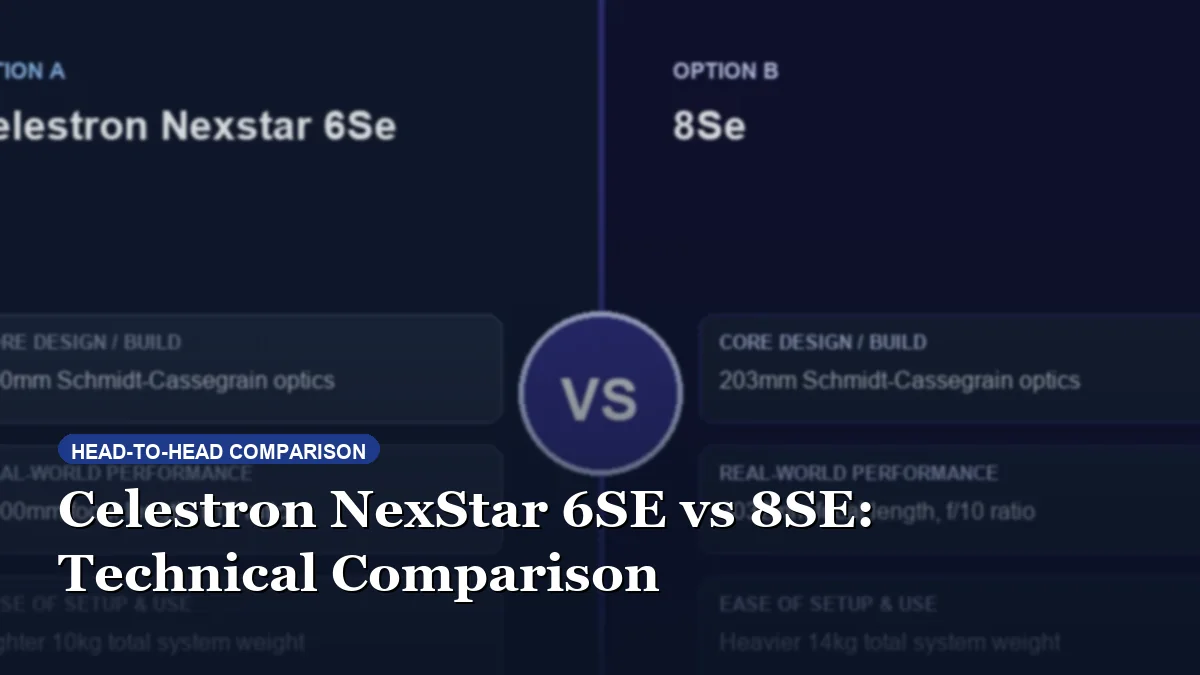
Pick the six-inch model for ultimate portability and faster thermal cooling. Choose the eight-inch OTA for maximum light grasp when resolving faint deep-sky nebulae and tight planetary details.
Compare all top models in our Best Telescope: Top Backyard Picks for Astronomy.
Side-by-Side Breakdown
| Criteria | Celestron Nexstar 6Se | 8Se | Edge |
|---|---|---|---|
| Core Design / Build | 150mm Schmidt-Cassegrain optics | 203mm Schmidt-Cassegrain optics | 8Se |
| Real-World Performance | 1500mm focal length, f/10 ratio | 2032mm focal length, f/10 ratio | 8Se |
| Ease of Setup & Use | Lighter 10kg total system weight | Heavier 14kg total system weight | Celestron Nexstar 6Se |
| Durability & Reliability | Cast aluminum fork arm design | Cast aluminum fork arm design | Tie |
| Efficiency / Operating Footprint | Faster thermal equilibrium time | Larger thermal mass requiring cooling fans | Celestron Nexstar 6Se |
| Maintenance Requirements | Standard corrector plate cleaning | Standard corrector plate cleaning | Tie |
| Best Ideal Use Case | Mobile observers and lunar specialists | Advanced visual observers and astrophotographers | 8Se |
Core Optical Design and Engineering Differences
Both instruments utilize folded catadioptric designs featuring a spherical primary mirror and a corrector plate. This layout folds light paths to maintain compact tube lengths despite long focal distances.
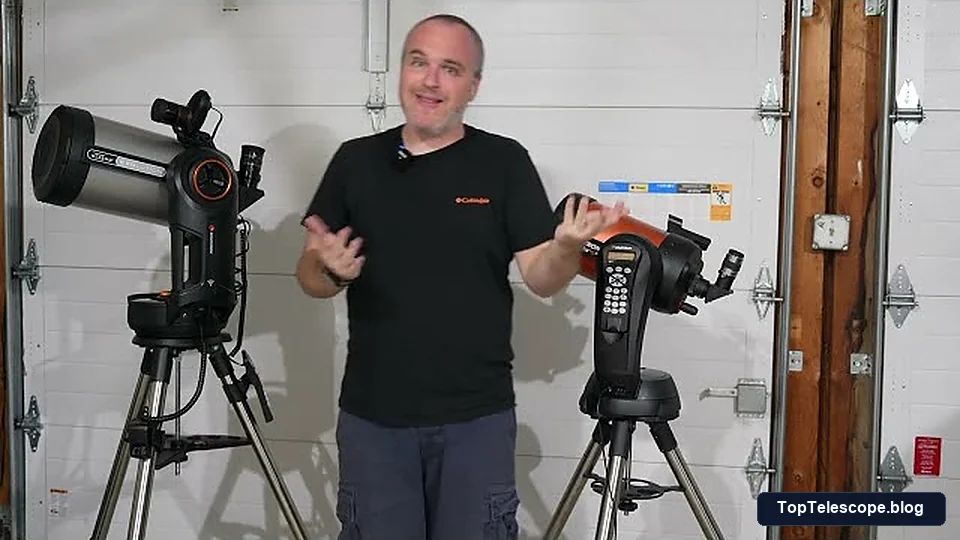
The primary mechanical difference lies in the aperture diameter of the primary mirror. Stepping up from six to eight inches increases total light collection surface area significantly for fainter celestial targets.
The Schmidt-Cassegrain design of both telescopes utilizes a spherical primary mirror paired with a corrector plate. This layout minimizes optical aberrations while maintaining a remarkably compact physical tube length.
Stepping up to the eight-inch aperture increases light collection substantially over the six-inch model. However, thermal equilibrium takes longer, requiring users to manage internal cooling times carefully before observing.
- Aperture scales from 150mm to 203mm.
- Focal length increases from 1500mm to 2032mm.
- Both systems operate at a native focal ratio of f/10.
Optical Coatings and Light Transmission
As detailed in our Celestron Nexstar 8Se review, proprietary StarXceed multi-coatings maximize optical light transmission across the visual spectrum to enhance planetary contrast and deep-sky clarity.
Higher transmission percentages ensure faint stellar photons reach your eyepiece without significant attenuation caused by glass absorption or internal reflection anomalies.
- Proprietary StarXceed multi-layer glass treatments.
- Optimized for high-contrast planetary viewing.
Mechanical Mounting and OTA Weight Distribution
Single-fork arm alt-azimuth mounts support both optical tubes. As noted in our Celestron NexStar 6SE review, aluminum castings provide rigid structural support while keeping the mechanical footprint compact.
Balancing the heavier eight-inch optical tube demands precise dovetail positioning. The six-inch variant offers greater margin for error during field balancing due to its reduced mass.
Single fork arm mounts demand precise balancing to prevent motor strain. The heavier optical tube of the larger model pushes the mechanical tolerances of the drive base much closer to its maximum limit.
Steel tripod legs provide superior rigidity compared to older aluminum variants. Proper vibration dampening pads significantly improve physical stability during high magnification focusing sessions in the field.
- Single-fork arm motorized alt-azimuth mount base.
- Standard Vixen-style dovetail mounting rail integration.
- Internal battery compartment requires eight AA cells.
Tripod Stability and Vibration Damping
Steel tripod legs provide a sturdy foundation for both instruments. However, the increased mass and longer moment arm of the eight-inch tube amplify wind vibrations noticeably.
Adding anti-vibration pads or upgrading to a heavier pier significantly improves settling times when focusing at high magnification during unsteady atmospheric conditions.
- Adjustable steel tubular tripod legs.
- Accessory spreader tray locks legs into rigid alignment.
Real-World Planetary and Lunar Performance
Resolving fine lunar craters requires sharp optical wavefronts. Our Celestron NexStar 8SE review highlights how these instruments deliver crisp high-magnification images of tight double stars and cloud belts.
Atmospheric seeing conditions often limit maximum usable magnification. On exceptional nights, the eight-inch system exploits its superior resolution to reveal intricate details on Jupiter.
Planetary contrast heavily favors the larger aperture when atmospheric seeing conditions permit. Resolving fine Jovian cloud belts requires optimal thermal stabilization and precise collimation of the secondary mirror.
Lunar craters showcase intricate terracing and shadow details under steady skies. Higher magnification limits of the bigger system let advanced observers push resolutions on tiny craterlets successfully.
- Higher light grasp reveals subtle lunar rilles.
- Increased resolving power separates tight binary stars.
- Both accept standard 1.25-inch and 2-inch accessories.
Magnification Limits and Eyepiece Pairing
Theoretical maximum magnification reaches roughly three hundred powers for the smaller unit and four hundred powers for the larger option under ideal atmospheric seeing conditions.
Pairing these scopes with wide-field eyepieces yields comfortable exit pupils for extended viewing sessions without inducing eye strain during marathon observing nights.
- Calculate magnification by dividing focal length by eyepiece focal length.
- Use high-grade plossl or wide-field oculars.
Deep-Sky Imaging and Visual Brightness Trade-offs
Observing distant nebulae and galaxies depends directly on light gathering area. Discussed further within our Celestron NexStar 4SE review, the eight-inch collector gathers significantly more photons.
This extra light brightness makes faint spiral arms and distant globular clusters noticeably more distinct when viewed from dark sky locations away from urban light pollution.
Surface brightness rules visual galaxy observation under dark skies. Collecting more photons means faint deep-sky objects appear more structured through the wider optical window of the eight-inch variant.
Astrophotography demands an optional wedge for long exposures to eliminate field rotation. Long focal lengths require strict guiding tolerances to keep stars sharp across the sensor.
- Seventy-seven percent increase in light grasp.
- Reveals fainter Messier and NGC catalog objects.
Astrophotography Tracking Considerations
Alt-azimuth tracking introduces field rotation during long exposure imaging sessions. Serious astrophotographers mount either optical tube onto an equatorial wedge for deep-sky imaging work.
The compact tube length reduces moment arms, but guiding accuracy remains paramount when shooting faint galaxies at long focal lengths.
- Field rotation occurs during long exposures on alt-az mounts.
- Equatorial wedges required for serious deep-sky imaging.
Power Efficiency, Alignment, and Electronics
Computerized GoTo hand controllers drive internal servo motors via standard SkyAlign technology. Alignment requires centering three bright celestial objects in your eyepiece view.
Power consumption remains moderate, but motorized slewing draws significant current. Using an external regulated power tank prevents erratic slewing behavior caused by voltage drops.
Internal computerized hand controls rely on steady electrical current to maintain tracking accuracy. Using an external lithium power tank prevents erratic motor behaviors caused by voltage drops.
Alignment routines like SkyAlign simplify initial setup for beginners observing outdoors. Mastering this computerized alignment procedure ensures goto accuracy remains dependable throughout your entire viewing session.
- SkyAlign multi-star automated alignment procedure.
- Hand controller with database exceeding forty thousand objects.
- Requires stable twelve-volt external power supply.
Hand Controller Firmware and Updates
Flash-upgradeable hand controllers allow users to download the latest firmware updates directly from the manufacturer website using a standard auxiliary serial cable connection.
Keeping system software current ensures optimal tracking accuracy and prevents minor bugs from interfering with automated celestial object catalog searches.
- Flash memory supports firmware updates.
- Aux port accommodates optional GPS accessories.
Maintenance, Optics Care, and Longevity
Catadioptric systems feature sealed optical tubes that protect internal mirror surfaces from dust and atmospheric moisture accumulation over years of regular outdoor usage.
The exposed outer corrector plate requires occasional cleaning using optical-grade microfiber cloths and specialized fluid to prevent dust buildup from degrading image contrast.
Dust accumulation on corrector plates rarely harms performance significantly during visual sessions. Gentle cleaning with optical microfiber cloths prevents scratching the delicate antireflective coatings over time.
Mechanical gears require periodic inspection to ensure smooth tracking without backlash. Storing components in padded carrying cases protects internal electronics from moisture and physical impacts.
- Sealed optical tube prevents internal dust accumulation.
- Periodic exterior cleaning of corrector glass required.
- Store in climate-controlled environments to prevent mold.
Thermal Acclimation and Cooling Times
Massive glass blanks require time to reach thermal equilibrium with ambient outdoor temperatures before delivering sharp high-magnification planetary views without thermal image distortion.
The larger eight-inch mirror takes significantly longer to cool down compared to the smaller optical tube during rapid temperature drops at night.
- Thermal equilibrium prevents internal air currents.
- Larger mirrors require extended cooling periods.
Which Setup Fits Your Observing Workflow
Selecting the ideal instrument depends heavily on your physical mobility and primary astronomical interests. Transporting heavy gear frequently favors the lighter six-inch configuration.
Conversely, fixed backyard observatories or users prioritizing maximum photon collection will benefit immensely from stepping up to the larger eight-inch optical tube assembly.
Portability often dictates how frequently an amateur astronomer actually brings gear outside. Choosing a lighter optical setup encourages spontaneous stargazing trips rather than staying indoors.
Dedicated backyard astronomers usually prioritize maximum light gathering capability over effortless transport. Evaluating your personal storage space helps determine whether the larger OTA fits your lifestyle.
- Assess your physical strength and transport requirements.
- Balance deep-sky goals against equipment weight limits.
Storage Footprint and Transportability
Both systems break down into manageable components for car transport. The smaller unit fits easily into compact vehicle trunks alongside luggage and camping gear.
Protecting your investment during transit demands padded carrying cases designed specifically for fork-mounted Schmidt-Cassegrain optical assemblies and accessories.
- Compact footprint fits standard vehicle trunks.
- Optional padded cases recommended for safe transit.
Frequently Asked Questions
Can I use standard 2-inch eyepieces with these telescopes?
Yes, both models accept 2-inch visual backs and star diagonals. This allows wide-field viewing without vignetting your image.
How long do internal batteries last during field use?
Internal AA batteries deplete quickly during active GoTo slewing. Using an external 12V power tank ensures reliable all-night operation.
Are these telescopes suitable for serious astrophotography?
They excel at lunar and planetary imaging using high-speed cameras. Deep-sky imaging requires an equatorial wedge to eliminate field rotation.
How frequently should I collimate the optics?
Schmidt-Cassegrain optics hold collimation exceptionally well over time. Check alignment occasionally on a bright star and adjust secondary screws gently.
What is the primary difference in visual brightness?
The eight-inch model gathers roughly seventy-seven percent more light than the smaller version. This extra aperture reveals fainter deep-sky structure.