Celestron NexStar 4SE vs 5SE: Ultimate Optical Duel
Choosing between these two computerized Maksutov-Cassegrain and Schmidt-Cassegrain systems depends heavily on your transport needs and light-gathering requirements.

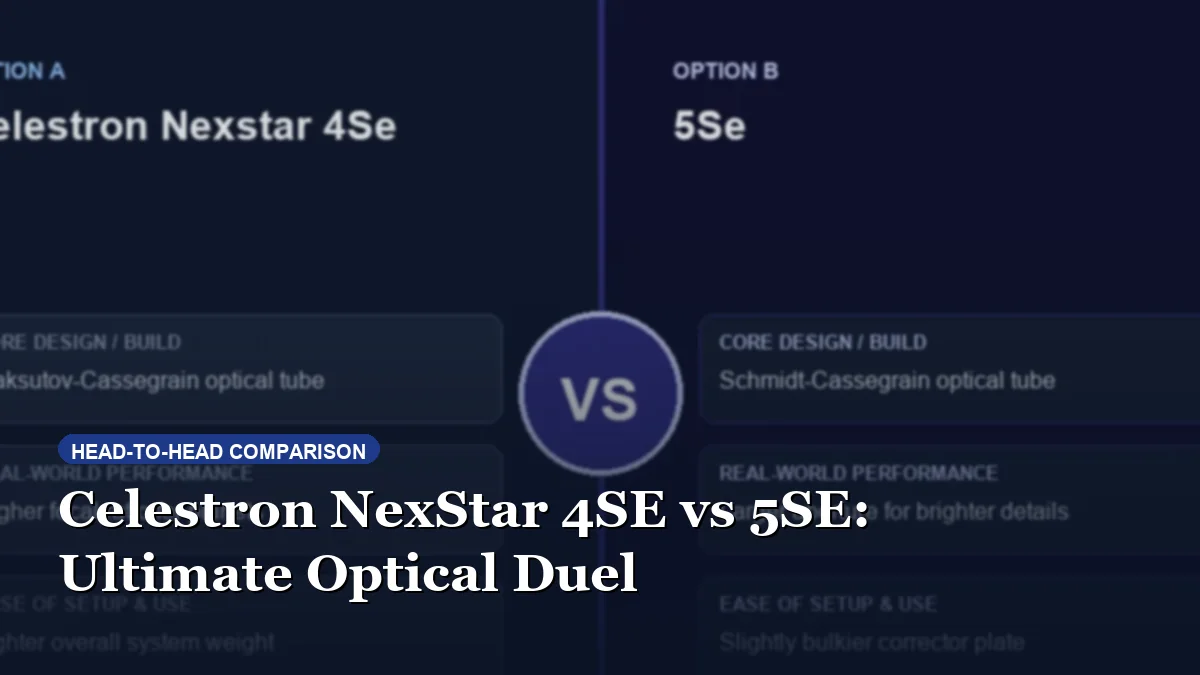
Pick the 4SE for ultimate portability and extended focal reach on lunar targets, or choose the 5SE for superior light grasp and richer deep-sky views.
Compare all top models in our Best Telescope: Top Backyard Picks for Astronomy.
Side-by-Side Breakdown
| Criteria | Celestron Nexstar 4Se | 5Se | Edge |
|---|---|---|---|
| Core Design / Build | Maksutov-Cassegrain optical tube | Schmidt-Cassegrain optical tube | 5Se |
| Real-World Performance | Higher focal ratio for planets | Larger aperture for brighter details | 5Se |
| Ease of Setup & Use | Lighter overall system weight | Slightly bulkier corrector plate | 4Se |
| Durability & Reliability | Cast aluminum fork mount base | Cast aluminum fork mount base | Tie |
| Efficiency / Operating Footprint | Compact tube fits tight spaces | Slightly wider optical assembly footprint | 4Se |
| Maintenance Requirements | Factory-aligned sealed optical tube | Open Schmidt design needs occasional care | 4Se |
| Best Ideal Use Case | Planetary viewing and airline travel | Balanced deep-sky and lunar observing | 5Se |
Optical Architecture and Design Physics
The Celestron NexStar 4SE utilizes a classic Maksutov-Cassegrain optical layout featuring a thick meniscus corrector lens. Our detailed celestron nexstar 4se review covers how this design reduces chromatic aberration significantly across the visual spectrum.
Conversely, the Celestron NexStar 5SE employs a Schmidt-Cassegrain design. It features a thinner corrector plate combined with a spherical primary mirror to balance weight and manufacturing costs.
Both instruments rely on internal baffling to suppress stray light reflections. However, the smaller aperture of the 4SE inherently yields a darker background sky during urban observing sessions.
- Maksutov meniscus corrector suppresses false color
- Schmidt corrector plate balances weight and aperture
- Internal baffles reduce unwanted stray light glare
Focal Length and Magnification Potential
With a focal length of 1325mm, the NexStar 4SE achieves high native magnification easily. This optical characteristic benefits planetary observers seeking detailed planetary disc studies.
The NexStar 5SE provides a 1250mm focal length paired with a larger 125mm aperture. This combination delivers broader bright-field views while maintaining high-resolution imaging capabilities.
- Longer native focal length favors planetary work
- Larger aperture supports higher useful magnification limits
Mount Mechanics and Tracking Precision
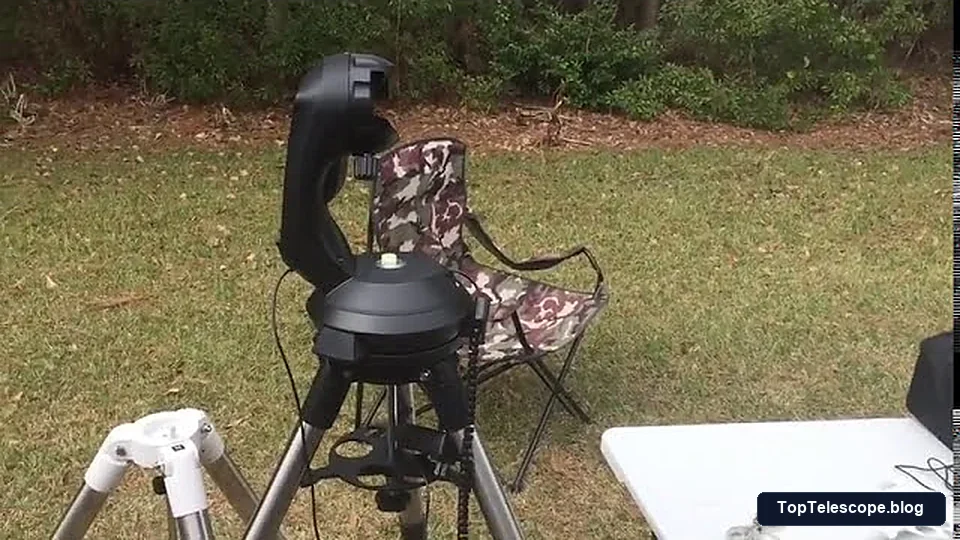
Both telescopes share a robust single-fork arm altazimuth mount design powered by internal DC servo motors. The computerized hand control utilizes SkyAlign technology for rapid field calibration.
Tracking accuracy remains consistent across both platforms when properly leveled. Users must ensure stable power delivery via standard alkaline batteries or an external lithium power tank.
The heavy-duty steel tripod provides a rigid foundation, effectively minimizing dampening times during high-power focusing adjustments and wind gusts in open field environments.
- Single-fork arm altazimuth tracking architecture
- SkyAlign calibration simplifies field setup routines
- Sturdy steel tripod dampens mechanical vibrations
GoTo Computerization and Software Integration
The NexStar hand control database houses over 40,000 celestial objects. Firmware updates can be explored further in our celestron nexstar 8 se review, and are easily managed through standard auxiliary ports located on the fork base.
Advanced astronomers can connect external control software via standard RS-232 communication protocols, enabling seamless laptop or tablet integration for automated astrophotography sessions.
- Extensive internal database with over 40000 targets
- Auxiliary ports support external computer control setups
Ergonomics, Portability, and Field Handling
Field ergonomics heavily favor the NexStar 4SE due to its exceptionally compact optical tube assembly. Our comprehensive celestron nexstar 4se review shows that transporting this equipment to remote dark-sky sites requires minimal storage space.
The NexStar 5SE introduces slightly more bulk and weight, requiring careful handling during the optical tube mounting process. Single-person setup remains entirely manageable for most adult users.
Carrying handles integrated into the mount base simplify transport between indoor storage areas and outdoor viewing locations without risking mechanical alignment shifts or component drops.
- Compact optical tube eases travel packing demands
- Integrated carrying handles improve physical safety
- Manageable component weight supports solo field deployment
Power Management and Battery Efficiency
Internal battery compartments house eight AA cells within the base structure. Cold weather conditions can quickly drain alkaline batteries, making external power sources highly recommended.
Utilizing a dedicated rechargeable power tank prevents erratic GoTo motor behavior caused by voltage drops during prolonged tracking sessions in freezing winter temperatures.
- Internal battery bay holds eight standard cells
- External power tanks prevent cold-weather voltage drops
Optical Performance Under Real Skies
Observing lunar craters and Saturn rings reveals distinct optical characteristics between these two instruments. Our detailed celestron nexstar 8se telescope review shows the NexStar 5SE gathers nearly sixty percent more light than its smaller counterpart.
Deep-sky objects such as globular clusters and bright nebulae appear noticeably brighter through the 5SE. The 4SE compensates with high-contrast planetary performance under turbulent atmospheric seeing conditions.
Collimation stability remains impressive on both systems thanks to factory-locked primary mirrors, ensuring reliable optical performance straight out of the shipping container.
- Larger aperture increases deep-sky surface brightness
- High-contrast optics excel during turbulent seeing nights
- Factory-locked mirrors maintain long-term alignment integrity
Planetary and Lunar Resolution Limits
When targeting Jupiter cloud belts, the 5SE resolves subtle atmospheric storms more readily. The 4SE still delivers crisp planetary edges despite its smaller light-collecting surface area.
Both telescopes accept standard 1.25-inch eyepieces and accessories, allowing users to fine-tune magnification steps using high-grade Plossl or wide-field ocular lenses.
- Superior light grasp resolves subtle planetary storms
- Standard 1.25-inch eyepiece compatibility ensures versatility
Maintenance, Durability, and Care Protocols
Routine maintenance involves keeping optical surfaces free from dust and dew accumulation. Lens cleaning should be performed sparingly using specialized optical microfiber cloths and approved solutions.
The sealed Maksutov tube of the 4SE prevents internal dust contamination effectively. The open Schmidt design of the 5SE requires occasional corrector plate inspection.
Storing the equipment in padded transport cases protects electronic encoders and internal motor gears from moisture damage during humid summer observation nights.
- Sealed optical tube prevents internal dust buildup
- Microfiber cloths protect delicate anti-reflective coatings
- Padded storage cases safeguard sensitive internal electronics
Dew Prevention and Thermal Acclimation
Thermal equilibrium is vital for crisp high-power viewing. Allowing the optical tube to acclimate to ambient outdoor temperatures for thirty minutes prevents internal air currents.
Installing an optional dew shield prevents moisture condensation on the corrector plate during humid autumn evenings, ensuring uninterrupted observation sessions through midnight.
- Thermal acclimation eliminates internal air turbulence
- Dew shields protect corrector plates from moisture buildup
Value Assessment and Buyer Decision Framework
Choosing between these models hinges entirely on your primary observational goals and travel habits. Casual stargazers prioritizing effortless portability will appreciate the compact 4SE platform.
Observers seeking deeper penetration into deep-sky catalogs will find the 5SE worth the slight increase in physical bulk. Both systems offer exceptional automated astronomy entry points.
Evaluating your local light pollution levels helps determine whether the extra light-gathering power of the larger aperture is truly necessary for your backyard viewing sessions.
- Match instrument size to your travel frequency
- Consider local light pollution levels before buying
- Evaluate deep-sky versus planetary viewing priorities
Long-Term Upgrade Path and Accessories
Upgrading standard accessories enhances overall system utility over time. Adding a solar filter allows safe daytime viewing of sunspots during peak solar cycle activity.
Investing in high-quality eyepieces and a focal reducer transforms these computerized scopes into capable entry-level astrophotography rigs for capturing lunar mosaics.
- Solar filters enable safe daytime sunspot viewing
- Focal reducers improve astrophotography exposure times
System Specifications and Physical Footprint
Reviewing physical dimensions ensures your storage space accommodates the assembled mount and tripod. The 4SE breaks down into highly manageable components for trunk storage.
The 5SE requires slightly more clearance in vehicle backseats but remains extremely user-friendly. Reviewing total system weight prevents unexpected fatigue during long loading operations.
Proper balancing of accessories prevents undue strain on the single-arm fork motor clutches, extending the operational lifespan of the internal drive gears significantly.
- Breakdown design fits standard vehicle trunks easily
- Balanced accessory loading protects internal drive gears
- System weight parameters remain entirely solo-friendly
Tripod Stability and Ground Footprint
Steel tripod legs provide rigid support across uneven terrain. Spreading the leg spread to maximum width ensures optimal vibration dampening during focusing operations.
Accessory trays lock the tripod legs firmly into place while providing convenient holding slots for extra eyepieces during active dark-sky observing sessions.
- Steel tripod legs ensure maximum rigidity
- Accessory trays provide convenient ocular storage slots
Frequently Asked Questions
Can both telescopes be used for serious astrophotography?
They excel at lunar and planetary imaging using high-speed cameras. However, their altazimuth mounts cause field rotation during long exposures, limiting deep-sky imaging.
Do I need an external power supply for the GoTo system?
Internal AA batteries drain quickly in cold weather conditions. Using a rechargeable external power tank ensures stable motor voltage throughout the night.
How difficult is the alignment process for beginners?
The built-in SkyAlign technology makes setup extremely straightforward. You simply center any three bright celestial objects to complete the automated alignment calibration routine.
Can I attach standard 1.25-inch eyepieces and filters?
Both optical tubes feature standard visual backs and star diagonals. This allows you to use any standard 1.25-inch accessories without proprietary restrictions.
Which model offers better transportability for air travel?
The NexStar 4SE features a significantly more compact optical tube. This makes it the superior choice for airline carry-on luggage storage.