Celestron EdgeHD 8 vs Meade LX90 8 Technical Comparison
Choosing between these two optical titans requires balancing flat-field astrograph versatility with integrated fork-mount goto convenience for your backyard observatory.

Choose the EdgeHD 8 for superior flat-field imaging and modular mounting flexibility, or select the LX90 8 for an all-inclusive visual tracking system right out of the box.
Compare all top models in our Best Telescope: Top Backyard Picks for Astronomy.
Side-by-Side Breakdown
| Criteria | Celestron Edgehd 8 | Meade Lx90 8 | Edge |
|---|---|---|---|
| Core Design / Build | Aplanatic Schmidt-Cassegrain with built-in corrector lenses. | Classic Schmidt-Cassegrain with UHTC optical coatings. | Celestron Edgehd 8 |
| Real-World Performance | Delivers pinpoint stars across a large imaging sensor format. | Provides high contrast and bright visual deep-sky views. | Celestron Edgehd 8 |
| Ease of Setup & Use | Optical tube assembly requires a separate equatorial mount. | Complete fork mount and tripod system deploys as one unit. | Meade Lx90 8 |
| Durability & Reliability | Anodized aluminum optical tube with internal mirror support locks. | Heavy-duty fork arms with dual-axis DC servo motors. | Meade Lx90 8 |
| Efficiency / Operating Footprint | Compact optical tube allows for flexible mounting configurations. | Fork mount requires substantial clearance and careful balancing. | Celestron Edgehd 8 |
| Maintenance Requirements | Standard collimation procedures with fixed mirror tensioners. | Routine alignment checks and firmware updates for the hand box. | Celestron Edgehd 8 |
| Best Ideal Use Case | Advanced astrophotography and precise long-exposure imaging tasks. | Quick backyard visual astronomy and automated object tracking. | Meade Lx90 8 |
Core Optical Design and Engineering
The optical foundation of any modern telescope dictates its ultimate performance ceiling during complex imaging sessions or casual backyard viewing tasks. Engineers employ distinct optical formulas to tackle inherent physical aberrations.
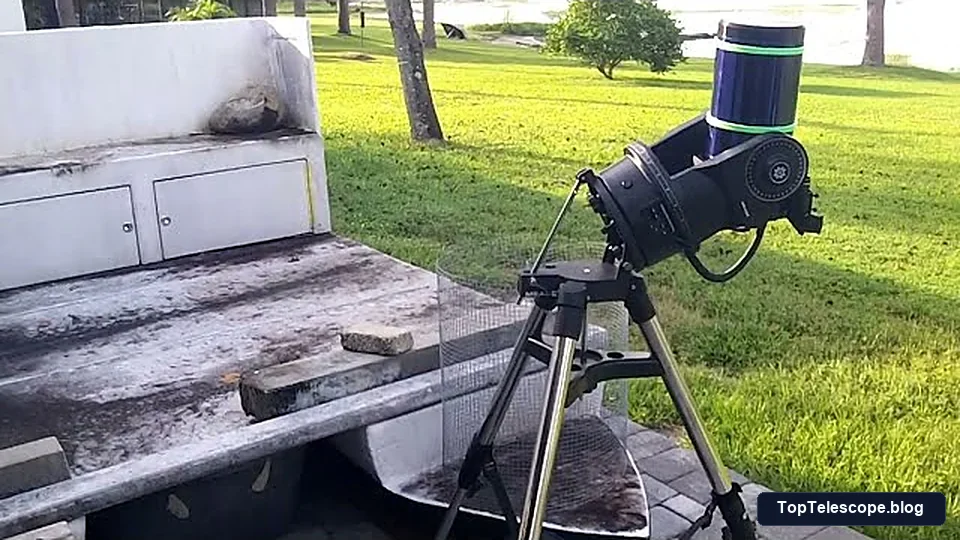
Understanding these foundational design choices helps astronomers match specific equipment configurations to their primary observational goals without encountering unexpected performance bottlenecks during critical imaging runs.
The EdgeHD 8 incorporates built-in field corrector lenses inside the baffle tube, ensuring a flat focal plane that eliminates off-axis star astigmatism across large camera sensors completely.
Our Meade LX90 10 Inch Review notes that this classic Schmidt-Cassegrain design features standard spherical optics, which produces noticeable coma at the edges when paired with modern sensors.
- EdgeHD optical system features corrector lenses inside the baffle tube.
- LX90 optical system utilizes classic Schmidt-Cassegrain geometry with specialized coatings.
- EdgeHD mirror support clutches lock the primary mirror firmly in place.
- Meade Ultra-High Transmission Coatings maximize overall optical light throughput efficiently.
Corrector Plate and Field Flattening
EdgeHD optics integrate field-flattening lens elements directly into the rear baffle assembly. This eliminates off-axis coma and astigmatism across large sensor formats.
Classic designs rely on standard corrector plates, which can introduce slight field curvature at the extreme edges of wide-field camera sensors during long exposures.
- Integrated lens elements ensure pinpoint star images right to corners.
- Standard plates provide great visual flat fields but require corrective flatteners.
Mount Integration and Mechanical Handling
Mount architecture dictates how efficiently an observer transitions from storage to active sky scanning under dark field conditions. Integrated fork systems contrast sharply with modular optical tube assemblies.
Weight distribution and physical footprint play massive roles in determining whether a telescope system remains a permanent backyard fixture or travels frequently to remote dark-sky locations.
Celestron delivers the optical tube assembly independently, allowing users to mount it on robust equatorial systems like the CGEM II for precision long-exposure astrophotography without excessive flexure.
The Meade LX90 integrates permanently into a heavy dual-fork altazimuth base, offering rapid setup convenience for visual observers while severely limiting equatorial tracking capabilities without an optional wedge.
- Fork-mounted systems combine drive bases and optical tubes into one chassis.
- Modular OTAs allow users to select equatorial or alt-azimuth mounts.
- Fork arms add permanent deadweight to field transport routines.
- Vixen-style dovetail bars simplify optical tube swapping procedures.
Fork Mount Versus Equatorial Flexibility
The fork design of the LX90 offers rapid deployment speeds and integrated dual-axis tracking motors. Users simply level the heavy tripod and begin alignment routines.
Conversely, as detailed in our Celestron EdgeHD 8 Review, separating the optical tube from its mount gives advanced imagers the freedom to attach high-capacity equatorial tracking heads.
- Fork arms provide rigid mechanical tracking for visual observers.
- Modular setups let astrophotographers upgrade mounts independently over time.
Real-World Imaging and Visual Performance
Evaluating real-world light gathering requires looking past theoretical specifications into actual optical transmission rates and focal plane behavior under varying atmospheric seeing conditions.
Both instruments feature an eight-inch aperture, yielding identical light-grasp capabilities for faint deep-sky nebulae, globular clusters, and high-resolution planetary surface details.
High-magnification planetary observation reveals exceptionally sharp contrast on the EdgeHD due to its silicon dioxide overcoats protecting the primary aluminum mirror surfaces from rapid atmospheric degradation over time.
Deep-sky imaging with the LX90 demands an external field flattener to achieve pinpoint stars, yet its f/10 focal ratio remains well-suited for capturing smaller planetary nebulae and distant globular clusters.
- Eight-inch apertures capture ample light for deep-sky exploration.
- High-transmission coatings maximize photon delivery to the eyepiece.
- Point-source light concentration tests favor flat-field optical designs.
- Baffling inside both tubes suppresses stray internal reflections effectively.
Astrograph Capabilities and Star Halos
Specialized internal optics in the EdgeHD control chromatic aberration and mirror shift during prolonged imaging sequences. Stars remain crisp and tight across the entire frame.
The LX90 excels brilliantly for visual astronomy and lunar studies, though astrophotographers may notice slight field curvature without adding dedicated external flattener accessories.
- Mirror support clutches prevent image shift during focusing.
- Ultra-High Transmission Coatings enhance overall visual image contrast.
Electronics, Software, and Control Systems
Modern computerized telescopes rely heavily on intuitive hand controllers and robust internal databases to locate thousands of celestial objects within seconds of initialization.
Computerized GoTo systems transform complex star-hopping chores into automated routines, making advanced astronomy accessible to beginners and seasoned researchers alike.
As highlighted in our Celestron NexStar Evolution 8 EdgeHD Technical Review, these systems utilize the NexStar+ hand controller and advanced control software for automated observatory setups.
Meade relies on the AudioStar hand controller featuring built-in Astronomer Inside audio descriptions, which provides beginner-friendly guided tours but lacks the robust native third-party software ecosystem of competitors.
- Hand controllers store databases containing tens of thousands of targets.
- Precision servo motors ensure smooth tracking across celestial coordinate axes.
- USB ports streamline direct laptop computer hardware connections.
- Internal battery compartments prevent messy dangling power cords outdoors.
Tracking Accuracy and Interface Usability
Meade incorporates robust AudioStar technology into the LX90 platform, providing educational audio commentary alongside reliable object location and tracking performance.
Celestron utilizes the well-regarded NexStar software ecosystem, offering streamlined alignment procedures and seamless integration with external planetarium software applications.
- AudioStar handboxes offer educational multimedia features for learners.
- NexStar firmware delivers reliable alignment and broad software compatibility.
Maintenance, Durability, and Longevity
Owning precision optical instruments demands routine care, proper storage protocols, and periodic mechanical checks to ensure optimal performance over many years of service.
Robust construction materials protect delicate internal optical alignments from thermal shocks and minor bumps encountered during transport to dark observing sites.
Optical alignment requires periodic collimation using three accessible screws on the secondary mirror cell, though the fixed mirror design of the EdgeHD maintains alignment significantly better during transport.
Meade fork-mounted assemblies demand careful handling of internal drive gears and electronic circuit boards, requiring routine mechanical servicing to prevent backlash accumulation within the altitude and azimuth worm drives.
- Aluminum housings protect internal optics from ambient moisture.
- Regular collimation checks maintain peak optical performance standards.
- Closed optical tubes protect internal corrector plates from dust accumulation.
- Desiccant plugs help manage interior humidity levels effectively over years.
Collimation Stability and Mirror Locks
Maintaining proper mirror alignment is critical for high-magnification planetary viewing. The EdgeHD features mirror support locks that keep the primary element fixed securely in place.
The classic design requires standard secondary mirror adjustments over time, though sturdy mechanical construction ensures reasonable alignment stability under normal usage.
- Internal mirror locks prevent unwanted sagging during imaging.
- Accessible collimation screws simplify routine optical alignment tasks.
Ergonomics, Transport, and Setup Footprint
Physical dimensions and component weight directly influence how frequently an astronomer takes their equipment outdoors for unexpected clear nights.
Balancing ergonomic grip points with secure locking mechanisms prevents accidental drops and physical strain during nighttime assembly procedures.
Splitting the optical tube from a modular mount reduces single-component lifting weight, making the EdgeHD setup much safer for solo backyard astronomers handling heavy equipment in the dark.
The integrated fork and tube assembly of the LX90 creates an awkward, heavy lift requiring two people to safely maneuver onto heavy-duty field tripod legs without damaging connectors.
- Carrying handles assist with safe optical tube transportation.
- Adjustable tripod legs compensate for uneven ground surfaces.
- Carrying handles built into fork bases improve grip safety significantly.
- Balanced counterweight systems prevent sudden rotational slip incidents during adjustments.
Weight Distribution and Lifting Mechanics
Lifting an integrated fork mount and tripod combination requires careful technique due to the combined weight centered in the fork base.
Modular setups distribute weight more evenly, allowing users to transport optical tubes separately from heavy equatorial mounts and counterweights.
- Separate components reduce lifting strain during field assembly.
- Integrated forks simplify single-piece storage in home closets.
Which Telescope Fits Your Specific Setup
Selecting the ideal telescope depends heavily on your primary observational interests, mechanical preferences, and long-term upgrade aspirations within the hobby.
Assessing your local light pollution levels and storage space helps finalize whether a modular astrograph or integrated fork system serves you best.
Our Celestron Advanced VX 8 EdgeHD Review details why this modular optical system excels at deep-sky astrophotography and wide-field sensor compatibility for evolving imagers.
Select the Meade LX90 if you prioritize rapid visual astronomy sessions, integrated fork stability, and a self-contained GoTo system that minimizes assembly steps under dark sky conditions.
- Match instrument capabilities directly to your primary astronomical interests.
- Consider future equipment upgrades before purchasing a complete system.
- Modular systems scale easily into advanced astrophotography imaging rigs.
- Fork mounts excel during fast public visual outreach events.
Final Decision Matrix for Astronomers
Choose the EdgeHD if your primary passion involves deep-sky astrophotography, modular mount flexibility, and pristine flat-field camera performance.
Opt for the LX90 if you prioritize rapid visual deployment, all-inclusive fork tracking, and an intuitive GoTo database right out of the box.
- EdgeHD systems reward dedicated astrophotographers and imagers.
- LX90 platforms delight visual observers seeking fast setup.
Frequently Asked Questions
Can I use standard eyepieces with both telescopes?
Yes, both instruments accept standard 1.25-inch and 2-inch accessories. They utilize standard visual backs for maximum compatibility.
Do these telescopes require regular optical collimation?
Both designs require occasional secondary mirror alignment checks. Using internal mirror locks helps maintain alignment during transit.
Are these systems suitable for beginners in astronomy?
Both models offer computerized GoTo systems that assist newcomers. The automated database simplifies finding celestial targets quickly.
Can I perform astrophotography with the Meade LX90?
Yes, it tracks well for short exposures on an alt-azimuth base. Adding a wedge accessory enables long-exposure deep-sky imaging.
How heavy are these telescope systems to transport?
Total weights range around fifty pounds depending on configuration. Using padded transport bags makes field deployment much easier.