Celestron Edge HD 8 vs 8SE Technical Comparison
Choosing between these two optical tubes involves balancing flat-field astrophotography precision against lightweight visual portability. Understanding your specific observing goals determines the ideal setup.

Pick the Edge HD 8 for advanced flat-field imaging and permanent observatories. Choose the 8SE for grab-and-go visual astronomy and automated tracking simplicity.
Compare all top models in our Best Telescope: Top Backyard Picks for Astronomy.
Side-by-Side Breakdown
| Criteria | Celestron Edge Hd 8 | 8Se | Edge |
|---|---|---|---|
| Core Design / Build | Flat-field Schmidt-Cassegrain | Standard Schmidt-Cassegrain | Edge HD 8 |
| Real-World Performance | Apochromatic star points across sensors | Sharp center with edge coma | Edge HD 8 |
| Ease of Setup & Use | Requires separate heavy equatorial mount | Integrated fork arm single-unit design | 8Se |
| Durability & Reliability | Heavy-duty machined aluminum housing | Composite fork and aluminum tube | Edge HD 8 |
| Efficiency / Operating Footprint | Requires substantial counterweights and power | Compact single-arm alt-az layout | 8Se |
| Maintenance Requirements | Mirror locks maintain focus stability | Standard collimation knobs need checks | Edge HD 8 |
| Best Ideal Use Case | Deep-sky imaging with large sensors | Quick visual sessions and outreach | Tie (depends on goal) |
Core Design and Engineering Differences
Evaluating the optical architecture reveals fundamental differences in how light travels to your eyepiece. Both feature an 8-inch aperture, but internal corrector lenses alter performance significantly.
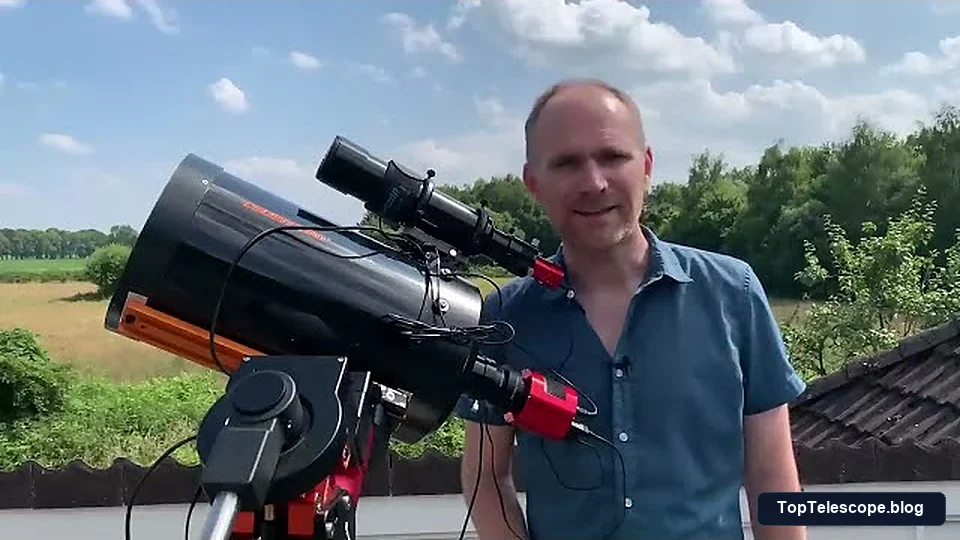
The standard optical tube relies on a classic Schmidt design. Meanwhile, our celestron c8 edge hd review details how the advanced flat-field version integrates corrector optics inside the baffle tube to eliminate off-axis aberrations completely.
Engineering standards dictate strict tolerances for optical alignment and mechanical stability during operation.
The EdgeHD optical tube features a proprietary flat-field system utilizing built-in corrector lenses located near the rear baffle, effectively eliminating off-axis coma and field curvature across large imaging sensors.
Conversely, as detailed in our comprehensive nexstar 8se review, the standard Schmidt-Cassegrain design utilizes a spherical primary mirror without corrective elements, causing noticeable star distortion toward the edges of modern frames.
Mechanical construction also differs significantly, as the EdgeHD incorporates mirror locks to prevent image shift during focusing, whereas the 8SE relies on a traditional primary mirror clutch system common in portable catadioptric assemblies.
- Aperture: 203mm for both optical tubes.
- Focal Length: 2032mm focal length standard.
- Corrector Lens: Built-in field flatteners on Edge HD.
Optical Formulas and Mirror Systems
Mirror shift plagues many classical designs during focus adjustments. Celestron integrated mirror support locks in the advanced model to hold primary optics securely during long exposures.
Standard versions lack these mechanical locks, requiring careful tension adjustments. Both systems maintain identical focal ratios, yet the optical purity varies noticeably near frame edges.
- Mirror Locks: Present on Edge HD.
- Focus Shift: Minimized via internal clutches.
OTA Construction and Weight Metrics
Physical handling depends heavily on overall tube weight and balance. The advanced flat-field optical tube weighs roughly fourteen pounds, demanding robust mounting hardware for stability.
Standard versions weigh slightly less due to missing internal lens elements. Transporting these instruments requires sturdy padded cases to protect delicate corrector plates from impact damage.
- Tube Weight: 14 lbs versus 12.5 lbs.
- Aluminum Construction: Standard across both housings.
Real-World Performance Comparison
Testing optical performance under dark skies exposes distinct advantages for specialized imaging. Pinpoint stars across large sensor formats require the specialized corrector lenses found in advanced configurations.
Visual observers looking at planetary details will notice exceptional contrast in both instruments. Atmospheric seeing conditions often limit resolution before optical design imperfections become visible to human eyes.
When evaluating lunar and planetary resolution under steady seeing conditions, both optical systems deliver identical focal lengths of 2032mm, though the EdgeHD maintains superior contrast due to its advanced internal baffling and antireflective coatings.
Deep-sky astrophotography heavily favors the EdgeHD because its specialized optical configuration yields pin-point stars across a standard 32mm image circle, bypassing the off-axis aberrations inherently present in uncorrected Schmidt-Cassegrain optical tube assemblies.
- Field Curvature: Corrected on Edge HD.
- Central Obstruction: Approximately 34 percent.
Planetary Resolution and Contrast
High-magnification views of Jupiter and Saturn demand pristine optical alignment and thermal equilibrium. Both telescopes deliver stunning planetary contrast when allowed to acclimate to ambient temperatures fully.
Cooling vents on the advanced model accelerate thermal stabilization significantly. Standard tubes lack these filtered vents, extending the waiting period before achieving optimal high-power resolution.
- Cooling Vents: Integrated on Edge HD.
- Thermal Acclimation: Faster with filtered fans.
Deep-Sky Astrophotography Footprint
Astrophotography exposes every optical aberration across modern large-format sensors. As evaluated in our celestron 11 edge hd review, this advanced flat-field tube projects a flat image plane, eliminating distorted star shapes.
Standard optical tubes exhibit noticeable field curvature and coma with APS-C sensors. Correcting this requires purchasing dedicated focal reducers and field flatteners separately for imaging work.
- Sensor Coverage: Full-frame compatible on Edge HD.
- Coma Correction: Built into the optical train.
Mounting Systems and Stability Profiles
Selecting an appropriate mount dictates overall system rigidity during extended viewing sessions. Optical tubes require rock-solid foundations to eliminate frustrating image vibrations caused by wind or touch.
Fork-mounted systems integrate the optical tube into a single pre-assembled unit. This design prioritizes rapid setup convenience over the heavy payload capacity required for equatorial tracking.
The 8SE arrives bundled with a single-fork altazimuth mount featuring aluminum legs, which provides adequate stability for visual observation but introduces dampening times exceeding three seconds when focusing manually at high magnifications.
In contrast, the optical tube of the EdgeHD requires a sturdy German equatorial mount like the CGEM II or CGX, ensuring robust tracking accuracy and eliminating field rotation during long-exposure astrophotography sessions.
- Fork Integration: Standard on the 8SE.
- Dovetail Bar: CGE style on Edge HD.
Alt-Az Fork vs Equatorial Mounts
Alt-azimuth mounts rotate in horizontal and vertical axes for intuitive tracking. Long exposure astrophotography on these mounts suffers from field rotation, necessitating an equatorial wedge for imaging.
Equatorial mounts track the night sky along Earth axis smoothly. Pairing the heavy flat-field tube with a German equatorial mount guarantees stability for multi-hour deep-sky exposures.
- Alt-Az Tracking: Suitable for visual use.
- EQ Tracking: Essential for long exposures.
Tracking Accuracy and Alignment
Computerized hand controllers simplify celestial alignment using multi-star calibration routines. StarSense technology automates this alignment process quickly, saving valuable observing time under dark skies.
Motor drives require reliable external power to maintain accurate sidereal tracking rates. Low battery voltage causes erratic slewing behavior and tracking errors during critical imaging sequences.
- Alignment Routines: SkyAlign software built-in.
- Tracking Rate: Sidereal, lunar, and solar.
Ease of Setup and Field Portability
Field ergonomics dictate how often you actually take your equipment outside. Heavy, complex multi-piece setups often remain indoors due to the sheer physical effort required for transport.
Similar to the findings in our astromaster 130 review, the single-arm fork system breaks down into manageable components for quick backyard deployment, making it an ideal grab-and-go telescope choice.
Field deployment for the 8SE remains remarkably straightforward, boasting an integrated quick-release base and a total system weight under thirty pounds that allows single-person transport to dark-sky locations without excessive physical strain.
Transporting the EdgeHD setup demands considerably more effort, as separating the heavy optical tube from the counterweighted equatorial mount requires careful assembly and polar alignment procedures that extend your total pre-observation preparation window.
- Setup Time: Under ten minutes for fork.
- Component Count: Fewer pieces simplify transport.
Assembly Ergonomics and Cabling
Managing power cords and camera cables prevents snagging during automated GoTo slews. Careful cable routing protects delicate ports from mechanical strain during meridian flips and tracking.
Advanced imaging setups involve numerous USB wires, filter wheels, and autoguider cables. Organizing these connections requires dedicated cable management solutions to ensure smooth operational reliability.
- Cable Management: Requires careful routing.
- Port Protection: Prevents accidental disconnects.
Power Management and Field Battery Life
Computerized mounts draw continuous electrical current to drive internal servo motors. Utilizing a reliable lithium power tank ensures uninterrupted operation throughout entire night-sky observation sessions.
Standard alkaline batteries deplete quickly in cold weather conditions. Field astronomers must invest in rechargeable power supplies to maintain steady voltage levels during winter observing nights.
- Power Draw: 12V DC standard requirement.
- Battery Type: Lithium-ion packs recommended.
Maintenance, Efficiency and Longevity
Long-term equipment ownership demands regular inspection and basic mechanical maintenance. Protecting delicate optical surfaces from dew and dust preserves high-contrast views over many years of use.
Storing optical tubes in temperature-controlled environments prevents internal moisture condensation. Proper storage habits protect mirror coatings and mechanical gears from premature wear and corrosion.
Both optical tubes require periodic collimation checks of the secondary mirror, though the fixed corrector plate assembly on the EdgeHD demands extra care to protect the internal corrector lenses from dust and moisture intrusion.
Thermal equilibrium presents another operational factor, making active cooling fans or passive cool-down periods essential for the massive glass thickness of the primary mirror, ensuring optimal wavefront accuracy throughout rapidly changing ambient temperature drops.
- Storage Climate: Dry indoor environment.
- Dew Prevention: Dew shields recommended.
Mirror Shift and Collimation Stability
Transporting optical tubes inevitably subjects internal components to mechanical vibrations. Routine collimation checks ensure optical axes remain perfectly aligned for maximum image sharpness at high magnification.
Secondary mirror adjustment screws require gentle handling with proper hex tools. Making micro-adjustments while viewing an artificial star pattern yields precise optical alignment every single time.
- Collimation: Secondary mirror adjustment.
- Optical Alignment: Verified via star test.
Cleaning Protocols and Dust Mitigation
Dust accumulation on corrector plates rarely impacts visual performance significantly. Aggressive cleaning attempts risk scratching delicate anti-reflective coatings, so gentle compressed air is preferred.
Professional optical cleaning solutions should only be applied when heavy residue obscures light transmission. Always follow manufacturer guidelines carefully to maintain pristine optical surface integrity.
- Corrector Cleaning: Minimalist approach advised.
- Dust Protection: Dust covers essential.
Which Option Fits Your Setup
Choosing between these systems depends entirely on your primary astronomical pursuits. Visual astronomers prioritize rapid setup simplicity, while dedicated imagers demand flawless flat-field optical correction.
Investing in a modular optical tube allows future upgrades to advanced equatorial mounts. Carefully evaluating your current experience level ensures long-term satisfaction with your telescope investment.
Selecting the right instrument depends primarily on your observational goals, making the 8SE an ideal choice for dedicated visual astronomers seeking a grab-and-go package with automated GoTo tracking capabilities for planetary and lunar viewing.
Serious astrophotographers should invest in the EdgeHD configuration to secure uncompromising optical flatness, long-term mechanical stability, and seamless integration with autoguiding equipment necessary for deep-sky imaging success over multi-hour exposures.
- User Experience: Beginner to advanced.
- Upgrade Path: Modular components preferred.
Visual Observers vs Imagers
Casual stargazers appreciate the intuitive interface of fork-mounted computerized systems. Deep-sky astrophotographers require heavy equatorial tracking platforms to capture faint nebulae with long focal lengths.
Balancing weight capacity and optical performance prevents buyer remorse down the road. Select the instrument that matches your willingness to transport and assemble complex heavy gear.
- Visual Priority: Ease of use.
- Imaging Priority: Optical flatness.
Final Purchasing Criteria
Review physical weight limitations, transport vehicle capacity, and local light pollution levels before purchasing. Matching telescope capabilities to your lifestyle guarantees frequent usage and maximum enjoyment.
Quality optical instruments provide decades of reliable service when maintained properly. Take time to assess your personal astronomical goals thoroughly before selecting your ideal telescope setup.
- Lifestyle Match: Consider portability limits.
- Long-Term Value: High durability standards.
Frequently Asked Questions
Can I use the Edge HD 8 on a standard alt-azimuth mount?
Yes, you can mount the optical tube on compatible alt-azimuth bases using a standard dovetail bar. This configuration works wonderfully for quick visual astronomy sessions.
Does the 8SE require a wedge for astrophotography?
Long exposure deep-sky imaging on an alt-azimuth fork mount suffers from field rotation. Adding an equatorial wedge allows for longer tracking exposures without trailing stars.
How often should I check the collimation on these telescopes?
Collimation should be checked whenever the telescope experiences rough transport or temperature shifts. Regular star testing ensures your optics deliver maximum contrast and sharpness.
What is the main difference in corrector optics?
The advanced model features internal corrector lenses built into the baffle tube. This design eliminates field curvature across large camera sensors completely.
Are these telescopes difficult for beginners to operate?
Computerized GoTo systems feature intuitive hand controllers that simplify celestial object location. Beginners can master alignment routines quickly with minimal prior experience.