Celestron CPC 800 vs NexStar 8SE: Technical Comparison
Choosing between these two Schmidt-Cassegrain titans requires weighing fork-mount stability against cantilever portability. Both offer identical optical apertures, but their mechanical foundations diverge sharply.

Choose the CPC 800 if you prioritize rock-solid tracking stability and heavy-duty field endurance. Select the NexStar 8SE if single-person transport and rapid backyard assembly matter most.
Compare all top models in our Best Telescope: Top Backyard Picks for Astronomy.
Side-by-Side Breakdown
| Criteria | Celestron CPC 800 | NexStar 8SE | Edge |
|---|---|---|---|
| Core Design / Build | Heavy dual-fork mount integrated directly with the optical tube. | Modular single-arm cantilever holding a removable optical tube. | CPC 800 |
| Real-World Performance | Exceptional vibration damping during high-magnification planetary viewing. | Moderate vibration damping requiring steady ground surfaces. | CPC 800 |
| Ease of Setup & Use | Bulky assembly requiring two-person lifting for safe placement. | Lightweight modular setup easily managed by a single operator. | NexStar 8SE |
| Durability & Reliability | Die-cast aluminum base built for demanding observatory environments. | Composite materials with internal plastic gear housings. | CPC 800 |
| Efficiency / Operating Footprint | Large footprint requiring wide tripod leg spread. | Compact footprint fitting easily on narrow balconies. | NexStar 8SE |
| Maintenance Requirements | Periodic internal gear backlash adjustment and heavy lifting care. | Routine battery maintenance and careful clutch management. | NexStar 8SE |
| Best Ideal Use Case | Permanent backyard observatory or semi-permanent setup. | Mobile backyard astronomy and travel-friendly stargazing. | Split |
Architectural Evolution and Optical Design Heritage
Both instruments utilize a Schmidt-Cassegrain optical system featuring an identical eight-inch aperture and focal length. This proven configuration folds light efficiently inside a compact aluminum tube assembly.
Building upon the optical principles detailed in our Celestron NexStar 4SE review, Celestron applies proprietary StarBright XLT coatings across all glass surfaces to maximize light transmission and boost deep-sky contrast.
Primary mirror shifting remains a common characteristic of both systems during fine focusing adjustments. Users must account for this mechanical play when centering faint deep-sky objects at high focal magnifications.
The optical lineage of these Schmidt-Cassegrain systems traces back decades, refining folded light paths to maximize focal length within compact aluminum tubes while maintaining strict factory aperture tolerances.
Celestron applies proprietary StarXBright XLT coatings across all corrector plate and primary mirror surfaces, significantly boosting light transmission efficiency and reducing internal scatter during high-contrast planetary observations.
While both optical tubes share identical 203mm apertures and 2032mm focal ratios, their structural integration into different mount architectures dictates their long-term mechanical stability and field deployment characteristics.
- Identical 2032mm focal length delivering consistent focal ratios
- Proprietary StarBright XLT optical coatings on corrector plates
- Internal baffling designed to suppress off-axis stray light
Corrector Plate Physics
The front Schmidt corrector plate removes spherical aberration inherent in spherical primary mirrors. Maintaining clean corrector surfaces is vital for preserving optimal wavefront interference patterns.
Thermal acclimatization requires up to an hour for both closed tubes to reach ambient outdoor temperatures. Rapid temperature drops can induce internal air currents that temporarily degrade high-power planetary resolution.
- Hand-figured optical correction plates matched to primary mirrors
- Closed-tube design protecting optics from dust and moisture
Mechanical Mounting Systems and Stability Engineering
The dual-fork mounting architecture of the CPC 800 provides superior load distribution compared to cantilever designs. Heavy-duty castings eliminate flexing moments along the altitude axis during extended tracking sessions.
Conversely, our Celestron NexStar 8SE review details how its single-arm fork design prioritizes rapid field teardown, though this single attachment point concentrates mechanical stress, requiring careful balancing.
Tripod rigidity dictates overall operational stability under windy field conditions. The robust steel-legged tripod of the CPC series absorbs wind gusts much better than standard aluminum legs.
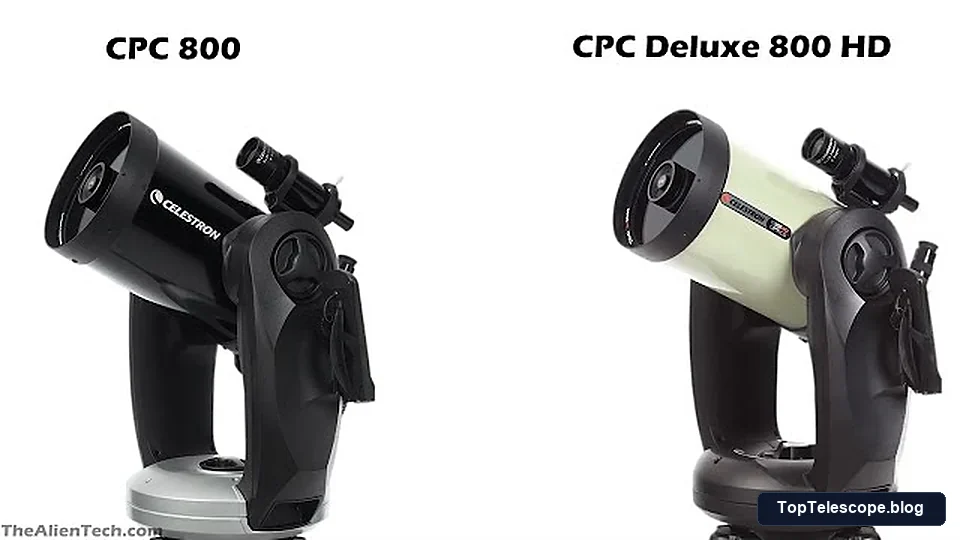
As noted in our Celestron CPC 800 XLT review, the system utilizes a heavy-duty dual-fork arm casting integrated directly into a wide stance metal base, effectively dampening wind vibrations.
Conversely, the NexStar 8SE relies on a single-arm cantilever design attached to a lighter steel tripod, prioritizing rapid setup speed over the absolute rigidity required for long-exposure astrophotography.
Engineers design the fork base to house internal azimuth drive gears, whereas the single-arm variant exposes its drive housing, making the CPC architecture inherently more resistant to external mechanical impacts.
- Dual-fork altitude-azimuth casting versus single-arm cantilever design
- Heavy-duty 2-inch steel tripod legs on the heavier model
- Standard 1.5-inch steel legs provided with the modular unit
Vibration Damping Characteristics
Focusing adjustments on the CPC 800 settle within two seconds due to massive base mass. The NexStar 8SE typically requires slightly longer damping times after manual touch inputs.
Adding heavy electronic focusers or large eyepieces shifts the center of gravity considerably. Operators must verify balance offsets to prevent excessive wear on internal drive gears.
- Mass distribution influencing physical damping decay rates
- Clutch tension adjustments required for heavy accessory loads
Ergonomic Handling, Field Portability, and Assembly Footprint
Field transport demands a realistic assessment of physical lifting capacity and storage space. The CPC 800 weighs roughly seventy pounds assembled, making single-person transport an awkward logistical challenge.
The NexStar 8SE separates easily into a lightweight optical tube and manageable base unit. This modularity allows astronomers to transport the complete system in compact compact car trunks.
Carrying handles integrated directly into the heavy fork base provide secure grip points. However, the sheer bulk requires careful maneuvering through standard residential doorways and tight spaces.
Field transportability remains a major differentiator, as the integrated CPC 800 weighs roughly 42 pounds combined, requiring deliberate lifting techniques and secure grip handles during solo field deployments.
The NexStar 8SE breaks down into modular components, with the optical tube weighing a manageable 14 pounds and the steel tripod collapsing compactly for easy car trunk storage.
Observers must evaluate their physical strength against total assembly weight, since hauling a heavy integrated fork mount demands significantly more stamina than assembling a lightweight cantilever system.
- Integrated base handles versus standard tube dovetail mounting
- Total assembled weight differences exceeding twenty-five pounds
- Modular breakdown simplifying vehicle loading procedures
Balancing and Weight Distribution
Proper balancing reduces current draw on internal DC servo motors during tracking operations. Counterweight rails can be added to correct heavy camera payloads mounted at the rear cell.
Field ergonomics also involve reaching eyepiece viewing angles during zenith observations. Using a diagonal extender prevents uncomfortable neck strains during high-altitude celestial tracking.
- Dovetail rail adjustments for balancing camera payloads
- Ergonomic eyepiece positioning during high-altitude viewing
Alignment Software, Tracking Precision, and GoTo Automation
As outlined in our Celestron NexStar 8SE review, both telescopes utilize intuitive hand controls featuring proprietary SkyAlign technology, letting users center three bright celestial objects to establish coordinate models.
Internal tracking accuracy relies on high-precision worm gears driven by low-backlash DC motors. The heavier base of the CPC system provides smoother sidereal tracking for long-exposure imaging.
Database contents include over forty thousand celestial objects accessible via the computerized handset. Firmware updates can be downloaded easily through standard serial or USB connection ports.
Both telescopes incorporate Celestron’s intuitive SkyAlign technology, enabling users to center any three bright celestial objects to establish precise pointing models without requiring prior constellation knowledge.
Tracking accuracy on the dual-fork CPC platform benefits from permanent programmable periodic error correction, which minimizes worm gear tracking errors during extended imaging sessions under dark skies.
The single-arm 8SE hand controller utilizes identical firmware databases containing over 40,000 celestial objects, though its mechanical drive gears lack PEC capabilities found on the heavier fork model.
- SkyAlign multi-star alignment routine standard across platforms
- 40,000+ object database with extensive user-defined targets
- Programmable periodic error correction on advanced drives
GPS Integration and Automated Timekeeping
An internal GPS receiver on the CPC model automatically acquires exact time, date, and location data. This eliminates manual data entry errors during hurried field setups under dark skies.
The lighter alternative requires manual entry of geographic coordinates unless paired with an optional accessory GPS module. Accurate time input remains critical for successful GoTo alignment precision.
- Internal multi-channel GPS receiver for instant initialization
- Manual location entry requirements on the modular setup
Optical Performance, Collimation Stability, and Planetary Resolution
Aperture light-gathering power remains equal between both units, delivering stunning views of lunar craters. Resolution limits allow clear splitting of tight double stars under steady atmospheric conditions.
Collimation alignment must be checked periodically using secondary mirror adjustment screws. The rigid structural housing of the CPC maintains alignment longer across bumpy transport routes.
Contrast levels on Jupiter's cloud belts benefit from high-quality optical baffling systems. Stray internal reflections are effectively trapped before reaching the focal plane assembly.
Maintaining accurate primary mirror alignment is crucial, and both systems feature movable primary mirrors focused via an internal knob that can occasionally introduce slight image shift during adjustments.
High-magnification planetary viewing reveals sharp Cassini division details and Jovian cloud belts when thermal equilibrium is reached, provided the optical tube has acclimatized to ambient outdoor temperatures thoroughly.
Collimation retention favors the rigidly mounted CPC optical tube assembly, whereas the NexStar 8SE may require more frequent secondary mirror adjustments after being transported across rough terrain.
- Equal 8-inch light grasp resolving deep-sky galaxies
- Secondary mirror alignment screws for user collimation
- Internal knife-edge baffling suppressing stray light
High-Magnification Planetary Viewing
Observing planetary details demands stable air currents and precise optical thermal equilibrium. High magnification eyepieces reveal delicate planetary features when atmospheric seeing permits.
Image brightness remains optimal for globular clusters and planetary nebulae alike. Filters can be threaded easily onto standard 1.25-inch or 2-inch eyepieces for enhanced nebula contrast.
- Optimal performance thresholds with planetary eyepieces
- Filter compatibility for emission nebula contrast enhancement
Power Management, Cable Routing, and Auxiliary Accessory Integration
Computerized GoTo systems demand reliable external power sources to prevent erratic tracking behavior. Internal battery compartments require frequent cell replacement during cold winter observation nights.
External power tanks delivering twelve volts prevent voltage drops that cause hand controller lockups. Proper cable management prevents snagging during full three-hundred-sixty-degree rotation sweeps.
Auxiliary ports support autoguiders, focal reducers, and computerized focus motors seamlessly. Users should monitor total electrical current draw when operating multiple heavy accessories simultaneously.
Powering these computerized mounts requires stable external sources, as internal eight AA batteries drain rapidly and fail to deliver the steady amperage needed for reliable motor operation.
The CPC chassis includes convenient integrated carrying handles and internal cable pathways that prevent snagging, whereas the single-arm 8SE exposes external power cords that demand careful routing management.
Adding heavy accessories like off-axis guiders or dew heaters strains the cantilever payload limits of the 8SE, while the robust fork mount handles substantial auxiliary equipment without axis imbalance.
- 12V DC power requirements using external tank batteries
- Auxiliary accessory ports for autoguiders and focusers
- Cable wrap prevention during automated GoTo slewing
Power Supply Safety Standards
Using regulated power supplies protects sensitive internal circuit boards from damaging voltage surges. Fused DC power cables safeguard equipment against accidental reverse polarity connections.
Cold weather conditions drastically reduce standard battery capacities during long viewing sessions. Insulated battery pouches help maintain optimal chemical operating temperatures in freezing environments.
- Voltage regulation requirements for sensitive electronics
- Cold weather battery performance mitigation strategies
Long-Term Maintenance, Gear Wear, and Maintenance Protocols
Mechanical longevity depends heavily on routine cleaning and proper environmental storage practices. Dust covers should always be secured immediately after removing optical tube assemblies outdoors.
Gear grease on internal worm drives may require professional servicing after years of heavy use. Keeping mechanical assemblies free from moisture prevents premature oxidation of metal parts.
Optical cleaning must be performed sparingly using professional micro-fiber cloths and approved solutions. Excessive wiping can damage delicate anti-reflective coatings on the corrector plate surface.
Routine maintenance involves cleaning corrector plate glass using optical microfiber cloths and approved alcohol-free solutions, avoiding aggressive rubbing that could damage anti-reflective coatings over time.
Mechanical gear assemblies require periodic inspection for backlash, and nylon drive gears may eventually need professional regreasing if slewing noises increase during cold weather astronomical observing sessions.
Storing optical tubes in temperature-controlled environments prevents internal dust accumulation and moisture condensation, ensuring that corrector plates remain clear and optical performance stays optimized for decades.
- Routine dust cover protocols for optical protection
- Periodic lubrication checks for internal drive gears
- Safe optical cleaning guidelines using approved solvents
Storage and Environmental Protection
Storing optical tubes in climate-controlled environments prevents internal mold growth on glass surfaces. Silica gel packs placed inside storage cases absorb residual moisture effectively.
Transporting equipment in padded hard cases shields delicate electronic components from shock damage. Regular inspection of tripod fasteners ensures structural safety during field setups.
- Climate-controlled storage preventing optical mold growth
- Padded transport cases protecting internal electronics
Frequently Asked Questions
Can both telescopes use the same eyepieces and accessories?
Yes, both models feature standard visual backs accepting identical 1.25-inch and 2-inch eyepieces. This allows seamless sharing of optical accessories across both platforms.
Which model is easier to transport for a single person?
The NexStar 8SE is significantly easier to transport due to its lightweight modular design. The heavier fork assembly of the CPC requires considerably more lifting strength.
Do these telescopes require an external power source?
External 12-volt DC power tanks are highly recommended for reliable GoTo tracking. Internal battery packs drain quickly during extended cold-weather viewing sessions.
Are these telescopes suitable for astrophotography?
Both excel at planetary imaging, but deep-sky astrophotography requires an equatorial wedge. The CPC fork mount handles heavy camera payloads much better than single-arm mounts.
How often should the optical mirrors be collimated?
Collimation should be checked before every major observing session using a bright star. Transporting the NexStar 8SE may require more frequent alignment adjustments.