Apochromatic vs Achromatic Refractor: Optical Showdown
Choosing between refractor designs dictates your planetary clarity. Understanding glass properties ensures optimal viewing performance.

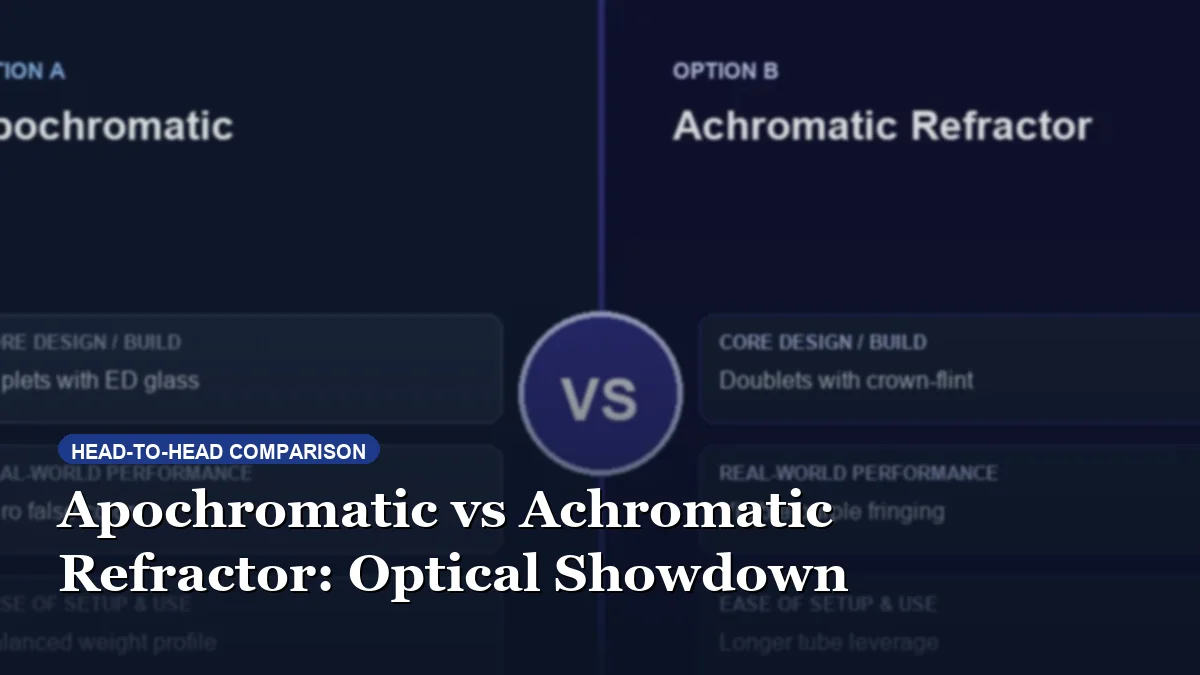
Astrophotographers should pick Side A for pristine color fidelity. Casual visual observers can choose Side B for budget savings.
Compare all top models in our Best Telescope: Top Backyard Picks for Astronomy.
Side-by-Side Breakdown
| Criteria | Apochromatic | Achromatic Refractor | Edge |
|---|---|---|---|
| Core Design / Build | Triplets with ED glass | Doublets with crown-flint | Apochromatic |
| Real-World Performance | Zero false color | Visible purple fringing | Apochromatic |
| Ease of Setup & Use | Balanced weight profile | Longer tube leverage | Achromatic Refractor |
| Durability & Reliability | Robust multicoated elements | Standard lens coatings | Apochromatic |
| Efficiency / Operating Footprint | Slower thermal acclimatization | Faster cool-down times | Achromatic Refractor |
| Maintenance Requirements | Precise collimation needed | Simple cell alignment | Achromatic Refractor |
| Best Ideal Use Case | Deep-sky imaging | Wide-field lunar viewing | Apochromatic |
Optical Physics and Glass Elements
Refractors bend incoming light through glass lenses to form images. Different glass types refract distinct wavelengths at varying angles, creating inherent optical challenges for modern manufacturers.
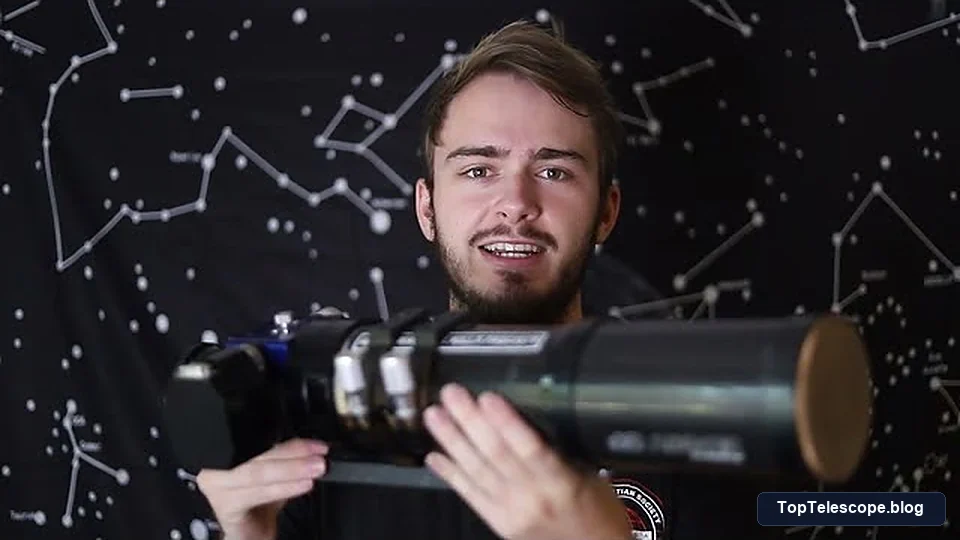
Standard optics use crown and flint glass elements. This combination brings two primary wavelengths into a common focus, leaving secondary spectrum errors clearly visible to observers.
Achromatic refractors utilize a two-element objective lens system typically pairing crown and flint glasses to bring two primary wavelengths into a common focal plane while leaving minor secondary spectrum errors visible.
Apochromatic systems integrate three or more elements using extra-low dispersion glass types to converge three distinct optical wavelengths into a single focal point, as detailed in our best apochromatic refractor telescope guide.
- Crown glass provides low dispersion properties across the spectrum.
- Flint glass introduces higher dispersion rates to balance refraction.
- Doublet designs pair two distinct elements for basic correction.
Doublet Versus Triplet Configurations
Triplet systems add a third lens element to further refine light paths. This extra glass layer enhances correction capabilities across the entire visual spectrum.
Cemented versus air-spaced designs dictate how lenses are mounted inside cells. Air-spaced configurations allow for better thermal adaptation during rapid temperature drops outside.
- Triplet setups eliminate residual chromatic aberration completely.
- Air gaps prevent thermal stress fractures during winter.
Chromatic Aberration Correction
Controlling false color remains the primary engineering hurdle for refractors. Specialized extra-low dispersion glass minimizes wavelength scatter, producing sharp contrast on bright lunar craters.
Standard doublets suffer from purple halos around high-contrast targets, an optical artifact detailed within our best planetary refractor guide that obscures fine planetary details during high-magnification viewing sessions.
Standard achromats display noticeable purple or blue halos around high-contrast targets like the Moon and bright planets because the residual thermal and optical dispersion cannot focus all visible light rays simultaneously.
True apo designs suppress secondary spectrum aberrations drastically by deploying advanced glass formulations, ensuring that red, green, and blue light form a tight point spread function without degrading high-magnification planetary contrast.
- ED glass elements suppress unwanted secondary spectrum dispersion.
- Standard crown-flint pairings show noticeable violet fringing.
- Aperture ratios dictate the severity of chromatic fringing.
Managing False Color at High Magnification
Pushing magnification limits exposes optical flaws quickly. Premium glass formulations maintain tight focus points, whereas budget doublets blur fine planetary cloud belts.
Filters can mitigate false color on traditional refractors. However, physical glass correction provides superior results without degrading overall image brightness or contrast.
- High power exposes marginal optical figure tolerances.
- Specialized minus-violet filters help suppress chromatic fringes.
Astrophotography and Imaging Capabilities
Modern deep-sky imaging demands pinpoint stars across large camera sensors, making our best apochromatic refractor for astrophotography picks essential for delivering flat fields and tight stellar point-spread functions without extra correctors.
Traditional doublets require additional optical correctors for photography. Without extra hardware, images show bloated blue halos around bright stars during long exposures.
Long exposure deep-sky astrophotography requires the absolute color purity delivered by triplet apochromats to prevent bloated star profiles and maintain sharp chrominance channel alignment across modern monochrome or color camera sensors.
While affordable achromats can capture wide-field narrowband images using specific sulfur or hydrogen-alpha filters, broadband RGB imaging immediately exposes their inherent optical color mismatch across standard silicon sensor wells.
- Apochromatic systems integrate seamlessly with dedicated astronomy cameras.
- Standard refractors demand field flatteners for edge sharpness.
- Color purity ensures accurate broadband nebula photography.
Field Flatness and Camera Sensors
Large sensor formats expose optical curvature near frame corners. Advanced triplet assemblies maintain uniform sharpness, ensuring stars remain pinpoints across the entire detector.
Slower focal ratios help reduce off-axis aberrations significantly. Astrophotographers must balance exposure time against focal length when selecting their primary imaging platform.
- Large sensors highlight edge distortion immediately.
- Integrated flatteners simplify the back-focus imaging train.
Mechanical Construction and Weight
Precision optics require rigid aluminum or carbon fiber tubes. Heavy glass elements demand robust internal cell structures to maintain optical alignment during transit.
Lighter optical tubes reduce strain on portable equatorial mounts. However, heavier triplet assemblies necessitate sturdier support hardware for stable tracking performance.
Heavy three-element apochromatic objective lenses require robust, temperature-compensated aluminum or carbon-fiber cells featuring precision push-pull collimation screws to maintain optical alignment during transport across rough terrain.
Simpler two-element achromatic tube assemblies are generally lighter and mechanically less complex, making them easier to handle for casual observers who prioritize quick setup times over complex mechanical adjustments.
- Aluminum alloy tubes offer excellent thermal stability.
- Carbon fiber reduces overall weight for field travel.
- Heavy lens cells shift balance points significantly.
Tube Materials and Focuser Rigidity
Rack-and-pinion focusers prevent camera slip during zenith imaging. Precision mechanics ensure heavy imaging gear stays locked in place throughout long integration sequences.
Temperature fluctuations cause metal tube expansion over time. High-end builds incorporate compensation rings to maintain critical focus during chilly night observations.
- Dual-speed focusers allow microscopic focal adjustments easily.
- Gear slip ruins long exposure astrophotography frames.
Thermal Equilibrium and Cool-Down Times
Glass elements must match ambient outdoor temperatures for sharp views. Massive triplet lenses require extended thermal adaptation periods before delivering optimal images.
Standard doublets cool down much faster due to lower glass volume. This quick adaptation makes them convenient for spontaneous backyard stargazing sessions.
Mass-heavy multi-element apochromatic lenses take significantly longer to reach ambient outdoor temperatures, necessitating built-in aluminum dew shields and cooling fans to prevent internal thermal currents from distorting wavefronts.
Simpler doublet achromatic objectives shed heat much faster due to lower total glass volume, as highlighted in our best refractor telescope for beginners roundup, allowing observers to achieve stable thermal equilibrium.
- Thermal currents inside tubes distort high-power views.
- Cooling fans accelerate internal temperature equalization safely.
- Thick glass stores daytime heat for hours.
Air-Spaced Lenses Versus Cemented Doublets
Cemented doublets transfer heat uniformly across optical surfaces. Air-spaced configurations trap micro-climates that require active ventilation to clear completely.
Observing through uncooled optics results in boiling planetary details. Patience is mandatory when deploying large, multi-element refractor telescopes outdoors.
- Cemented interfaces eliminate internal air boundary layers.
- Thermal plumes ruin high-resolution lunar observations.
Cost Efficiency and Value for Beginners
Optical manufacturing complexity drives retail pricing differences. Premium glass formulations require meticulous hand-figuring, creating a substantial investment for astronomy enthusiasts.
Entry-level observers find budget refractors financially accessible. These systems deliver satisfying wide-field views without requiring a major upfront financial commitment.
Beginners working with strict budgets often select achromatic refractors because their simpler manufacturing process provides an accessible entry point into visual astronomy and lunar observation without substantial financial risk.
Advanced apochromats demand exceptional optical polishing tolerances and exotic raw materials, driving production costs much higher but delivering uncompromised visual performance for dedicated long-term astronomy enthusiasts.
- Specialty ED glass raw materials are expensive.
- Mass production lowers the cost of standard doublets.
- Mount requirements dictate total system setup budgets.
Long-Term Investment and Upgrade Paths
Quality optics retain resale value exceptionally well over time. Buying premium equipment initially prevents the financial loss associated with iterative gear upgrades.
Budget scopes serve as excellent grab-and-go travel tools later. Even advanced astronomers keep smaller refractors for quick comet hunting sessions.
- High-end refractors become lifelong optical investments.
- Starter scopes remain useful as wide-field finders.
Portability and Mount Requirements
Physical dimensions dictate how easily equipment travels to dark sites. Compact tube lengths allow for effortless airline transport and quick deployment under clear skies.
Long focal length models demand heavy-duty equatorial tracking mounts. Maneuvering bulky setups requires patience and dedicated permanent observatory spaces.
Compact apochromatic refractors often feature shorter focal lengths and shorter optical tubes, reducing total leverage on portable alt-azimuth mounts while still demanding sturdy heavy-duty tripod legs for high-power viewing.
Longer focal length achromats require much heavier equatorial mounts and sturdy counterweight systems to manage the increased rotational torque caused by their extended moment arm during breezy outdoor observing sessions.
- Short tube designs fit inside standard overhead compartments.
- Sturdy tripods eliminate annoying high-magnification image vibrations.
- Counterweight balancing ensures smooth manual tracking.
Field Deployment and Tripod Stability
Wind gusts test the mechanical limits of light tripods. Securing equipment properly prevents frustrating vibrations during delicate planetary sketching sessions.
Quick-release dovetail bars streamline field assembly routines. Minimizing setup friction encourages more frequent stargazing adventures outdoors.
- Stainless steel tripod legs damp vibrations quickly.
- Dovetail clamps secure heavy optical tubes safely.
Frequently Asked Questions
What causes chromatic aberration in refractors?
Different wavelengths bend at varying angles through standard glass. This optical dispersion creates unwanted color fringes around bright planetary targets.
Do I need a triplet lens for visual astronomy?
Triplets are primarily necessary for demanding astrophotography tasks. Visual observers can enjoy stunning lunar views using quality doublets.
Why do apochromatic telescopes cost significantly more?
Specialty extra-low dispersion glass requires complex manufacturing processes. These premium materials ensure pristine color fidelity across the visual spectrum.
How do thermal currents affect refractor performance?
Trapped internal heat creates air turbulence inside optical tubes. Allowing scopes to reach ambient temperature ensures sharp planetary details.
Can I use standard filters with traditional refractors?
Minus-violet filters help suppress false color on standard doublets. However, physical glass correction remains the superior technical solution for imaging.