90mm Refractor vs 130mm Reflector: Technical Comparison
Evaluating optical performance, aperture metrics, and physical footprints. Choosing between these designs shapes your entire astronomy workflow.

Choose the 90mm refractor for zero maintenance and crisp lunar viewing. Select the 130mm reflector when you require maximum light gathering for faint deep-sky nebulae.
Compare all top models in our Best Telescope: Top Backyard Picks for Astronomy.
Side-by-Side Breakdown
| Criteria | 90Mm Refractor | 130Mm Reflector | Edge |
|---|---|---|---|
| Core Design / Build | Sealed lens tube | Open Newtonian mirror | Tie |
| Real-World Performance | High contrast planetary | High photon collection | 130mm Reflector |
| Ease of Setup & Use | Grab-and-go simplicity | Requires balancing | 90Mm Refractor |
| Durability & Reliability | Rugged factory alignment | Needs frequent checks | 90Mm Refractor |
| Efficiency / Operating Footprint | Longer physical profile | Shorter wider barrel | 130mm Reflector |
| Maintenance Requirements | Dust-free sealed optics | Regular mirror collimation | 90Mm Refractor |
| Best Ideal Use Case | Lunar and double stars | Galaxies and clusters | 130mm Reflector |
Optical Design and Lens Configurations
Refractor telescopes utilize glass objective lenses to bend incoming starlight down a sealed tube. This closed optical assembly prevents internal air currents and eliminates image degradation from thermal instability.
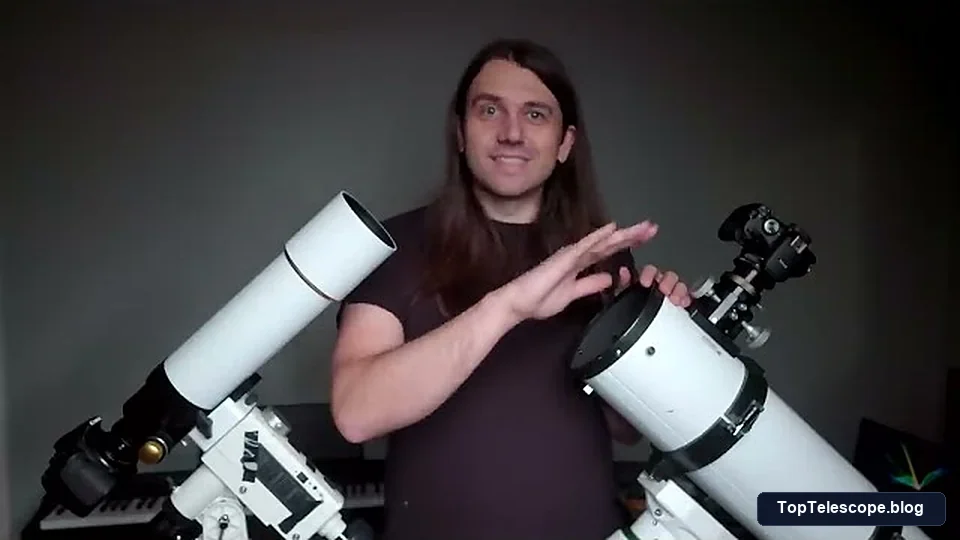
Newtonian reflectors gather light using a curved primary mirror at the base of an open tube. A secondary diagonal flat mirror then bounces this focused cone outward to the eyepiece.
The 90mm refractor utilizes a front objective lens system that bends incoming light rays to a focal point. This configuration uses crown and flint glass elements to minimize chromatic aberration effectively.
Conversely, the 130mm reflector relies on a curved parabolic primary mirror at the optical tube base. Light reflects back up to a flat secondary diagonal mirror positioned near the front aperture.
- Refractors use transmissive glass optics
- Reflectors use reflective mirror surfaces
- Sealed tubes prevent internal dust accumulation
Lens Coatings and Glass Types
Premium refractors incorporate extra-low dispersion glass elements to minimize chromatic aberration. These specialized coatings ensure high light transmission rates across the entire visible spectrum during observations.
- Extra-low dispersion glass reduces false color
- Broadband coatings maximize photon transmission
Aperture Metrics and Light Gathering
Aperture diameter remains the single most critical specification when evaluating faint celestial objects. The larger 130mm reflector collects significantly more photons than smaller lenses, revealing fainter galaxies.
While the smaller 90mm refractor gathers less total light, its unobstructed optical path delivers higher contrast ratios. Planetary surfaces and lunar craters appear exceptionally sharp and well-defined.
The 130mm aperture delivers a significantly larger surface area for capturing faint photons from distant nebulae and galaxies. This larger light collector gathers roughly two times more light than smaller systems.
While a 90mm refractor has less light grasp, its unobstructed optical path preserves maximum image contrast. Exploring top refractor telescope picks reveals exceptional planetary performance without central obstruction diffraction.
- Larger aperture resolves fainter stellar magnitudes
- Unobstructed light paths improve visual contrast
- Photon collection scales exponentially with diameter
Resolving Power and Magnification Limits
Theoretical magnification limits depend directly upon the physical diameter of the primary optic. Exceeding these optical thresholds results in dim, blurry images that lack meaningful structural detail.
- Magnification caps limit extreme eyepiece swapping
- Atmospheric seeing dictates usable power
Mechanical Build and OTA Footprint
Optical tube assemblies demand robust mounting systems to prevent frustrating image vibrations during high-magnification viewing sessions. Heavy-duty aluminum tripods provide the necessary stability for both instrument classes.
Refractors maintain a long physical profile that increases leverage forces on standard alt-azimuth mounts. Reflectors feature shorter, wider barrels that sit closer to the center of gravity.
Refractor optical tube assemblies feature rigid metal cells that securely lock lenses into permanent alignment. This robust mechanical build prevents internal shifting during transport and reduces the need for frequent mechanical recalibration.
The 130mm reflector requires a sturdy steel or aluminum tube to support the heavier mirror cell. Proper tube ring placement is essential to balance the OTA securely on standard equatorial or alt-azimuth mounts.
- Rigid tripods minimize annoying image tremors
- Tube balance affects mount tracking smoothness
- Physical leverage impacts overall stability
Focuser Mechanics and Rigidity
Smooth focuser operation ensures precise image snap during delicate lunar focusing tasks. Rack-and-pinion or Crayford designs prevent camera slippage during astrophotography sessions.
- Crayford focusers offer backlash-free adjustment
- Tension locks secure heavy eyepieces firmly
Collimation and Routine Maintenance
Refractor telescopes arrive factory-aligned and permanently sealed against dust, eliminating the need for periodic mirror adjustments. Users simply mount the instrument and immediately begin observing the night sky.
Newtonian reflectors require frequent mirror collimation to maintain optimal performance after transport. Following our guide to collimating reflectors helps users master alignment screws using specialized laser tools.
Refractor telescopes arrive factory-collimated and rarely require user intervention to maintain peak optical performance. Users only need to perform routine exterior cleaning on exposed glass surfaces using specialized optical wipes.
Reflectors demand active mirror alignment procedures before every observing session to ensure pin-point stellar images. Mastering the adjustment knobs on the primary mirror cell is vital for maintaining high-magnification clarity.
- Refractors require zero optical alignment
- Reflectors need regular mirror tuning
- Factory seals protect internal lens elements
Tools for Mirror Alignment
Laser collimators simplify the mirror adjustment process for novice telescope owners in the field. Careful calibration guarantees pinpoint star images across the entire visual field.
- Laser tools speed up field alignment
- Cheshire eyepieces offer precise optical checks
Planetary and Deep Sky Performance
Observing planets requires high contrast to resolve subtle cloud belts on Jupiter or Saturn's rings. Refractor optics excel here, delivering pristine planetary details without central obstruction scattering.
Deep-sky objects like nebulae and star clusters demand maximum light grasp to overcome surface brightness limitations. The generous aperture of a reflector brings these distant targets into clear view.
The 90mm refractor excels at resolving tight lunar rilles and subtle Jovian cloud belts under steady atmospheric seeing conditions. Its high-contrast imaging profile reveals crisp planetary details featuring diffraction-limited optics.
Conversely, the 130mm reflector triumphs when hunting faint deep sky targets like globular clusters and emission nebulae. The increased light grasp resolves individual stars inside dense stellar clusters effortlessly.
- Planetary targets favor high-contrast optics
- Faint nebulae require large light buckets
- Central obstructions scatter minor starlight
Lunar Crater Observations
Sharp shadow termination lines across lunar craters highlight subtle topographical elevations effectively. High-contrast refractor lenses reveal intricate crater floor textures cleanly.
- Terminator shadows expose fine topography
- High contrast separates close surface features
Portability and Field Setup
Transporting astronomy gear to dark sky sites requires careful consideration of weight distribution and physical dimensions. Compact reflector tubes fit easily across vehicle backseats despite wider diameters.
Refractor setups often require longer storage cases due to their extended focal lengths, though overall weight remains manageable. Both systems demand reliable counterweight balance for smooth tracking.
Transporting a 90mm refractor requires minimal cargo space inside a standard vehicle backseat or storage closet. The compact optical tube and lightweight mount facilitate rapid field deployment during impromptu stargazing sessions.
As noted in our Celestron StarSense Explorer review, a 130mm Newtonian reflector demands careful handling and extra time for thermal acclimatization. Users must perform counterweight balancing before observing.
- Compact tubes fit easily inside vehicles
- Counterweights ensure balanced tracking axes
- Storage cases protect vulnerable glass surfaces
Vehicle Transport and Storage
Securing optical tubes safely during transit prevents accidental mechanical damage on bumpy roads. Padded bags absorb shocks and protect delicate alignment configurations effectively.
- Padded cases cushion against road impacts
- Secure tie-downs prevent shifting equipment
Investment Value and Long-Term Utility
Selecting the right instrument involves balancing initial equipment costs with long-term maintenance requirements. Reviewing our beginner telescope picks helps newcomers weigh mechanical simplicity against optical power carefully.
Experienced astronomers often maintain both instrument types to cover different observing priorities across changing seasonal targets. Understanding these core mechanical differences ensures lasting satisfaction under starry skies.
Selecting a 90mm refractor provides beginner astronomers with a dependable grab-and-go instrument that retains utility as a dedicated guide scope later. Its durable construction ensures decades of service with minimal upkeep.
Choosing the 130mm reflector maximizes optical aperture per unit cost, offering advanced deep sky performance on a modest budget. This instrument rewards active hobbyists who enjoy mastering technical maintenance routines.
- Balance maintenance needs with optical power
- Accessory compatibility expands viewing options
- Seasonal targets dictate equipment preferences
Accessory Expansion Paths
Upgrading eyepieces, filters, and diagonals enhances visual experiences across both telescope architectures significantly. Standard barrel sizes ensure broad compatibility with aftermarket astronomy gear.
- Standard barrels fit universal eyepieces
- Nebula filters boost deep-sky contrast
Frequently Asked Questions
How often should a reflector mirror be adjusted?
Reflector mirrors require frequent collimation checks before every major observing session, especially after vehicle transport. Maintaining proper mirror alignment ensures crisp planetary views and sharp star points.
Why do refractors cost more per millimeter of aperture?
Crafting large, flawless glass lenses requires complex polishing techniques and expensive raw materials. This intricate manufacturing process makes refractors significantly costlier than equivalent mirrors.
Can beginners easily operate a Newtonian reflector telescope?
Beginners can easily master Newtonian reflectors by learning basic alignment procedures and safety precautions. Patience during setup ensures rewarding views of distant galaxies and star clusters.
Do refractor telescopes require any internal cleaning over time?
Refractor telescopes feature permanently sealed optical tubes that protect sensitive internal glass elements from accumulating dust and moisture over many years of outdoor use.
This robust closed architecture effectively eliminates internal air currents, ensuring consistent thermal stability and maximum visual contrast during detailed planetary observations under changing weather conditions.
Which telescope type works better under urban light pollution?
Both telescope designs perform similarly under light-polluted skies, though aperture helps capture faint targets. Urban observers benefit from adding specialized narrowband contrast filters to their eyepieces.