80mm Refractor vs 114mm Reflector: Concise Verdict
Comparing an 80mm refractor and a 114mm reflector reveals a classic trade-off between optical maintenance-free portability and deep-sky light-gathering power.

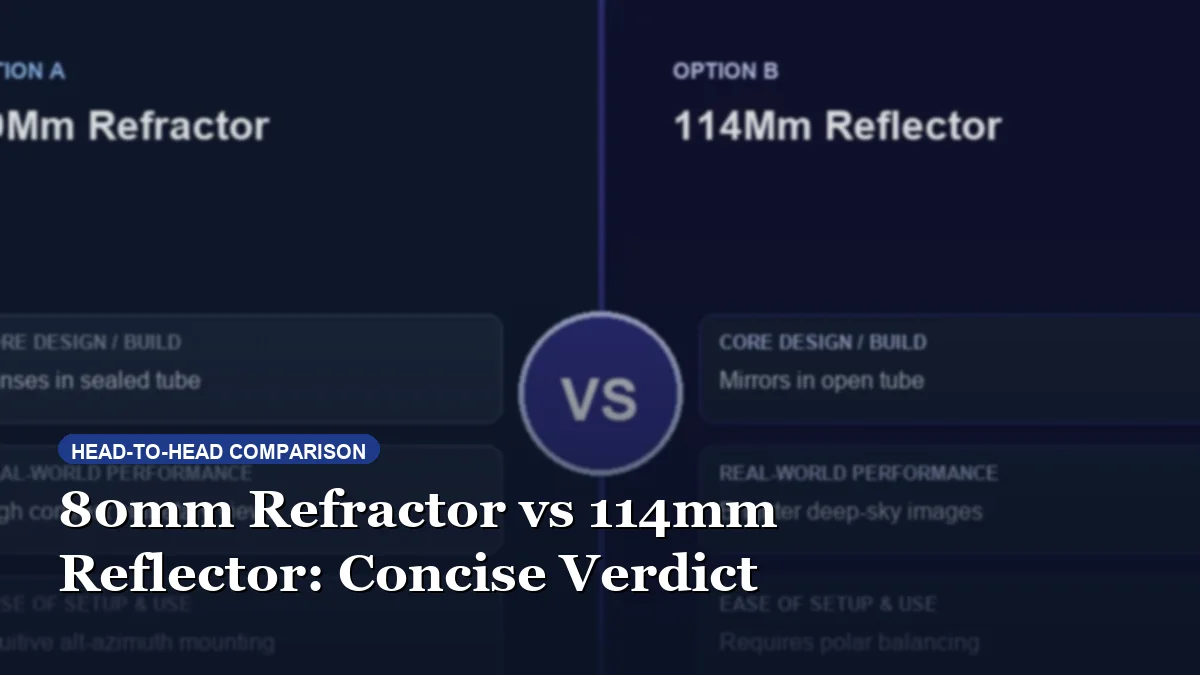
Choose the 80mm refractor for grab-and-go portability and zero maintenance, or select the 114mm reflector for superior deep-sky light-gathering performance on faint galaxies.
Compare all top models in our Best Telescope: Top Backyard Picks for Astronomy.
Side-by-Side Breakdown
| Criteria | 80Mm Refractor | 114Mm Reflector | Edge |
|---|---|---|---|
| Core Design / Build | Lenses in sealed tube | Mirrors in open tube | Refractor |
| Real-World Performance | High contrast planetary views | Brighter deep-sky images | Reflector |
| Ease of Setup & Use | Intuitive alt-azimuth mounting | Requires polar balancing | Refractor |
| Durability & Reliability | Fixed factory alignment | Needs periodic collimation | Refractor |
| Efficiency / Operating Footprint | Compact travel-friendly size | Bulkier optical tube width | Refractor |
| Maintenance Requirements | Zero regular upkeep needed | Manual mirror cleaning/alignment | Refractor |
| Best Ideal Use Case | Wide-field and lunar viewing | Faint nebulae and galaxies | Reflector |
Core Design and Engineering Fundamentals
Choosing between an 80mm refractor and a 114mm reflector involves fundamentally different optical physics, mechanical layouts, and light paths that directly impact your nightly astronomical viewing sessions in the field.

Refractors use precision glass lenses at the front tube opening to bend incoming starlight directly down to a rear focal point without any internal obstructions blocking the incoming light cone.
Choosing an 80mm refractor for your portable setup provides sharp wide-field views, making our best 80mm refractor for astrophotography guide an essential resource for gear selection.
Conversely, a 114mm Newtonian reflector employs a curved primary mirror at the optical tube base. Light reflects back up to a flat diagonal secondary mirror positioned near the upper aperture.
- Lens glass types and coatings
- Internal tube baffling systems
- Primary optical focal ratios
Internal Mirror Configurations
Newtonian reflectors rely on a curved primary mirror at the rear of the steel tube to bounce light forward toward a secondary flat diagonal mirror suspended near the top.
This folded optical path allows manufacturers to package a larger 114mm aperture into a surprisingly short physical tube length while keeping manufacturing costs exceptionally manageable for beginners.
- Spider vane support structures
- Rear cell thermal ventilation
Aperture and Light Gathering Performance
Light-gathering power remains the absolute most critical specification determining whether faint deep-sky nebulae and distant galaxies appear as distinct structures or remain completely invisible in your eyepiece.
The larger 114mm collector gathers significantly more photons than smaller lenses, revealing fainter star clusters and resolving finer details on planetary disk features during steady atmospheric seeing conditions.
Examining this performance closely in our Celestron StarSense Explorer 114mm Newtonian review highlights how aperture size directly impacts faint deep-sky visibility during clear nights.
While the refractor suffers from minor light loss due to glass absorption, its unobstructed aperture yields higher contrast transfer. Planetary details often appear sharper despite the smaller overall light-gathering diameter.
- Photon collection surface area
- Rayleigh resolution limits
- Limiting stellar magnitude reach
Contrast Versus Raw Light
While the smaller refractor captures fewer total photons, its unobstructed optical train delivers remarkably high contrast levels that make planetary edges and lunar craters pop sharply.
Reflectors face minor diffraction spikes caused by spider vanes holding the diagonal mirror, which slightly scatters bright starlight when observing exceptionally brilliant targets like Jupiter or Sirius.
- Aperture diffraction spikes
- Scattered light control systems
Optical Aberrations and Image Quality
When selecting optics for high-magnification viewing, consulting recommendations in our best refractor telescope guide ensures you choose models designed to minimize chromatic aberration effectively.
Achromatic refractors frequently exhibit false color fringes around high-contrast objects because glass bends different light wavelengths at slightly different focal lengths along the optical axis.
Achromatic 80mm refractors frequently exhibit chromatic aberration, causing purple fringes around bright celestial objects. Premium glass types mitigate this native dispersion issue but increase overall manufacturing costs significantly.
Newtonian reflectors are entirely free of chromatic aberration because mirrors reflect all light wavelengths equally. However, fast 114mm systems introduce coma distortion near the extreme edges of wide-field eyepiece views.
- Glass chromatic aberration
- Spherical mirror figure errors
Managing Mirror Coma and Astigmatism
Reflectors generally avoid chromatic aberration entirely since reflection physics treats all visible light wavelengths equally, but fast parabolic mirrors can introduce off-axis coma distortion.
Properly aligning your optics through regular collimation procedures ensures that a reflector delivers crisp, sharp planetary images across most of the usable focal plane area.
- Collimation accuracy standards
- Parabolic mirror edge shaping
Mechanical Setup and Field Portability
Transporting your astronomy gear to dark sky sites requires evaluating total equipment weight, physical dimensions, and how easily the entire optical tube assembly mounts to tripods.
The compact 80mm refractor slips easily into small storage spaces, making it an ideal grab-and-go travel telescope for spontaneous backyard stargazing sessions or weekend camping trips.
The compact physical profile of an 80mm refractor makes it an exceptional grab-and-go travel telescope. You can easily stow the entire assembly in a padded backpack for remote dark-sky excursions.
A 114mm reflector features a wider optical tube requiring sturdier mounting solutions. Managing the physical length and balancing weights demands careful attention during field setup and breakdown procedures.
- OTA weight distribution balance
- Standard dovetail mounting bars
Managing Reflector Bulk
Standard 114mm reflectors feature wider tube diameters that demand sturdier mounting platforms to eliminate annoying vibrations while focusing at high magnifications on windy nights.
Although slightly bulkier than sleek refractors, most amateur reflectors still fit comfortably across the back seat of a standard sedan without requiring specialized transport cases.
- Tubular ring mounting systems
- Tripod footprint stability size
Maintenance Requirements and Longevity
Long-term equipment ownership demands understanding routine upkeep tasks necessary to preserve optimal optical alignment and prevent mechanical wear across changing seasonal temperature extremes.
Sealed refractor optical tubes require virtually zero maintenance, locking factory alignment permanently inside the cell and protecting delicate lens coatings from accumulated dust and moisture.
Sealed refractor optical tubes require virtually zero internal maintenance over decades of heavy usage. You only need to clean the exterior objective lens surface occasionally using specialized micro-fiber cloths.
Reflectors require routine mirror collimation to maintain optimal optical alignment before every observing session. Exposed primary coatings also degrade slowly over time, eventually necessitating professional re-coating after many years.
- Sealed optical tube designs
- Front dust cap protection
Routine Reflector Upkeep
Learning proper alignment techniques through our Newtonian reflector collimation guide helps beginners maintain sharp planetary details and prevent frustrating optical aberrations during outdoor viewing sessions.
Open reflector tubes also collect dust over years of outdoor use, eventually demanding careful mirror washing procedures to restore maximum reflectivity and contrast.
- Manual collimation laser tools
- Primary mirror washing protocols
Mount Compatibility and Accessories
Choosing the correct mount style ensures smooth tracking of celestial objects as Earth rotates throughout the night without introducing excessive frame wobble or tracking resistance.
Lightweight refractors pair exceptionally well with simple altitude-azimuth mounts that operate intuitively, allowing beginners to point and view targets without complex polar alignment steps.
Lightweight 80mm refractors mount effortlessly on simple alt-azimuth heads or sturdy photographic tripods. Standard Vixen-style dovetail bars attach securely without requiring heavy-duty counterweight balancing systems in the field.
The side-mounted eyepiece position of a Newtonian reflector benefits greatly from stable equatorial mounts. Proper counterweight balancing remains essential to prevent excessive strain on internal mechanical gears during tracking.
- Alt-azimuth mechanical operation
- Fine adjustment slow-motion cables
Equatorial Tracking Solutions
Equatorial mounts balance reflectors effectively, counteracting planetary motion with a single axis adjustment once the polar axis aligns properly with celestial north.
Standard 114mm setups benefit greatly from motor drives, which maintain steady centering on high-magnification lunar features during extended visual observation sessions.
- Polar axis alignment process
- Motorized tracking drive units
Choosing Your Ideal Instrument
Selecting between these two popular beginner telescopes depends entirely on your specific viewing priorities, backyard environment, storage limitations, and personal tolerance for equipment maintenance.
Prioritize the refractor if you demand zero-maintenance optics, maximum portability, and sharp contrast for viewing wide star fields and bright lunar features.
Select the 80mm refractor if you prioritize rapid deployment, zero collimation, and crisp lunar views. It serves as a dependable terrestrial spotting scope alongside its primary nighttime astronomical duties.
Choose the 114mm reflector if you demand maximum light-gathering aperture on a strict budget. It provides deeper reach into faint nebulae and galaxies despite requiring routine mechanical alignment adjustments.
- Portability convenience priorities
- Wide-field visual observing
When to Buy the Reflector
Choose the larger reflector if your primary goal involves exploring faint deep-sky objects where maximum light-gathering aperture proves absolutely essential for success.
Budget-conscious astronomers seeking maximum optical performance per dollar will find that reflectors deliver superior aperture value for studying distant nebulae.
- Deep-sky light gathering goals
- Maximum aperture value return
Frequently Asked Questions
Do 114mm reflectors require difficult mirror alignment before every single viewing session?
Collimation becomes second nature after a few initial attempts, requiring only a simple collimation cap or laser tool to align the mirrors properly for optimal high-magnification images.
You will quickly master this routine maintenance task within minutes without seeking any professional assistance during your backyard astronomy adventures.
Can an 80mm refractor resolve distant faint galaxies as clearly as a larger reflector?
Smaller glass lenses simply lack the required light-gathering surface area needed to reveal dim deep-sky objects with distinct structural details like spiral arms. However, they still deliver stunning optical contrast on wide star fields and bright lunar features.
Which telescope type proves better suited for apartment living and frequent travel?
The compact dimensions and lightweight tube assembly of the 80mm refractor make it vastly superior for tight storage spaces and quick transport. It packs easily into vehicle trunks alongside standard luggage for weekend camping trips.
Do achromatic refractors suffer from annoying false color distortion around bright stars?
Achromatic glass lenses bend different light wavelengths at slightly different focal points, which introduces noticeable purple fringes around extremely bright targets like Venus or brilliant stars. Using contrast filters can reduce this optical artifact effectively.
Are equatorial mounts difficult for absolute beginners to operate successfully outdoors?
Equatorial tracking mounts demand a basic understanding of polar alignment with celestial north, which can initially frustrate absolute beginners setting up gear at night. Alt-azimuth designs offer a much simpler point-and-view alternative for casual backyard observers.