8 Inch vs 10 Inch Dobsonian: Technical Comparison
Choosing between these two popular apertures involves balancing light gathering capacity against physical bulk. This guide breaks down the engineering trade-offs.

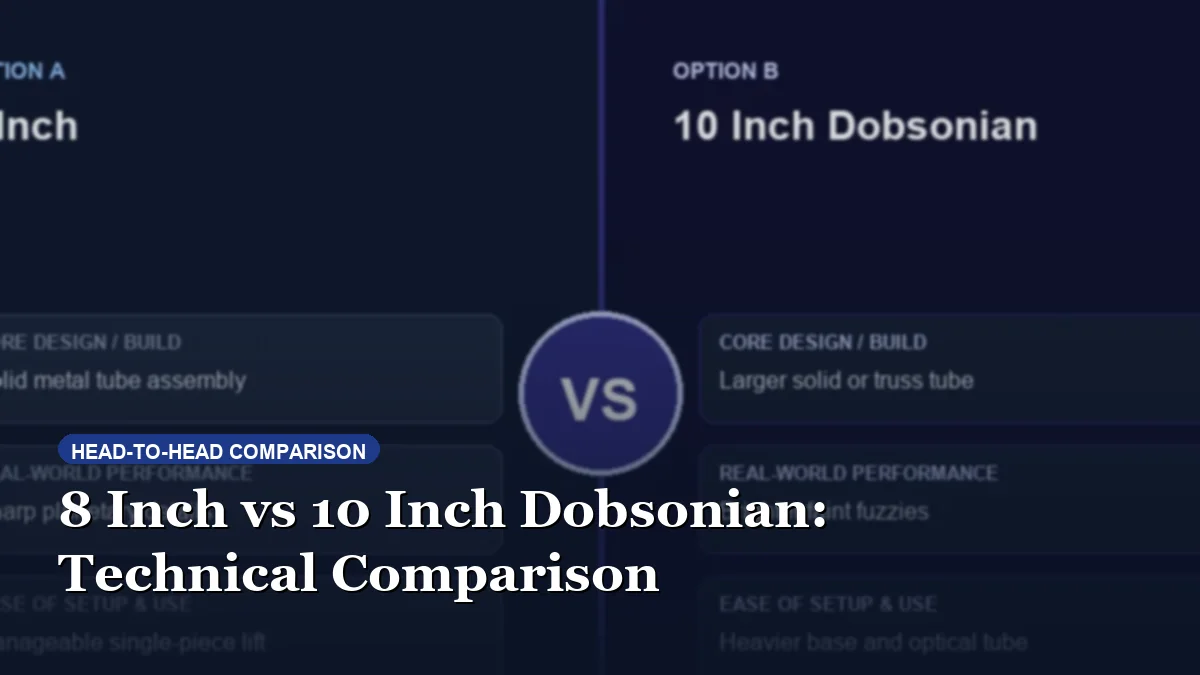
Pick the 8 inch model for easier backyard handling and quick transport. Choose the 10 inch dobsonian if you demand maximum deep-sky brightness and superior resolution under dark skies.
Compare all top models in our Best Telescope: Top Backyard Picks for Astronomy.
Side-by-Side Breakdown
| Criteria | 8 Inch | 10 Inch Dobsonian | Edge |
|---|---|---|---|
| Core Design / Build | Solid metal tube assembly | Larger solid or truss tube | 8 Inch |
| Real-World Performance | Sharp planetary details | Brighter faint fuzzies | 10 Inch Dobsonian |
| Ease of Setup & Use | Manageable single-piece lift | Heavier base and optical tube | 8 Inch |
| Durability & Reliability | Sturdy pyrex primary mirror | Thicker glass requiring acclimation | Tie |
| Efficiency / Operating Footprint | Standard vehicle backseat fit | Requires front seat or wagon | 8 Inch |
| Maintenance Requirements | Standard secondary alignment | Frequent primary mirror checks | 8 Inch |
| Best Ideal Use Case | Mobile backyard astronomy | Dedicated deep sky hunter | 10 Inch Dobsonian |
Core Optical Design and Engineering Differences
Newtonian reflectors rely on a parabolic primary mirror to focus incoming starlight toward a flat secondary mirror. The primary difference centers on aperture diameter, scaling from twenty centimeters up to twenty-five centimeters.
Focal ratios typically hover around f/6 for the smaller unit and f/5 for the larger variant. This physical scaling directly alters optical performance, tube length, and mechanical stress across the entire mount structure.
Engineers must balance focal length with eyepiece height to maintain comfortable viewing angles. Taller tubes demand sturdier rocker box bases to mitigate wind vibrations and ensure smooth altitude bearing movement during tracking sessions.
- Primary mirror diameter increases light collection by roughly fifty-six percent.
- Focal length adjustments alter overall optical speed and high-magnification capability.
- Tube thickness and weight demand reinforced particle board or laminate rocker boxes.
Mirror Substrate Thickness and Thermal Mass
Glass thickness increases significantly when moving from twenty to twenty-five centimeters. A thicker substrate requires longer cooling times to reach ambient outdoor temperatures before delivering sharp planetary views.
Ventilation fans mounted behind the primary mirror cell help accelerate thermal equilibrium. Without adequate cooling, boundary layer currents distort incoming wavefronts and ruin high-power lunar observations.
- Thicker glass retains daytime heat longer inside closed optical tubes.
- Rear cooling fans mitigate thermal distortion within thirty minutes of setup.
Aperture Physics and Light Gathering Power
Light gathering capacity scales proportionally with the surface area of the primary mirror. Stepping up to the larger aperture yields a noticeable brightness boost when observing faint emission nebulae and distant galaxies.
Resolution limits also tighten as aperture expands, allowing observers to split close double stars more cleanly. Rayleigh criterion calculations favor the larger optical surface for resolving fine planetary details.
However, atmospheric seeing conditions frequently limit maximum magnification regardless of mirror size. Under turbulent skies, both instruments will experience image degradation that restricts theoretical high-power capabilities.
- Surface area increases substantially, capturing vastly more photons per second.
- Resolution thresholds drop, enabling sharper separation of tight stellar binaries.
- Atmospheric turbulence remains the ultimate bottleneck for high magnification.
Limiting Magnitude and Faint Object Detection
Faint fuzzies reveal more internal structure through the larger light funnel. Spiral arms in Messier galaxies become marginally more distinct under dark rural skies when utilizing the extra collecting area.
Stellar limiting magnitude improves by roughly half a magnitude with the optical upgrade. This difference transforms invisible threshold targets into securely confirmed visual catches.
- Spiral galaxy structure appears with enhanced contrast in rural skies.
- Marginal stellar targets cross the threshold into definite visibility.
Real-World Deep Sky and Planetary Performance
Observing planets demands high contrast and steady thermal equilibrium across the optical train. Reviewing top recommendations in our best 10 inch dobsonian telescope roundup highlights ideal instruments for viewing faint planetary details.
Deep-sky performance highlights the distinct advantage of greater light throughput. Globular clusters resolve into individual pinpoints of light across a wider magnitude range when using the larger aperture system.
Eyepiece selection plays a critical role in extracting maximum performance from these focal lengths. Premium wide-field oculars help compensate for manual tracking at high magnifications across both platforms.
- Planetary contrast remains exceptionally high in both long focal systems.
- Globular clusters resolve deeper into their dense stellar cores.
- Wide-field eyepieces ease manual tracking during high-power sessions.
Planetary Resolution Versus Deep Sky Brightness
Planetary imaging or visual study relies heavily on exit pupil optimization. The twenty-centimeter scope provides very comfortable viewing comfort for bright lunar and planetary targets without flooding the eye.
Conversely, dim planetary nebulae benefit immensely from the enhanced photon flux of the twenty-five-centimeter tube. Surface brightness scales favorably for low-contrast emission features spanning small angular diameters.
- Exit pupil matching ensures comfortable viewing during bright lunar sessions.
- Emission nebulae show enhanced surface brightness in larger mirrors.
Optical Collimation and Maintenance Demands
Maintaining precise optical alignment is essential for peak performance in fast Newtonian reflectors. Both systems require regular laser or Cheshire eyepiece checks to ensure accurate mirror collimation before viewing.
Larger primary mirrors can be slightly more susceptible to slight shifts during transport. Cell designs on twenty-five-centimeter tubes must provide robust lateral support to prevent pinching the glass substrate.
Dust accumulation on horizontal primary mirrors necessitates occasional cleaning using specialized optical solutions. Careful handling prevents scratching delicate aluminum coatings and protective overcoats on the glass.
- Laser collimators simplify routine alignment checks before observing sessions.
- Primary mirror cell rigidity prevents warping during rough vehicle transport.
- Dust cleaning requires strict adherence to safe optical maintenance protocols.
Mirror Cell Design and Edge Support
Proper edge support prevents the primary mirror from sagging under its own weight. Twenty-centimeter cells use simple clips, while heavier twenty-five-centimeter mirrors require multi-point flotation systems to maintain optical figure.
Thermal expansion and contraction can alter collimation slightly as evening temperatures drop. Periodic check-ins during long winter observing sessions ensure optimal sharpness remains dialed in.
- Flotation systems distribute weight evenly across larger glass substrates.
- Temperature drops necessitate minor collimation tweaks during cold nights.
Mechanical Handling, Ergonomics, and Setup
Dobsonian mounts are celebrated for their intuitive point-and-look mechanical simplicity. Examining specifications inside our best 12 inch dobsonian telescope guide reveals how physical dimensions impact your backyard transport ergonomics.
The smaller setup features a tube that easily wraps in human arms for one-piece transport. The larger platform often approaches limits where two-piece transport becomes a mandatory ergonomic safety requirement.
Rocker box bases use Teflon or laminate bearing pads to ensure buttery smooth movements. Balancing friction tension is critical for preventing drift while allowing effortless manual tracking at high powers.
- Single-piece transport suits compact backyard deployment routines.
- Two-piece breakdown protects backs when handling heavier twenty-five centimeter tubes.
- Teflon bearing pads ensure smooth manual tracking at high magnifications.
Base Stability and Vibration Dampening
Particle board rocker boxes absorb minor bumps without inducing excessive secondary oscillations. Heavier bases provide a more rigid foundation that dampens wind gusts much faster during field observing sessions.
Adding adjustable feet or dampening pads improves stability on uneven ground surfaces. Ground contact rigidity directly translates to a more stable high-magnification viewing experience.
- Rigid particle board absorbs minor impacts and wind vibrations.
- Adjustable ground contact pads level the mount on soft soil.
Transportation, Storage, and Vehicle Footprint
Storage space inside a typical home or apartment often dictates maximum telescope size. Selecting options from our best 8 inch dobsonian telescope guide helps you balance aperture with manageable floor space clearance.
Transporting gear to dark sky sites requires careful measurement of vehicle trunk openings. While the twenty-centimeter optical tube slides easily across standard backseats, the twenty-five-centimeter variant frequently requires angle placement.
Truss-tube variants of larger apertures alleviate storage woes by breaking down completely. However, solid-tube configurations remain favored for their rapid assembly speed and structural alignment retention.
- Vertical storage footprints vary based on outer tube diameter.
- Vehicle backseat clearance determines travel viability for dark sky trips.
- Solid tube designs offer faster field deployment than modular truss systems.
Backseat Geometry and Packing Logistics
Fitting a long optical tube into a compact sedan can test packing patience. Securing the tube safely with seatbelts prevents rolling during transit on winding rural roads toward dark sky locations.
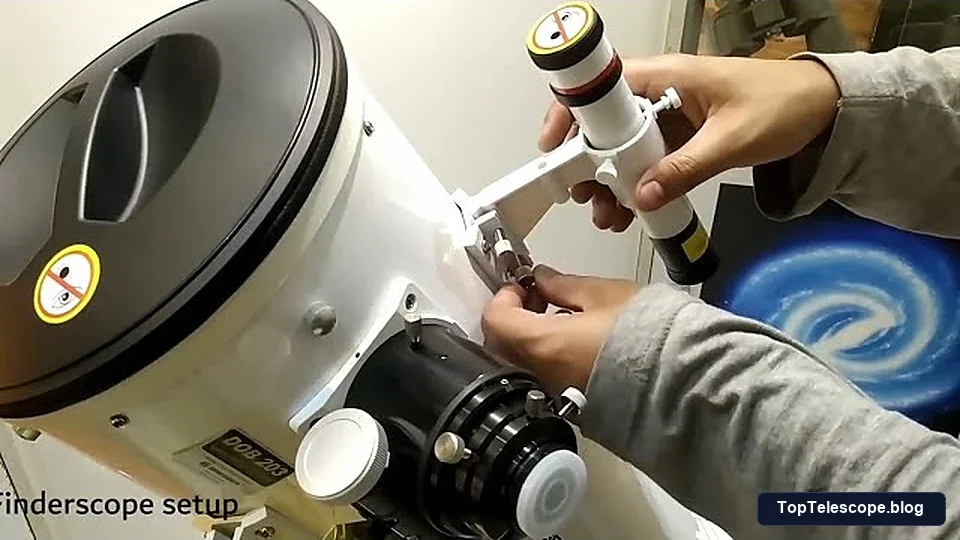
Accessory cases containing eyepieces, finderscopes, and power banks must share cargo space. Efficient packing ensures all ancillary gear arrives safely alongside the primary telescope assembly.
- Seatbelt anchoring prevents rolling hazards on winding rural roads.
- Accessory case placement requires careful coordination in limited trunks.
Matching Your Sky Conditions and Experience Level
Local light pollution levels heavily influence which aperture delivers true value. Comparing heavy-duty options within our best 16 inch dobsonian telescope selection shows how skyglow background brightness affects deep-sky targets.
Beginner astronomers often benefit from the lighter, more forgiving nature of the smaller format. Experienced observers packing heavy gear for rural excursions easily exploit the resolving power of the larger tube.
Budget allocation for high-quality eyepieces should also factor into the purchasing decision. Investing in premium oculars enhances viewing comfort regardless of which primary mirror aperture you ultimately choose.
- Suburban light pollution impacts faint deep-sky contrast across both sizes.
- Beginners find the lighter platform easier to manage during initial learning curves.
- Eyepiece investments matter equally for optimizing visual performance.
Suburban Light Pollution Versus Rural Dark Skies
Light pollution drowns out low-contrast extended nebulae regardless of mirror diameter. Urban stargazers often find planetary and double star viewing more productive than hunting faint threshold galaxies.
Transporting the instrument to dark rural sites unlocks the true potential of twenty-five centimeters. True dark skies transform marginal threshold objects into stunning visual spectacles.
- Urban observers rely heavily on planetary and double star targets.
- Rural dark skies unlock the full potential of large aperture mirrors.
Frequently Asked Questions
Can a beginner easily handle a ten inch Dobsonian?
Beginners can manage it if they possess adequate physical strength and transport space. However, the eight inch model offers a much more forgiving learning curve for backyard astronomy.
How much brighter do deep sky objects appear in the ten inch?
Deep sky objects appear noticeably brighter due to the increased surface area. This extra photon collection helps reveal faint spiral structure that remains invisible in smaller tubes.
Do both telescopes fit across a standard car backseat?
An eight inch tube slides easily across most standard sedan backseats. The ten inch variant often requires careful angling or folding down passenger seats for secure transport.
How often do these Newtonian reflectors require optical collimation?
Both designs require quick collimation checks before every serious observing session. Transporting the gear over bumpy roads usually necessitates minor adjustments to the primary and secondary mirrors.
Which telescope performs better under severe suburban light pollution?
Both struggle equally with low contrast extended nebulae under heavy light pollution. Urban observers achieve better results focusing on bright planets, the Moon, and tight double stars.