70mm Refractor vs 114mm Reflector: Technical Showdown
Choosing between these entry-level optical designs defines your initial astronomy journey. We examine core mechanics, light gathering, and daily maintenance.

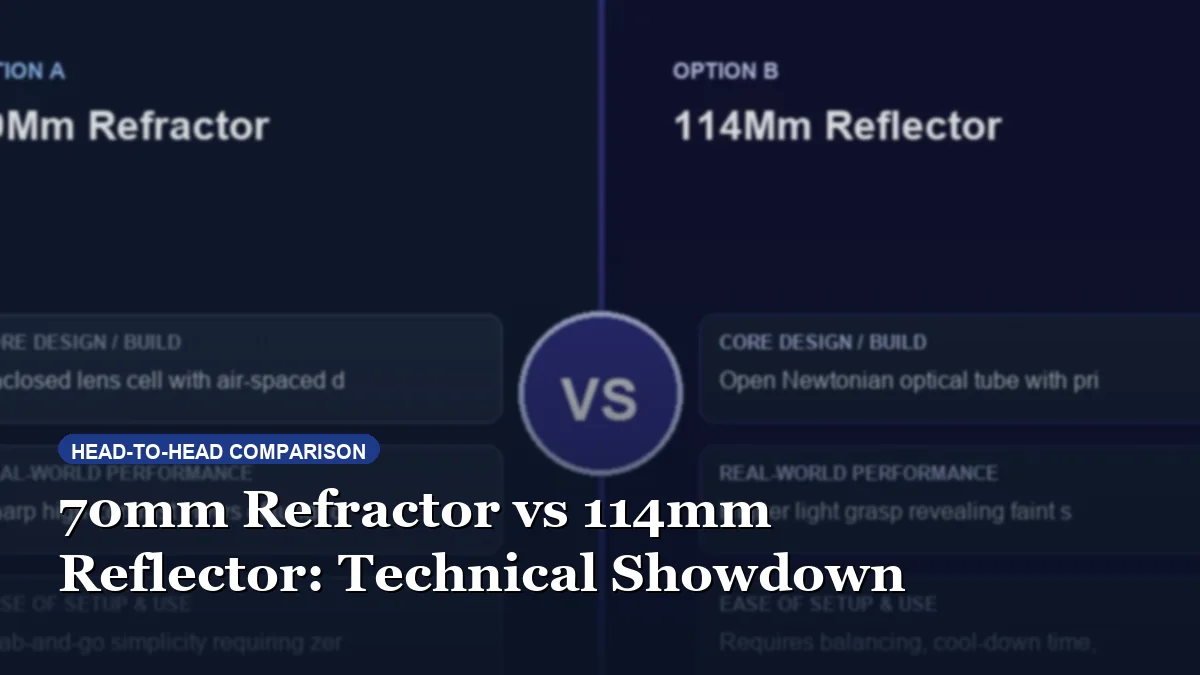
Choose the 70mm refractor for zero-maintenance lunar viewing and ultra-portable travel. Select the 114mm reflector for significantly brighter deep-sky nebulae and galaxies despite requiring periodic alignment.
Compare all top models in our Best Telescope: Top Backyard Picks for Astronomy.
Side-by-Side Breakdown
| Criteria | 70Mm Refractor | 114Mm Reflector | Edge |
|---|---|---|---|
| Core Design / Build | Enclosed lens cell with air-spaced doublet glass elements | Open Newtonian optical tube with primary and secondary mirrors | Side A |
| Real-World Performance | Sharp high-contrast views of lunar craters and planetary disks | Higher light grasp revealing faint star clusters and distant galaxies | Side B |
| Ease of Setup & Use | Grab-and-go simplicity requiring zero warm-up or alignment | Requires balancing, cool-down time, and occasional mirror checks | Side A |
| Durability & Reliability | Rugged sealed tube resists dust and minor bumps securely | Open mirror cells demand careful transport and protective covers | Side A |
| Efficiency / Operating Footprint | Compact lightweight footprint ideal for small balconies | Bulkier cylindrical tube needing a sturdy equatorial base | Side A |
| Maintenance Requirements | Virtually maintenance-free aside from occasional exterior lens cleaning | Periodic user collimation using specialized alignment tools | Side A |
| Best Ideal Use Case | Urban astronomy, terrestrial spotting, and quick grab sessions | Budget-friendly deep-sky exploration under dark skies | Side B |
Core Optical Design and Engineering Principles
The 70mm refractor uses a front objective lens to bend incoming light rays to a focal point at the rear of the tube. This classic design eliminates central obstructions, providing exceptionally high contrast for planetary observation.
Conversely, as highlighted in our Celestron StarSense Explorer 114mm Newtonian review, the 114mm reflector utilizes a curved primary mirror to bounce light up to a secondary diagonal mirror, maximizing aperture while keeping costs low.
- Refractor objective lenses use air-spaced glass elements to manage chromatic dispersion.
- Reflector primary mirrors feature reflective aluminum coatings protected by silicon dioxide.
- Newtonian secondary spider vanes diffraction spike bright stars during high magnification.
Refraction Physics and Lens Configuration
Light passing through a refractor lens experiences refraction, where different wavelengths bend at slightly different angles. Achromatic designs use two distinct glass types to bring red and blue wavelengths into common focus.
This sealed optical tube prevents internal air currents from degrading image stability. Thermal stabilization occurs rapidly because the entire chassis lacks large internal thermal traps common in wide tubes.
- Doublet objective designs reduce false color fringing around bright planetary targets.
- Fully multicoated glass surfaces maximize light transmission across the visible spectrum.
Reflection Physics and Mirror Assemblies
Reflecting telescopes bypass chromatic aberration completely because reflection relies on angle equality rather than light transmission. However, spherical primary mirrors suffer from spherical aberration unless parabolized.
The open optical tube accelerates thermal equilibrium with ambient outdoor air, though it exposes internal optical surfaces to airborne dust, pollen, and dew accumulation during extended nocturnal observation sessions.
- Parabolic mirrors correct spherical aberration for sharp high-power focus points.
- Open tubes require dust caps and careful storage to protect reflective coatings.
Aperture Light Gathering and Resolution Limits
Aperture diameter dictates both light grasp and theoretical resolving power for any telescope. Understanding what a 70mm telescope reveals helps contextualize how the 114mm aperture collects roughly two and a half times more photons.
This massive boost in light-gathering surface area allows observers to detect much fainter deep-sky objects, including distant star clusters, diffuse emission nebulae, and outlying galaxies under dark rural skies.
- Light-gathering power scales directly with the square of the objective diameter.
- Resolution limits follow Dawes' limit, dictating the smallest resolvable double star.
- Larger mirrors reveal subtle gray-scale hues across faint gaseous deep-sky structures.
Magnification Limits and Practical Power
Maximum useful magnification generally caps out at roughly fifty times per inch of aperture under pristine atmospheric conditions. Pushing beyond these physics-based limits yields dim, blurry, and unresolvable images.
A 70mm instrument hits optimal performance near one hundred thirty power, while a 114mm system scales cleanly up to two hundred twenty power when atmospheric seeing permits steady viewing.
- Excessive magnification spreads collected light too thin, ruining image brightness.
- Atmospheric turbulence often limits practical planetary power long before optical caps.
Deep-Sky Versus Planetary Resolution
Planetary resolution benefits greatly from the unobstructed light path of a refractor, delivering crisp edge definitions on Jupiter's cloud belts. Smaller apertures struggle to resolve fine details on distant Mars.
Deep-sky performance heavily favors the reflector because extended objects require maximum photon collection. Faint galaxies remain completely invisible in small lenses but emerge as ghostly smudges in larger mirrors.
- Unobstructed refractor wavefronts maximize high-contrast planetary detail transfer.
- Reflector light grasp transforms invisible deep-sky fuzz into structured nebulae.
Mechanical Setup and Field Portability
Field ergonomics significantly impact how often an amateur astronomer actually takes their equipment outside. The 70mm refractor boasts a remarkably compact and lightweight chassis that travels effortlessly.
A 114mm Newtonian reflector typically features a bulkier mechanical footprint, demanding a heavy tripod base to dampen wind vibrations. Reviewing proper mirror alignment through our reflector collimation guide ensures optimal optical performance.
- Refractor tubes fit easily into standard duffel bags for airline travel.
- Reflectors require wider mounting rings and robust alt-azimuth or equatorial mounts.
- Total system weight dictates setup fatigue during late-night stargazing sessions.
Tripod Stability and Mount Ergonomics
Steady mounts prevent frustrating image jitter caused by wind gusts or manual focusing adjustments. Lightweight aluminum tripods pair wonderfully with small refractors without sacrificing overall mobility.
Newtonian reflectors often utilize equatorial mounts with counterweight bars, which require proper balancing. This balancing process takes extra time during field setup but ensures smooth manual tracking.
- Equatorial mounts track celestial rotation smoothly via a single polar axis.
- Alt-azimuth mounts offer intuitive up-down and left-right pointing mechanics.
Grab-and-Go Usability Factors
Spontaneous stargazing opportunities favor simple equipment that requires zero calibration before use. Grasping a refractor off a closet shelf lets you view the Moon within seconds of stepping outside.
Reflectors demand patience for thermal cool-down and occasional mirror alignment checks. Skipping these preparatory steps can temporarily degrade high-power planetary image sharpness until ambient equalization occurs.
- Instant thermal stabilization eliminates waiting periods before backyard observing.
- Quick deployment encourages frequent use on short weeknight stargazing windows.
Optical Aberrations and Visual Fidelity
Every optical design introduces specific inherent aberrations that distort incoming light waves. Understanding these physical limitations helps buyers manage visual expectations for both lunar and stellar targets.
Achromatic refractors suffer from chromatic aberration, producing a faint purple halo around brilliant celestial objects like Venus and the Moon. Newtonian reflectors remain entirely free from this color fringing.
- Chromatic aberration concentrates uncorrected blue wavelengths outside the focal plane.
- Coma distortion stretches off-axis stars into tiny comet shapes in fast reflectors.
- Spherical aberration softens focus when primary mirrors lack parabolic shaping.
Managing False Color in Refractors
Focal length plays a critical role in controlling chromatic aberration in simple doublet lenses. Longer focal ratios naturally minimize false color by stretching the focal cone for different wavelengths.
Using specialized minus-violet filters can successfully suppress purple fringing in fast achromatic refractors, enhancing perceived contrast across high-contrast lunar terminator shadows and bright planetary features.
- Longer focal ratios inherently reduce residual chromatic dispersion in doublets.
- Color-correction filters enhance contrast on bright targets by blocking stray wavelengths.
Addressing Mirror Coma and Alignment
Fast Newtonian reflectors experience off-axis coma, making stars near the edge of the field look distorted. This optical quirk remains completely unnoticeable during narrow-field planetary observations.
Properly aligning the primary and secondary mirrors eliminates axial errors. Regular collimation checks ensure that on-axis star images remain pinprick sharp across standard eyepiece fields of view.
- Coma correctors restore pinpoint star fields in wide-aperture Newtonian systems.
- Regular alignment maintenance keeps optical performance at peak factory specifications.
Maintenance, Collimation and Longevity
Long-term ownership costs and upkeep routines differ dramatically between sealed lenses and open mirrors. The refractor architecture requires virtually zero internal alignment maintenance over years of regular use.
Reflecting telescopes demand periodic user collimation to align optical axes using simple tools like laser collimators. Neglecting this crucial maintenance step leads to degraded image sharpness and poor resolution.
- Sealed refractor lens cells protect internal elements from dust and moisture.
- Open reflector tubes require occasional mirror washing and optical realignment.
- Aluminum mirror coatings degrade over decades and eventually require professional recoating.
Collimation Routines for Reflectors
Transporting a reflector in a car subjects the mirror cells to mechanical vibrations that alter alignment. Learning to adjust the thumb screws on the primary mirror becomes an essential owner skill.
Collimation takes only a few minutes once mastered, utilizing simple collimation caps or laser tools. Keeping mirrors properly aligned guarantees maximum optical performance every single night.
- Laser collimators provide fast and accurate alignment verification in the field.
- Primary mirror adjustment screws feature spring-loaded tension for stable holding.
Lens Care and Optical Cleanliness
Refractor lenses accumulate dust on the outer surface over time, but minor particles have negligible impact on image quality. Cleaning should occur rarely using specialized photographic optical wipes and fluid.
Avoid aggressive wiping to protect delicate antireflective coatings applied to glass surfaces. Proper storage in dry environments prevents fungus growth on internal glass elements during humid seasons.
- Compressed air effectively removes loose dust without touching soft lens coatings.
- Dedicated optical cleaning solutions dissolve grease without leaving residue streaks.
Planetary, Lunar and Deep-Sky Performance
Different optical configurations excel at specialized astronomical targets based on their physical parameters. Consulting our refractor telescope guide for planets and galaxies highlights why small lenses shine brightly when tracking swift planetary bodies.
Reflectors dominate deep-sky observation by channeling copious amounts of faint starlight into the eyepiece. Choosing the right design depends heavily on your preferred celestial target categories.
- Lunar viewing reveals sharp mountain shadows through clean refractor glass.
- Planetary disks display high contrast details without central obstruction scatter.
- Faint deep-sky fuzzes resolve structured spiral arms inside larger mirrors.
Solar System Target Optimization
The Moon offers endless high-contrast viewing opportunities that showcase the optical strengths of refractors. Craters, rilles, and mountain peaks pop with crisp clarity under magnification.
Planets like Saturn and Jupiter require steady optics to resolve subtle atmospheric bands. Refractors deliver clean planetary images free from secondary mirror diffraction spikes.
- High contrast optics render subtle planetary atmospheric details clearly.
- Sharp lunar terminator shadows provide stunning three-dimensional viewing experiences.
Faint Nebula and Galaxy Hunting
Deep-sky objects demand maximum light gathering to overcome surface brightness limitations. A 114mm mirror captures photons efficiently, bringing Messier catalog objects into visual range.
Globular clusters resolve into individual pinprick stars more easily with larger apertures, transforming hazy gray patches into glittering celestial jewels under dark skies.
- Aperture size dictates successful detection thresholds for faint galaxies.
- Dark rural skies amplify the deep-sky advantages of larger mirror systems.
Making Your Final Choice: Which Design Fits You
Selecting your ideal instrument requires balancing performance priorities against lifestyle constraints. Urban dwellers with limited balcony space often prefer the compact nature of a refractor.
Rural observers seeking maximum deep-sky reach on a budget will find the reflector offers unbeatable photon collection per unit of currency invested in the optical assembly.
- Evaluate available storage space before purchasing long optical tubes.
- Consider local light pollution levels when prioritizing deep-sky versus planetary targets.
- Factor in willingness to perform routine mechanical adjustments like collimation.
Buyer Checklist for Refractor Success
Confirm that the kit includes a sturdy alt-azimuth mount and standard eyepieces. Check that the focuser features a standard size to accept future accessory upgrades easily.
Verify the optical tube length fits comfortably inside your designated storage location and vehicle trunk for convenient weekend camping trips.
- Ensure standard 1.25-inch focuser compatibility for future eyepiece upgrades.
- Check total package weight to guarantee comfortable backyard transport.
Buyer Checklist for Reflector Success
Ensure the package includes a collimation tool or budget for a simple laser collimator. Verify that the mirror cell features accessible adjustment thumbscrews for effortless alignment.
Check that the equatorial mount includes flexible slow-motion cables for smooth manual tracking of celestial objects across the night sky.
- Confirm inclusion of basic collimation tools for mirror alignment.
- Verify sturdy mount construction to minimize wind vibration during tracking.
Frequently Asked Questions
Which telescope is better for absolute beginners?
The 70mm refractor is ideal for beginners wanting zero-maintenance setup. It offers instant stargazing right out of the box.
Can I see faint galaxies with a 114mm reflector?
Yes, the 114mm aperture collects enough light to reveal several bright Messier galaxies under dark skies. Faint details appear as subtle gray smudges.
Do I need to collimate a refractor telescope?
No, refractors feature fixed sealed lenses that never require user collimation. This makes them remarkably reliable transportable instruments.
Why do reflectors show diffraction spikes on bright stars?
Secondary mirror support vanes diffract incoming starlight, creating characteristic spikes. This optical side effect does not impact planetary sharpness.
Is a 70mm refractor good for terrestrial spotting?
Yes, adding an erecting diagonal transforms the refractor into a dual-purpose spotting scope. This provides correct-orientation daytime viewing.