6 Inch vs 8 Inch Dobsonian: Complete Technical Guide
Choosing between these apertures involves balancing optical light-gathering power against physical portability. Understanding structural differences ensures you select the best Newtonian reflector for your backyard astronomy adventures.

Choose the 6-inch Dobsonian for superior portability and easier backyard storage. Select the 8-inch Dobsonian if you prioritize deep-sky light grasp and higher resolution capabilities despite the heavier optical tube.
Compare all top models in our Best Telescope: Top Backyard Picks for Astronomy.
Side-by-Side Breakdown
| Criteria | 6 Inch | 8 Inch Dobsonian | Edge |
|---|---|---|---|
| Core Design / Build | Parabolic primary mirror in a solid steel tube | Larger parabolic mirror with reinforced cell | 8 Inch Dobsonian |
| Real-World Performance | Clear planetary detail and bright Messier objects | Significantly brighter deep-sky views and resolution | 8 Inch Dobsonian |
| Ease of Setup & Use | Lighter tube assembly and compact base footprint | Heavier base and tube requiring two-piece transport | 6 Inch |
| Durability & Reliability | Sturdy particle board rocker box with Teflon pads | Robust laminate base featuring roller bearings | Tie |
| Efficiency / Operating Footprint | Quick thermal acclimation due to smaller glass mass | Requires longer cooling times for optimal thermal stability | 6 Inch |
| Maintenance Requirements | Standard collimation routine with simple spring clips | Frequent mirror cell checks and minor adjustment | Tie |
| Best Ideal Use Case | Mobile observers and urban balcony astronomers | Dedicated backyard stargazers seeking deep-sky detail | 8 Inch Dobsonian |
Core Design and Optical Engineering
Both instruments utilize a Newtonian reflector optical layout mounted on a simplified altazimuth rocker box. The primary mirror collects incoming starlight and reflects it toward a flat secondary diagonal mirror near the open aperture.
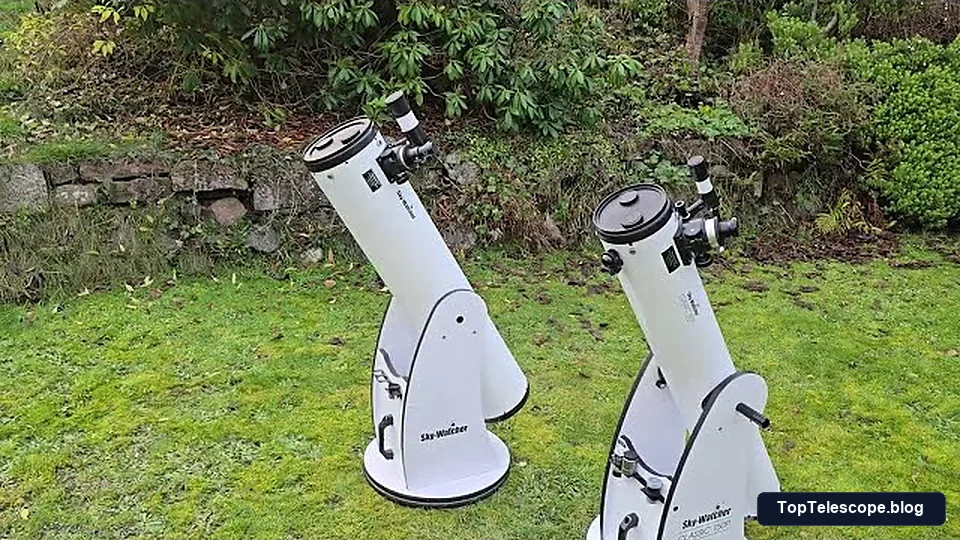
Engineering tolerances demand precise parabolic curves to eliminate spherical aberration at higher focal lengths. Manufacturing consistency across modern production lines ensures reliable optical performance straight out of the shipping container for both sizes.
Focal ratios typically hover around f/8 for the 6-inch model while the best 8 inch dobsonian telescope usually features an f/6 optical design. This configuration offers an optimal balance between physical tube length and manageable eyepiece pairings.
- Primary mirrors feature reflective aluminum coatings with protective overcoats.
- Secondary spiders use thin vanes to minimize diffraction spikes on bright stars.
- Focuser assemblies generally incorporate standard 2-inch Crayford or rack-and-pinion designs.
Optical Coatings and Glass Substrates
Modern telescope mirrors rely on specialized optical coatings to maximize reflectivity across the visible spectrum. High-reflectivity aluminum layers ensure that maximum photon counts reach your eye during faint nebula observations.
Pyrex or specialized low-expansion glass substrates minimize thermal distortion during rapid temperature drops. Selecting the right mirror material directly impacts how quickly your telescope achieves thermal equilibrium under evening skies.
- Enhanced coatings deliver roughly 94 percent reflectivity on primary surfaces.
- Substrate thickness prevents warping during aggressive transport over rough roads.
Real-World Light Gathering and Resolution
Aperture diameter dictates both light grasp and maximum resolving power for astronomical targets. The larger mirror surface area collects significantly more photons, revealing fainter spiral arms in distant galaxies.
Resolving double stars and planetary surface features depends heavily on clear aperture dimensions. The larger light cone of the bigger tube delivers sharper high-magnification views when atmospheric seeing conditions remain stable.
Calculating theoretical magnification limits reveals distinct operational boundaries for each telescope size. Pushing magnification beyond optical thresholds results in dim, blurry images that lack usable contrast and fine detail.
- Limiting stellar magnitude increases noticeably with every extra inch of aperture.
- Resolution scales linearly with primary mirror diameter according to standard physics.
- Planetary contrast benefits from clean optical surfaces and minimal central obstructions.
Deep-Sky Object Performance
Observing faint nebulae and distant star clusters requires maximum photon collection efficiency. Choosing the best 10 inch dobsonian telescope provides breathtaking views of celestial structures that remain completely invisible in smaller entry-level instruments.
Dark sky site performance amplifies the inherent advantages of larger primary mirrors. Experienced observers consistently note richer contrast on elusive Messier catalog entries when utilizing the bigger optical tube.
- Globular clusters resolve into individual pinpoints of light more readily.
- Emission nebulae respond exceptionally well to broadband light pollution filters.
Mechanical Mounts and Structural Stability
The best 16 inch dobsonian telescope mount relies on smooth friction materials to glide effortlessly across altitude and azimuth axes. Sturdy wooden rocker boxes provide remarkable stability without requiring heavy equatorial counterweight shafts.
Balancing the optical tube within the altitude bearings remains crucial for jitter-free tracking at high magnifications. Heavy finderscopes and wide-field eyepieces alter center-of-gravity calculations, requiring adjustable friction tensioners.
Base construction quality dictates long-term durability when transporting equipment to dark sky locations. Moisture-resistant laminates protect wooden components from morning dew and damp field grass during extended observing sessions.
- Teflon pads paired with laminate surfaces ensure buttery smooth manual tracking.
- Sturdy side handles simplify lifting the heavy wooden base into vehicle trunks.
- Spring-loaded tension clutches prevent the front-heavy optical tube from slipping.
Rocker Box Ergonomics
User comfort during long observing sessions depends heavily on eyepiece height and mount height. Ground-based Dobsonian designs keep the eyepiece at comfortable viewing angles for a wide variety of astronomical targets.
Standing versus sitting positions change based on altitude angle pointing towards the zenith. Selecting an adjustable observing chair prevents fatigue during marathon stargazing sessions under dark skies.
- Base footprint occupies minimal floor space on paved observation pads.
- Carrying cutouts integrated into the wood panels offer secure grip points.
Portability, Ergonomics, and Field Setup
Physical dimensions dictate how frequently a telescope actually makes it outside for stargazing. The smaller configuration slips easily across backseat vehicle floors without requiring complex disassembly procedures or seat folding.
Lifting a bulky optical tube assembly requires careful technique to avoid straining your lower back. Splitting transport duties between the mount base and the optical tube makes field deployment manageable for solo astronomers.
Total system weight influences your willingness to travel away from urban light pollution sources. Choosing lighter equipment often translates to more frequent usage and greater overall astronomical skill development.
- Total setup time generally takes less than five minutes from trunk to sky.
- Compact form factor fits effortlessly into standard sedan trunk compartments.
- Ergonomic carry handles reduce awkward lifting angles on stairs.
Vehicle Transport Considerations
Transporting rigid steel optical tubes demands adequate padding to protect alignment integrity. Securing components with seatbelts or cargo straps prevents shifting during sudden highway braking maneuvers.
Storage footprint inside apartments or closets influences long-term hobby satisfaction. Vertical storage corners keep living spaces tidy while keeping your optics ready for immediate backyard deployment.
- Backseat placement secures the optical tube against rolling hazards.
- Base unit rests flat on vehicle floors without tipping risks.
Maintenance, Collimation, and Mirror Care
Newtonian reflectors require periodic optical alignment checks known as collimation to ensure sharp focus. Using a simple laser collimator or Cheshire eyepiece streamlines this routine maintenance task before every observing session.
Primary mirror cells feature adjustment screws that align tilt angles with high mechanical precision. Keeping locking screws snug prevents vibrational drift caused by bumpy vehicle transport across unpaved roads.
Dust accumulation on optical surfaces is normal and requires minimal cleaning intervention over time. Excessive cleaning risks scratching delicate aluminum coatings, so homeowners should rely on compressed air blowers instead.
- Collimation verifies precise optical alignment between primary and secondary mirrors.
- Spring-loaded adjustment knobs allow tool-free collimation tweaks in the field.
- Dust covers protect open apertures during extended indoor storage periods.
Thermal Acclimation Procedures
Glass mirrors trap ambient heat during daytime storage inside warm residential buildings. Allowing adequate cooling time ensures internal air currents inside the tube settle before serious planetary imaging begins.
Optional cooling fans accelerate thermal stabilization by exhausting trapped heat out the rear cell. Quick temperature matching eliminates shimmering boundary layer currents that ruin high-power visual clarity.
- Thermal equilibrium prevents internal tube currents from blurring planetary details.
- Battery-powered cooling fans mount easily onto rear mirror cells.
Eyepiece Pairing and Magnification Limits
Focal length calculations determine your choice of eyepieces for wide-field or high-power viewing. Dividing telescope focal length by eyepiece focal length reveals exact magnification figures for every optical combination.
Wide-field oculars provide immersive spacewalk experiences when touring dense Milky Way star fields. Premium glass designs correct edge aberrations, delivering pinpoint stars right up to the extreme field stops.
Barlow lenses double or triple effective focal lengths without requiring extensive eyepiece collections. Inserting these optical amplifiers expands your magnification range using existing accessories during steady viewing nights.
- Standard 1.25-inch and 2-inch barrel sizes accommodate massive wide-field oculars.
- Exit pupil calculations prevent excessive image dimming at maximum magnifications.
- Eye relief measurements ensure comfortable viewing for astronomers wearing corrective glasses.
Calculating Useful Magnification
Practical magnification limits follow strict physical rules based on aperture diameters. Pushing beyond recommended thresholds yields empty magnification where image details simply enlarge without gaining resolution.
Atmospheric seeing conditions often dictate maximum usable power long before optical limits occur. Turbulent jet stream air currents blur fine planetary features regardless of telescope size.
- General rule dictates fifty magnification power per inch of aperture.
- Low-power eyepieces deliver brightest images for faint extended nebulae.
Matching Your Observing Environment and Goals
Urban backyard stargazers battling severe light pollution face unique contrast challenges with deep-sky targets. Upgrading to the best 12 inch dobsonian telescope makes planetary and lunar observation exceptionally rewarding despite local streetlights.
Rural dark sky expeditions transform modest apertures into breathtaking windows across the universe. Transporting your instrument away from civilization unlocks faint galaxies and intricate dust lanes within nebulae.
Defining your primary observing goals ensures long-term satisfaction with your equipment investment. Balancing physical exertion against optical performance guides you toward the ideal telescope for your lifestyle.
- Urban balconies demand compact footprints and easy vertical maneuverability.
- Dark sky sites reward maximum light grasp with unforgettable deep-sky vistas.
- Personal physical fitness determines safe handling limits for heavier optical tubes.
Future-Proofing Your Astronomy Setup
Starting your astronomical journey with a capable aperture prevents premature equipment upgrades later. Master observers find that intermediate Newtonian reflectors remain relevant additions to advanced collections.
Investing in quality accessories like comfortable chairs and good charts enhances overall enjoyment. Accessories travel easily between different telescope upgrades over the course of your hobby.
- Versatile focal lengths accommodate varied observing interests over time.
- Resale markets remain strong for well-maintained reflector telescope systems.
Frequently Asked Questions
Which telescope size is easier for beginners to transport?
The 6-inch Dobsonian offers superior portability because its lighter tube and smaller base fit easily across backseat vehicle floors without requiring complex seat folding maneuvers.
Can I see faint deep-sky galaxies with an 8-inch mirror?
Yes, the 8-inch aperture collects significantly more photons, revealing faint spiral structure and elusive galaxy details that remain invisible in smaller instruments under identical dark skies.
How often do these Newtonian reflectors require collimation?
Checking optical alignment takes only moments before each session using a simple laser tool. Rough transport over bumpy unpaved roads requires more frequent adjustment than stable backyard storage.
Do these telescopes require special motorized tracking mounts?
No, traditional Dobsonians use smooth manual altazimuth rocker boxes for tracking. Observers gently nudge the optical tube by hand to keep celestial targets centered at high magnifications.
What accessories should I purchase alongside the optical tube?
Investing in a comfortable adjustable observing chair and a quality Barlow lens enhances your viewing experience. Additional wide-field eyepieces expand your magnification range for planetary viewing.