10 Inch vs 12 Inch Dobsonian: Definitive Technical Comparison
Choosing between these aperture titans requires balancing optical throughput with physical ergonomics. Aperture rules deep-sky viewing, but rig weight dictates actual usage frequency.

Choose the 10 inch for superior portability and manageable garage storage. Select the 12 inch Dobsonian if you demand maximum light grasp for faint fuzzies and accept heavy truss disassembly.
Compare all top models in our Best Telescope: Top Backyard Picks for Astronomy.
Side-by-Side Breakdown
| Criteria | 10 Inch | 12 Inch Dobsonian | Edge |
|---|---|---|---|
| Core Design / Build | Solid tube or simple truss, Pyrex/Borosilicate mirrors | Heavier truss or solid tube, thick primary mirror | 10 Inch |
| Real-World Performance | 254mm light grasp, sharp planetary contrast | 305mm light grasp, deep sky resolution | 12 Inch Dobsonian |
| Ease of Setup & Use | Single-piece or light split tube, easy lifting | Heavy components requiring careful balancing | 10 Inch |
| Durability & Reliability | Robust laminate particle board bases | Sturdier truss poles, complex collimation holds | 10 Inch |
| Efficiency / Operating Footprint | Fits across standard vehicle backseat | Requires SUV or dedicated wagon transport | 10 Inch |
| Maintenance Requirements | Standard primary mirror cleaning, simple collimation | Frequent truss tension checks, heavier mirror cell | 10 Inch |
| Best Ideal Use Case | Backyard observer valuing quick deployment | Dedicated dark sky mobile astronomer | 12 Inch Dobsonian |
Core Optical Engineering Differences
Optical physics dictates that aperture dictates performance for deep-sky observation. The ten inch mirror collects roughly forty percent more light than an eight inch, while stepping up to twelve yields another significant leap.
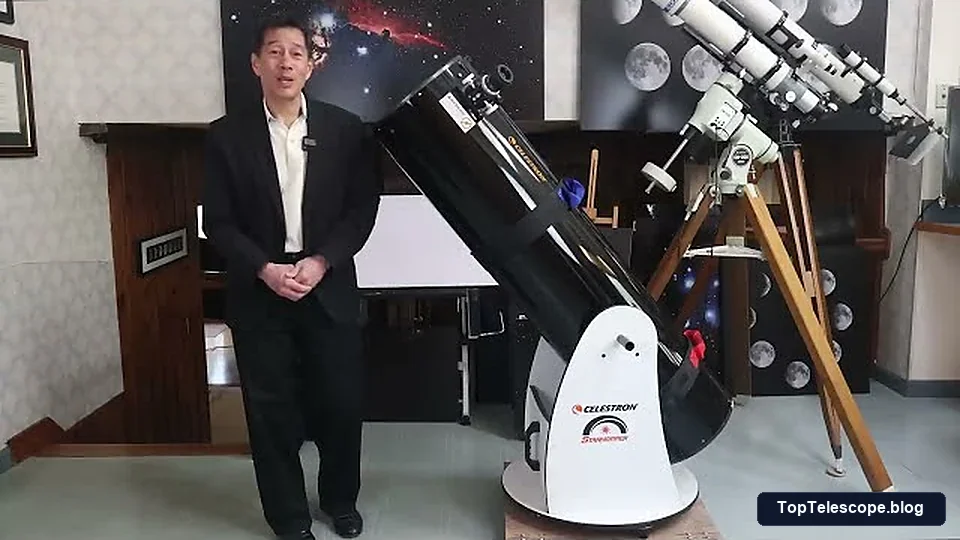
Stepping up from our featured 10 inch dobsonian telescope picks, a twelve-inch primary mirror increases light-gathering area by roughly forty-four percent. This extra aperture resolves fainter targets and enhances planetary contrast.
- Primary mirror diameter measured precisely at 254 millimeters for side A.
- Light collection area increases by roughly forty-four percent on side B.
- Surface accuracy requirements scale exponentially with larger mirror diameters.
Primary Mirror Thickness and Support
Thermal stability depends heavily on glass thickness and substrate composition. A typical twelve inch mirror requires a thicker profile or advanced sandwich design to prevent sagging, whereas ten inch units manage thermal shifts faster.
- Pyrex or Borosilicate substrates reduce thermal expansion during rapid outdoor cool-downs.
- Edge support clips prevent optical distortion in heavier primary mirror cells.
Mechanical Design and Structural Rigidity
Constructing a massive telescope demands rigorous engineering to eliminate flexure. Examining systems like our 16 inch dobsonian telescope choices highlights altitude bearings made from high-density polyethylene riding smoothly against Teflon pads.
Truss-tube configurations become practically mandatory for twelve-inch Dobsonians to manage OTA weight. Solid tubes at this scale suffer from flexure, requiring robust aluminum poles and precision clamping mechanisms to maintain optical collimation.
- Altitude bearing diameter dictates smoothness during planetary tracking maneuvers.
- Base particle board density impacts overall moisture resistance and stability.
Solid Tubes Versus Truss Poles
While ten inch models frequently arrive as solid optical tubes, twelve inch versions typically adopt truss designs. Truss architectures reduce total weight significantly, but they require longer assembly times and meticulous field collimation checks before sessions.
- Truss pole clamps require periodic tuning to maintain optical alignment.
- Solid tube designs retain collimation much better during rough transport.
Real-World Deep-Sky Performance
Stepping outside under dark skies reveals the true capability of large apertures. Resolving faint details inside spiral arms or splitting tight binary stars depends entirely on your mirror's diameter and local atmospheric seeing conditions.
Under dark rural skies, models featured in our 12 inch dobsonian telescope guide reveal spiral structure in faint galaxies. Resolving globular clusters into individual pinpoint stars demands this extended light cone.
- Limiting magnitude extends deeper by roughly half a magnitude between sizes.
- Surface brightness of extended nebulae benefits directly from increased light grasp.
Resolving Globular Clusters and Galaxies
Observing distant globular clusters like Messier 13 highlights the upgrade. The twelve inch resolves thousands of pinpoint stars right to the core, whereas the ten inch resolves fewer peripheral stars under identical rural night skies.
- Core resolution separates individual stars much cleaner in larger apertures.
- Faint galaxy arms show subtle structural contrast improvements with extra aperture.
Collimation, Thermal Equilibrium, and Maintenance
Large primary mirrors trap substantial thermal energy throughout the day. Active cooling fans become mandatory accessories for twelve inch systems, accelerating thermal equilibrium so you can achieve sharp planetary focus much faster after sunset.
Larger glass masses demand active cooling fans to reach ambient temperature quickly. A twelve-inch mirror takes significantly longer to shed heat than a ten-inch substrate, directly impacting your ability to use high magnifications early in the session.
- Boundary layer currents distort high magnification views until cooled completely.
- Primary mirror fans run on standard battery packs for field usage.
Maintaining Precise Optical Alignment
Collimating fast Newtonian optics requires careful laser or Cheshire alignment tools. The twelve inch truss design demands more frequent adjustments due to mechanical shifting of poles, while the ten inch solid tube holds alignment reliably.
- Laser collimators speed up alignment routines during dark sky sessions.
- Secondary mirror holders must resist twisting under heavy thermal and mechanical loads.
Portability, Transport, and Storage Footprint
Physical logistics often dictate which telescope gets used most frequently. If loading heavy equipment into a compact car feels exhausting, your scope stays indoors, rendering optical advantages completely useless during clear weekend stargazing nights.
Vehicle compatibility shifts dramatically when upgrading past ten inches. While a ten-inch solid tube fits across most back seats, a twelve-inch truss assembly requires careful breakdown into manageable components that fit securely in compact hatchbacks.
- Backseat vehicle loading requires careful measuring for solid tube diameters.
- Total assembled weight challenges single-person lifting ergonomics significantly.
Vehicle Loading Dynamics and Storage
Storing a massive Dobsonian requires dedicated garage floor space. For users seeking ultimate portability, our best 8 inch dobsonian picks outlines smaller options that fit easily across standard vehicle backseats.
- Rocker box dimensions consume substantial floor space in home storage areas.
- Handle placements on the optical tube assembly prevent accidental dropping incidents.
Ergonomics, Mounting Heights, and Accessories
Eyepiece positioning at zenith creates notable height discrepancies between these models. Shorter observers might need a sturdy observing step stool when using the twelve inch variant, while the ten inch remains accessible while standing firmly.
Eyepiece height at zenith is a critical ergonomic factor. A twelve-inch focal length often forces observers to use an adjustable observing chair or step stool, whereas a ten-inch scope remains more accessible while standing near the ground.
- Zenith eyepiece height reaches over sixty inches on larger systems.
- Crayford focusers with dual-speed knobs provide precise planetary adjustments.
Finder Scope Integration and Balance
Balancing heavy accessories like optical finders or binoviewers requires adjustable counterweights. Larger Dobsonians demand stronger friction brakes on altitude bearings to prevent nose-heavy diving when swapping out heavy wide-field eyepieces during observing sessions.
- Magnetic counterweight systems attach easily to particle board rocker boxes.
- Rigel or Telrad finders help star-hop efficiently across dark rural skies.
Total System Investment and Long-Term Value
Investing in advanced aperture telescopes demands long-term commitment to astronomy. Upgrading components like finders, focusers, and eyepieces enhances performance, making your initial optical tube assembly a foundation for decades of rewarding stargazing adventures.
Investing in larger optics demands budgeting for premium eyepieces and coma correctors. Fast focal ratios on twelve-inch mirrors highlight optical aberrations, making quality wide-field oculars an essential part of your overall hardware setup.
- Upgraded optical coatings increase light transmission across the visible spectrum.
- Sturdy base construction ensures the mount survives years of transport vibration.
Resale Stability and Durability
High-demand aperture sizes retain exceptional resale value within local astronomy communities. Proper mirror care and regular cleaning preserve optical coatings, ensuring your investment remains attractive to fellow stargazers if you decide to upgrade later.
- Mirror coating longevity depends on minimizing dust accumulation and moisture.
- Mechanical parts availability simplifies long-term repairs and DIY modifications.
Frequently Asked Questions
Which telescope offers better transportability for weekend road trips?
The ten inch model is significantly easier to transport because its solid tube configuration fits across standard vehicle backseats without requiring complex disassembly procedures or risk of misalignment.
In contrast, the twelve inch unit demands an SUV or specialized vehicle configuration to safely accommodate its bulky truss poles and massive rocker box.
Do I need an observing step stool for a twelve inch Dobsonian?
Observing objects near the zenith with a twelve inch telescope frequently positions the eyepiece at heights exceeding sixty inches, meaning most average-height observers will definitely require a stable step stool.
Meanwhile, the ten inch variant keeps the eyepiece much lower, allowing comfortable standing observations without constantly repositioning physical steps during your session.
How much harder is collimating a truss Dobsonian compared to a solid tube?
Collimating a truss Dobsonian takes slightly more patience because the poles introduce minor flexure whenever you assemble the telescope at your dark sky observing location.
However, utilizing a quality laser collimator makes this routine alignment process straightforward, ensuring your optics deliver sharp planetary views despite the mechanical separation.
Can beginners easily manage the weight of a twelve inch mirror cell?
Managing a twelve inch mirror cell requires careful lifting technique because the heavy glass and surrounding metal cell create an awkward, dense load that can strain your lower back during transport.
Beginners often find that the ten inch alternative offers a much more forgiving physical weight distribution for solo setup routines.
Is the optical performance upgrade from ten to twelve inches truly noticeable?
The step up in aperture provides a noticeable increase in light grasp, allowing you to resolve faint spiral arms in distant galaxies and separate tight globular clusters with noticeably greater structural clarity.
However, this optical benefit depends entirely on observing under genuinely dark rural skies where atmospheric seeing conditions are stable.