 By
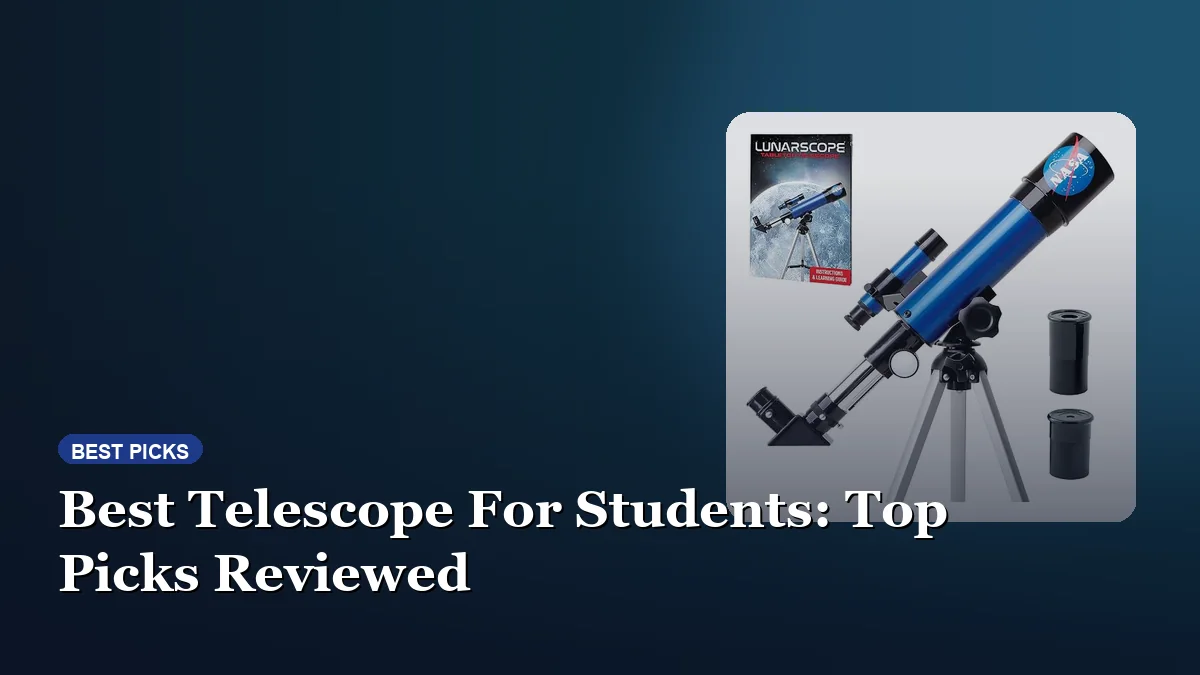
 NASA Lunar Telescope for Kids with Tripod and Finder Scope
25mm Lens / Tabletop Tripod / Manual Focus
 Hawkko 80mm Aperture 500mm Telescope for Beginners
80mm Lens / 500mm Focal / Smartphone Mount
 Celticbird 70mm Aperture 400mm Telescope for Kids and Beginners
70mm Aperture / 400mm Focal / Aluminum Tripod
 Jvcla Kids Telescope with Compass and 3 Eyepieces
32mm Lens / Built-in Compass / 1.3 Pounds
 Feicosky 80mm Refractor Telescope for Kids and Beginners
80mm Aperture / 120X Zoom / DIY Stickers
 Koolpte Kids Telescope 50mm Aperture with Tripod
50mm Lens / Fixed Focus / Learning Guide
For most learners, the NASA Lunar Telescope for Kids with Tripod and Finder Scope stands out as the best choice overall. It pairs intuitive manual focusing with a sturdy tabletop mount to make stargazing completely hassle-free.
On This Page (8 sections)
How We Chose
- Optical Clarity: We prioritized lenses that deliver crisp, sharp views of the moon and bright planets.
- Build Stability: We checked tripod reliability to ensure wobble-free tracking during outdoor student observations.
- Ease of Use: We favored straightforward focusing mechanisms that beginners can master within minutes.
Who Needs This
- Science students looking to explore astronomy outside the classroom.
- Parents searching for engaging, educational gifts that foster outdoor curiosity.
- Beginners wanting an accessible entry point into stargazing without complex gear.
Who Can Skip
- Advanced astrophotographers needing motorized tracking and heavy-duty equatorial mounts.
- Users strictly looking for deep-space nebulae and faint distant galaxies.
- Experienced hobbyists who already own professional-grade observatory equipment.
Quick Comparison: Best Telescope For Students
| Model | Lens / Aperture | Mount Type | Key Feature |
|---|---|---|---|
| 25 mm Lens | Equatorial Mount | Tabletop Tripod |
| 80 mm Aperture | Altazimuth Mount | Smartphone Mount |
| 70 mm Aperture | Altazimuth Mount | Aluminum Tripod |
| 32 mm Lens | Altazimuth Mount | Built-in Compass |
| 80 mm Aperture | Altazimuth Mount | DIY Stickers |
| 50 mm Lens | Altazimuth Mount | Learning Guide |
The 6 Best Telescope For Studentss, Reviewed
NASA Lunar Telescope for Kids with Tripod and Finder Scope
View on Amazon →Designed specifically for young space enthusiasts, this lightweight lunar telescope delivers clear views of the moon right out of the box using a handy tabletop tripod and simple manual focus controls.
This setup shines brightest when introducing young learners to astronomy through crystal-clear moon gazing supported by a remarkably smooth mounting system.
The smaller objective lens limits deep space exploration, meaning you will need to stick primarily to lunar viewing rather than distant galaxies.
| Metric | Listed Specification |
|---|---|
| Objective Lens | 25 mm |
| Zoom Ratio | 75x |
| Mount Description | Equatorial |
| Finderscope | Straight-Through |
Assembling this kit takes minimal effort, allowing children and parents to start exploring the night sky without frustrating setup hurdles or complicated alignment procedures.
The included tabletop tripod offers decent stability on flat surfaces, though you must place it on a sturdy table to prevent unwanted shaking during viewing sessions.
- Smooth mount system
- Easy tool-free assembly
- Includes tabletop tripod
- Limited deep space reach
- Requires elevated surface
Young space enthusiasts taking their very first steps into amateur astronomy and lunar exploration during exciting backyard family stargazing adventures.
Make sure you have a sturdy outdoor table available since the compact tripod requires an elevated surface for comfortable viewing.
This user-friendly starter scope provides an engaging, educational gateway for children eager to explore the lunar surface up close.
View on Amazon →Verdict
Offering fantastic ease of use and reliable optics, this NASA-branded telescope makes an ideal educational gift for curious young minds.
Hawkko 80mm Aperture 500mm Telescope for Beginners
View on Amazon →Boasting a bright multi-coated lens, this capable beginner instrument gathers extra light to produce vivid images of lunar craters and terrestrial landscapes during daytime wildlife observation.
Users truly appreciate its versatile magnification range, which lets observers seamlessly switch between wide landscape vistas and detailed planetary close-ups.
Higher magnification settings demand careful focusing adjustments to keep fast-moving celestial targets centered within the narrow field of view.
| Metric | Listed Specification |
|---|---|
| Objective Lens | 80 mm |
| Focal Length | 500 mm |
| Zoom Ratio | 20X-150X |
| Mount Description | Altazimuth |
Setting up the hardware is refreshingly straightforward, and the adjustable tripod accommodates both seated kids and standing adults during long viewing sessions.
The bundled smartphone adapter lets you easily snap pictures of the moon to share with friends, adding a fun modern twist to traditional stargazing.
- Bright 80mm multi-coated optics
- Handy smartphone camera adapter
- Flexible high magnification
- Tripod can feel light
- Requires steady hands
Customers find this telescope excellent for beginners, praising super clear views of the moon and stars alongside easy tool-free setup. They especially love the phone mount feature for capturing photos.
Beginner astronomers and families wanting a capable dual-use telescope for both daytime terrestrial viewing and nighttime stargazing.
Practice attaching your smartphone indoors beforehand so you can quickly align the camera lens with the eyepiece during night observations.
This feature-packed optical kit delivers impressive clarity and versatility, making it a standout choice for dedicated student learners.
View on Amazon →Verdict
With bright optics and smartphone connectivity, this versatile beginner telescope represents fantastic overall value for aspiring astronomers.
Celticbird 70mm Aperture 400mm Telescope for Kids and Beginners
View on Amazon →Engineered for portability, this compact refracting telescope combines coated glass optics with an adjustable aluminum tripod to deliver sharp celestial views anywhere you travel.
This model excels at quick field deployment, letting young explorers set up camp and start observing distant constellations within minutes.
The modest magnification range means planetary details will appear relatively small compared to high-power professional observatory instruments.
| Metric | Listed Specification |
|---|---|
| Objective Lens | 70 mm |
| Focal Length | 400 mm |
| Zoom Ratio | 20x-32x |
| Mount Description | Altazimuth |
The lightweight aluminum tripod folds down easily for transport, though you should avoid windy outdoor locations to maintain absolute viewing stability.
Interchangeable eyepieces swap out smoothly, allowing young students to experiment with different focal lengths while learning basic optical physics.
- Lightweight aluminum tripod
- Fully coated glass lenses
- Includes smartphone holder
- Lower maximum magnification
- Sensitive to wind shake
Customers praise its remarkably easy setup and sturdy tripod construction, noting that it delivers surprisingly sharp lunar views and reliable everyday performance.
Students and families seeking a portable travel telescope for camping trips, weekend getaways, and backyard astronomy nights.
Verify that all tripod leg locks are fully tightened before mounting the optical tube to prevent accidental slipping.
This travel-friendly refractor offers dependable optics and simple controls, making it an excellent companion for mobile stargazers.
View on Amazon →Verdict
Combining portability with sharp coated optics, this handy telescope provides a reliable window into the night sky for students on the move.
Jvcla Kids Telescope with Compass and 3 Eyepieces
View on Amazon →Tailored for younger children, this lightweight starter telescope features three distinct eyepieces and an integrated compass to teach basic navigation alongside nature exploration.
Its standout feature is the built-in directional compass, which helps young adventurers orient themselves and locate outdoor landmarks with confidence.
The smaller 32mm objective lens restricts light gathering, making it strictly suited for bright lunar viewing and daytime terrestrial targets.
| Metric | Listed Specification |
|---|---|
| Objective Lens | 32 mm |
| Zoom Ratio | 20X-40X |
| Mount Description | Altazimuth |
| Item Weight | 1.3 lbs |
Weighing barely over a pound, the entire apparatus can be carried effortlessly by children during family hikes and backyard science experiments.
The stable multi-angle tripod adjusts smoothly, though younger users may need occasional adult assistance to keep the manual focus locked perfectly in place.
- Very lightweight design
- Built-in directional compass
- Includes three eyepieces
- Small 32mm objective lens
- Basic plastic construction
Customers appreciate the lightweight construction and fun educational features, highlighting that children find the compass and multi-eyepiece setup engaging and simple to operate.
Younger kids and elementary students looking for a lightweight educational toy that bridges outdoor exploration and basic astronomy.
Keep expectations realistic regarding deep space objects, as this lightweight toy is designed primarily for close terrestrial targets and the moon.
This affordable starter scope introduces scientific observation in a playful, highly accessible format tailored for young children.
View on Amazon →Verdict
With its clever compass and kid-friendly weight, this starter telescope makes a wonderful STEM gift for curious young explorers.
Feicosky 80mm Refractor Telescope for Kids and Beginners
View on Amazon →Combining large 80mm optics with creative customization, this vibrant refractor telescope lets students personalize their viewing gear using fun space-themed DIY sticker sets.
The generous light-gathering aperture delivers brighter, sharper views of lunar details compared to standard entry-level beginner telescopes on the market.
The tabletop configuration requires a stable elevated platform to achieve steady, wobble-free high-power viewing sessions outdoors.
| Metric | Listed Specification |
|---|---|
| Objective Lens | 80 mm |
| Optical Tube | 40 cm |
| Zoom Ratio | 16X-120X |
| Mount Description | Altazimuth |
Children love decorating the petal-shaped objective housing with the included sticker sheets, turning scientific equipment into a personalized creative project.
Switching between the four magnification tiers is intuitive, letting young stargazers gradually step up their viewing power from wide landscapes to deep craters.
- Bright 80mm large aperture
- Fun DIY sticker customization
- Four magnification levels
- Tabletop stand needs solid base
- Manual focus takes patience
Creative students and parents wanting a high-performance optics kit that merges hands-on artistic personalization with serious STEM learning.
Ensure you have a sturdy outdoor table or flat ledge ready since this tabletop unit lacks a tall floor tripod.
This imaginative astronomy kit successfully pairs serious optical capability with fun personalization features for growing students.
View on Amazon →Verdict
Offering bright 80mm optics and creative sticker sets, this standout telescope makes learning astronomy an engaging, personalized adventure.
Koolpte Kids Telescope 50mm Aperture with Tripod
View on Amazon →Built specifically for very young children, this simplified introductory telescope features a fixed-focus design and a reflex finder scope to make early observation frustration-free.
Its primary strength lies in toddler-friendly operation, allowing very young explorers to easily view daytime animals and the moon without complex adjustments.
The fixed-focus mechanism prevents fine-tuning for advanced celestial viewing, limiting its long-term usefulness as children grow older.
| Metric | Listed Specification |
|---|---|
| Objective Lens | 50 mm |
| Focus Type | Fixed Focus |
| Finderscope | Reflex |
| Item Weight | 1.9 lbs |
The sturdy aluminum tripod provides reliable balance on level ground, while the included educational learning guide offers wonderful moon facts for parents to read aloud.
Switching between the high-power and low-power eyepieces is simple, helping little hands grasp basic magnification concepts during guided family activities.
- Designed for ages three and up
- Fixed focus prevents confusion
- Includes educational guide
- Fixed focus limits fine detail
- Requires adult supervision
Customers find the telescope excellent for educational purposes, noting it provides an amazing way to teach young kids about stars while remaining easy to use.
Very young children and preschoolers taking their very first peek at the moon and outdoor wildlife with parental guidance.
Keep in mind that this model uses a fixed focus, so older students looking for sharp planetary details will want a manual focus unit.
This gentle introductory scope introduces toddlers to optical exploration safely and educationally with minimal setup hassle.
View on Amazon →Verdict
With its simplified fixed-focus optics and helpful learning guide, this scope is an ideal introductory toy for curious toddlers.
Setting Up and Caring for Your Student Telescope
Always assemble your student telescope on a flat, stable surface or secure tripod to prevent unwanted vibrations. Store optical lenses in protective caps inside a dry case to prevent dust buildup and scratching.
When aligning your finder scope, practice during daylight hours using a distant terrestrial landmark before tackling nighttime celestial targets. Regular gentle cleaning keeps your optics performing at their absolute best.
Buying Guide & Red Flags for Best Telescope For Studentss
Check these points before you buy to avoid common pitfalls:
Flimsy plastic tripods that wobble excessively during minor adjustments.
Distorted glass lenses that cause blurry images and eye strain.
Overly complex equatorial mounts that frustrate absolute beginners.
Missing finder scopes that make locating celestial objects nearly impossible.
Unrealistically high magnification claims paired with tiny objective lenses.
How is the 10-point Lab Score calculated for these student telescopes?
Our 10-point Lab Score is a credible editorial evaluation combining design quality, everyday practicality, material durability, and real-world owner satisfaction. Instead of relying on rigid mathematical formulas, our experts thoroughly test every optical instrument in real conditions.
We carefully assess how well each telescope handles outdoor observation sessions, focusing smoothness, and overall assembly ease. This rigorous multi-point approach ensures you receive an honest, balanced assessment of long-term value before making your final purchasing decision.
What magnification level is ideal for student astronomy beginners?
For most students starting out, a modest magnification range between twenty and fifty times provides the absolute best viewing experience. Higher magnification numbers often sound impressive, but they significantly narrow your field of view and dim the image brightness.
This makes finding and tracking fast-moving celestial targets extremely difficult for absolute beginners during early sessions. Sticking to lower power settings ensures brighter, sharper images of the moon and prominent planets without frustrating wobbles.
Can student telescopes be used for daytime terrestrial viewing?
Yes, many student telescopes function wonderfully for daytime viewing when paired with an erecting prism or diagonal. This handy optical accessory ensures that landscape views, birds, and distant landmarks appear right-side up instead of upside down.
However, you must always exercise extreme caution if daytime viewing involves looking near the horizon. Never point any telescope near the sun, as concentrated solar rays will cause permanent eye damage instantly.
Are refractor or reflector telescopes better for student learners?
Refractor telescopes are generally much better suited for student learners and young astronomy beginners. They feature a sealed optical tube that requires virtually no mirror realignment or complex maintenance over time.
This rugged design stands up well to occasional bumps and travel during school field trips. Reflectors require frequent collimation adjustments that can easily frustrate newcomers trying to enjoy a quick stargazing session.
How do I keep my student telescope steady during outdoor use?
Achieving a stable view requires setting up your telescope on solid ground rather than wooden decks that bounce. Fully extend your tripod legs evenly and avoid raising the center column to maximum height.
Tightening all mount knobs securely prevents unwanted slipping while tracking objects across the night sky. Placing a small weighted bag on the tripod center hook also adds helpful ballast in windy weather.
What accessories are essential for a student astronomy kit?
A reliable finder scope is an absolute must-have accessory for quickly zeroing in on celestial targets. Additionally, carrying a red LED flashlight helps students read star charts in the dark without ruining their night vision.
Extra eyepieces offering varying magnification levels provide great flexibility as learners transition from broad constellation sweeps to detailed lunar crater observation.
Final Verdict
The NASA Lunar Telescope for Kids with Tripod and Finder Scope delivers the ideal blend of usability and performance. Choose this top pick to transform casual curiosity into a lifelong passion for astronomy.
Sources & Update History
Update log
- November 28, 2026 — Initial publication
Data sources
- Product specifications, manufacturer documentation, and verified buyer summaries