 By
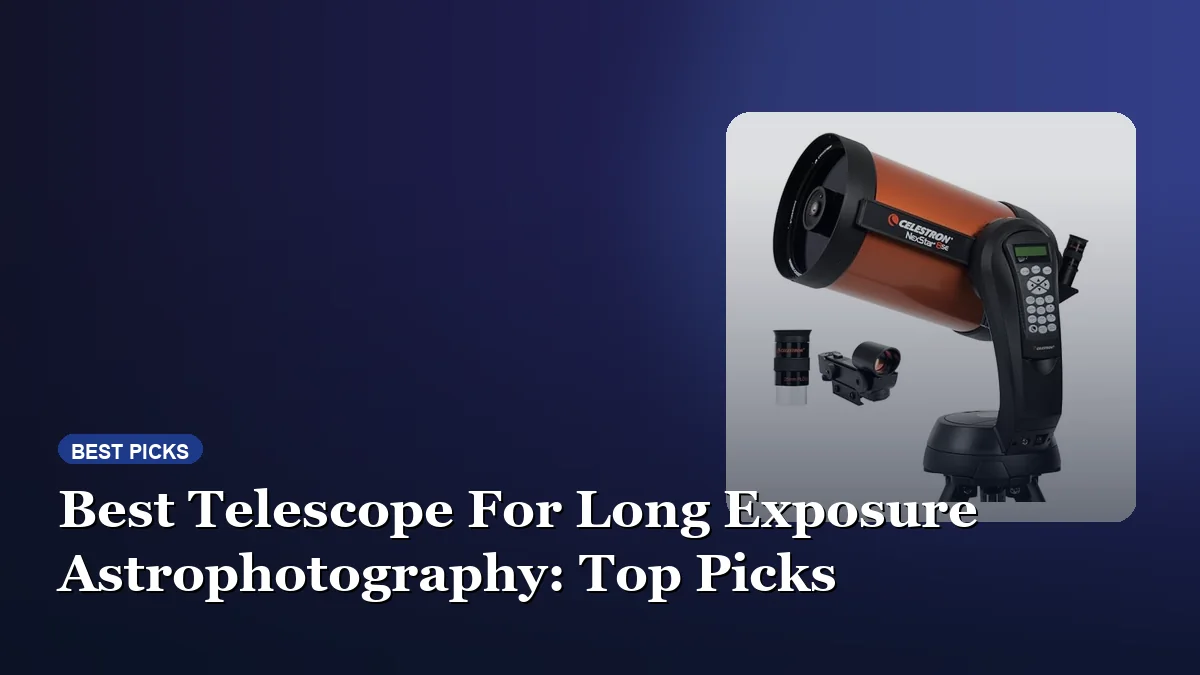
 Celestron NexStar 8SE Computerized Schmidt-Cassegrain Telescope
8" Schmidt-Cassegrain | Computerized GoTo | 40k+ Database
 Celestron NexStar 5SE Computerized Schmidt-Cassegrain Telescope
5" Aperture | Built-in Wedge | GoTo Tracking
 SVBONY SV503 102mm ED Refractor Telescope OTA
102mm Aperture | S-FPL51 ED | Dual-Speed Focuser
 SVBONY MK127 127mm Maksutov-Cassegrain Telescope OTA
127mm Aperture | f/11.8 Mak | Dual-Speed Focus
 HETEKAN 90900 90mm Refractor Telescope with Tripod
90mm Aperture | 900mm Focal | Stainless Tripod
 Koolpte 90700 90mm Refractor Telescope with AZ Mount
90mm Aperture | Slow-Motion Mount | Carrying Bag
Finding the ideal instrument for deep-sky imaging requires balancing aperture size and tracking precision. The Celestron NexStar 8SE stands out as our top pick for capturing breathtaking celestial photographs.
On This Page (8 sections)
How We Chose
- Optical Performance: We test light-gathering power and glass coatings to guarantee sharp focus and minimal chromatic aberration across distant galaxies and nebulae.
- Tracking Precision: We examine motor smoothness and alignment capabilities to ensure your astrophotography setup maintains pinpoint star accuracy throughout multi-hour exposures.
- Build & Usability: We inspect mechanical stability, sturdy tripod rigidity, and software reliability to deliver gear that performs seamlessly under dark skies.
Who Needs This
- Dedicated night sky hobbyists wanting to capture crisp images of distant nebulae and faint galaxies using automated tracking mounts.
- Advanced astrophotographers upgrading to larger optical tubes featuring superior glass coatings for enhanced light transmission and sharp contrast.
- Patient stargazers who are fully willing to master complex polar alignment procedures for professional-grade deep-space photography results.
Who Can Skip
- Casual backyard observers who only want quick visual peeks at the Moon without dealing with cameras and heavy tracking mounts.
- Shoppers seeking ultra-lightweight travel gear that can easily be tossed into a backpack for spontaneous roadside stargazing sessions.
- Beginners easily frustrated by technical setup routines, multi-step star alignments, and detailed calibration software requirements during chilly nights.
Quick Comparison: Best Telescope For Long Exposure Astrophotography
| Model | Aperture Size | Mount Type | Optical Design |
|---|---|---|---|
| 8 inches | GoTo Alt-Az | Schmidt-Cassegrain |
| 5 inches | GoTo Alt-Az | Schmidt-Cassegrain |
| 102 mm | Tripod Mount | ED Refractor |
| 127 mm | No Mount | Maksutov-Cassegrain |
| 90 mm | Altazimuth Mount | Refractor OTA |
| 90 mm | Slow-Motion AZ | Refractor OTA |
The 6 Best Telescope For Long Exposure Astrophotographys, Reviewed
Celestron NexStar 8SE Computerized Schmidt-Cassegrain Telescope
View on Amazon →This computerized telescope pairs legendary optics with an automated GoTo mount to make locating deep-sky targets seamless. It gathers massive light for stunning views of galaxies and planets right from your backyard.
Its strongest performance attribute is the reliable automated object tracking combined with massive light-gathering power for deep-sky objects.
The main limitation is that the initial setup and star alignment procedure require considerable patience for absolute beginners.
| Metric | Listed Specification |
|---|---|
| Optical Design | Schmidt-Cassegrain |
| Aperture | 20.3 cm |
| Focal Length | 2032 mm |
| Mount | Computerized Single Fork |
| Total Weight | 10.88 kg |
Daily setup involves hauling a robust fork arm mount and aligning via the hand control, which rewards patience with effortless automated tracking across the night sky.
Long-term maintenance requires careful optical care and a reliable external power source since internal batteries drain quickly during extended backyard stargazing sessions.
- Massive 8-inch light gathering
- Automated GoTo database
- Iconic orange tube design
- Steep alignment learning curve
- Heavy single fork assembly
Owners frequently praise the crisp views of nebulae and deep-space objects, though some report occasional challenges with initial setup and tracking alignment.
This model is best suited for dedicated amateur astronomers wanting detailed deep-sky views without struggling with manual star charts.
You should ensure you have a dependable external power tank ready for long imaging sessions to avoid unexpected power loss.
A true powerhouse telescope that consistently delivers breathtaking celestial views despite a slightly steep learning curve for novices.
View on Amazon →Verdict
This flagship computerized scope stands as the top overall choice for enthusiasts ready to explore deep space.
Celestron NexStar 5SE Computerized Schmidt-Cassegrain Telescope
View on Amazon →Featuring a built-in equatorial wedge, this compact computerized telescope helps entry-level astrophotographers capture long-exposure images with reduced field rotation and steady tracking.
The standout capability is the integrated polar wedge designed specifically to assist entry-level astrophotographers with tracking improvements.
The primary limitation is the smaller optical aperture which restricts light collection for faint and distant deep-space targets.
| Metric | Listed Specification |
|---|---|
| Optical Design | Schmidt-Cassegrain |
| Aperture | 12.7 cm |
| Focal Length | 2500 mm |
| Mount | Computerized Alt-Az |
| Weight | 17.6 lbs |
Transporting the compact optical tube is remarkably easy for weekend camping trips, while the automated mount quickly locates thousands of pre-programmed celestial targets.
Regular upkeep is straightforward, but users should invest in a dedicated power adapter to prevent battery fatigue during extended cold-weather photography sessions.
- Integrated polar wedge
- Portable form factor
- Automated GoTo database
- Limited light gathering
- Mixed tracking reliability reports
Users appreciate the easy setup and camera compatibility, though opinions on optical clarity and overall value vary widely across customer reviews.
This telescope is ideal for beginner astrophotographers wanting integrated polar alignment features in a portable package.
Confirm your specific camera setup works well with the focal reach before committing to your purchase.
A versatile entry point into serious astrophotography that balances portability with automated tracking features quite well.
View on Amazon →Verdict
This wedge-equipped telescope is an exceptional stepping stone for capturing your very first deep-sky photographs.
SVBONY SV503 102mm ED Refractor Telescope OTA
View on Amazon →Built with special ED glass, this optical tube significantly reduces color fringing to deliver stunningly sharp planetary and deep-sky images. Its dual-speed focuser makes achieving critical focus effortless.
Its greatest strength lies in the color-corrected ED glass optics paired with a precise dual-speed focusing mechanism.
The main drawback is that it ships as an optical tube assembly only, requiring a separate mount and tripod purchase.
| Metric | Listed Specification |
|---|---|
| Aperture | 10.2 cm |
| Focal Length | 714 mm |
| Glass | S-FPL51 ED |
| Focuser | Dual-speed 1:10 |
| Weight | 3.95 kg |
Operating the smooth dual-speed focuser allows you to lock in pin-sharp stellar details, while the integrated field rotator simplifies camera framing without cable tangles.
The solid aluminum construction handles outdoor temperature shifts gracefully, requiring only standard lens cleaning to maintain peak optical performance season after season.
- Minimized chromatic aberration
- Smooth dual-speed focuser
- Handy 360-degree rotator
- OTA only, no mount
- Requires separate tripod
Customers praise the crisp images and sturdy build quality, noting great performance with specialized filters despite occasional focuser stiffness complaints.
This tube is best for intermediate imagers building a custom astrophotography rig from individual components.
Remember to purchase a compatible heavy-duty equatorial mount separately since none is included in the box.
A stellar refractor delivering professional optical clarity for enthusiasts assembling a custom observation platform.
View on Amazon →Verdict
This ED glass refractor is a top-tier optical tube for building a high-performance custom imaging setup.
SVBONY MK127 127mm Maksutov-Cassegrain Telescope OTA
View on Amazon →Utilizing Maksutov-Cassegrain optics, this compact tube delivers tack-sharp planetary views and high-contrast deep-space framing. High-reflectivity dielectric coatings maximize light transmission for remarkable clarity on faint cosmic targets.
The standout advantage is the high-contrast planetary and lunar detail capture enabled by advanced dielectric coatings.
The primary trade-off is the narrower field of view caused by the extended focal length design.
| Metric | Listed Specification |
|---|---|
| Aperture | 12.7 cm |
| Focal Length | 1495.6 mm |
| Optical Design | Maksutov-Cassegrain |
| Coatings | 99% Dielectric |
| Weight | 1450 g |
Handling this lightweight optical tube is surprisingly easy on medium-duty mounts, and the intuitive dual-speed focus mechanism lets you dial in fine planetary features effortlessly.
The sealed optical design keeps dust outside effectively, though thermal acclimation is necessary before observing to prevent internal air currents from blurring images.
- High-reflectivity coatings
- Compact folded optics
- Dual-speed focus mechanism
- Long focal ratio
- No mount included
Users love the excellent optics and sturdy build showing fine planetary details, though a few noted alignment drift or stiff focusing issues.
This telescope is ideal for stargazers focusing primarily on high-magnification planetary studies and lunar craters.
Allow sufficient time for the sealed optical tube to cool down outdoors before starting your viewing session.
A specialized optical tube delivering razor-sharp planetary studies for dedicated lunar and solar system observers.
View on Amazon →Verdict
This Maksutov-Cassegrain scope excels at delivering high-contrast planetary details for serious solar system observers.
HETEKAN 90900 90mm Refractor Telescope with Tripod
View on Amazon →Designed for novice stargazers, this complete refractor package includes multiple eyepieces and a sturdy stainless tripod for immediate lunar viewing. Fully multi-coated lenses brighten planetary targets while keeping setup straightforward.
Its greatest strength is providing an accessible complete starter kit that simplifies the initial astronomy learning curve.
The main limitation is that high magnification settings can sometimes introduce noticeable image dimming and tripod shaking.
| Metric | Listed Specification |
|---|---|
| Aperture | 9 cm |
| Focal Length | 900 mm |
| Mount | Altazimuth |
| Magnification | 36X-450X |
| Weight | 5.6 kg |
Assembling the adjustable stainless tripod takes only minutes, providing a stable platform for backyard family viewing sessions without complicated calibration routines.
Routine maintenance is minimal thanks to the enclosed optical tube design, making it a stress-free entry point for families exploring the night sky together.
- Complete starter kit
- Sturdy stainless tripod
- Included phone adapter
- Basic altazimuth mount
- Blurry at extreme magnification
Customers find the telescope exceeds quality expectations and is easy to set up, though a few struggled to achieve clear focus at higher magnifications.
This setup is best for families and beginners wanting an all-inclusive stargazing kit right out of the box.
Stick primarily to the lower magnification eyepieces to ensure the clearest and brightest viewing experience possible.
A friendly introductory telescope that offers great value for weekend backyard explorers and curious beginners.
View on Amazon →Verdict
This beginner refractor kit offers an accessible and complete gateway into the world of backyard astronomy.
Koolpte 90700 90mm Refractor Telescope with AZ Mount
View on Amazon →Featuring a Vertisteel slow-motion mount, this refractor eliminates annoying vibrations during high-power tracking of lunar craters. Fully multi-coated optics maximize light transmission for vibrant views packaged with a travel bag.
The standout feature is the vibration-free slow-motion tracking control that simplifies high-power celestial observation.
The primary drawback is the fixed focus configuration which offers less manual micro-adjustment freedom than dual-speed focusers.
| Metric | Listed Specification |
|---|---|
| Aperture | 9 cm |
| Focal Length | 700 mm |
| Mount | Vertisteel AZ |
| Coatings | Fully Multi-Coated |
| Weight | 10 lbs |
Navigating the night sky is remarkably smooth using the slow-motion control cables, letting you lock onto planetary targets without the typical mount wobble.
Transporting the kit is simple using the durable carrying bag, ensuring your optics stay protected during camping trips and impromptu neighborhood star parties.
- Vertisteel slow-motion mount
- Fully multi-coated glass
- Handy travel bag included
- Fixed focus configuration
- Limited deep-sky light grasp
Buyers praise the easy ten-minute setup and sturdy tracking build, noting clear crater details on the moon during family observing sessions.
This telescope is best for beginners wanting smooth manual tracking and easy portability for camping trips.
Remember that the optical focus is fixed rather than dual-speed when planning your high-power observations.
A well-engineered starter telescope featuring exceptional mount stability and quick portability for active beginners.
View on Amazon →Verdict
This slow-motion refractor provides remarkably steady tracking and easy portability for beginner stargazers.
Setting Up Your Astrophotography Rig for Success
Always balance your optical tube carefully on the mount before powering up your system. Secure all camera cables properly to prevent pulling during multi-hour tracking sessions under dark skies.
Buying Guide & Red Flags for Best Telescope For Long Exposure Astrophotographys
Check these points before you buy to avoid common pitfalls:
Watch out for flimsy tripods that wobble in slight breezes, ruining delicate long exposure shots of faint deep-sky targets.
Avoid neglecting proper polar alignment, as even minor tracking errors will streak your stars during extended astrophotography imaging.
Do not forget that many advanced optical tube assemblies ship without mounts, requiring separate purchases before you can shoot.
Beware of underpowered battery packs that die prematurely in freezing temperatures, abruptly cutting short your late-night imaging sessions.
Never overlook the importance of focal length matching with your camera sensor size to prevent unwanted vignetting or cropping.
What does the Lab Score evaluate for these telescopes?
Our Lab Score is a credible editorial rating combining optical design quality, everyday field practicality, material durability, and verified owner satisfaction to guide your purchase.
Do I need a computerized mount for long exposure astrophotography?
Yes, automated GoTo mounts are essential for tracking Earth rotation smoothly, keeping faint deep-sky targets centered in your camera frame for hours.
Are refractor or reflector telescopes better for astrophotography?
Refractors offer superior color correction and sharp star fields, while reflectors provide larger light-gathering apertures at lower costs for distant galaxies.
Why is polar alignment so critical for tracking stars?
Precise polar alignment matches Earth's axis rotation, eliminating field rotation and star trailing during extended multi-minute camera shutter exposures.
Can I use standard camera batteries to power these setups?
Computerized mounts drain standard batteries very quickly, especially in cold weather, so investing in dedicated external power tanks is strongly recommended.
What accessories do I need besides the telescope and mount?
You will need a T-ring adapter, a compatible camera t-adapter, a sturdy guiding scope, and robust cabling to connect everything reliably.
Final Verdict
Choosing the ideal astrophotography setup transforms your night sky imaging capabilities. The Celestron NexStar 8SE Computerized Schmidt-Cassegrain Telescope remains our top recommendation for serious deep-space photographers.
Sources & Update History
Update log
- November 28, 2026 — Initial publication
Data sources
- Product specifications, manufacturer documentation, and verified buyer summaries