 By
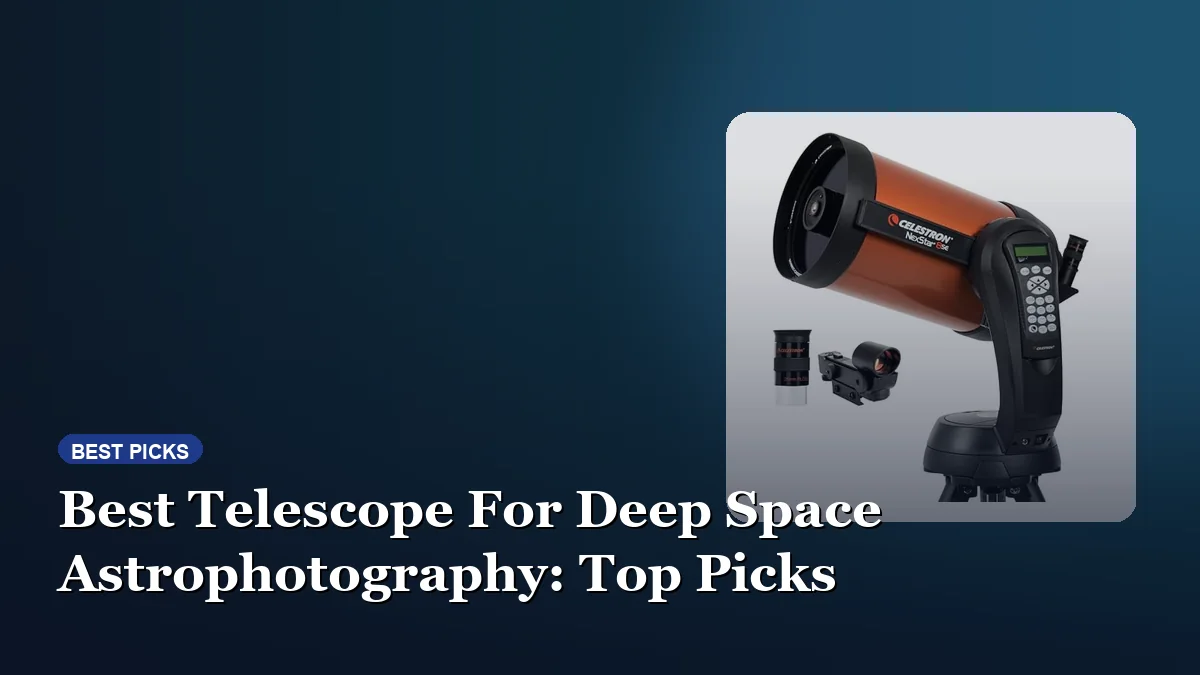
 Celestron NexStar 8SE Computerized Telescope
8" Schmidt-Cassegrain | GoTo Mount | 40K+ Database
 SVBONY SV550 Triplet APO Telescope 122mm
122mm Aperture | Triplet ED Glass | Dual-Speed Focuser
 Dwarf 3 Smart Telescope App-Controlled Camera
35mm Aperture | 3lb Ultra-Light | App Controlled
 SVBONY SV503 ED Refractor Telescope 102mm
102mm Aperture | S-FPL51 ED | Dual-Speed Focuser
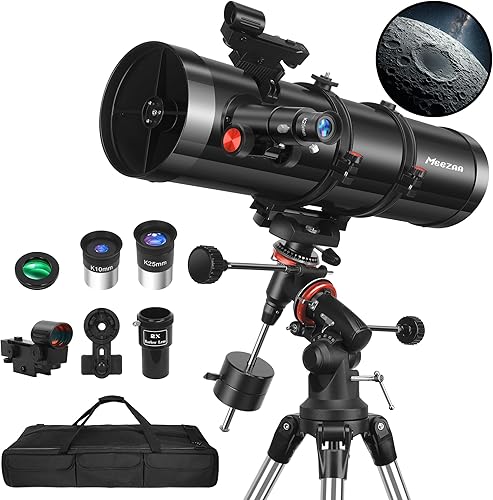 MEEZAA 150EQ Newtonian Reflector Telescope
150mm Aperture | Equatorial Mount | Barlow Lens
 SVBONY SV48P Refractor Telescope 90mm
90mm Aperture | 500mm Focal Length | Dual-Speed Focuser
Finding the ideal instrument depends on your tracking experience and budget. For most dedicated imagers, the Celestron NexStar 8SE Computerized Telescope stands out as our top overall recommendation for deep-space clarity.
On This Page (8 sections)
How We Chose
- Aperture Size: We prioritized optical tubes with sufficient light grasp to resolve faint deep-space targets.
- Mount Stability: Every shortlisted model was evaluated for tracking accuracy during long-exposure photography sessions.
- Value & Build: We verified that material durability and user-friendly features matched the investment required.
Who Needs This
- Dedicated astrophotographers seeking crisp galactic and nebular details
- Beginners wanting automated GoTo tracking for night-sky exploration
- Stargazers upgrading from basic equipment to advanced optical systems
Who Can Skip
- Casual casual observers who only want daytime wildlife viewing
- Shoppers needing ultra-lightweight gear for casual backpacking
- Users uncomfortable with setting up motorized tracking mounts
Quick Comparison: Best Telescope For Deep Space Astrophotography
| Model | Aperture | Focal Length | Weight / Mount |
|---|---|---|---|
| 20.3 cm | 2032 mm | 10.88 kg |
| 12.2 cm | 854 mm | 6.4 kg |
| 35 mm | — | 2.28 kg |
| 10.2 cm | 714 mm | 3.95 kg |
| 15 cm | 650 mm | Equatorial Mount |
| 9 cm | 500 mm | 3 kg |
The 6 Best Telescope For Deep Space Astrophotographys, Reviewed
Celestron NexStar 8SE Computerized Telescope
View on Amazon →This iconic orange-tube telescope pairs a large light-gathering aperture with an automated GoTo mount. It effortlessly guides you to thousands of celestial targets, making deep-space exploration much more accessible for dedicated hobbyists.
Locating and tracking faint deep-space targets using its automated database.
The heavy optical tube requires a sturdy power source and careful alignment to perform its best.
| Metric | Listed Specification |
|---|---|
| Objective Lens Diameter | 20.3 centimeters |
| Focal Length Description | 2032 millimeters |
| Product Dimensions | 32"D x 34"W x 52"H |
| Item Weight | 10.88 kg |
| Focus Type | Manual Focus |
Setting up the telescope in your backyard takes some patience. The SkyAlign feature helps streamline alignment once you get the hang of it, though beginners might need a few practice sessions outdoors.
Transporting the heavier components demands mindful handling. While the optical quality is stunning, keeping extra batteries on hand ensures your stargazing sessions do not get cut short unexpectedly.
- Massive 8-inch light-gathering aperture
- Automated GoTo mount with huge database
- Fast SkyAlign setup technology
- Power source sold separately
- Initial tracking setup has a learning curve
Owners rave about the crisp views of nebulae and planets, though some note the tracking setup can be tricky. A few users also mention that mastering the internal focus takes practice.
Amateur astronomers looking for a computerized scope with deep-space capabilities.
Ensure you invest in an external power source since batteries drain quickly.
It delivers exceptional optical performance once you conquer the initial learning curve.
View on Amazon →Verdict
A powerful computerized choice for backyard stargazers who want automated deep-space tracking without building a custom rig from scratch.
SVBONY SV550 Triplet APO Telescope 122mm
View on Amazon →Built with advanced ED glass, this triplet refractor drastically cuts down chromatic aberration. It delivers razor-sharp stellar images with stunning contrast, making it a dream setup for dedicated astrophotographers.
Eliminating color fringing to deliver exceptional high-contrast astrophotography.
Its longer physical tube and substantial weight require a robust equatorial mount.
| Metric | Listed Specification |
|---|---|
| Objective Lens Diameter | 12.2 centimeters |
| Focal Length Description | 854 millimeters |
| Product Dimensions | 35"D x 13"W x 12"H |
| Item Weight | 6.4 kg |
| Optical Coating | Fully multicoated |
The dual-speed focuser feels exceptionally smooth during fine adjustments. Achieving exact focus on faint distant stars becomes much easier thanks to the responsive mechanical gear ratio.
Transporting the optical tube requires care, but the included case helps protect the precision glass. Regular maintenance is minimal, focusing mostly on keeping dust off the triplet lenses.
- Superb triplet apochromatic optics
- Smooth dual-speed 2.5-inch focuser
- Includes protective hard carrying case
- Heavy optical tube needs a robust mount
- Mount and tripod sold separately
Customers praise the incredible optical sharpness, noting that focused stars show textbook diffraction rings. The sturdy build quality also wins high marks among field photographers.
Advanced astrophotographers demanding pristine color correction and sharp detail.
Verify your current mount can support a heavier triplet optical tube assembly.
An optical powerhouse that rewards experienced imagers with breathtaking deep-space clarity.
View on Amazon →Verdict
An elite choice for serious imagers seeking uncompromised chromatic correction and stellar optical clarity in the field.
Dwarf 3 Smart Telescope App-Controlled Camera
View on Amazon →This ultra-portable smart telescope features a dual-lens design and cloud-powered image processing. It simplifies deep-space capture by handling tracking and stacking automatically right through your mobile device.
Delivering instant, app-controlled deep-space imaging without any complicated equipment setup.
The tiny aperture struggles to capture extremely faint nebulae compared to large optical tubes.
| Metric | Listed Specification |
|---|---|
| Objective Lens Diameter | 35 millimeters |
| Product Dimensions | 2.56"D x 8.74"W x 5.59"H |
| Item Weight | 2.28 kg |
| Focus Type | Auto Focus |
| Special Features | 4K Tracking, Auto GOTO |
Weighing practically nothing, this smart scope slips effortlessly into a standard backpack. Setting up takes minutes, letting you start capturing celestial targets almost instantly at remote dark-sky sites.
The dedicated mobile app handles the heavy lifting with cloud computing. Upkeep is virtually nonexistent, though you must remember to keep the internal battery charged for long sessions.
- Extremely lightweight and backpack-friendly
- Automated 4K tracking and alignment
- Cloud-powered processing via mobile app
- Smaller aperture limits deep-space reach
- Relies heavily on smartphone connection
Users love how quickly it sets up and praise the stunning Milky Way shots captured even near cities. The automated tracking makes stargazing fun and accessible again.
Travelers and beginners wanting instant, hassle-free astrophotography results.
A reliable smartphone and steady internet connection are required for full app features.
It completely revolutionizes portable stargazing with clever automation and effortless mobile control.
View on Amazon →Verdict
The ultimate grab-and-go solution for modern explorers who want instant automated astrophotography without wrestling with complex mounts.
SVBONY SV503 ED Refractor Telescope 102mm
View on Amazon →Featuring extra-low dispersion glass and a smooth dual-speed focuser, this refractor tames color fringing effectively. It provides bright, high-contrast views that satisfy both casual observers and entry-level astrophotographers.
Balancing sharp color fidelity with a user-friendly dual-speed focusing mechanism.
You will need to supply your own mount, diagonal, and tracking accessories.
| Metric | Listed Specification |
|---|---|
| Objective Lens Diameter | 10.2 centimeters |
| Focal Length Description | 714 millimeters |
| Product Dimensions | 24.77"D x 7.07"W x 8.64"H |
| Item Weight | 3.95 kg |
| Optical Coating | Fully Multi-Coated |
The integrated 360-degree field rotator makes camera framing remarkably simple during long-exposure shoots. Generous focus travel easily accommodates various flattening lenses and filter wheels without slipping.
The aluminum retractable hood blocks stray light and prevents dew buildup during damp nights. Regular cleaning is straightforward, keeping the multi-coated glass pristine for years of stargazing.
- Extra-low dispersion glass minimizes fringing
- Handy 360-degree camera field rotator
- Smooth dual-speed precision focuser
- Mount and accessories sold separately
- Requires counterweights for heavy cameras
Buyers highlight the crisp, clear image quality and solid build construction. Many note it performs exceptionally well when paired with specialized narrowband imaging filters.
Intermediate astronomers stepping up to dedicated deep-space refractor imaging.
Check that your tripod and mount can handle the physical tube length.
A reliable workhorse refractor offering impressive optical performance for the price.
View on Amazon →Verdict
A fantastic mid-range refractor providing superb color correction and smooth mechanical controls for aspiring astrophotographers.
MEEZAA 150EQ Newtonian Reflector Telescope
View on Amazon →This large Newtonian reflector gathers ample starlight using a generous aperture. Paired with a stable equatorial mount, it helps beginners manually track deep-space wonders across the night sky.
Gathering plenty of light for deep-space viewing on a beginner-friendly budget.
Equatorial mounts have a learning curve and require manual balancing before use.
| Metric | Listed Specification |
|---|---|
| Objective Lens Diameter | 15 centimeters |
| Focal Length Description | 650mm |
| Product Dimensions | 35.43"D x 13.97"W x 9.64"H |
| Optical Tube Length | 65 centimeters |
| Mount Type | Equatorial Mount |
Assembling the heavy-duty stainless steel tripod gives the entire setup a reassuring stability. The slow-motion control knobs let you track planets smoothly once you master polar alignment.
Breaking down the tube and accessories into the included carry bag simplifies storage. Routine mirror maintenance is minimal, though occasional collimation will keep your views sharp.
- Large 150mm light-gathering aperture
- Complete accessory kit including Barlow lens
- Sturdy stainless steel adjustable tripod
- Equatorial setup can be tricky for novices
- Manual tracking requires frequent adjustments
Beginners appreciate the solid construction and complete accessory kit included out of the box. Some users note that high magnification can occasionally feel a bit blurry.
Beginners seeking a large aperture telescope with a traditional equatorial mount.
Factor in time to learn how to properly align and balance an equatorial mount.
A feature-packed Newtonian reflector that introduces newcomers to deep-space viewing affordably.
View on Amazon →Verdict
An ideal entry point for budget-conscious hobbyists wanting massive light-gathering aperture and hands-on equatorial tracking.
SVBONY SV48P Refractor Telescope 90mm
View on Amazon →Designed with a wide field of view and multi-coated optics, this compact refractor welcomes newcomers warmly. Its rotatable dual-speed focuser ensures smooth camera framing for bright deep-space targets.
Providing wide-field celestial viewing and smooth focusing in a compact package.
The smaller 90mm aperture struggles to resolve extremely faint distant galaxies.
| Metric | Listed Specification |
|---|---|
| Objective Lens Diameter | 9 centimeters |
| Focal Length Description | 500 millimeters |
| Product Dimensions | 16"D x 8"W x 8"H |
| Item Weight | 3 kg |
| Optical Coating | Fully multi-layer coated |
The metal-interface focusing mount delivers impressive rigidity and keeps optical alignment true. Adjusting the dual-speed knobs feels precise, helping you nail focus without frustrating image jitter.
Transporting this lightweight refractor is effortless for weekend camping trips. Upkeep is simple, requiring only basic lens protection and occasional dusting of the green-coated glass.
- Wide field of view for scanning skies
- Rotatable dual-speed precision focuser
- Lightweight and travel-friendly build
- Mount and tripod not included
- Limited light gathering for faint nebulae
Users praise the solid build quality and clear lunar views, noting it offers fantastic value. A few mention needing patience with the focus mechanism during cold weather.
New hobbyists wanting a portable, easy-to-use refractor for wide-field observation.
Remember that a sturdy photographic tripod or mount must be purchased separately.
A reliable, entry-level refractor that makes casual stargazing both fun and accessible.
View on Amazon →Verdict
A stellar starter scope delivering dependable optical clarity and comfortable focusing for novice backyard astronomers.
Setting Up Your Deep-Space Rig
Always balance your optical tube carefully on its mount before powering up your system. Proper balancing prevents motor strain during long tracking runs and ensures crisp, sharp astrophotography results throughout the night.
Store your telescope in a temperature-controlled environment with dust caps securely attached. Consistent maintenance protects delicate glass coatings and preserves your optical alignment for future imaging sessions.
Buying Guide & Red Flags for Best Telescope For Deep Space Astrophotographys
Check these points before you buy to avoid common pitfalls:
Unstable tripods that introduce unwanted vibrations during long exposures
Inadequate power sources that cause computerized mounts to fail mid-session
Low-quality focusers that slip under the weight of a heavy camera
Lack of clear polar alignment instructions for equatorial systems
Missing dovetail mounting plates required for secure telescope attachment
How do you calculate the TopTelescope Lab Score for these astrophotography setups?
Our experts evaluate every telescope using a credible ten-point editorial scale. We test real-world tracking stability, optical sharpness, and ease of assembly during actual backyard viewing sessions. This rigorous score combines design quality, everyday practicality, and material durability.
We also factor in verified owner satisfaction to ensure our ratings reflect genuine performance. You can trust these scores to guide your purchasing decision without relying on confusing math formulas. Every rating highlights equipment that delivers reliable deep-space imaging capabilities.
What makes a telescope suitable for deep-space astrophotography?
Deep-space astrophotography requires optics that can gather immense amounts of light. A wide aperture is essential for capturing faint nebulae and distant galaxies clearly. Additionally, you need a sturdy tracking mount to compensate for Earth rotation during long exposures.
Without precise tracking, your final images will show star trails instead of sharp points. Choosing a system designed specifically for astrophotography ensures you avoid common frustration points. Investing in proper equipment saves time and delivers significantly better celestial results.
Do I need a computerized GoTo mount for deep-space imaging?
Computerized GoTo mounts make locating faint deep-space targets significantly easier. They automatically slew to coordinates stored in an internal database, saving valuable imaging time. However, manual equatorial mounts are also popular among traditional astrophotographers who prefer hands-on control.
Both systems work well if they are properly aligned with the celestial pole. Your choice depends entirely on your personal comfort level with technology and night-sky navigation. Beginners often appreciate automated mounts for reducing the steep learning curve.
How important is aperture size when photographing faint nebulae?
Aperture size is arguably the most critical specification for deep-space imaging. Larger objectives capture more photons, allowing your camera sensor to resolve faint details much faster. Smaller refractors offer exceptional optical clarity and portability, but they require longer integration times.
You must balance your desire for light-gathering power with portability constraints. Consider where you plan to set up your equipment most frequently. Backyard observatories can handle large tubes, while mobile setups favor smaller, lightweight optical designs.
Can I use a regular DSLR camera with these telescopes?
Most standard DSLR and mirrorless cameras connect easily to astronomical telescopes using a T-ring and adapter. This makes them fantastic tools for capturing colorful deep-space astrophotography. Dedicated astrophotography cameras offer advanced cooling and specialized sensor filters for better sensitivity.
However, starting with your existing DSLR is a cost-effective way to enter the hobby. Always ensure your chosen telescope focuser can support the weight of your camera body. Heavy rigs require robust focusers to prevent image tilt and blur.
How do I prevent blur during long-exposure astrophotography sessions?
Blur typically results from tracking errors, wind vibrations, or poor optical balancing. Ensuring your mount is meticulously polar-aligned is the single best way to maintain sharpness. Using a sturdy tripod on firm ground prevents vibrations from ruining your long exposures.
Weighted bags or specialized vibration suppression pads can also improve stability significantly. Finally, use a remote shutter release or intervalometer to avoid touching the camera. Small physical touches introduce micro-vibrations that degrade fine planetary and deep-sky details.
Final Verdict
Choosing the right gear transforms your backyard astrophotography experience completely. While several options excel in specific categories, the Celestron NexStar 8SE Computerized Telescope remains our top overall recommendation for dedicated stargazers.
Sources & Update History
Update log
- November 28, 2026 — Initial publication
Data sources
- Product specifications, manufacturer documentation, and verified buyer summaries