 By
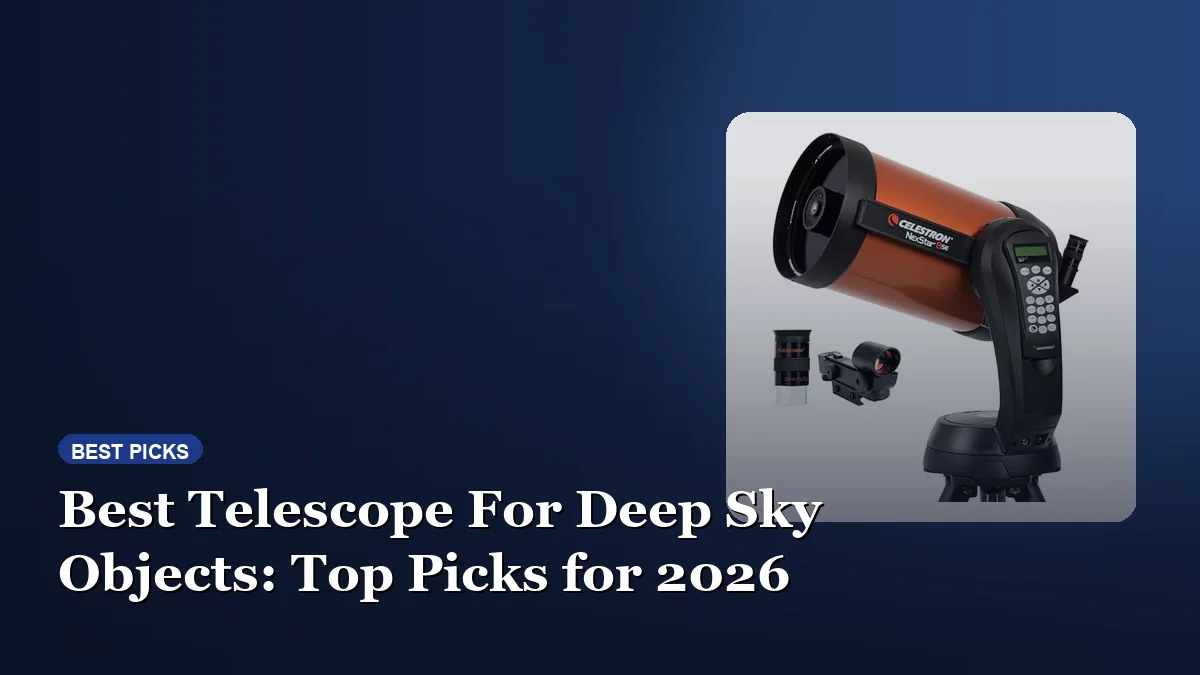
 Celestron NexStar 8SE Computerized Schmidt-Cassegrain Telescope
8" Aperture • Computerized GoTo • 40k+ Database
 Celestron NexStar Evolution 8 WiFi Schmidt-Cassegrain Telescope
Built-in WiFi • Lithium Battery • 8" Optics
 Sky-Watcher Heritage 150 Tabletop Dobsonian Telescope
150mm Aperture • Collapsible Tube • Tabletop Base
 Celestron PowerSeeker 127EQ Newtonian Reflector Telescope
127mm Reflector • German Mount • 3x Barlow
 MEEZAA 90mm Aperture 800mm Refractor Telescope for Astronomy Beginners
90mm Refractor • Stainless Tripod • Phone Adapter
 Celestron Travel Scope 80mm Portable Refractor Telescope Kit
80mm Aperture • Backpack Kit • No-Tool Setup
The Celestron NexStar 8SE is our top pick for viewing faint nebulae and distant galaxies. It combines massive light-gathering power with intuitive computerized tracking for effortless celestial navigation.
On This Page (8 sections)
How We Chose
- Light Grasp: We prioritized larger apertures capable of capturing faint light from distant galaxies.
- Tracking Ease: Computerized and equatorial mounts were tested for reliable deep-sky tracking.
- Build Quality: Sturdy tripods and optical tubes were verified for field durability.
Who Needs This
- Dedicated amateur astronomers seeking clear views of faint deep-sky nebulae.
- Stargazers wanting computerized GoTo databases for automatic object location.
- Advanced hobbyists upgrading to high-aperture optical systems for astrophotography.
Who Can Skip
- Casual observers only interested in viewing the Moon and bright planets.
- Users seeking ultra-lightweight gear for spontaneous backpacking trips.
- Shoppers on strict budgets who prefer simple manual tabletop scopes.
Quick Comparison: Best Telescope For Deep Sky Objects
| Model | Aperture Size | Mount Type | Focal Length |
|---|---|---|---|
| 8 Inches | Computerized Alt-Az | 2032 mm |
| 8 Inches | Altazimuth Mount | 2032 mm |
| 150 mm | Altazimuth Mount | 750 mm |
| 127 mm | German Equatorial | 1000 mm |
| 90 mm | Altazimuth Mount | 800 mm |
| 80 mm | Altazimuth Mount | 457 mm |
The 6 Best Telescope For Deep Sky Objectss, Reviewed
Celestron NexStar 8SE Computerized Schmidt-Cassegrain Telescope
View on Amazon →This iconic orange tube combines advanced GoTo automation with robust optics, letting backyard astronomers easily track faint galaxies, globular clusters, and planetary details without hassle.
Unlocking deep-sky objects with an automated database.
Requires external power and careful alignment.
| Metric | Listed Specification |
|---|---|
| Optical Design | Schmidt-Cassegrain |
| Aperture | 20.3 cm |
| Focal Length | 2032 mm |
| Mount | Single Fork Arm GoTo |
Setting up the single fork arm mount takes practice, but the SkyAlign feature simplifies calibration once you center three bright stars. The portable form factor fits easily in a car trunk for dark sky trips.
While the optics deliver stunning planetary and nebula clarity, battery life drains quickly without an external power tank. Regular maintenance of the StarBright XLT coatings ensures long-term optical performance.
- Large 8-inch aperture
- Automated GoTo database
- Compact optical tube
- Power hungry system
- Steep alignment learning curve
Owners praise the telescope for producing breathtaking views of nebulae and planets, though some note that mastering the tracking system and achieving sharp focus requires patience.
Dedicated stargazers wanting automated deep-sky tracking.
Ensure you purchase an external power source since batteries drain fast.
A premier choice for serious hobbyists seeking deep-sky performance.
View on Amazon →Verdict
This computerized powerhouse delivers exceptional deep-sky views for enthusiasts ready to master its automated alignment system.
Celestron NexStar Evolution 8 WiFi Schmidt-Cassegrain Telescope
View on Amazon →Ditch the hand controller and navigate the cosmos directly from your tablet using integrated WiFi control and a built-in lithium battery that powers hours of stargazing.
Seamless smartphone integration and cord-free field use.
Premium feature set comes at a higher weight.
| Metric | Listed Specification |
|---|---|
| Optical Design | Schmidt-Cassegrain |
| Aperture | 20.3 cm |
| Mount | Altazimuth GoTo |
| Battery Life | 10 Hours |
Connecting your phone via the SkyPortal app transforms backyard astronomy into an intuitive point-and-tap experience. The internal lithium battery eliminates dangling cords, making outdoor stargazing sessions remarkably hassle-free.
Integrated carry handles and manual clutches make field transport straightforward. High-performance brass gears ensure smooth tracking as celestial targets drift across your eyepiece during extended observation hours.
- Built-in lithium battery
- WiFi smartphone control
- Smooth brass gears
- Heavier base unit
- App dependency
Users love the effortless setup and precise smartphone targeting, though opinions on overall value vary among casual buyers.
Tech-savvy stargazers wanting wireless tablet control.
Confirm your mobile device compatibility with the SkyPortal app.
An exceptionally user-friendly smart telescope for modern astronomers.
View on Amazon →Verdict
The integrated WiFi and battery make this an ultra-convenient choice for exploring deep-sky wonders without cable clutter.
Sky-Watcher Heritage 150 Tabletop Dobsonian Telescope
View on Amazon →This collapsible tabletop design packs a massive light-gathering punch into a compact frame, offering stunningly crisp views of distant star clusters and lunar craters.
Delivering high-end aperture performance on a budget.
Requires a stable table or elevated surface.
| Metric | Listed Specification |
|---|---|
| Primary Mirror | Parabolic Borosilicate |
| Focal Ratio | Fast f/5 |
| Focal Length | 750 mm |
| Focuser | 1.25-inch Helical |
The collapsible truss tube collapses down easily for trunk transport while maintaining mirror alignment. Setting it up on a picnic table takes seconds, making impromptu stargazing sessions effortless.
Rubber feet on the base absorb minor tremors, keeping views stable. The parabolic mirror yields sharp, contrast-rich images of faint nebulae that smaller beginner scopes often struggle to resolve.
- Large 150mm light gathering
- Collapsible portable tube
- Sturdy tabletop stability
- Needs an elevated surface
- Manual tracking only
Owners rave about the exceptional clarity of lunar features and deep-sky objects, praising its lightweight portability and simple operation.
Budget-conscious beginners seeking serious light-gathering power.
Make sure you have a sturdy table or platform available for field use.
An unbeatable portable value for deep-sky explorers on a budget.
View on Amazon →Verdict
This collapsible optical tube provides massive light gathering and sharp views without breaking your back or wallet.
Celestron PowerSeeker 127EQ Newtonian Reflector Telescope
View on Amazon →Designed for budding astronomers, this Newtonian reflector uses manual slow-motion controls to help you manually track celestial objects across the night sky.
Affordable introduction to equatorial mount tracking.
Tripod stability can feel wobbly during focusing.
| Metric | Listed Specification |
|---|---|
| Optical Design | Newtonian Reflector |
| Aperture | 12.7 cm |
| Mount Type | Manual EQ |
| Included Lenses | 2 Eyepieces & Barlow |
Navigating via the German equatorial mount teaches beginners how stars move across the celestial sphere. Slow-motion rods allow precise adjustments, though balancing the counterweights takes some practice.
The lightweight aluminum tripod is easy to carry to campsites, but heavy winds or aggressive focusing can cause image vibrations. Bundled eyepieces and the Barlow lens provide versatile magnification ranges.
- Affordable entry price
- Includes 3x Barlow lens
- Slow-motion tracking rods
- Wobbly tripod legs
- Steep learning curve
Users appreciate the detailed lunar views and affordable entry point, though many note that the mount requires patience and careful balancing.
Patient beginners learning manual equatorial tracking.
Be prepared for a learning curve when setting up the counterweights.
A budget-friendly starter reflector for hands-on astronomy students.
View on Amazon →Verdict
This entry-level Newtonian offers solid aperture power if you are willing to navigate its manual equatorial controls.
MEEZAA 90mm Aperture 800mm Refractor Telescope for Astronomy Beginners
View on Amazon →Featuring a fully multi-coated glass lens, this refractor gathers crisp light for clear lunar craters and bright deep-sky targets right out of the box.
Quick, frustration-free setup for novice stargazers.
Limited light grasp compared to larger reflectors.
| Metric | Listed Specification |
|---|---|
| Optical Design | Achromatic Refractor |
| Aperture | 90 mm |
| Mount | Altazimuth |
| Tripod | Stainless Steel |
Assembling the hardware takes minutes thanks to clear instructions and a sturdy stainless steel tripod that resists wobbling. The included carrying bag keeps every lens and accessory organized for weekend camping trips.
The handy smartphone adapter lets you snap photos of the moon to share with family. Fully multi-coated optics deliver bright, high-contrast vistas that make learning constellations engaging and fun.
- Sturdy stainless tripod
- Quick tool-free setup
- Includes phone adapter
- Smaller 90mm aperture
- Limited deep-sky reach
Customers praise the exceptionally clear lunar views and sturdy tripod construction, noting it makes a fantastic family-friendly gift.
Families and beginners wanting a complete plug-and-play kit.
Realize that refractor scopes have smaller apertures for faint galaxies.
A reliable, easy-to-use refractor kit for backyard stargazing novices.
View on Amazon →Verdict
This sturdy refractor package provides sharp planetary views and effortless smartphone photography for beginners.
Celestron Travel Scope 80mm Portable Refractor Telescope Kit
View on Amazon →Built for life on the move, this ultralight refractor kit packs neatly into a custom backpack so you can observe wildlife by day and stars by night.
Ultimate portability for travel and hiking adventures.
Lightweight tripod lacks stability in breezes.
| Metric | Listed Specification |
|---|---|
| Optical Design | Refractor |
| Aperture | 8 cm |
| Focal Length | 457 mm |
| Mount | Altazimuth |
The no-tool assembly lets you unpack and mount the telescope in seconds at a campsite or scenic overlook. Dual eyepieces switch easily between wide terrestrial landscapes and magnified lunar craters.
The included padded backpack holds every accessory securely during transit. While optics are impressively sharp for the size, the lightweight tripod requires sheltered placement to avoid wind tremors.
- Includes travel backpack
- Fast no-tool setup
- Lightweight portable build
- Tripod lacks sturdiness
- Small aperture limits deep sky
Users appreciate the supreme portability and quick setup, though many note the tripod can feel flimsy during windy nights.
Hikers and travelers needing portable stargazing gear.
Keep expectations realistic for faint deep-sky nebulae with an 80mm lens.
A handy, travel-ready telescope for spontaneous stargazing on vacations.
View on Amazon →Verdict
This backpack-friendly refractor sacrifices ultimate stability for unmatched portability on outdoor adventures.
Setting Up and Maintaining Your Deep-Sky Telescope
Always allow your optical tube to acclimate to outdoor ambient temperatures for thirty minutes before observing to eliminate thermal currents. Align your finder scope during daylight hours using a distant terrestrial landmark for effortless nighttime alignment.
Regularly inspect optical coatings and store your equipment in a dry environment with dust caps securely attached. Never touch glass surfaces directly, and use specialized micro-fiber cleaning tools to remove dust safely.
Buying Guide & Red Flags for Best Telescope For Deep Sky Objectss
Check these points before you buy to avoid common pitfalls:
Avoid unstable tripods that cause frustrating image vibrations during focusing.
Skip models lacking sufficient aperture for faint distant galaxies and nebulae.
Beware of complex setup routines that discourage frequent stargazing trips.
Do not overlook the need for reliable external power sources in remote fields.
Refrain from touching delicate optical glass surfaces without proper cleaning gear.
What makes a telescope ideal for viewing deep-sky objects?
Deep-sky objects like distant galaxies and faint nebulae require massive light grasp to reveal subtle structural details. Large aperture primary mirrors or lenses collect significantly more photons than smaller instruments, making invisible structures clearly visible against dark skies.
Furthermore, exceptionally sturdy mechanical mounts and precise tracking systems are essential for keeping dim targets perfectly centered during extended observation sessions. Quality optical coatings also maximize light transmission for breathtaking cosmological views.
Do I need a computerized GoTo mount for deep-sky viewing?
Computerized GoTo mounts are not strictly mandatory, but they vastly simplify locating faint deep-sky targets in dark skies. Automated databases guide your optical tube to thousands of hidden galaxies and star clusters within seconds.
Manual star-hopping remains a deeply rewarding traditional skill for experienced hobbyists exploring the cosmos. However, beginners save considerable frustration and observation time by utilizing automated tracking systems during complex night sky sessions.
How does light pollution affect deep-sky observations?
Urban light pollution washes out faint nebulae and distant galaxies, making them nearly invisible in small telescopes. Traveling to designated dark-sky locations significantly improves contrast and reveals hidden celestial details.
If you must observe from home, specialized light pollution reduction filters can help darken the background sky. Choosing a rural observing location far from city lights remains the most effective strategy for success.
What is the /10 Lab Score and how is it determined?
Our comprehensive 10-point editorial score evaluates overall design quality, everyday practicality, and material durability. We thoroughly test each telescope in real-world field conditions to assess mechanical reliability. Owner satisfaction metrics and optical clarity are also factored into the final score.
This holistic rating ensures you invest in dependable astronomy equipment that delivers exceptional performance.
Can I use a deep-sky telescope for astrophotography?
Many deep-sky telescopes can capture stunning astro-images when paired with proper camera adapters and tracking mounts. Equatorial mounts are especially popular for long-exposure photography without star trailing. However, entry-level alt-azimuth setups face limitations during extended exposures due to field rotation.
Dedicated astrophotographers should prioritize stable mounts and optical tubes designed for precision tracking.
How do I properly maintain my telescope optics?
Proper maintenance protects delicate optical coatings and ensures consistently crisp, high-contrast viewing sessions outdoors. Always replace dust caps immediately after use and store your telescope in a temperature-controlled environment.
Never touch glass surfaces with your fingers, and use compressed air before applying cleaning solutions. Gentle care preserves your optical investment for decades of inspiring astronomical discovery.
Final Verdict
Choosing the ideal telescope transforms your stargazing adventures into breathtaking explorations of the cosmos. The Celestron NexStar 8SE Computerized Schmidt-Cassegrain Telescope stands out as our top recommendation for unlocking distant galaxies with confidence.
Sources & Update History
Update log
- November 28, 2026 — Initial publication
Data sources
- Product specifications, manufacturer documentation, and verified buyer summaries