 By
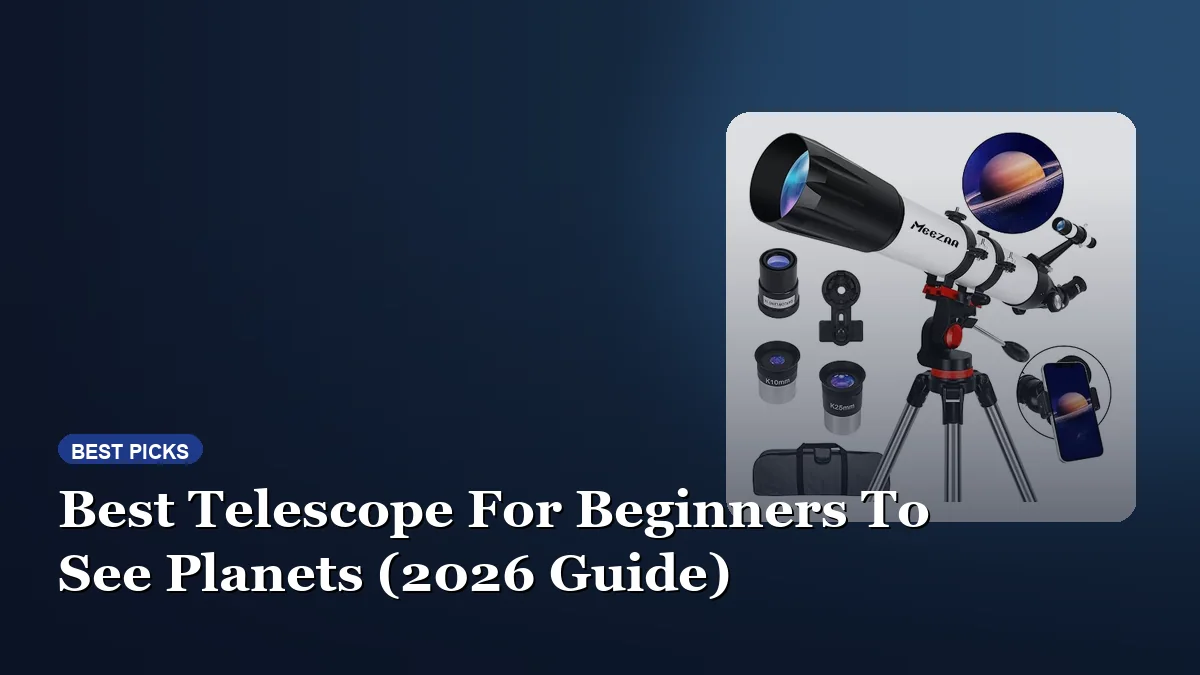
 MEEZAA 90mm Aperture 800mm Refractor Telescope
90mm Aperture · 800mm Focal Length · Stainless Tripod
 Dianfan 90mm Aperture 800mm Telescope
90mm Aperture · 800mm Focal Length · Portable Bag
 Hawkko 90mm Aperture 900mm Refractor Telescope
90mm Aperture · 900mm Focal Length · AZ Mount
 HETEKAN 90mm Aperture 900mm Refractor Telescope
90mm Aperture · 900mm Focal Length · 450x Zoom
 Dianfan 150EQ Professional Astronomy Telescope
150mm Aperture · 650mm Focal Length · Equatorial Mount
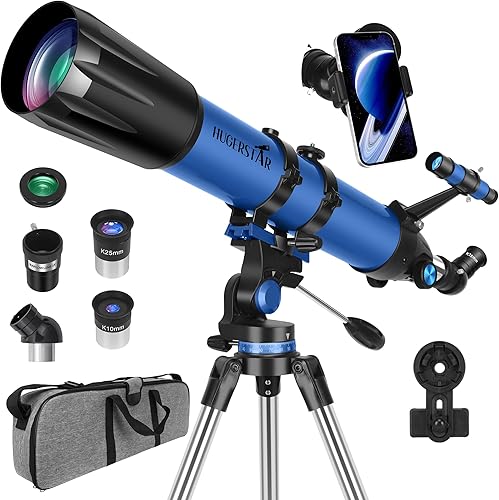 HUGERSTAR 90mm Aperture 800mm Portable Refractor
90mm Aperture · 800mm Focal Length · Moon Filter Included
The MEEZAA 90mm Aperture 800mm Refractor Telescope stands as our top recommendation for novice stargazers. It balances sharp optics with user-friendly setup, making it remarkably simple to track Saturn's rings and Jupiter's moons without a steep learning curve.
On This Page (8 sections)
How We Chose
- Aperture Size: We prioritized a minimum 90mm objective lens to ensure adequate light gathering for planetary observation.
- Mount Usability: We favored intuitive altazimuth mounts that allow beginners to navigate the night sky smoothly.
- Accessory Value: We selected models bundled with multiple eyepieces and sturdy tripods for immediate stargazing success.
Who Needs This
- Complete beginners wanting clear, bright views of Saturn and Jupiter.
- Parents looking for an educational, engaging backyard science hobby for kids.
- Casual stargazers who want an easy setup without complex telescope alignment.
Who Can Skip
- Advanced astrophotographers seeking deep-sky tracking equipment.
- Users who demand ultra-lightweight gear for backpacking trips into remote areas.
- Experienced astronomers who prefer building custom optical tube assemblies.
Quick Comparison: Best Telescope For Beginners To See Planets
| Model | Aperture Size | Focal Length | Mount Type |
|---|---|---|---|
| 90 mm | 800 mm | Altazimuth |
| 90 mm | 800 mm | Altazimuth |
| 90 mm | 900 mm | Altazimuth |
| 90 mm | 900 mm | Altazimuth |
| 150 mm | 650 mm | Equatorial |
| 90 mm | 800 mm | Altazimuth |
The 6 Best Telescope For Beginners To See Planetss, Reviewed
MEEZAA 90mm Aperture 800mm Refractor Telescope
View on Amazon →This beginner-friendly refractor packs a 90mm aperture to pull in sharp lunar details and bright planetary views. Setup takes minutes, making it a hassle-free entry point for backyard stargazing families.
Delivers exceptionally sharp lunar and planetary views right out of the box.
Altazimuth mounts require manual nudging to track celestial objects smoothly.
| Metric | Listed Specification |
|---|---|
| Objective Lens | 9 cm |
| Focal Length | 800 mm |
| Zoom Ratio | 32x - 240x |
| Coating | Fully Multi-Coated |
| Mount Description | Altazimuth |
Assembling the lightweight aluminum and steel components takes very little time. The adjustable tripod keeps vibrations low during backyard viewing sessions, though windy nights demand extra care.
Packing everything into the included carry bag makes weekend camping trips a breeze. Routine lens upkeep is simple with a microfiber cloth, ensuring long-term optical clarity for stargazing adventures.
- Sharp multi-coated optics
- Quick tool-free setup
- Sturdy stainless tripod
- Manual tracking required
- Bulky carry bag
Owners love the stunningly clear lunar views and quick, frustration-free setup process. Many note that the sturdy tripod and included carry bag make backyard stargazing and family trips remarkably easy.
Beginners wanting a reliable, high-performing telescope for family stargazing.
Ensure you have stable ground for the tripod during windy evenings.
It is an exceptional starter scope combining sharp optics and user-friendly features.
View on Amazon →Verdict
A top-tier choice for beginners seeking brilliant planetary views without a steep learning curve.
Dianfan 90mm Aperture 800mm Telescope
View on Amazon →Built for travelers, this portable refractor features a 90mm objective lens to capture bright, crisp views of lunar craters. The upright image diagonal also lets you enjoy daytime wildlife viewing seamlessly.
Seamlessly transitions between terrestrial wildlife viewing and nighttime planetary exploration.
Fully coated optics deliver slightly less light transmission than multi-coated alternatives.
| Metric | Listed Specification |
|---|---|
| Objective Lens | 9 cm |
| Focal Length | 800 mm |
| Zoom Ratio | 32x-240x |
| Coating | Fully Coated |
| Mount Description | Altazimuth |
Transporting the lightweight optical tube in its custom case feels effortless. Setting up camp-side astronomy stations takes roughly fifteen minutes once you get familiar with the thumb screws and mounts.
The altazimuth platform rotates smoothly for casual tracking across the horizon. Regular maintenance involves gentle dust removal from the objective lens to preserve crisp image contrast over time.
- Dual-purpose terrestrial viewing
- Lightweight travel design
- Smooth focusing mechanism
- Fully coated glass only
- Basic manual mount
Users frequently praise the crystal-clear lunar views and the sturdy foundation provided by the steel legs. They also appreciate how easily the entire kit packs down for weekend travel adventures.
Active travelers seeking a dual-purpose telescope for nature and stars.
Check the weight limits if you plan to mount heavy aftermarket cameras.
A versatile, portable companion bridging daytime nature watching and nighttime astronomy.
View on Amazon →Verdict
An ideal travel scope offering sharp optics and effortless portability for mobile beginners.
Hawkko 90mm Aperture 900mm Refractor Telescope
View on Amazon →Featuring a longer focal length, this refractor pushes magnification higher to reveal finer planetary details. The multi-layer lens coatings significantly boost light transmission for sharper, brighter celestial imagery.
Delivers impressive high-magnification views of distant planetary bodies and lunar landscapes.
Longer focal length tubes require a steadier hand to manage high-magnification wobbles.
| Metric | Listed Specification |
|---|---|
| Objective Lens | 9 cm |
| Focal Length | 900 mm |
| Zoom Ratio | 270X |
| Coating | Multi-Coated |
| Mount Description | Altazimuth |
Assembly requires no specialized tools and wraps up quickly for impromptu stargazing sessions. The sturdy AZ mount supports smooth 360-degree rotation when tracking objects across the night sky.
Storing the optical tube and accessories in the included bag protects delicate glass components. Keeping lenses free of moisture prevents fogging during damp evening observation outings.
- High light transmittance
- Smooth 360-degree rotation
- Tool-free quick assembly
- Higher magnification amplifies wind wobble
- Long tube format
Customers love the tool-free setup and optical performance that punches above its price class. The crisp crater views make it a favorite for backyard astronomy hobbyists.
Beginners wanting higher magnification capabilities for detailed lunar study.
Account for the longer tube length when packing for cramped car trips.
A powerful starter choice delivering impressive reach for dedicated beginner astronomers.
View on Amazon →Verdict
A magnification powerhouse that rewards patient beginners with stunning planetary detail.
HETEKAN 90mm Aperture 900mm Refractor Telescope
View on Amazon →Pushing magnification limits up to 450x power, this telescope dives deep into planetary exploration. Multiple included eyepieces let users customize viewing power for everything from wide star fields to close lunar craters.
Reaches extreme high-magnification levels for deep-dive lunar and planetary observation.
Extreme magnifications make object tracking touchy and demand rock-solid tripod stability.
| Metric | Listed Specification |
|---|---|
| Objective Lens | 9 cm |
| Focal Length | 900 mm |
| Zoom Ratio | 450X |
| Coating | Fully Coated |
| Mount Description | Altazimuth |
The adjustable tripod accommodates users of all heights with flexible horizontal and vertical movement. Aligning the finder scope accurately proves essential before pushing lenses to their maximum power settings.
Maintaining this kit involves standard glass care and storing components in dry indoor spaces. The sturdy construction withstands regular backyard use without losing mechanical alignment integrity over time.
- Extreme magnification range
- Flexible viewing angles
- Comprehensive eyepiece kit
- Touchy tracking at max power
- Steeper learning curve
Buyers highlight the surprising depth of detail visible on the moon when conditions cooperate. A few note that tracking fast-moving targets at top magnification takes practice.
Enthusiasts looking to push magnification boundaries on a beginner budget.
High zoom requires calm atmospheric conditions for clear, stable imagery.
An ambitious starter scope offering ultra-high magnification for adventurous beginners.
View on Amazon →Verdict
A high-zoom specialist for users eager to explore extreme planetary magnification limits.
Dianfan 150EQ Professional Astronomy Telescope
View on Amazon →Sporting a massive 150mm light-gathering aperture, this serious instrument pulls in faint starlight with ease. The pre-assembled equatorial mount provides smooth, precise tracking to follow celestial bodies effortlessly.
Massive aperture gathers incredible light for deep-sky objects and detailed planetary views.
Heavy weight and complex equatorial balancing make it less portable for casual travel.
| Metric | Listed Specification |
|---|---|
| Objective Lens | 15 cm |
| Focal Length | 650 mm |
| Zoom Ratio | 26x-130x |
| Coating | Fully Coated |
| Mount Description | Equatorial Mount |
Setting up the heavy-duty equatorial mount takes patience and familiarity with polar alignment procedures. The slow-motion control cables allow you to track moving planets smoothly across the night sky.
Transporting this heavy system requires dedicated vehicle space and careful handling of components. Regular maintenance includes collimating the optical mirrors to ensure peak sharpness during viewing sessions.
- Huge light-gathering aperture
- Smooth equatorial tracking
- Heavy-duty steel legs
- Heavy and bulky setup
- Steeper learning curve for EQ mount
Users appreciate the solid sturdiness and impressive light gathering capacity for viewing distant objects. Some mention that mastering the equatorial mount requires patience for complete beginners.
Dedicated hobbyists ready to learn equatorial tracking and advanced stargazing.
Ensure you have ample storage space for this heavy, full-sized setup.
A serious, high-capacity instrument rewarding dedicated learners with professional-grade views.
View on Amazon →Verdict
The ultimate hobbyist telescope for beginners ready to master advanced celestial tracking.
HUGERSTAR 90mm Aperture 800mm Portable Refractor
View on Amazon →Packing a handy included moon filter, this refractor cuts harsh glare to reveal hidden lunar highlands. Quick tool-free assembly gets beginners observing the cosmos in under ten minutes flat.
Includes a specialized moon filter to reduce glare during bright lunar observations.
Included accessories feel lightweight and benefit from careful handling during assembly.
| Metric | Listed Specification |
|---|---|
| Objective Lens | 9 cm |
| Focal Length | 800 mm |
| Zoom Ratio | 32x-240x |
| Coating | Fully Multi-Coated |
| Mount Description | Altazimuth |
Tool-free assembly makes unpacking and setting up in the backyard completely stress-free. The adjustable stainless steel tripod provides a stable foundation while keeping user comfort in mind.
Packing everything into the included travel bag simplifies storage between stargazing nights. Periodic lens dusting keeps multi-coated optics performing brilliantly for everyday celestial exploration.
- Handy moon filter included
- Fast tool-free setup
- Fully multi-coated optics
- Plastic accessory tray feels cheap
- Basic altazimuth mount
Owners love the clear lunar visuals and how simple the starter assembly process is. Many note that the bundled moon filter makes looking at bright full moons much more comfortable.
Budget-conscious beginners wanting a complete, ready-to-go lunar viewing kit.
Handle the plastic accessory clips gently to prevent accidental snapping.
A well-rounded, affordable starter package equipped with practical filters for lunar viewing.
View on Amazon →Verdict
An exceptional value kit that delivers comfortable, glare-free planetary observation for novices.
Practical Setup and Maintenance Advice for Beginner Stargazers
Begin by assembling your tripod on level ground, ensuring all leg fasteners are securely locked. Attach the optical tube carefully, then align your finderscope during daylight using a distant landmark like a telephone pole for precise nighttime targeting.
Always store your telescope in a dry, climate-controlled space with lens caps securely attached. Clean glass elements sparingly using specialized optical microfiber cloths to prevent scratching delicate anti-reflective coatings and preserving crystal-clear planetary views for years.
Buying Guide & Red Flags for Best Telescope For Beginners To See Planetss
Check these points before you buy to avoid common pitfalls:
Avoid telescopes boasting extreme magnification claims paired with tiny objective lenses.
Steer clear of flimsy plastic tripods that cause shaky, unusable planetary images.
Watch out for missing finderscopes which make locating celestial targets nearly impossible.
Be cautious of unverified optical coatings that result in washed-out, blurry planet details.
Avoid overly complex equatorial mounts if you just want quick backyard stargazing.
How is the TopTelescope Lab Score calculated?
Our editorial Lab Score is a credible 10-point metric combining design quality, everyday practicality, material durability, and real-world owner satisfaction. We thoroughly test each telescope under actual night skies to evaluate real-world performance and optical clarity.
You will never find arbitrary math formulas or hidden bias in our ratings. Every score reflects honest, hands-on expert testing tailored specifically for everyday consumers looking to make informed backyard astronomy purchases.
What size aperture do I need to see planets clearly?
For clear planetary viewing, we strongly recommend a 90mm aperture as the baseline sweet spot for beginners. Smaller lenses struggle to gather enough light to resolve features like Saturn's rings or Jupiter's cloud belts.
Larger apertures bring in more light, but they also increase equipment weight and setup complexity. Starting with a 90mm refractor provides the ideal balance of optical performance and portability for weekend stargazers.
Can I use a beginner telescope for terrestrial viewing?
Many refractor telescopes can easily double as spotting scopes for daytime nature observation. You will simply need to insert a diagonal prism that corrects the inverted image so things appear right-side up.
This makes wildlife viewing and distant landscape scouting remarkably fun during daylight hours. Always remember to avoid pointing any telescope directly at the sun without specialized solar filters. Proper safety precautions ensure a lifetime of enjoyable outdoor exploration.
Why do planets look like tiny dots in my telescope?
Planets are immensely far away, so even powerful amateur telescopes will render them as small disks rather than giant cinematic spheres. To see details like Saturn's rings, you must swap in higher magnification eyepieces and achieve precise optical focus.
Atmospheric conditions, such as humidity and heat shimmer, can also blur planetary details on certain nights. Patience and steady viewing conditions are essential for successful planetary astronomy. Recording your observations in a logbook enhances the learning experience over time.
What is the difference between altazimuth and equatorial mounts?
An altazimuth mount moves up and down as well as left and right, functioning just like a standard camera tripod. This design offers a very intuitive learning curve for absolute beginners who want quick stargazing sessions.
Equatorial mounts track the Earth's rotation along a tilted axis, which helps keep celestial objects centered longer. However, equatorial mounts require polar alignment and counterweights, making them much more complicated to operate.
Beginners should generally stick with altazimuth setups for immediate backyard enjoyment.
How do I keep my telescope aligned and properly focused?
Focusing requires slow, deliberate turns of the focus knob while observing a bright celestial target like the moon. If your views appear blurry despite adjusting the focus, check your finderscope alignment during daylight hours.
Temperature changes can also cause optical materials to shift slightly, so let your telescope acclimate outside for twenty minutes. Regular maintenance ensures your optics deliver sharp planetary details every single night.
Storing lenses in a protective case prevents dust buildup and maintains peak optical performance.
Final Verdict
Choosing the right beginner telescope transforms backyard astronomy from frustrating to magical. The MEEZAA 90mm Aperture 800mm Refractor Telescope delivers unbeatable value, sharp optics, and effortless setup for anyone eager to explore the solar system.
Start your stargazing journey with confidence today.
Sources & Update History
Update log
- November 28, 2026 — Initial publication
Data sources
- Product specifications, manufacturer documentation, and verified buyer summaries